Anaes · Volatile & inhalational agents
Volatile & inhalational agents
Also known as Inhalational agents · Volatile anaesthetics · Sevoflurane · Desflurane · Isoflurane · Minimum alveolar concentration
The volatile anaesthetic agents — sevoflurane, desflurane, isoflurane and the older halothane — together with xenon and nitrous oxide, produce general anaesthesia by an action on the central nervous system whose depth tracks the alveolar (and hence brain) partial pressure. The framework rests on four exam-critical ideas: potency correlates with lipid solubility (the Meyer-Overton correlation) and is measured by the minimum alveolar concentration (MAC); the speed of induction and emergence is governed by the blood:gas solubility (the lower the solubility, the faster); nitrous oxide is a special case — weak, analgesic, but one that expands closed gas spaces and inactivates vitamin B12; and every volatile is a trigger of malignant hyperthermia and an environmental greenhouse gas, considerations that increasingly shape the choice of agent. Built on the ENIGMA-II trial of nitrous-oxide safety (Myles 2014, Leslie 2015), the minimum-alveolar-concentration reviews (Sonner 2003, Eger 2001), halothane hepatitis (Ray 1991), the climate-impact assessment (Sulbaek Andersen 2023), the nephrotoxicity review (Hauquiert 2025), the EEG-guided emergence-delirium meta-analysis (Haidar 2026), and the volatile-preconditioning review (Guerrero-Orriach 2022).
On this page & tools
Your progress
Saved locally on this device.
8 MCQs with explanations
Target exams
Red flags
Overview & definition
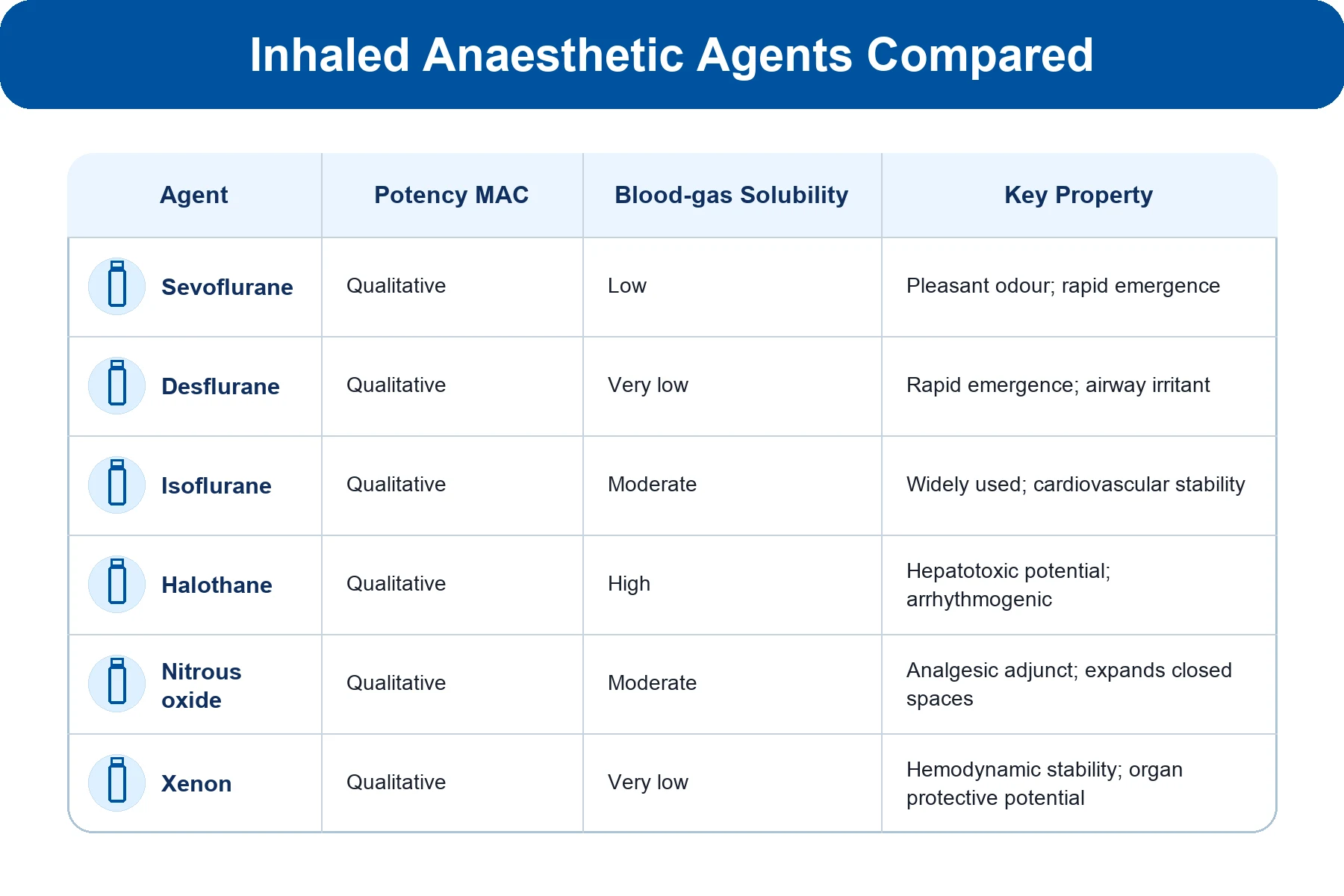
The volatile anaesthetic agents are liquids at room temperature, vaporised and delivered as a gas, that produce general anaesthesia by an action on the central nervous system. The modern clinical agents are sevoflurane, desflurane and isoflurane; halothane, the agent that dominated practice for decades, is now largely retired for its hepatotoxicity and its sensitisation of the myocardium to catecholamines. They are joined by two gases: nitrous oxide, a weak anaesthetic with distinctive pharmacology and risks, and xenon, an inert gas with a near-ideal profile that is scarce and expensive.[3]
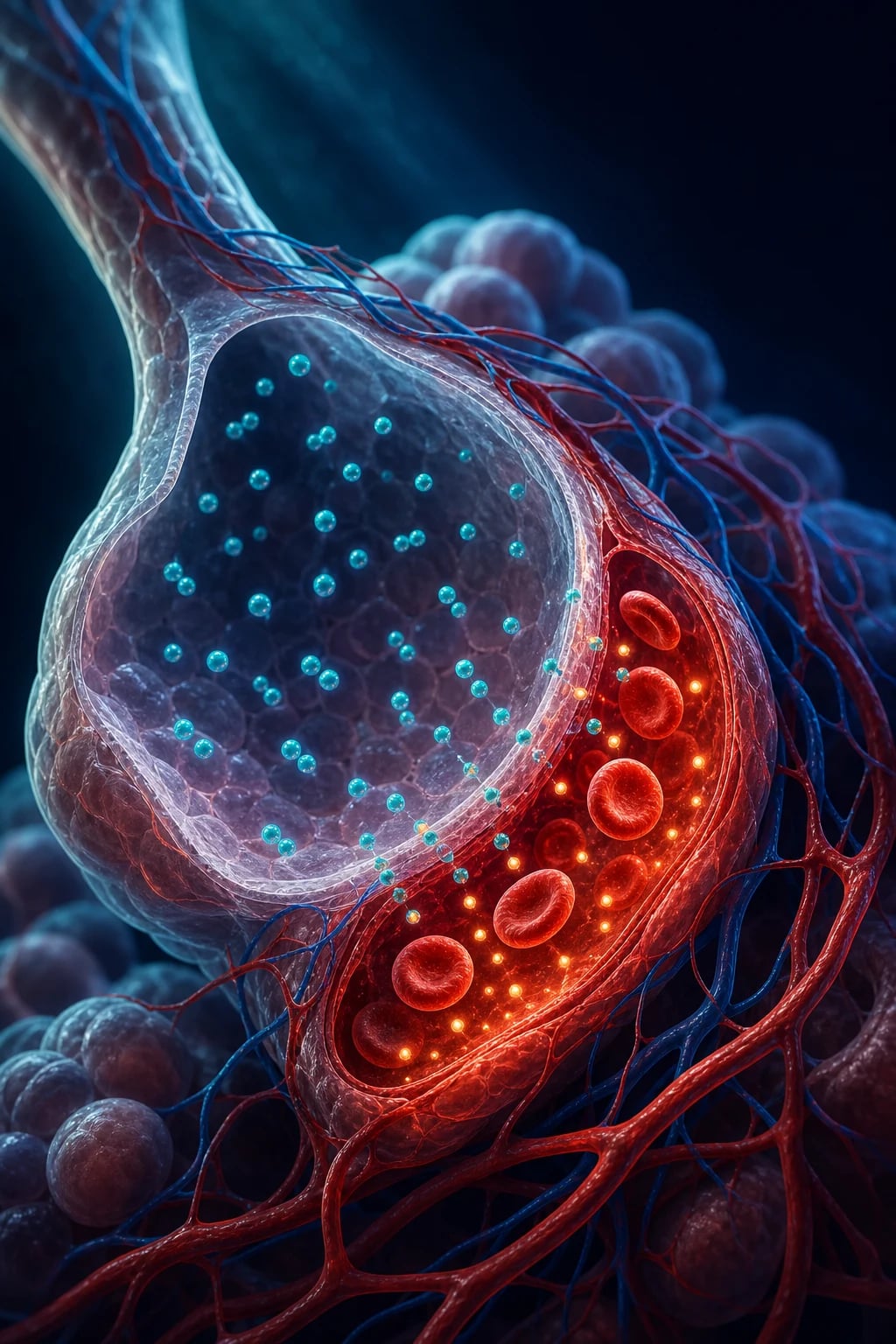
What unites them is the principle that their clinical effect tracks their partial pressure in the alveoli, which rapidly equilibrates with the partial pressure in the brain. Depth of anaesthesia is therefore governed by the inspired concentration and by how quickly that concentration is delivered to the brain — the pharmacokinetics of uptake and distribution — and the potency of each agent is defined by its minimum alveolar concentration (MAC). [1]
Mechanism of action: Meyer-Overton and the lipid membrane
The defining pharmacological correlation of the inhaled agents is the Meyer-Overton relationship: the potency of an agent is directly proportional to its lipid solubility (its oil:gas partition coefficient). The more lipid-soluble the agent, the more potent it is — so MAC, the measure of potency, is inversely related to lipid solubility, and their product (MAC times the oil:gas coefficient) is roughly constant across agents.[3]
This correlation pointed for a century to a unitary target: the lipid bilayer of the neuronal membrane, with anaesthesia resulting from a non-specific disruption of membrane function. The modern view is more nuanced — the agents act at specific protein targets, including the GABA-A receptor (the principal mediator of immobility and hypnosis), and to lesser extents the NMDA receptor (relevant to xenon and nitrous oxide), the two-pore-domain potassium channels and the glycine receptor. But the Meyer-Overton correlation remains the bedrock description of inhaled-agent potency. [1]
The modern agents
- Sevoflurane is the contemporary agent of choice for the inhalational induction, and the routine maintenance agent in much of the world. It is non-pungent and sweet-smelling, so it is tolerated by the awake patient taking breaths for an inhalational induction (essential in the needle-phobic child and the difficult intravenous access). It is haemodynamically stable, with a moderate blood:gas solubility and a smooth, rapid recovery.
- Desflurane is the most insoluble of the modern agents, giving it the fastest uptake and elimination — the agent of choice for a rapid emergence in the obese or the long case. It is, however, pungent and airway-irritant: it coughs, causes breath-holding and laryngospasm if used for an inhalational induction, and is reserved for maintenance after the airway is secured. Its high saturated vapour pressure (near atmospheric at room temperature) demands a heated, pressurised vaporiser.
- Isoflurane is the cheap, stable workhorse — intermediate in solubility, pungent (so not for inhalational induction), and an excellent vasodilator. It is largely retired in favour of sevoflurane but remains common where cost is decisive.
- Halothane is largely historical. It is non-irritant and potent, but it sensitises the myocardium to catecholamines (risking arrhythmia with exogenous adrenaline or endogenous catecholamine surges) and causes immune-mediated halothane hepatitis, a rare but often fatal hepatocellular injury.[5]
- Xenon is an inert elemental gas, an NMDA-receptor antagonist with an extremely low blood:gas solubility (rapid on and off), exceptional haemodynamic stability, and none of the environmental baggage of the halogenated agents — but it is expensive and scarce, limiting its routine use.
Minimum alveolar concentration (MAC) and potency
The minimum alveolar concentration (MAC) is the alveolar concentration of an agent, at one atmosphere, that prevents movement in response to a standard surgical stimulus in 50 per cent of subjects — the median effective dose, a measure of potency. The lower the MAC, the more potent the agent: halothane (MAC about 0.75 per cent) and isoflurane (about 1.15 per cent) are potent; sevoflurane (about 2 per cent) and desflurane (about 6 per cent) are less so; and nitrous oxide (MAC around 104 per cent) cannot, on its own, achieve one MAC at atmospheric pressure and so cannot produce surgical anaesthesia alone.[3]
MAC is additive: a 0.5 MAC dose of sevoflurane with 0.5 MAC of nitrous oxide gives a 1 MAC anaesthetic. It is also modified by patient factors: it falls with age (the MAC of every agent is lower in the elderly and in infants beyond the neonatal period), and it is reduced by pregnancy, hypothermia, acute alcohol, opioids, benzodiazepines and the alpha-2 agonists, and increased by chronic alcohol intake, hyperthermia and hyperthyroidism.[4]
Solubility, uptake and the alveolar-to-inspired ratio
The speed at which an inhaled anaesthetic acts is governed by its blood:gas partition coefficient — its solubility in blood. The principle is that the brain partial pressure follows the alveolar partial pressure, and the alveolar partial pressure rises only as fast as the agent is not being taken up into the blood. An insoluble agent (low blood:gas coefficient — desflurane, nitrous oxide, sevoflurane) is taken up slowly, so its alveolar and brain partial pressures rise fast, and induction and emergence are rapid. A soluble agent (high blood:gas coefficient) is taken up avidly into the blood, so the alveolar pressure rises slowly and the onset is delayed. [1]
This is why desflurane and sevoflurane have displaced the older soluble agents (ether, halothane): their low solubility makes the anaesthetic controllable, the induction smooth and the emergence rapid. [1]
The concentration effect and the second gas effect
Two related phenomena accelerate the rise of the alveolar partial pressure when a high concentration of an agent is inspired. The concentration effect is the observation that the higher the inspired concentration, the faster the alveolar concentration approaches it — most marked with nitrous oxide, which is delivered at high (50 to 70 per cent) concentrations. The second gas effect is the consequence: the rapid uptake of large volumes of nitrous oxide from the alveoli concentrates the accompanying gases (the volatile agent and oxygen) in the remaining alveolar volume, accelerating their alveolar — and hence brain — partial pressure rise. The effect is modest in practice but is the rationale for using nitrous oxide as a carrier early in an inhalational induction. [1]
Pharmacokinetics: induction, maintenance and a rapid emergence
The volatile agents are excreted overwhelmingly unchanged through the lungs — only a small fraction is metabolised (about 5 per cent of sevoflurane, less for the others). This is their great practical advantage over the intravenous agents: the depth can be turned up and down rapidly by changing the dialled concentration, and emergence, driven by the fall of the alveolar partial pressure, is fast — fastest for the insoluble desflurane, then sevoflurane, then isoflurane. The recovery is so prompt that desflurane and sevoflurane are favoured for day-case surgery and for the obese, where a rapid, predictable wake-up is wanted. [1]
Systemic effects: cardiovascular, respiratory, cerebral, uterine
- Cardiovascular. The halogenated agents vasodilate, lowering the systemic vascular resistance and the blood pressure, while the cardiac output is largely preserved (a contrast with halothane, which directly depresses the myocardium and sensitises it to catecholamines). They do not, in general, sensitise the myocardium to adrenaline. Desflurane can raise the heart rate and blood pressure transiently on a rapid increase in concentration, a sympathetic response to be avoided in the ischaemic patient.
- Respiratory. They are bronchodilators (useful in asthma), they reduce the tidal volume and increase the respiratory rate, and they blunt the ventilatory response to hypoxia and to carbon dioxide.
- Cerebral. They increase the cerebral blood flow and the intracranial pressure by cerebral vasodilation, while reducing the cerebral metabolic rate — a concern in the patient with raised intracranial pressure, where they are used cautiously with hyperventilation.
- Uterine. They relax uterine smooth muscle, which is useful for uterine relaxation in a caesarean dystocia but bleeds the postpartum uterus — a consideration in obstetric anaesthesia. [1]
Nitrous oxide: the special case
Nitrous oxide is the weakest of the inhaled agents (MAC around 104 per cent), and it cannot produce surgical anaesthesia on its own. It is used as an analgesic supplement (50 to 70 per cent) alongside a volatile or a total intravenous technique, and its analgesic action is exploited in obstetrics and in the emergency department (as Entonox, a 50:50 mixture with oxygen).[1]
It carries three distinctive risks. First, it is much more soluble than nitrogen, so it diffuses into and expands any closed gas-filled space — a pneumothorax, an obstructed bowel, a venous air embolism, the middle ear — increasing the pressure and the volume, which is why it is contraindicated in these settings. Second, it irreversibly oxidises the cobalt atom of vitamin B12, inactivating methionine synthase; with prolonged exposure this causes a megaloblastic anaemia and a subacute combined degeneration of the cord resembling B12 deficiency, and it raises the homocysteine. Third, it is a greenhouse gas. [1]
The clinical question of whether nitrous oxide is safe — given the B12 effect and the homocysteine — was settled by the ENIGMA-II trial, a large randomised study of the addition of nitrous oxide to general anaesthesia in at-risk patients: it found more severe postoperative nausea and vomiting, but no increase in death or major cardiovascular events at thirty days, and the long-term follow-up found no excess late death or morbidity.[1][2]
Adverse effects: hepatotoxicity, nephrotoxicity, emergence agitation, neurotoxicity
- Halothane hepatitis — an immune-mediated, often fatal hepatocellular injury, now rare because halothane is little used.[5]
- Nephrotoxicity — sevoflurane is degraded by strong (especially desiccated) carbon-dioxide absorbents to compound A, a nephrotoxin in rats; the modern absorbents and the avoidance of desiccated soda lime have made clinical nephrotoxicity exceedingly rare, and a contemporary narrative review finds the risk with modern practice negligible. Carbon monoxide formation from desiccated baralyme, especially with desflurane, is a related chemical hazard of the absorbent.[7]
- Emergence agitation and delirium, particularly in children after sevoflurane — a well-recognised phenomenon whose prevention is an active field; EEG-guided titration reduces its incidence.[8]
- Developmental neurotoxicity — the finding, in neonatal animal models, that prolonged or repeated exposure causes neuronal apoptosis, prompted a regulatory warning and ongoing concern about anaesthesia in the very young; the clinical relevance of brief single exposures remains uncertain.
Malignant hyperthermia: the trigger
Every volatile anaesthetic agent is a trigger of malignant hyperthermia. This is the single most important safety constraint on the class: in the known or suspected MH-susceptible patient, no volatile is given — the anaesthetic is a strict total intravenous technique with a clean, vapour-free machine. (Succinylcholine is the other trigger.) The mechanism — uncontrolled sarcoplasmic-reticulum calcium release via the ryanodine receptor — is covered in the malignant-hyperthermia topic. [1]
The environmental cost and clinical choices
The halogenated volatile agents are potent greenhouse gases with global-warming potentials many hundreds to thousands of times that of carbon dioxide, and atmospheric lifetimes of years to decades; desflurane is by far the worst, with an exceptionally high warming potential. The climate-impact assessment of anaesthetic gases has made the choice of agent an environmental as well as a clinical decision.[6]
The practical response is to favour the lower-impact agent that meets the clinical need (sevoflurane over desflurane where the extra speed is not needed), to avoid nitrous oxide where it is not required, to use low fresh-gas flows with circle systems, to ensure scavenging, and to consider total intravenous anaesthesia as the lower-impact alternative. The carbon footprint of an anaesthetic is now a legitimate factor in agent selection.[6]
Organ protection: ischaemic preconditioning
A beneficial property of the volatile agents, increasingly understood, is anaesthetic preconditioning — the exposure of the myocardium to a volatile agent before an ischaemic insult reduces the subsequent infarct size, through the activation of pro-survival signalling pathways. This is one of the arguments for a volatile-based technique in cardiac and major vascular surgery, where the myocardium is at risk, balanced against any haemodynamic cost.[9]
The clinical approach: agent selection
The agent is chosen by the interaction of its pharmacology with the patient and the operation. Sevoflurane is the default — smooth, non-pungent, suitable for inhalational induction, haemodynamically stable. Desflurane is reserved for the rapid emergence in the long or obese case, accepting its pungency and its environmental cost. Isoflurane is chosen for cost. Nitrous oxide is used as an analgesic adjuvant where it is not contraindicated. Xenon is the ideal where haemodynamic stability is paramount and cost is no object. The total intravenous alternative is chosen for the MH-susceptible patient and where the environmental or other profile is preferred.[3][6][9]
Clinical
- Standard approach
- Evidence-based
Alternative
- Modified technique
- Risk-benefit
Red flags
[1] [1] [1] [1] [1]References
- [1]Myles PS, Leslie K, Chan MT, Forbes A, et al. The safety of addition of nitrous oxide to general anaesthesia in at-risk patients having major non-cardiac surgery (ENIGMA-II): a randomised, single-blind trial Lancet, 2014.PMID 25142708
- [2]Leslie K, Myles PS, Kasza J, Forbes A, et al. Nitrous Oxide and Serious Long-term Morbidity and Mortality in the Evaluation of Nitrous Oxide in the Gas Mixture for Anaesthesia (ENIGMA)-II Trial Anesthesiology, 2015.PMID 26501387
- [3]Sonner JM, Antognini JF, Dutton RC, Flood P, et al. Inhaled anesthetics and immobility: mechanisms, mysteries, and minimum alveolar anesthetic concentration Anesth Analg, 2003.PMID 12933393
- [4]Eger EI 2nd. Age, minimum alveolar anesthetic concentration, and minimum alveolar anesthetic concentration-awake Anesth Analg, 2001.PMID 11574362
- [5]Ray DC, Drummond GB. Halothane hepatitis Br J Anaesth, 1991.PMID 1859766
- [6]Sulbaek Andersen MP, Nielsen OJ, Sherman JD. Assessing the potential climate impact of anaesthetic gases Lancet Planet Health, 2023.PMID 37438003
- [7]Hauquiert B, Gonze A, Gennart T, Perriens E. Nephrotoxicity and Modern Volatile Anesthetics: A Narrative Review Toxics, 2025.PMID 40559988
- [8]Haidar L, Abadi F, Sarieddine T, Vitali A, et al. EEG-Guided Anesthesia for the Prevention of Emergence Delirium in Children: A Systematic Review and Meta-Analysis JAMA Pediatr, 2026.PMID 41627803
- [9]Guerrero-Orriach JL, Carmona-Luque MD, Gonzalez-Alvarez L, et al. Heart Failure after Cardiac Surgery: The Role of Halogenated Agents, Myocardial Conditioning and Oxidative Stress Int J Mol Sci, 2022.PMID 35163284