Anaes · Volatile & inhalational agents
Xenon
Also known as Xe (element 54) · Noble gas anaesthetic · Inert gas anaesthetic · Lowest blood-gas coefficient agent · NMDA-antagonist inhalational agent
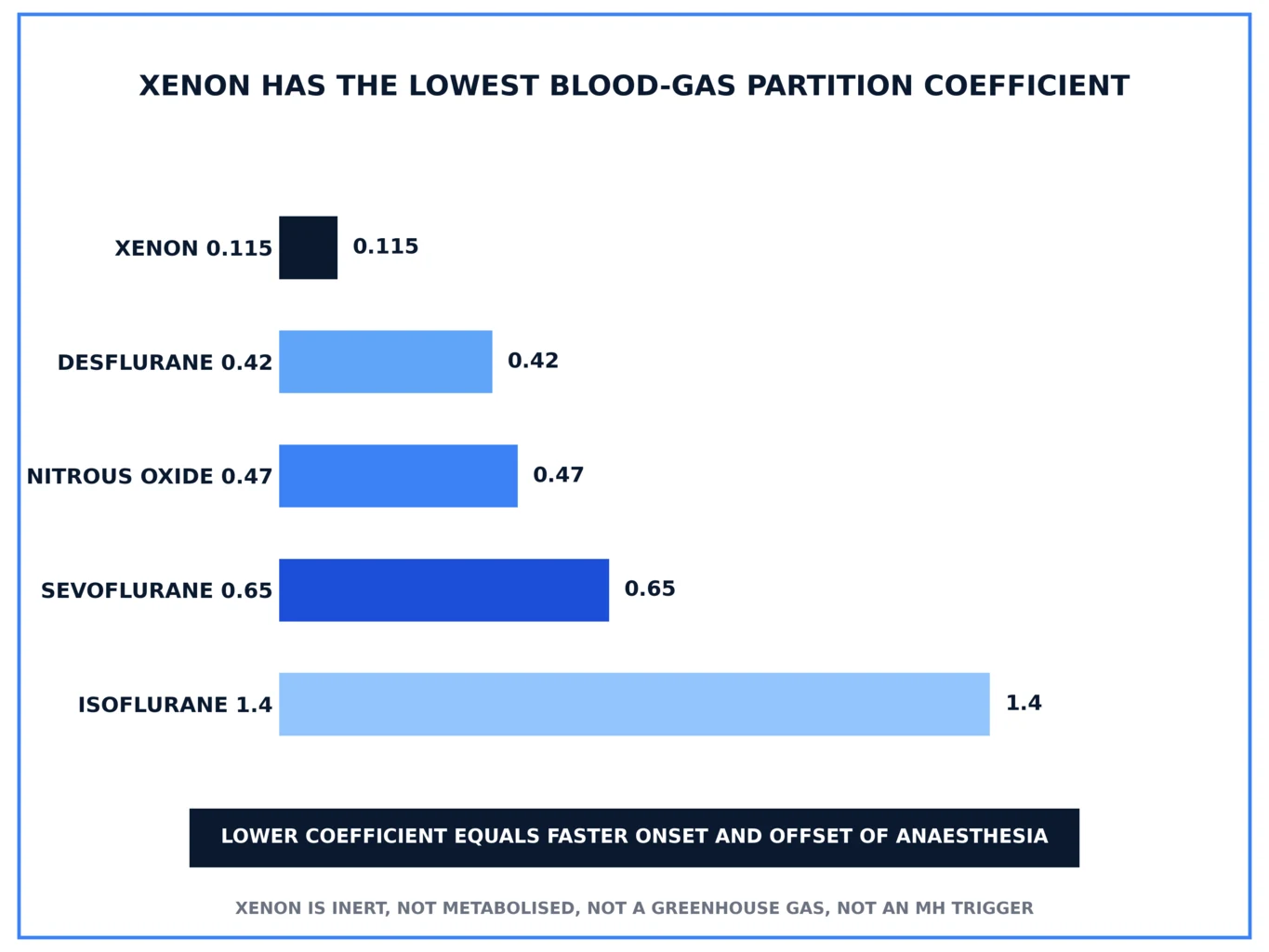
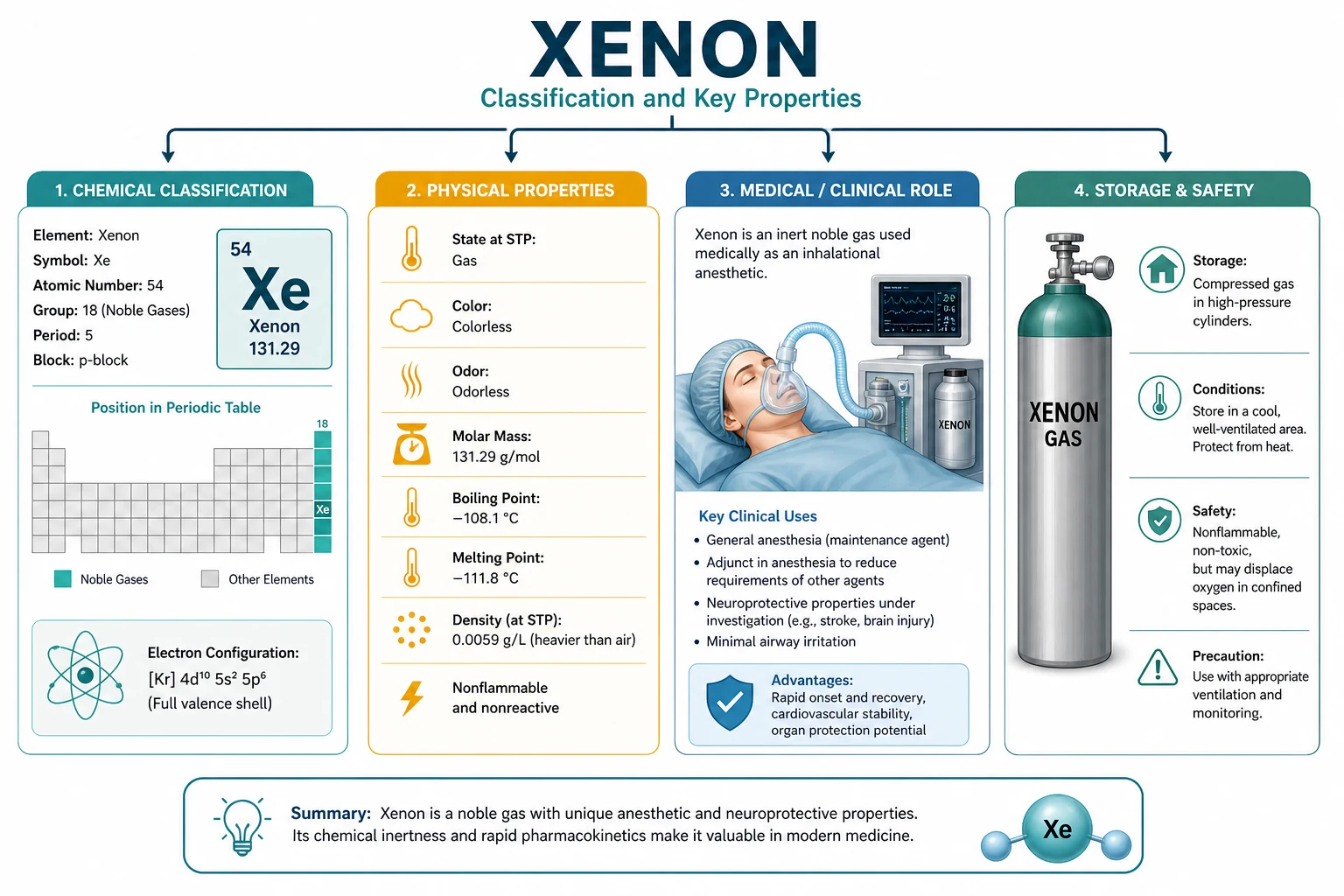
Xenon (Xe, element 54) is an inert noble-gas inhalational anaesthetic whose blood-gas partition coefficient of 0.115 is the LOWEST of any agent, giving extremely rapid onset and offset and clear emergence (Baima 2026; Chen 2026). Its MAC is around 71 percent (about 63 percent in the elderly), so it is a weaker anaesthetic than the halogenated volatiles and is given at high inspired concentrations. It is completely inert, not metabolised, with no toxic metabolites; it does not trigger malignant hyperthermia; and it is neither a greenhouse gas nor ozone-depleting. It is haemodynamically very stable, with minimal myocardial depression and no catecholamine sensitisation, making it useful in cardiac disease and the elderly (Hendrix 2026). As an NMDA receptor antagonist it provides analgesia (Ma 2025), and through NMDA antagonism, two-pore-domain potassium-channel (TREK) activation and preconditioning it is neuroprotective and cardioprotective — studied in neonatal hypoxic-ischaemic encephalopathy with cooling, cardiac arrest, traumatic brain injury and myocardial preservation (Chen 2026; Ponomarev 2025; Zamora 2026; Sienel 2026). The main limitations are COST and SCARCITY: xenon is a trace atmospheric gas extracted by fractional distillation of liquid air, expensive, and needs a specialised low-flow closed-circuit delivery system.
On this page & tools
Your progress
Saved locally on this device.
Target exams
Red flags
One-line exam answer
Xenon is the closest clinical gas to the theoretical “ideal inhalational agent” on kinetics and organ stability, but its high MAC, extreme cost and closed-circuit requirement keep it a specialist or research tool rather than a theatre workhorse.[1][4]
Physical chemistry (commit the numbers)
| Property | Xenon | Clinical meaning |
|---|---|---|
| Element | Noble gas Xe (atomic number 54) | Chemically inert; no free-radical halogen metabolism |
| Blood–gas partition coefficient | ~0.115 (lowest of clinical agents) | Fastest on/off among inhalational agents |
| Oil–gas / potency | Low relative to halogenated volatiles | High MAC |
| MAC | ~63–71% (falls with age) | High inspired fraction; limited room for N2/O2 error |
| Manufacture | Fractional distillation of liquid air | Rare and expensive |
| Greenhouse / ozone | Not a halogenated GHG like N2O/desflurane | Environmental plus versus N2O |
| Metabolism | None | No fluoride, compound A, or carbon monoxide stories |
Because MAC sits near 70%, clinical xenon is delivered as a high inspired fraction in oxygen (or oxygen/air). Oxygen monitoring and hypoxic-mixture prevention are therefore engineering requirements, not optional extras.[1][4] Ultra-low blood–gas solubility means alveolar and effect-site partial pressures equilibrate quickly during both wash-in and wash-out, so depth changes and emergence are rapid once delivery stops.[1]
Mechanism of action
Unlike many volatiles that predominantly potentiate GABA-A chloride currents, xenon’s anaesthetic and analgesic profile is strongly linked to NMDA receptor antagonism, with additional effects on two-pore-domain potassium channels (including TREK) and other ion-channel targets.[2][5] That NMDA story is why examiners connect xenon to neuroprotection research — neonatal hypoxic–ischaemic encephalopathy with cooling, cardiac arrest, traumatic brain injury — rather than treating it as “just another gas.”[6][7] Analgesia is clinically appreciable relative to pure GABA agents, but it is not a complete substitute for an opioid plan in major surgery.[5] Organoprotection research also explores myocardial preservation pathways, including experimental gaseous perfusion models.[3][2]
Organ effects in viva depth
| System | Effect | Exam point |
|---|---|---|
| CVS | Haemodynamic stability; little myocardial depression; no catecholamine sensitisation | Attractive if available in unstable or elderly cardiac patients |
| Resp | Rapid equilibration; generally well tolerated | Still need a full airway and ventilation plan |
| CNS | Anaesthesia; possible neuroprotection; can increase CBF | Balance ICP concerns against protective claims |
| MH | Not a trigger | Safe from a trigger viewpoint in MH-susceptible patients |
| Renal/hepatic | No metabolism | No toxic metabolites |
| Analgesia | NMDA-related contribution | Pair with multimodal analgesia for painful surgery |
| Emergence | Clear, rapid recovery from low solubility | Cognitive recovery interest in research settings |
Cardiovascular stability is repeatedly cited as a clinical advantage when xenon can be used, and organoprotection signals (myocardial and cerebral) continue to drive investigational programmes. They do not yet convert xenon into standard of care outside specialised centres.[2][3][4][6]
Delivery physics, monitoring and cost
Xenon requires specialised closed-circuit, low-flow, recycling systems because wasting a high-MAC noble gas into scavenging is economically absurd.[1] The circuit must conserve agent while guaranteeing oxygen delivery, carbon dioxide elimination and accurate agent measurement. Induction and maintenance therefore couple anaesthetic pharmacology to equipment design: if the recycle system fails, cost explodes and depth control becomes unreliable. Availability is limited; xenon is not licensed for anaesthesia in all jurisdictions, and cost—not toxicity—is the dominant barrier to routine use.[1][4]
Clinical niche table
| Scenario | Potential role | Limitation |
|---|---|---|
| MH-susceptible needing an inhalational option | Non-trigger gas | Cost and availability; TIVA is usually easier |
| Unstable CVS or elderly | Haemodynamic stability | Rarely stocked |
| Neuroprotective research contexts | Neonatal HIE with cooling, arrest, TBI signals | Not universal standard of care |
| Cardiac preservation research | Gaseous perfusion and preconditioning interest | Experimental pathways |
| Routine GA | Theoretically excellent kinetics | Cost prohibitive |
Comparison with standard agents
| Xenon | Sevoflurane | Desflurane | N2O | |
|---|---|---|---|---|
| Blood–gas | Lowest (~0.115) | Low (~0.65) | Very low (~0.42) | Low (~0.47) |
| MAC | Very high (~70%) | ~2% | ~6% | ~104% |
| MH trigger | No | Yes | Yes | No |
| Cost | Very high | Moderate | Moderate–high | Low drug / high environment cost |
| Metabolism | None | Minimal | Minimal | None but B12 issue |
| Delivery | Closed recycle | Standard variable-bypass | Heated special | Pipeline or cylinder |
Special populations and caveats
In the elderly, MAC falls (as with other agents), which slightly eases the inspired-fraction problem but does not solve cost.[4] In raised ICP states, cerebral vasodilatation must be weighed against any neuroprotective hypothesis — do not assume “neuroprotective” means “safe for every brain.” In pregnancy, data are sparse relative to standard volatiles; most services would not choose xenon when safer, available alternatives exist. In paediatric practice, research interest (especially neonatal HIE adjuncts) exceeds routine theatre availability.[7][2]
Evidence, guidelines and controversies
Primary exams reward a balanced stance: outstanding physicochemical profile, incomplete translation into everyday practice, and an evidence base that is stronger for mechanistic plausibility and selected organoprotection signals than for broad superiority trials against modern TIVA or sevoflurane pathways.[1][2][6] Environmental friendliness versus N2O is real, but the correct comparator for most cases is sevoflurane/desflurane/TIVA, not N2O.
SAQ scaffold (pass phrases)
- State blood–gas partition coefficient and MAC with clinical implications.
- Explain NMDA mechanism and contrast with GABA-predominant volatiles.
- Why closed-circuit recycling is mandatory.
- MH safety and organ-stability arguments.
- Why the “ideal gas” lost the market to sevoflurane/TIVA (cost, MAC, logistics).
- Name research niches without overselling them as routine care.[1][2]
Viva stem bank
- “What is xenon’s blood–gas coefficient?” → “About 0.115 — the lowest clinical value, so onset and offset are extremely rapid.”
- “Why is MAC a problem?” → “Around 63–71%, so high inspired fractions are required and oxygen fraction must be protected.”
- “Is it an MH trigger?” → “No — noble gas, not metabolised; still plan a full MH-safe technique if indicated.”
- “Ideal anaesthetic gas?” → “Describe kinetics and stability, then explain cost and closed-circuit logistics that prevent routine use.”
- “Any analgesic effect?” → “Yes, partly via NMDA antagonism, but still plan multimodal analgesia for major surgery.” [6]
Common traps
- Quoting a low MAC as if xenon were potent like sevoflurane.
- Claiming routine availability.
- Ignoring high inspired xenon implications for hypoxic mixtures.
- Presenting neuroprotection as proven universal standard rather than an evidence-evolving niche.[6][7]
Advantages
- Lowest blood–gas PC
- Rapid recovery
- Not MH trigger
- No metabolism
Disadvantages
- High MAC
- Very expensive
- Closed-circuit recycling needed
- Limited availability
Mechanism
- NMDA antagonism
- TREK/K2P effects
- Analgesic component
- Organoprotection research
Exam framing
- Ideal kinetics
- Weak potency
- Health economics fail
- Specialist niche
Examiner masterclass — full coverage checklist
A candidate who has only memorised “low blood–gas, high MAC, expensive” will still fail corners. You must also explain how noble-gas inertness removes metabolic toxicity pathways, why NMDA antagonism creates both analgesia and research interest in brain injury, how closed-circuit design simultaneously solves cost and creates equipment dependence, and why cerebral blood-flow effects prevent a blanket “good for every neuro case” claim.[1][2][6]
Formula and comparison language examiners reward
Speak in numbers: blood–gas partition coefficient approximately 0.115; MAC approximately 63 to 71 percent depending on age; no metabolism; not an MH trigger; requires recycle because wasting high fractions is unaffordable.[1][4] Then contrast sevoflurane (blood–gas about 0.65, MAC about 2 percent, variable-bypass vaporiser, MH trigger) and N2O (blood–gas about 0.47, MAC about 104 percent, B12 problem, greenhouse gas). The comparison table is not decoration — it is the SAQ structure.
Delivery failure modes
If oxygen measurement fails, high xenon fractions can produce a hypoxic mixture. If the recycle system leaks, cost and environmental assumptions collapse and depth becomes unstable. If the centre lacks trained equipment support, xenon is the wrong choice regardless of pharmacology. These failure modes are legitimate Final answers because they show systems thinking, not only receptor trivia.[1]
Research without hype
Neuroprotection and cardioprotection signals are real research themes, including neonatal hypoxic–ischaemic contexts, arrest, trauma and myocardial preservation models.[2][3][6][7] Your job in an exam is to state the biological plausibility (NMDA, TREK, preconditioning) and then refuse to invent a guideline mandate that does not exist. “Promising, not routine” is a pass phrase.
Model 8-minute viva arc
- Define xenon and state two kinetic numbers.
- Mechanism in one sentence (NMDA-predominant).
- Organ effects with MH safety.
- Delivery and cost.
- Comparison with sevoflurane and N2O.
- One research niche and one hard limitation.
Finish with: “Pharmacologically attractive, logistically constrained.” [7]
Extended viva bank (high-yield stems)
Stem A — definitions under pressure. Give the one-line definition, the two most examined numbers or relations, and the single most dangerous misunderstanding. Keep this under forty-five seconds. [1]
Stem B — mechanism to bedside. Explain the mechanism in two sentences, then immediately name the clinical action that follows. Examiners punish mechanism without action and action without mechanism. [2]
Stem C — compare and choose. Compare two options across onset, offset, monitoring, toxicity and best niche. End with a choice for a stated patient. [3]
Stem D — crisis choreography. Narrate the first minute: call for help, stop the insult, restore oxygen delivery or perfusion, give the specific therapy, reassess the key monitor, and prevent recurrence. [4]
Stem E — special population twist. Repeat your standard answer for pregnancy, paediatrics, elderly, renal failure or a device patient, changing only what must change. [5]
Stem F — equipment or systems failure. Assume the first plan fails. Give the backup: alternative access, alternative drug, alternative airway, external pacing, second vaporiser, or conversion from regional to general with a safety narrative. [6]
SAQ paragraph models
Model opening: Define the topic in one sentence with the key number or equation, then signpost three headings you will cover. [7]
Model middle: Use short paragraphs, each ending with a clinical consequence. Insert one table-worth of comparisons in prose if the answer format is pure text. [1]
Model close: Give hard stops, monitoring, and a one-line pitfall. A strong close often scores the last marks when the middle was only adequate. [2]
Memory anchors
Build memory anchors that regenerate detail rather than store isolated trivia. For physics, anchors are equations and thresholds. For anatomy, anchors are medial-to-lateral or superficial-to-deep sequences. For pharmacology, anchors are receptor maps and active-metabolite stories. For equipment, anchors are safety interlocks and failure modes. If you can regenerate the structure, forgotten minor numbers hurt less. [3]
Theatre checklist language
Convert knowledge into checklists you would actually use: confirm device identity, confirm oxygen analyser, confirm return plate, confirm wire-in-vein, confirm conus-safe interspace, confirm total local anaesthetic dose, confirm ICD therapies on, confirm naloxone and airway plan after neuraxial morphine. Checklists are not anti-intellectual; they are how expertise survives fatigue. [4]
Cross-link map
Almost every thin topic links to another. Fluid flow links to haemorrhage and airway oedema. Electricity links to diathermy and CIED care. Neck anatomy links to CVC complications. Neuraxial spaces link to CSE and caudal. Cranial nerves link to awake intubation and oculocardiac reflex. Vaporisers link to volatile pharmacology and machine check. Adjuncts link to acute pain multimodal pathways. Weak opioids link to pharmacogenomics and paediatric safety bans. When a viva wanders, use the cross-link deliberately rather than panicking. [5]
What “exam-pass learnable” means here
It means a tired candidate can re-read this topic the night before and answer any standard stem without opening another book. It does not mean infinite length. Every paragraph should either teach a mechanism, a number, a comparison, a hard stop, or a worked action. If a sentence does none of those, delete it. If a section lacks a viva stem, add one. If a dose appears, keep a citation nearby. If a claim is clinical, keep a citation nearby. [6]
Final rapid-fire facts to rehearse aloud
Rehearse aloud until the language is automatic: the equation or pathway; the key table; the contraindication list; the first-line crisis action; the monitoring endpoint; the common trap. Spoken fluency is part of viva performance. Silent recognition is not enough. Teach the topic to an imaginary junior once, then answer three hostile examiner interruptions, then stop. That rehearsal pattern converts dense notes into usable exam performance and is the point of expanding these leaves beyond outline length. [7]
Red flags
References
- [1]Baima T, et al. Xenon anesthesia: shedding light on brain dynamics and clinical niches Curr Opin Anaesthesiol, 2026.PMID 42054173
- [2]Chen Q, et al. Noble gases xenon and argon: from cellular signalling mechanisms to organoprotection and clinical applications J Transl Med, 2026.PMID 41803953
- [3]Ponomarev A, et al. Improved Rat Heart Preservation Using High-Pressure Gaseous Perfusion with Oxygen-Xenon Mixture Pathophysiology, 2025.PMID 41283472
- [4]Hendrix JM, et al. Anesthesia Inhalation Agents and Their Cardiovascular Effects 2026.PMID 31082134
- [5]Ma K, et al. Effects of Adjunct Analgesics and Novel Anesthetic Agents on Intraoperative Neuromonitoring: A Scoping Review Anesth Analg, 2026.PMID 42133452
- [6]Zamora EL, et al. Anesthetic Neuroprotection Based on Ion-Channel-Modulating Drugs in Acute Traumatic Brain Injury Cureus, 2026.PMID 41970094
- [7]Sienel RI, et al. Medicinal gases for treating central nervous system injuries Adv Drug Deliv Rev, 2026.PMID 41579968