Anaes · Perioperative cardiac arrest
Perioperative cardiac arrest
Also known as Perioperative cardiac arrest · Intraoperative cardiac arrest · Intraoperative CPR · NAP7 · Anaesthesia-related arrest · 4 Hs 4 Ts · Perimortem caesarean
Exam-exhaustive perioperative cardiac arrest: NAP7 epidemiology, theatre-modified ALS, 4 Hs and 4 Ts with anaesthesia-specific differentials (anaphylaxis, MH, LAST, embolism, haemorrhage, high spinal), adrenaline dosing, open-chest CPR after cardiac surgery, and maternal arrest with perimortem caesarean.
On this page & tools
Your progress
Saved locally on this device.
Target exams
Red flags

Why this is examined / one-line answer
Perioperative cardiac arrest is the ultimate theatre crisis. Examiners want NAP7-aware epidemiology, a theatre-modified ALS script, the 4 Hs and 4 Ts with anaesthesia differentials named out loud, exact adrenaline and defibrillation behaviour, and special pathways for cardiac surgery and maternal arrest. One-liner: I call for help, start CPR and 100% oxygen, treat shockable rhythms, give adrenaline every 3–5 minutes in non-shockable or refractory cycles, and I search for reversible causes that only exist under anaesthesia while I allocate a leader and a cognitive aid. [1]
NAP7 (RCoA) studied peri-operative cardiac arrest across UK practice. Incidence is on the order of ~3 per 10,000 anaesthetics (~1 in 3,000), with outcomes better than out-of-hospital arrest because of continuous monitoring and immediate help — but still high mortality, especially in neonates, ASA IV–V, emergency, and cardiac cases.[1]
NAP7-aware mental model
What NAP7 emphasises for viva:
- Arrest is rare but not mythical — have a theatre ALS plan before the first case of the day.
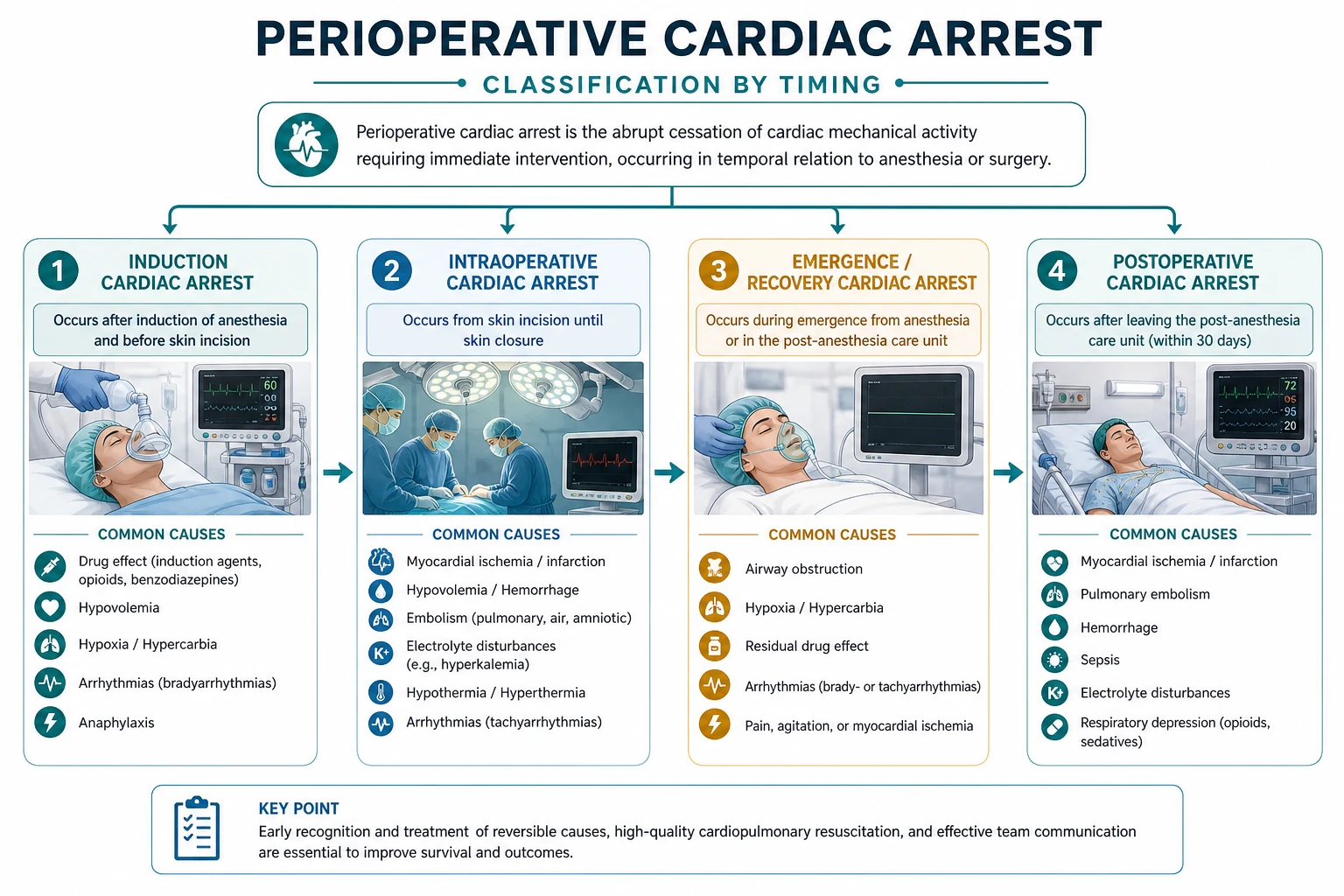
- Causes cluster by phase: induction (airway, drug, anaphylaxis, high spinal), maintenance (haemorrhage, embolism, cardiac, hypoxia), emergence/recovery (airway obstruction, residual block, hypovolaemia, PE).
- Human factors dominate: delayed recognition when monitors are silenced or misread, fixation on surgery, no designated leader, no cognitive aid, failure to stop surgery and pack.
- Outcomes improve with early defibrillation, high-quality CPR, ETCO2-guided resuscitation, and cause correction — not heroic drug stacks. [1]
Immediate theatre algorithm (first 60 seconds)
- Declare the crisis — “Cardiac arrest — call the crash team / additional help.”
- Note the time. Assign leader (usually senior anaesthetist not deep in a task), CPR, airway, drugs, defibrillator, runner, scribe.
- Stop surgery that is not immediately life-saving (pack, stop bleeding if that is the cause, remove retractors that impede CPR).
- Flatten the table, remove/side-arm drapes for access, start external chest compressions (rate ~100–120/min, depth ~5–6 cm adult, full recoil, minimise interruptions).
- 100% oxygen, confirm ET tube / airway, manual ventilation or ventilator with high FiO2; check circuit disconnect and gas supply.
- Attach/confirm defibrillator pads. Rhythm check every ~2 minutes.
- Adrenaline and amiodarone per ALS for the rhythm (see dosing).
- ETCO2 continuous: low ETCO2 suggests poor CPR or massive dead space (PE); sudden rise suggests ROSC.
- Consider TEE/TTE early if skilled help available — tamponade, PE, empty heart, severe hypovolaemia, regional wall motion.
- Deploy cognitive aid (ALS + specialty cards: LAST, anaphylaxis, MH). [1]
Rhythm-directed therapy (say the numbers)
Shockable (VF / pulseless VT)
- Defibrillate immediately (energy per local defibrillator protocol; biphasic typically 150–200 J start — follow machine).
- CPR 2-minute cycles between shocks.
- Adrenaline 1 mg IV after third shock (then every 3–5 min) per standard adult ALS teaching.
- Amiodarone 300 mg IV after third shock; further 150 mg if refractory VF/pVT. [1]
Non-shockable (asystole / PEA)
- Adrenaline 1 mg IV immediately, then every 3–5 minutes.
- High-quality CPR; prioritise reversible cause (often hypovolaemia, hypoxia, PE, high spinal, anaphylaxis, LAST). [1]
Adrenaline nuances examiners love
| Context | Teaching dose |
|---|---|
| Standard adult ALS arrest | 1 mg IV every 3–5 min |
| Anaphylaxis (not full arrest) | 50 microg IV boluses (adult) titrated; IM 500 microg if no IV |
| LAST-modified support | Prefer small epinephrine boluses; avoid large boluses if possible; lipid is specific therapy |
| Paediatrics | 10 microg/kg (0.01 mg/kg) IV every 3–5 min |
| Cardiac surgery / open chest | Follow cardiac arrest after cardiac surgery (CALS) pathways — often smaller epinephrine boluses and early re-sternotomy |
Do not invent unit-specific microdosing as universal law — state ALS baseline then modify with reason. [1]
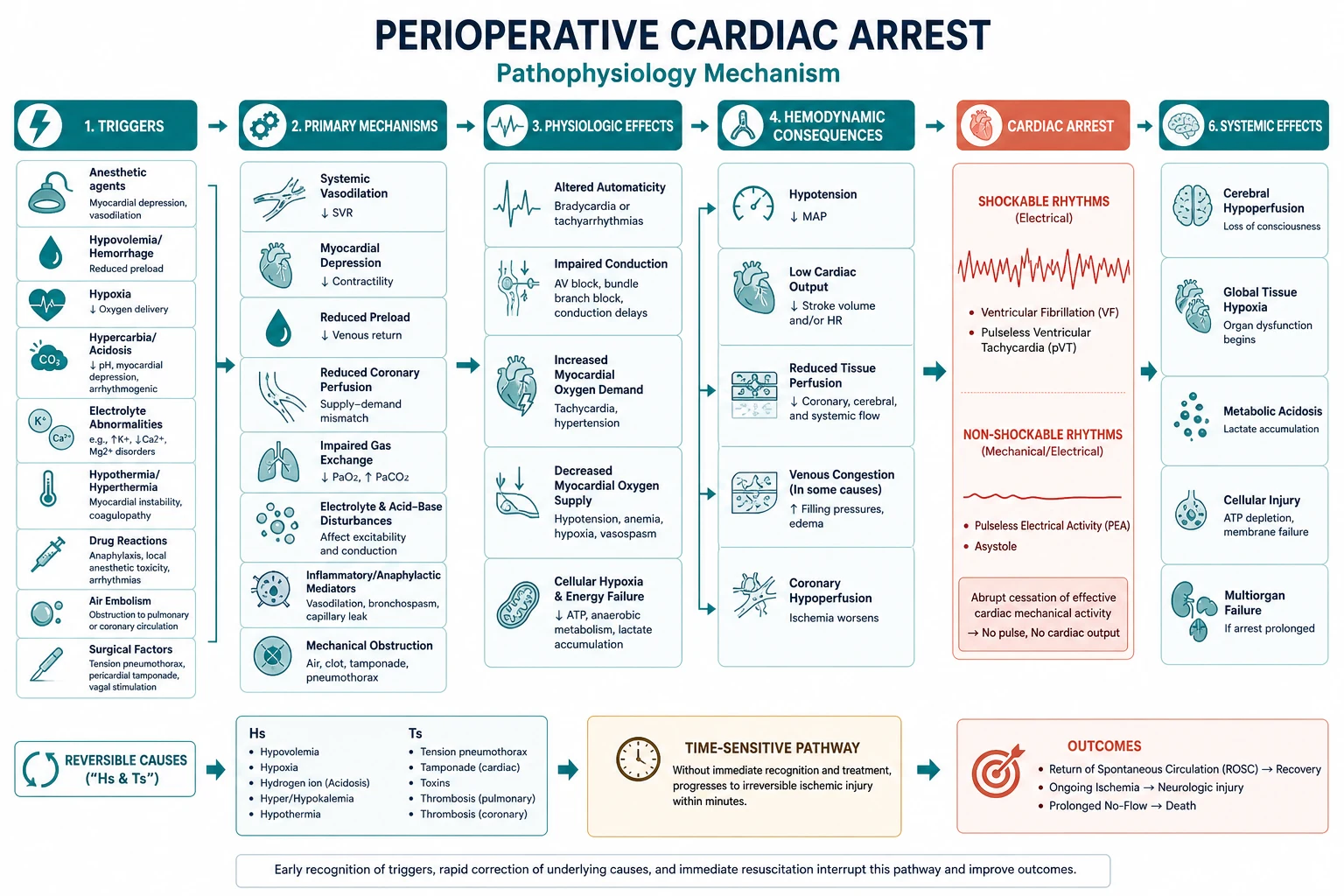
4 Hs and 4 Ts — theatre edition
Hs
| H | Theatre actions |
|---|---|
| Hypoxia | 100% O2, confirm tube, circuit, SpO2 probe, chest rise; if CICO → front-of-neck access per DAS.[3] |
| Hypovolaemia | Massive haemorrhage protocol, wide-bore access, blood products, source control; empty heart on echo |
| Hyper/hypokalaemia | ABG; hyperK → calcium, insulin–dextrose, salbutamol; stop sux if ongoing |
| Hypothermia | Active warming; prolonged CPR may be justified |
| Hydrogen ion (acidosis) | Ventilate; treat cause; bicarbonate not routine |
| Hypoglycaemia | Point-of-care glucose; dextrose |
Ts
| T | Theatre actions |
|---|---|
| Tension pneumothorax | Clinical + ultrasound; needle/finger thoracostomy then chest drain |
| Tamponade | TEE/TTE; pericardiocentesis / surgical drainage (cardiac theatre) |
| Thrombosis (coronary / PE) | Fibrinolysis / PCI pathways if PE or ACS suspected; prolonged CPR for massive PE |
| Toxins | LAST → lipid; anaphylaxis → adrenaline; overdose → specific antidotes |
| Trauma / surgical catastrophe | Pack abdomen, aortic compression, resuscitative thoracotomy where indicated |
Anaesthesia-specific differentials (must name)
- Anaphylaxis — hypotension/arrest after antibiotic, NMB, chlorhexidine, latex, blue dye; give adrenaline, fluids, stop trigger, take mast-cell tryptase later.
- High / total spinal — after neuraxial; bradycardia, profound hypotension, apnoea; airway, fluids, vasopressors, atropine; CPR if no output.
- LAST — after block/top-up; seizures ± collapse; lipid emulsion 20% 1.5 mL/kg lean BW bolus then 0.25 mL/kg/min, LAST-modified ALS.[2]
- Malignant hyperthermia — late hypercarbia, rigidity, rising temperature, hyperK; stop volatiles/sux, dantrolene, hyperventilate, cool, treat hyperK.
- Airway loss / CICO — cannot oxygenate; front-of-neck access without delay.[3]
- Drug error — wrong syringe, relative overdose, sux without airway plan, residual NMB with hypoxia.
- Massive haemorrhage — surgical bleeding, ruptured AAA, obstetric PPH, trauma.
- Embolism — venous air (sitting neuro, open veins), fat (long bone), cement (BCIS), amniotic fluid, thrombus PE.[4]
- Vagal asystole — peritoneal traction, oculocardiac, cervical stretch; stop stimulus, atropine, CPR if needed.
- Auto-PEEP / dynamic hyperinflation — disconnect circuit briefly in severe asthma/COPD.
Special situations
Cardiac surgery / recent sternotomy
External CPR may not generate adequate coronary perfusion with a rigid chest, tamponade, or graft issues. Follow cardiac arrest after cardiac surgery (CALS) principles used in your unit:
- Early re-sternotomy (often within 5 minutes of arrest if no ROSC) for internal massage and surgical correction.
- Prepare sterile field, surgeon, and internal paddles.
- Pace if asystole/bradycardia with epicardial wires present.
- Avoid large epinephrine stacks that produce catastrophic hypertension on ROSC — use small titrated doses per local CALS card.
Maternal cardiac arrest
- Call obstetric and neonatal teams immediately.
- Manual left uterine displacement (or 15–30° left tilt — but CPR quality is better flat with manual displacement).
- Standard maternal ALS with early advanced airway.
- Perimortem caesarean if no ROSC by ~4 minutes of arrest (aim delivery by 5 minutes) — primarily to improve maternal venous return and survival; also fetal salvage if viable.[5]
- Consider AFE, haemorrhage, high spinal, eclampsia/magnesium toxicity, PE, anaphylaxis.
Paediatrics
Weight-based adrenaline 10 microg/kg, defibrillation 4 J/kg, Broselow/cognitive aid, hypoxia and medication error are classic causes.
Laparoscopy / robotics
Deflate abdomen, release pneumoperitoneum, flatten, consider CO2 embolism (mill-wheel, sudden ETCO2 fall, right-heart strain).
Post-ROSC care (exam half-marks)
- Target oxygenation (avoid hyperoxia extremes), normocapnia if possible, support BP (often noradrenaline infusion).
- 12-lead ECG; consider urgent coronary angiography if ischaemic cause.
- Temperature control per current post-arrest guidance (avoid fever; targeted temperature management protocols unit-specific).
- ICU, treat cause, delayed multimodal prognostication (not at the bedside 30 minutes after ROSC).
- Hot debrief + cold debrief; incident reporting; family communication. [1]
CRM that scores marks
- Leader not task-bogged; closed-loop orders (“adrenaline 1 mg IV — give and confirm”).
- Cognitive aids open; runners for blood/lipid/dantrolene.
- Explicit differentials spoken every 2-minute cycle.
- Stop non-essential noise; one person speaks to family later. [1]
SAQ scaffold (10–15 marks)
- Immediate actions and team roles (3)
- Shockable vs non-shockable drugs and shocks (3)
- 4 Hs / 4 Ts with two anaesthesia-specific toxins (4)
- Maternal arrest / perimortem CS (3)
- When to open the chest after cardiac surgery (2) [1]
Viva stems with model outlines
Stem 1: “ETCO2 falls to zero, SpO2 crashes, no pulse after induction antibiotic.”
Anaphylaxis until proven otherwise; CPR, adrenaline, fluids, stop trigger, airway, call help. [1]
Stem 2: “Arrest 2 minutes after interscalene bupivacaine.”
LAST: CPR + lipid 1.5 mL/kg; LAST-ALS modifications. [1]
Stem 3: “Asystole on peritoneal traction.”
Stop stimulus, atropine, CPR if needed, short course often. [1]
Stem 4: “VF on cementing a hip hemiarthroplasty.”
BCIS / PE spectrum: CPR, 100% O2, fluids, inotropes, echo, surgeon communication. [1]
Stem 5: “Maternal PEA at CS under spinal.”
High spinal vs haemorrhage vs AFE; left displacement, ALS, perimortem CS timing. [1]
Stem 6: “Cardiac ICU 3 hours after CABG — PEA.”
CALS: early re-sternotomy, internal massage, surgical causes (bleed, tamponade, graft). [1]
Common traps
- Continuing surgery during ineffective CPR.
- Treating LAST or MH with adrenaline alone.
- Forgetting lipid / dantrolene / blood as “drugs.”
- No left uterine displacement in maternal arrest.
- Delayed front-of-neck access in CICO.
- Prognosticating neurological outcome in theatre.
- Silencing alarms that were the only warning. [1]
STOP-CPR (first minute)
Standard ALS
- 1 mg adrenaline cycles
- Defib shockable
- 4H4T search
- Post-ROSC ICU
LAST modification
- Lipid 1.5 mL/kg
- Small epinephrine boluses
- Avoid vasopressin/CCB/β-blocker
- Prolonged CPR / ECMO
Cardiac surgery CALS
- Early re-sternotomy
- Internal massage
- Pacing wires
- Smaller adrenaline boluses
Red flags
[1] [1] [1] [1] [1]References
- [1]Armstrong RA, et al. Peri-operative cardiac arrest: epidemiology and clinical features of patients analysed in the 7th National Audit Project of the Royal College of Anaesthetists Anaesthesia, 2024.PMID 37972476
- [2]Neal JM et al. The Third American Society of Regional Anesthesia and Pain Medicine Practice Advisory on Local Anesthetic Systemic Toxicity: Executive Summary 2017 Reg Anesth Pain Med, 2018.PMID 29356773
- [3]Frerk C, Mitchell VS, McNarry AF, et al. Difficult Airway Society 2015 guidelines for management of unanticipated difficult intubation in adults Br J Anaesth, 2015.PMID 26556848
- [4]Donaldson AJ et al. Bone cement implantation syndrome Br J Anaesth, 2009.PMID 19059919
- [5]Mushambi MC, Kinsella SM, Popat M, et al. Obstetric Anaesthetists' Association and Difficult Airway Society guidelines for the management of difficult and failed tracheal intubation in obstetrics Anaesthesia, 2015.PMID 26449292