Anaes · Postoperative nausea & vomiting
Postoperative nausea & vomiting (PONV)
Also known as PONV · Apfel score · Ondansetron · Dexamethasone · Aprepitant · Antiemetic prophylaxis
Exam-exhaustive PONV: Apfel four factors with exact risk steps, paediatric modifiers, prophylaxis by receptor class with mg/kg doses, different-class rescue, TIVA and opioid-sparing, and risk-stratified not universal triple therapy.
On this page & tools
Your progress
Saved locally on this device.
13 MCQs with explanations
Target exams
Red flags

Why this is examined / one-line answer
PONV is the commonest patient-reported anaesthetic failure mode and the leading cause of delayed discharge after ambulatory surgery. Examiners want the exact Apfel factors, percentage risk steps, drug classes with doses, the rule that rescue ≠ same class, and the insight that TIVA + opioid-sparing beat stacking four antiemetics on a volatile–opioid anaesthetic. One-liner: I risk-stratify with Apfel, cut baseline risk, give multimodal prophylaxis only as high as the risk demands, and rescue with a different receptor class. [1]
Overall incidence ≈ 30% after general anaesthesia; high-risk patients approach 80%.[1][2]
Pathophysiology (viva depth, not textbook)
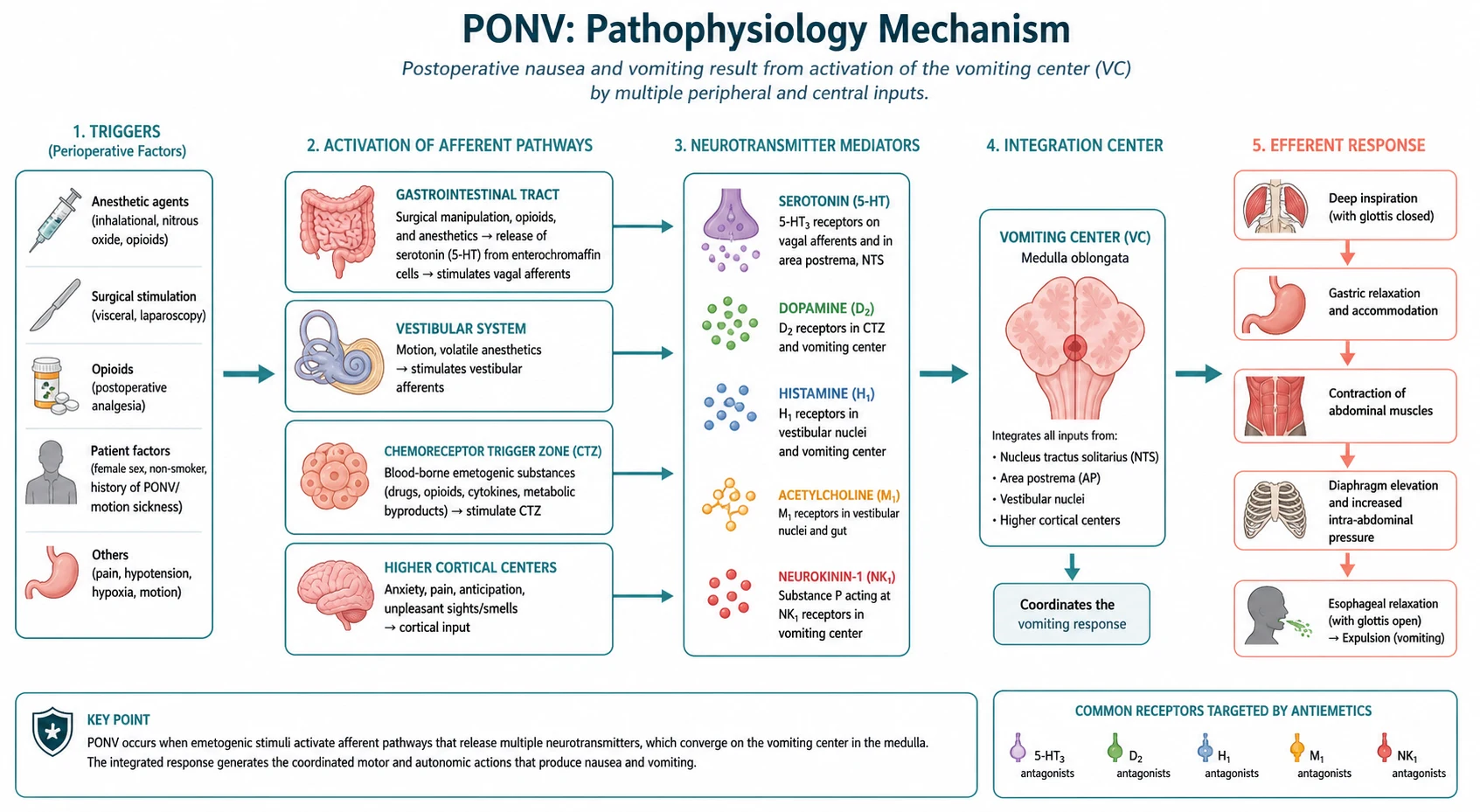
Multiple afferent pathways converge on the vomiting centre (medulla) and the chemoreceptor trigger zone (area postrema, outside the blood–brain barrier): [2]
| Receptor | Source / trigger | Antagonist class (examples) |
|---|---|---|
| 5-HT3 | Enterochromaffin serotonin (gut, opioids, surgery) | Ondansetron, granisetron, palonosetron |
| D2 | CTZ dopamine | Droperidol, haloperidol, metoclopramide |
| NK1 | Substance P / NTS | Aprepitant, fosaprepitant |
| H1 | Vestibular / histamine | Cyclizine, promethazine, dimenhydrinate |
| M1 | Vestibular / cholinergic | Hyoscine (scopolamine) patch |
| Opioid µ | Opioid emetogenesis | Minimise opioids; regional |
Corticosteroids (dexamethasone) act via anti-inflammatory and central mechanisms — not a single clean receptor label, but first-line prophylaxis. [1]
Different classes are additive; same-class stacking is not. [2]
Apfel simplified score — say it exactly
Four binary predictors (1 point each):[1]
- Female sex
- Non-smoker
- History of PONV and/or motion sickness
- Expected use of postoperative opioids [3]
| Score | Approximate PONV risk |
|---|---|
| 0 | ~10% |
| 1 | ~20% |
| 2 | ~40% |
| 3 | ~60% |
| 4 | ~80% |
Surgical risk modifiers (not in Apfel but viva-relevant): laparoscopy, gynaecology, breast, ENT, strabismus, cholecystectomy, long duration, volatile + N2O. [2]
Anaesthetic risk modifiers: volatiles, nitrous oxide, high-dose opioid, neostigmine (debated; many prefer sugammadex when otherwise indicated). [3]
Risk-stratified prophylaxis (not universal triple)
Consensus approach (Gan fourth consensus spirit): match number of interventions to risk; always reduce baseline risk.[2]
| Risk band | Strategy |
|---|---|
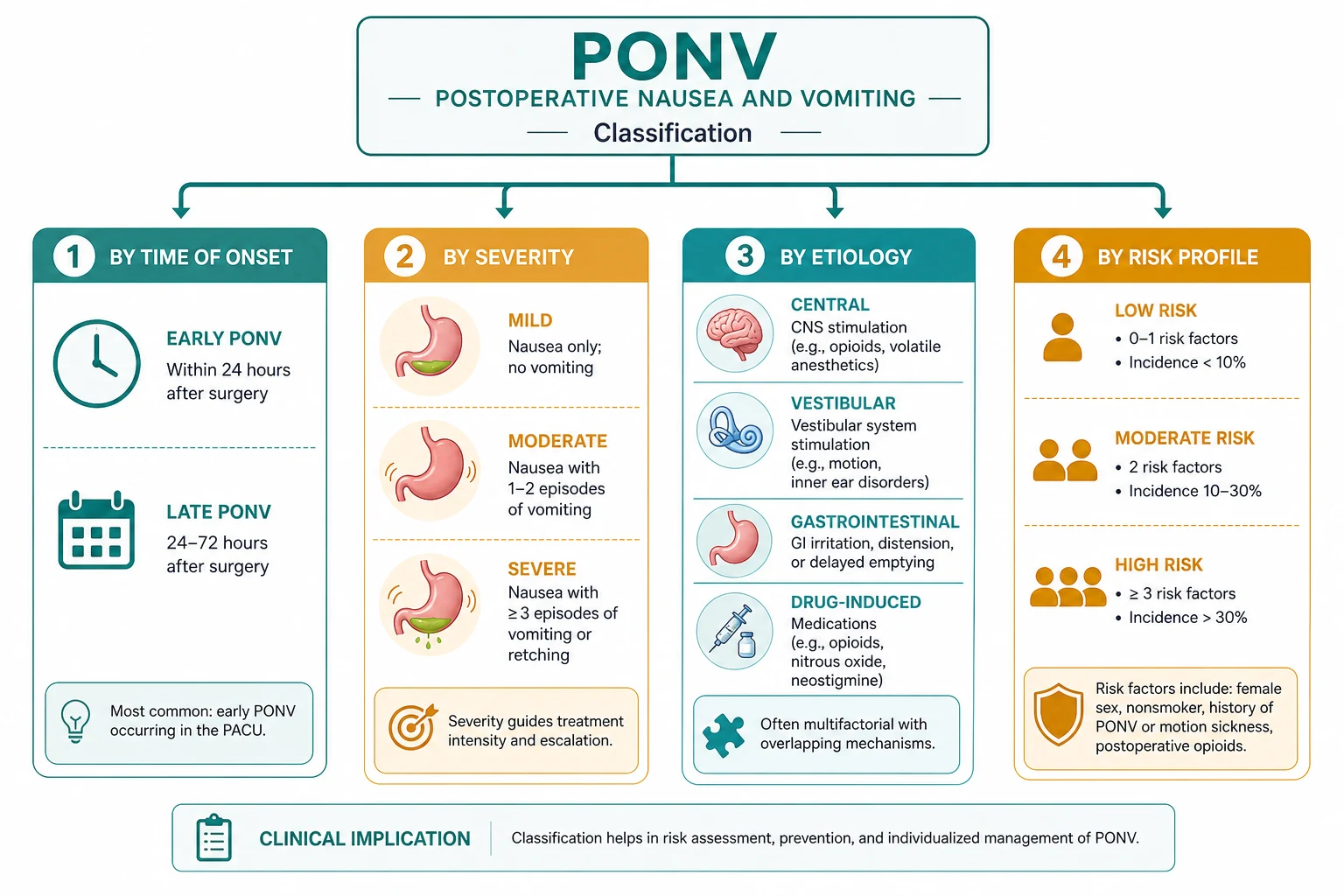
| Low (Apfel 0–1) | No routine prophylaxis; ensure rescue available |
| Moderate (Apfel 2) | 1–2 interventions (e.g. dexamethasone + ondansetron) ± TIVA |
| High (Apfel 3–4) | ≥2–3 interventions from different classes + TIVA preferred + aggressive opioid-sparing |
Do not give triple therapy to every ASA I man having short GA — that is not evidence-based stewardship and is a viva fail if you cannot justify risk. [2]
Baseline risk reduction (often higher yield than a fourth drug)
- Propofol TIVA — avoids volatiles/N2O; propofol has intrinsic antiemetic effect (~relative risk reduction meaningful in high-risk).
- Opioid-sparing multimodal analgesia — regional, local infiltration, paracetamol, NSAID/COX-2.
- Avoid N2O in high-risk when alternatives exist.
- Adequate hydration.
- Sugammadex instead of neostigmine/glycopyrrolate when residual block needs reversal after rocuronium (unit practice).
- Minimise high-dose intraoperative opioid (remifentanil alone still needs transition plan — hyperalgesia ≠ free lunch). [3]
TIVA reduces awareness risk only if pump safety is perfect — NAP5 awareness risk is higher with TIVA if infusions fail; use pEEG when TIVA is chosen for PONV.[3]
Prophylaxis by class — doses examiners want
Adult teaching doses (confirm local formulary; lean toward lower end in frail): [1]
| Class | Agent | Typical adult prophylaxis dose | Timing notes |
|---|---|---|---|
| Corticosteroid | Dexamethasone | 4–8 mg IV (often 4 mg enough; 8 mg if high risk) | At induction; delayed onset, long action |
| 5-HT3 | Ondansetron | 4 mg IV | End of surgery often preferred |
| 5-HT3 | Palonosetron | 0.075 mg IV | Long action (~40 h) — delayed PONV |
| D2 / butyrophenone | Droperidol | 0.625–1.25 mg IV | Low-dose QT concern historical; effective |
| D2 | Haloperidol | 0.5–1 mg IV | Alternative to droperidol |
| D2 / prokinetic | Metoclopramide | 10 mg IV | Modest at 10 mg; EPS risk if high dose |
| NK1 | Aprepitant | 40 mg PO pre-op | Strong for delayed PONV |
| NK1 | Fosaprepitant | 150 mg IV | IV NK1 option |
| H1 | Cyclizine | 50 mg IV | Rescue or prophylaxis |
| M1 | Hyoscine patch | 1.5 mg TD | Apply pre-op; anticholinergic SE |
Paediatric teaching doses (key): [3]
| Agent | Paediatric dose |
|---|---|
| Ondansetron | 0.1 mg/kg IV (max usually 4 mg) |
| Dexamethasone | 0.15 mg/kg IV (max often 5–8 mg unit-dependent) |
| Droperidol | Avoid or specialist only — EPS risk |
Paediatric risk modifiers
Age ≥3 years, surgery ≥30 min, strabismus, adenotonsillectomy, history of PONV/motion sickness, postoperative opioids. Children often have higher baseline rates than adults for ENT/strabismus — prophylaxis is more liberal in these lists.
Rescue rules (exam gold)
- Use a different pharmacological class than prophylaxis.
- If ondansetron was given ≤6 h ago, do not re-dose 5-HT3 as sole rescue — choose droperidol, cyclizine, promethazine, metoclopramide, or NK1 if not used.
- Treat pain, hypotension, and hypoxia — they worsen nausea.
- Consider NG decompression only if surgical indication (ileus, obstruction) — not routine for simple PONV.
- Day-case: if uncontrolled after multimodal rescue → admit. [2]
Multimodal worked examples
Day-case LC, woman, non-smoker, prior PONV, expects opioids (Apfel 4):
TIVA propofol–remifentanil, paracetamol + NSAID + local, dexamethasone 8 mg + ondansetron 4 mg + droperidol 0.625 mg (or aprepitant if available), rescue cyclizine ready. [3]
ASA I man, smoker, hernia, no opioids planned (Apfel 0–1):
No routine antiemetic; rescue ondansetron available; local infiltration. [1]
Child strabismus:
Ondansetron 0.1 mg/kg + dexamethasone 0.15 mg/kg; consider TIVA; avoid opioids if possible. [2]
Special situations
- Obstetrics: high baseline nausea; ondansetron commonly used post-CS; metoclopramide for prokinetic/antiemetic — follow obstetric formulary and trimester context for non-CS surgery.
- Parkinson / EPS risk: avoid high-dose D2 antagonists.
- Long QT: caution with ondansetron (high dose) and droperidol; ECG risk context.
- Diabetes: dexamethasone causes hyperglycaemia — still useful; monitor.
- Delayed / post-discharge PONV: prefer long-acting agents (palonosetron, aprepitant, hyoscine patch) + oral rescue script. [3]
SAQ scaffold
- List Apfel factors and risks at scores 0 and 4 (3)
- Name four receptor classes with one drug each (4)
- High-risk multimodal plan including TIVA (4)
- Rescue principles (2)
- Paediatric doses ondansetron + dexamethasone (2) [1]
Viva stems
“What is the Apfel score?” — four factors, 10–80% ladder.
“Rescue after dexamethasone + ondansetron?” — different class (droperidol/cyclizine/NK1).
“Why TIVA?” — no volatile/N2O + propofol antiemetic; watch awareness.
“Universal triple therapy?” — no — risk-stratify.
“Day-case failure causes?” — PONV first among anaesthetic causes; pain; social. [2]
Common traps
- Repeating ondansetron as rescue within hours.
- Forgetting female + non-smoker + history + opioids as the four.
- Quoting wrong risk percentages.
- Omitting baseline risk reduction.
- Using droperidol 5–10 mg (old dose) — modern antiemetic dose is low.
- Ignoring post-discharge delayed PONV in ambulatory women. [3]
PONV prophylaxis stack
Low risk
- Apfel 0–1
- No routine prophylaxis
- Rescue available
- Avoid overtreatment
Moderate
- Apfel 2
- 1–2 agents
- ± TIVA
- Opioid-sparing
High risk
- Apfel 3–4
- ≥2–3 classes
- TIVA preferred
- Regional analgesia
Integrated exam drill sheet
Sixty-second version
Say the definition, the critical number or sequence, the main clinical use, and the top red flag. Stop. If you cannot do this without notes, the topic is not yet learnable.
Three-minute version
Add mechanism, a comparison table spoken aloud, one special population, and one crisis stem with first actions. This is the standard viva unit.
Ten-minute mastery version
Add equipment detail or procedural steps, evidence limits, second-line options, and a teach-the-junior summary. This is Final long-case depth.
Written SAQ timing
For a 10-minute SAQ, spend one minute planning headings, seven minutes writing, two minutes checking hard stops and units. Headings should mirror examiner dimensions: definition, mechanism or anatomy, clinical application, complications, special situations.
Common mark-losing behaviours
- Lists without mechanisms
- Mechanisms without clinical action
- Doses without route or monitoring
- Landmarks without injury consequences
- Device talk without re-enable or backup plans
- Absolute claims where practice is protocol-dependent
Positive mark-gaining behaviours
- Numbers with units and approximate ranges
- Explicit assumptions for equations
- Side-by-side comparisons
- Named hard contraindications
- Monitoring endpoints
- Clear escalation
Cross-specialty board alignment
ANZCA Primary and Final, FRCA Primary and Final, ABA, EDAIC and FCAI all test these leaves repeatedly because they are portable across subspecialties. A candidate who owns flow physics, electrical safety, neck and neuraxial anatomy, vaporiser principles and core adjunct pharmacology can survive stems in ICU transfer, obstetric haemorrhage, thoracic lists and outpatient dental anaesthesia alike.
Personal rehearsal script
Read the AnswerCard twice. Cover it and rewrite it from memory. Speak the red flags. Draw one table from memory. Answer one hostile interruption. Then move on. Spaced repetition beats marathon re-reading.
Safety culture close
Every technical topic ends in patient safety: do not expand closed gas spaces, do not dilate arteries, do not leave ICD therapies off, do not apply Poiseuille in turbulence, do not ignore conus level, do not tip a full vaporiser back into service without protocol, and do not stack serotonergic weak opioids casually. Knowledge is only exam-pass when it prevents harm.
Red flags
References
- [1]Apfel CC, Läärä E, Koivuranta M, Greim CA, Roewer N. A simplified risk score for predicting postoperative nausea and vomiting: conclusions from cross-validations between two centers Anesthesiology, 1999.PMID 10485781
- [2]Gan TJ, et al. Fourth Consensus Guidelines for the Management of Postoperative Nausea and Vomiting Anesth Analg, 2020.PMID 32467512
- [3]Pandit JJ, et al. 5th National Audit Project (NAP5) on accidental awareness during general anaesthesia: summary of main findings and risk factors Br J Anaesth, 2014.PMID 25204697