Anaes · Patient safety
Venous thromboembolism prophylaxis
Also known as VTE prophylaxis · Thromboprophylaxis · DVT prophylaxis · ASRA timing · Neuraxial anticoagulation · LMWH epidural
Exam-exhaustive perioperative VTE prophylaxis: risk stratification, mechanical and pharmacological options, extended prophylaxis after major ortho/cancer surgery, and ASRA timing principles with neuraxial anaesthesia and catheter removal for ANZCA Final and equivalents.
On this page & tools
Your progress
Saved locally on this device.
Target exams
Red flags
Why this is examined / one-line answer
VTE is a leading preventable cause of perioperative death; for anaesthetists the exam twist is neuraxial–anticoagulant timing (haematoma risk) plus practical prophylaxis choices for ortho, cancer and the bleeding-risk patient.[1][2]
One-liner: I risk-stratify, use mechanical methods universally when possible, prescribe weight- and renal-aware anticoagulation, plan extended courses when indicated, and time every neuraxial needle or catheter removal to ASRA. [1]
Pathophysiology (brief)
Virchow’s triad in surgery: stasis (immobility, anaesthesia), hypercoagulability (tissue factor, inflammation, cancer, pregnancy), endothelial injury (trauma, lines). Risk continues after discharge — hence extended prophylaxis after some operations.[2]
Risk stratification
Caprini (and similar scores): weighted points for age, BMI, surgery type/duration, cancer, prior VTE, thrombophilia, oestrogen, immobility, etc. Higher scores → pharmacological prophylaxis if bleeding allows.[2]
High-risk exam groups
- Major orthopaedic (hip/knee arthroplasty, hip fracture)
- Major cancer / abdominal–pelvic cancer surgery
- Prior VTE or known thrombophilia
- Multiple trauma, spinal cord injury
- Obesity, pregnancy/puerperium (context-specific protocols) [2]
Bleeding-risk groups: active bleeding, severe thrombocytopenia, coagulopathy, recent intracranial/spinal bleed, untreated haemorrhagic stroke — mechanical first. [3]
Mechanical prophylaxis
- Early mobilisation — foundational; enhanced recovery anaesthesia enables it
- Graduated compression stockings (when no severe PAD / local leg disease)
- Intermittent pneumatic compression (IPC) — preferred mechanical device for many surgical pathways; bridge when anticoagulated delay needed
- Foot pumps in some ortho pathways [4]
No bleeding cost; combine with drugs in high VTE risk when safe. [1]
Pharmacological options (know roles)
| Agent | Teaching use | Notes |
|---|---|---|
| LMWH (enoxaparin etc.) | Workhorse surgical prophylaxis | Renal clearance; weight-band in extremes |
| UFH SC | Renal failure alternative | More HIT than LMWH; shorter half-life |
| Fondaparinux | Ortho / selected surgical | Longer neuraxial interval |
| DOACs (rivaroxaban, apixaban…) | Ortho pathways common | Renal/drug interactions; long ASRA holds |
| Aspirin | Selected ortho/trauma protocols | Modest efficacy; pathway-specific evidence base[4] |
| Warfarin | Less common for pure prophylaxis now | INR targets if used |
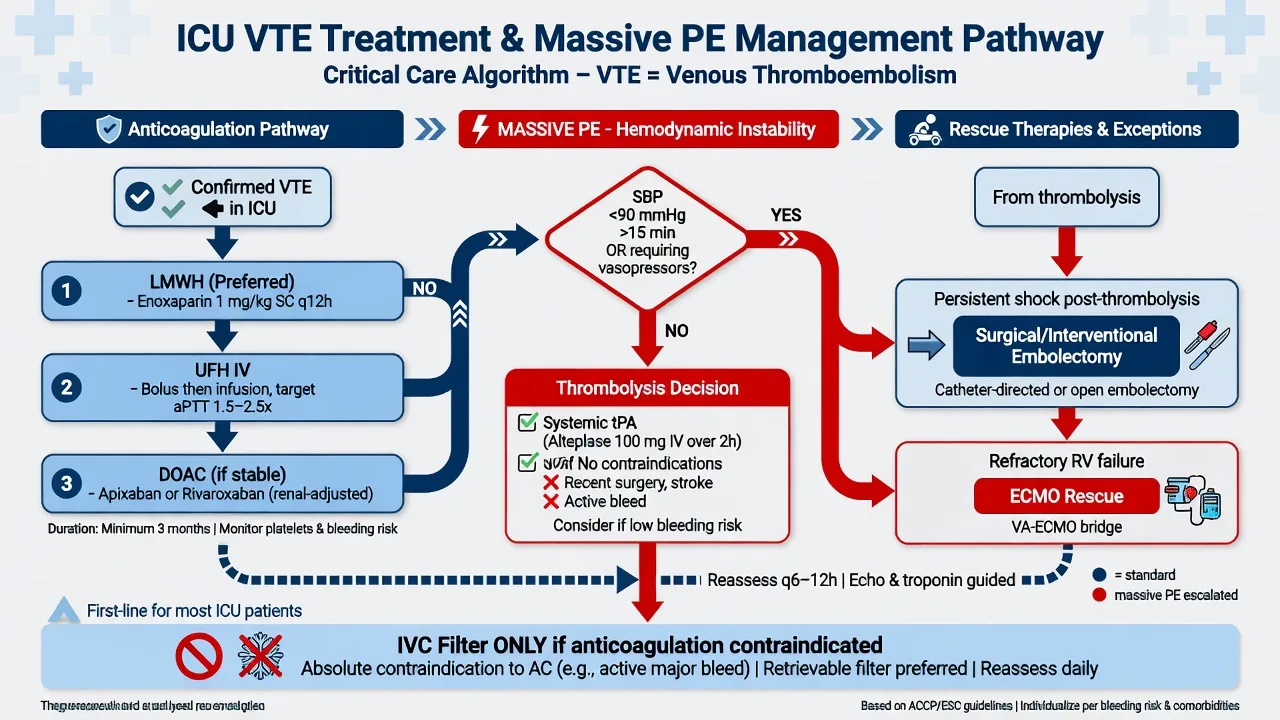
Extended prophylaxis: often ~4 weeks after major cancer abdominal/pelvic surgery and multi-week courses after major joint replacement — individualise to risk and bleeding.[3]
ASRA timing principles with neuraxial (core of this topic)
Spinal epidural haematoma is rare but devastating. ASRA 5th edition is the named current framework — always check the table for the exact drug, dose (prophylactic vs therapeutic), and renal function; below are the order-of-magnitude principles examiners expect you to carry.[1]
Principles (say these first)
- Insertion and catheter removal are both high-risk moments.
- Perform neuraxial at trough anticoagulant effect.
- Restart anticoagulant only after haemostasis and a safe interval post-procedure/removal.
- Therapeutic doses need longer gaps than prophylactic doses.
- Renal impairment prolongs LMWH/DOAC effect → longer waits or alternative agent.
- Monitor neurology after neuraxial in anticoagulated patients — new back pain/weakness is an emergency. [2]
Common teaching intervals (prophylactic adult, normal renal function — confirm ASRA)
| Drug class | Before puncture / catheter manip. | After puncture / catheter removal |
|---|---|---|
| LMWH prophylactic | ≥12 h since last dose | ≥4 h before next dose |
| LMWH therapeutic | ≥24 h | Delayed restart (often ≥4 h, sometimes longer per protocol) |
| UFH SC prophylactic | Shorter (often 4–6 h class teaching) | Per table |
| UFH IV therapeutic | Off infusion; APTT normal (often ≥4–6 h) | Delayed |
| Fondaparinux prophylactic | ~36–42 h class teaching | Delayed |
| DOACs | Days, drug- and CrCl-specific | Delayed restart |
| Warfarin | INR normalised (typically ≤1.4–1.5 teaching) | Restart per team |
| Aspirin alone | Usually not an absolute neuraxial ban | Still assess combined risks |
| P2Y12 inhibitors | Multi-day holds (e.g. clopidogrel ~5–7 d) | Per ASRA |
Indwelling epidural + once-daily prophylactic LMWH: many units allow with strict timing, first dose ≥4 h after insertion, catheter removal ≥12 h after a dose, next dose ≥4 h after removal — follow local adaptation of ASRA, never invent. [4]
Traumatic bloody tap: consider delaying anticoagulant restart further; document. [1]
Balancing VTE vs bleeding vs regional
[1]Special populations
- Obesity: underdosing LMWH is classic — use weight-banded protocols.
- Pregnancy: obstetric VTE protocols; LMWH preferred; neuraxial timing critical around delivery.
- Cancer: high risk; extended prophylaxis after major abdominal/pelvic resection when appropriate.[3]
- Ortho trauma/frailty: aspirin pathways appear in some guidelines — know they are protocol-dependent, not universal first-line for every joint.[4]
- HIT history: avoid heparin; fondaparinux/DOAC/other per haematology.
Anaesthetist’s practical checklist
- VTE risk + bleeding risk on the chart
- Mechanical devices on before induction when possible
- Pharmacological agent/time prescribed with neuraxial plan written beside it
- Catheter removal appointment timed to doses
- Ward education: motor checks, back pain escalation
- ERAS: short-acting drugs, regional analgesia, early walk [2]
SAQ answer scaffold
Patient for THR on evening enoxaparin 40 mg; surgeon requests spinal. Outline VTE and neuraxial plan. [3]
- Risk (2): major ortho = high VTE.
- Prophylaxis (3): IPC + LMWH/DOAC pathway; duration multi-week.[4]
- ASRA timing (4): ≥12 h after prophylactic LMWH before spinal; restart ≥4 h after.[1]
- Postop monitoring (2): neurology observations.
- If bloody tap (2): delay restart; document.
Viva stem bank and model phrases
Stem 1: “When can I site an epidural after enoxaparin 40 mg?”
After at least twelve hours in standard prophylactic teaching with normal renal function — I confirm against current ASRA and local policy. [4]
Stem 2: “When can I remove the epidural?”
At trough — typically twelve hours after the last prophylactic LMWH dose — then wait about four hours before the next dose. [1]
Stem 3: “Therapeutic enoxaparin 1 mg/kg BD?”
Longer hold, commonly twenty-four hours, and I am reluctant to keep indwelling catheters on therapeutic dosing without a very clear plan. [2]
Stem 4: “Patient refuses injections — aspirin only after TKA?”
Some ortho pathways use aspirin; I follow the agreed institutional protocol and still use mechanical prophylaxis. [3]
Stem 5: “Why extended prophylaxis after cancer surgery?”
Hypercoagulability persists after discharge; extended LMWH reduces post-discharge VTE in high-risk abdominal/pelvic cancer surgery. [4]
Stem 6: “New leg weakness day 1 on LMWH + epidural.”
Haematoma until proven otherwise — stop anticoagulant pathway carefully, urgent MRI, spine consult. [1]
Common traps
- Restarting LMWH immediately after catheter removal
- Siting spinal 2 hours after prophylactic LMWH “because only 40 mg”
- Mechanical prophylaxis omitted in bleeding-risk patients
- No extended course after major cancer resection when indicated
- Underdosing LMWH in obesity
- Forgetting renal function for LMWH/DOAC
- No neurological observation plan with epidural + anticoagulant [2]
VTE + neuraxial — TIME
Examiner mental map
- Virchow + risk groups / Caprini idea.
- Mechanical methods.
- Drug menu + extended prophylaxis.
- Bleeding vs VTE balance.
- ASRA principles.
- LMWH 12 h / 4 h teaching numbers.
- DOAC/fondaparinux longer holds.
- Catheter removal discipline.
- Haematoma recognition. [3]
Hit those nine and the VTE viva is done. [4]
Integrated exam drill sheet
Sixty-second version
Say the definition, the critical number or sequence, the main clinical use, and the top red flag. Stop. If you cannot do this without notes, the topic is not yet learnable.
Three-minute version
Add mechanism, a comparison table spoken aloud, one special population, and one crisis stem with first actions. This is the standard viva unit.
Ten-minute mastery version
Add equipment detail or procedural steps, evidence limits, second-line options, and a teach-the-junior summary. This is Final long-case depth.
Written SAQ timing
For a 10-minute SAQ, spend one minute planning headings, seven minutes writing, two minutes checking hard stops and units. Headings should mirror examiner dimensions: definition, mechanism or anatomy, clinical application, complications, special situations.
Common mark-losing behaviours
- Lists without mechanisms
- Mechanisms without clinical action
- Doses without route or monitoring
- Landmarks without injury consequences
- Device talk without re-enable or backup plans
- Absolute claims where practice is protocol-dependent
Positive mark-gaining behaviours
- Numbers with units and approximate ranges
- Explicit assumptions for equations
- Side-by-side comparisons
- Named hard contraindications
- Monitoring endpoints
- Clear escalation
Cross-specialty board alignment
ANZCA Primary and Final, FRCA Primary and Final, ABA, EDAIC and FCAI all test these leaves repeatedly because they are portable across subspecialties. A candidate who owns flow physics, electrical safety, neck and neuraxial anatomy, vaporiser principles and core adjunct pharmacology can survive stems in ICU transfer, obstetric haemorrhage, thoracic lists and outpatient dental anaesthesia alike.
Personal rehearsal script
Read the AnswerCard twice. Cover it and rewrite it from memory. Speak the red flags. Draw one table from memory. Answer one hostile interruption. Then move on. Spaced repetition beats marathon re-reading.
Safety culture close
Every technical topic ends in patient safety: do not expand closed gas spaces, do not dilate arteries, do not leave ICD therapies off, do not apply Poiseuille in turbulence, do not ignore conus level, do not tip a full vaporiser back into service without protocol, and do not stack serotonergic weak opioids casually. Knowledge is only exam-pass when it prevents harm.
References
- [1]Kopp SL, Vandermeulen E, McBane RD, et al. Regional anesthesia in the patient receiving antithrombotic or thrombolytic therapy: American Society of Regional Anesthesia and Pain Medicine Evidence-Based Guidelines (fifth edition) Reg Anesth Pain Med, 2025.PMID 39880411
- [2]Lohr J, et al. Evolution of the Caprini risk assessment score: 1991 to present: A living risk assessment tool J Vasc Surg Venous Lymphat Disord, 2026.PMID 42331469
- [3]Choi JDW, et al. The efficacy and safety of extended thromboprophylaxis after colorectal surgery: a systematic review and meta-analysis Int J Colorectal Dis, 2025.PMID 41065855
- [4]Riediger C, et al. Aspirin for Venous Thromboembolism Prevention in Orthopaedic Surgery with Focus on Trauma and Arthroplasty: A Structured Evidence-Based Review of Randomised Trials, Guidelines, and Contemporary Practice Considerations J Clin Med, 2026.PMID 42355718