Anaes · Perioperative medicine
Intraoperative cell salvage
Also known as ICS cell saver · Autologous blood salvage · AAGBI cell salvage
Exam-pass intraoperative cell salvage: indications, wash pathway, contraindications, obstetrics/malignancy nuances, coagulopathy after wash, and PBM integration.
On this page & tools
Your progress
Saved locally on this device.
Target exams
Red flags
Why this is examined / the one-line answer
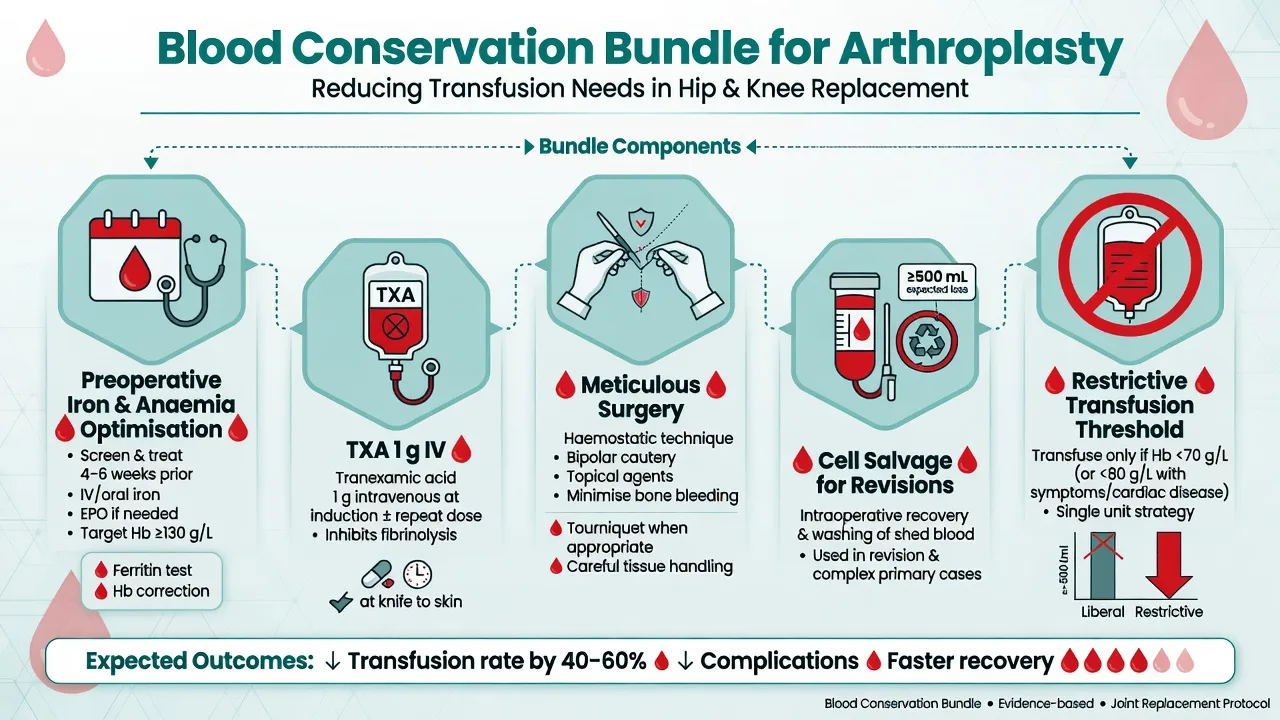
Intraoperative cell salvage (ICS) is core patient blood management (PBM) technology. It appears in arthroplasty revision, major spine, cardiac/aortic, obstetrics, trauma, liver, and Jehovah’s Witness / blood-refusal stems. Examiners do not want a brochure on machine brands. They want: when you set it up, what actually comes back, what it cannot do, and how you integrate it with TXA, haemostasis, and allogeneic MTP when loss is catastrophic.[1][2]
One-liner: I deploy ICS when adult expected blood loss is substantial or allogeneic transfusion is likely, reinfuse washed autologous RBCs via a trained continuous pathway, and plan factors/platelets/VET separately because salvage is not whole blood. [1]
Association of Anaesthetists 2018 cell salvage guidance is the named UK/ANZ-relevant practice framework examiners recognise; BJA reviews frame ICS inside broader conservation strategy.[1][2]
Preoperative assessment and decision to use ICS
Indications that pass exams
Use ICS when it is likely to reduce allogeneic red-cell exposure: [1]
| Context | Typical teaching |
|---|---|
| Adult expected EBL often >500 mL (or unit threshold) | Strong default for ICS setup |
| Revision hip/knee, major spine, pelvic trauma | High-yield list cases |
| Cardiac / aortic / major vascular | Common; heparin/coagulopathy awareness |
| Liver resection / transplant phases | Large volume wash possible |
| Obstetrics with significant PPH risk | Increasingly used with local SOP/filter rules |
| Alloantibodies / rare blood group | Conservation priority |
| Blood refusal with continuous-circuit acceptance | Ethical and practical cornerstone |
Also consider postoperative cell salvage only where local evidence and device type support it — do not conflate washed intraoperative systems with unwashed drain reinfusion without nuance.[1]
Consent and documentation
Explain: autologous washed red cells from the field; residual risks (contamination, air, process error); that bank blood may still be needed; that platelets and clotting factors are washed away. Document Jehovah’s Witness continuous-circuit preferences precisely (see blood-refusal topic).[1]
Contraindications and cautions (say “relative” honestly)
- Frank bacterial contamination / purulent field — usually avoid reinfusion risk of bacteraemia.
- Amniotic fluid / gross bowel content — follow local SOP; many units use separate suckers and strict wash; obstetrics has evolved practice with leucodepletion filters in some protocols.
- Malignancy — theoretical reinfusion of tumour cells; many centres still use ICS selectively (e.g. with leucodepletion) after consent and MDT context — do not give absolute dogma without local policy.[1][2]
- Sickle cell disease — specialised caution (sickling risk in circuit) — escalate haematology advice.
- Patient refusal of autologous reinfusion — respect documented wishes.
Applied technology — the viva gold
Sequence (draw it)
- Collection — dedicated sucker with anticoagulant (commonly heparinised saline) mixed at the tip/reservoir.
- Reservoir + filter — defoaming, debris filtration.
- Wash / centrifuge — plasma, free Hb fraction, anticoagulant, and most platelets/factors removed; RBC concentrate produced.
- Reinfusion — through a giving set with appropriate filter; no air; labelled autologous. [1]
Product identity: washed autologous red cells (Hct often roughly mid–high 50s depending on machine/settings — know that it varies). Not returned in clinically useful amounts: platelets, plasma coagulation factors, plasma proteins.[2]
Quality killers examiners love
- Excessive vacuum → haemolysis.
- Wrong or inadequate anticoagulant → clots in reservoir.
- Delayed processing of full bowls → quality and bacterial risk concerns.
- Contaminant sucker (cement, irrigation fluid, faeces, urine) into the blood sucker.
- Untrained intermittent operators — ICS is a process, not a button. [1]
Anaesthetic goals
- Right case, right time — set up before the blood hits the floor when possible.
- Trained operator and machine check.
- Minimise allogeneic RBC exposure without ignoring coagulopathy.
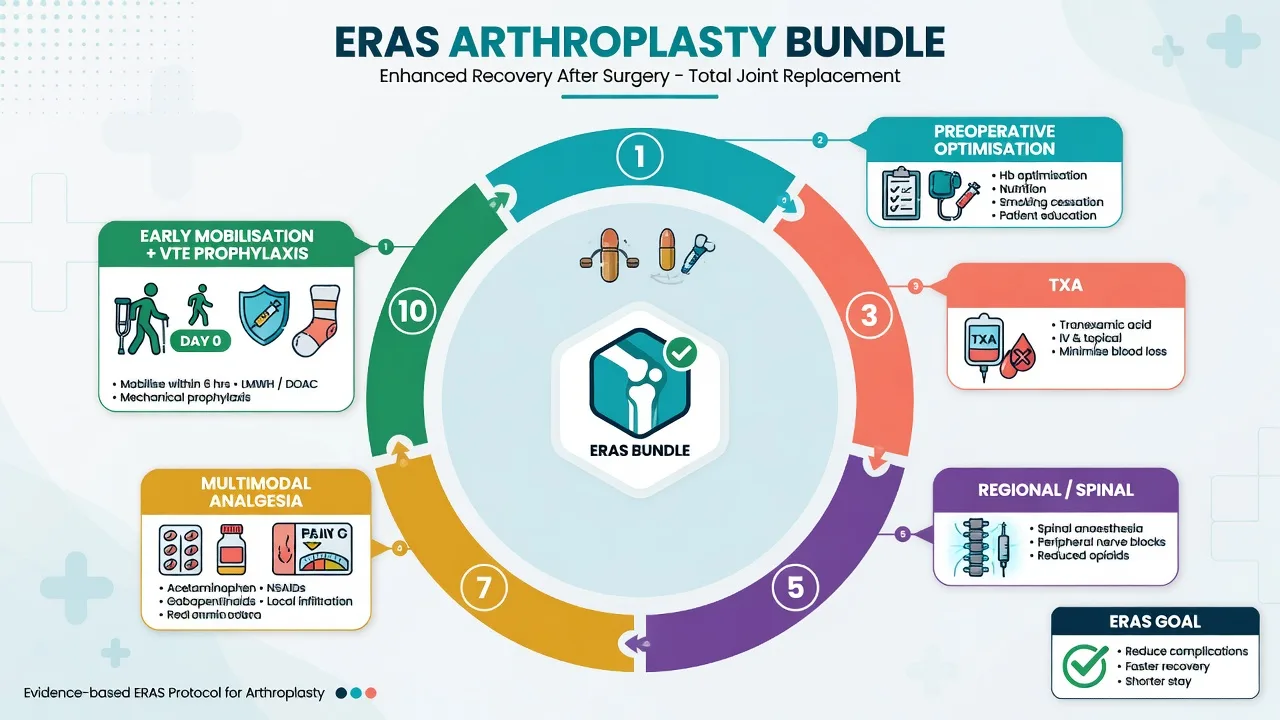
- Combine with TXA (where indicated), temperature control, surgical haemostasis, and restrictive allogeneic thresholds in appropriate cohorts.[3]
- Document volumes salvaged and reinfused.
Technique options and decision matrix
Monitoring and equipment
Machine and disposables check before incision when feasible: reservoir, bowl, wash fluid, anticoagulant mix, vacuum limit, reinfusion bag labelling. [1]
Patient side: standard monitoring; point-of-care Hb if large loss; temperature; consider VET (ROTEM/TEG) and formal coagulation when wash volumes are large or bleeding is microvascular. [1]
Backup: allogeneic blood available unless pure blood-refusal pathway with clear limits; cell salvage failure plan stated aloud. [1]
Intraoperative management — worked sequence
- Decide ICS at team brief; assign operator.
- Start collection early — waiting until 1 L on the floor wastes yield.
- Separate blood sucker from contaminant/irrigation sucker when practical.
- Process bowls as they fill; reinfuse promptly via filtered line; watch for air.
- Track cumulative reinfused volume; if multi-litre, think coagulopathy and check VET/labs.
- Use allogeneic RBCs only to indication — cardiac restrictive strategies (e.g. TRICS III context) remind examiners that more red cells are not always better, but that is threshold philosophy, not a reason to skip salvage when it reduces exposure.[3]
- Continue surgical haemostasis and TXA pathways as indicated.
Worked numbers (exam style)
Adult revision hip: EBL 1200 mL → salvage may return a clinically useful autologous RBC volume after wash losses (wash yield is incomplete — expect less than “all blood lost”). If microvascular ooze persists with Hb 95 g/L after reinfusion, the problem is often coagulation/temperature/surgery, not “more washed RBCs”. [1]
Crisis pivots
Machine failure mid-case
Declare; switch to allogeneic pathway / blood-refusal alternatives; do not leave unprocessed reservoir blood sitting without a plan. [1]
Coagulopathy after multi-litre wash
Treat as dilutional/consumptive picture: plasma, platelets, fibrinogen (or cryoprecipitate), calcium, temperature, surgical control, VET-guided therapy — not endless RBC bowls alone. [1]
Contaminated product suspected
Stop reinfusion; quarantine product; document; continue with bank blood if accepted; review process. [1]
Air in line / suspected air embolism
Stop infusion; standard air embolism management (prevent further air, 100% O2, support circulation, left lateral/head-down debates secondary to life support); check clamps and bag. [1]
Acute transfusion-type reaction to autologous product
Rare but process contaminants exist — stop, treat as reaction pathway, investigate. [1]
Postoperative plan
Document volumes collected/reinfused and any discarded product. Continue Hb trajectory monitoring. Do not automatically reinfuse postoperative drains as “the same as ICS” — device and evidence differ. Hand over ongoing bleeding risk and coagulation plan. [1]
Special populations
Obstetrics: washed ICS increasingly accepted; local leucodepletion filter policies and anti-D for Rh-negative mothers matter; amniotic fluid concerns are mitigated by wash/SOP but remain viva fodder.[1]
Paediatrics: different volume thresholds and equipment; specialist practice. [1]
Sepsis / contaminated surgery: relative contraindication to reinfusion. [1]
Cancer: individualised consent and policy — state uncertainty honestly. [1]
Cardiac surgery: ICS common; still manage CPB coagulopathy separately; restrictive allogeneic thresholds may apply to bank blood decisions.[3]
Jehovah’s Witness: continuous circuit often acceptable when discontinuous bank transfusion is not — confirm in writing.[1]
SAQ answer scaffold
Outline the role of intraoperative cell salvage in major orthopaedic revision surgery. [1]
- Definition/process (3): collect–wash–reinfuse autologous RBCs; trained operator.[2]
- Indications (2): EBL often >500 mL adult / likely transfusion; antibodies; blood refusal pathways.[1]
- Limitations (3): no platelets/factors; quality depends on suction/anticoagulant; not MTP.
- Cautions (2): infection, malignancy policy, contamination, consent.
- Integration (3): TXA, haemostasis, temperature, restrictive allogeneic use, coagulation monitoring.
Viva stem bank and model phrases
Stem 1: “When do you set up cell salvage?”
Model: “When adult blood loss is expected to be significant — commonly taught around more than 500 mL — or allogeneic transfusion is likely, and in special serology or blood-refusal pathways.”[1]
Stem 2: “What do you reinfuse?”
Model: “Washed autologous red cells. Not a useful platelet or clotting-factor product.” [1]
Stem 3: “Why might they still bleed after three bowls?”
Model: “Wash removes plasma and platelets; temperature and surgical bleeding may persist — I check coagulation/VET and treat factors, not only Hb.” [1]
Stem 4: “Cancer surgery — yes or no?”
Model: “Individualised. Theoretical tumour-cell concern exists; many units use ICS selectively with consent and local policy rather than absolute prohibition.”[1]
Stem 5: “Jehovah’s Witness accepts continuous circuit only.”
Model: “I keep an unbroken circuit from collection to reinfusion if that matches their documented acceptance, and maximise all other conservation measures.” [1]
Stem 6: “Obstetric haemorrhage — any special points?”
Model: “Washed ICS is increasingly used with local SOPs and filter policies; coordinate anti-D and communicate with the obstetric team.”[1]
Stem 7: “Does salvage replace a group and screen?”
Model: “No. ICS fails, yields are incomplete, and coagulopathy needs components — bank blood pathways remain unless refused.” [1]
Common traps
- Calling salvaged blood “whole blood”
- No coagulopathy plan after large-volume wash
- Starting collection too late
- High suction haemolysis / wrong anticoagulant
- Reinfusing grossly contaminated product
- Ignoring consent nuances in blood refusal
- Treating ICS as a reason to skip TXA or surgical haemostasis
- Conflating unwashed drain reinfusion with washed ICS evidence [1]
ICS quality — WASH
Examiner mental map
- Indicate correctly (volume/transfusion risk/special groups).
- Describe process and product identity.
- List quality killers and cautions (infection, cancer, obstetrics).
- Coagulopathy after wash — factors/platelets/VET.
- Integrate PBM (TXA, temperature, restrictive bank blood).
- Blood-refusal continuous circuit documentation. [1]
If you hit those six without selling the machine, you pass the cell-salvage viva. [1]
References
- [1]Klein AA, Bailey CR, Charlton AJ, et al. Association of Anaesthetists guidelines: cell salvage for peri-operative blood conservation 2018 Anaesthesia, 2018.PMID 29989144
- [2]Ashworth A, Klein AA Cell salvage as part of a blood conservation strategy in anaesthesia Br J Anaesth, 2010.PMID 20802228
- [3]Mazer CD, Whitlock RP, Fergusson DA, et al. Restrictive or Liberal Red-Cell Transfusion for Cardiac Surgery N Engl J Med, 2017.PMID 29130845