Anaes · Perioperative medicine
Enhanced recovery after surgery (ERAS)
Also known as ERAS · Enhanced Recovery After Surgery · Fast-track surgery · Carbohydrate loading · Multimodal perioperative care
High-yield ERAS for fellowship exams: bundle philosophy, anaesthetic elements (fasting, carb load, opioid-sparing, PONV, fluids, normothermia), audit/adherence, and when not to force a pathway.
On this page & tools
Your progress
Saved locally on this device.
Target exams
Red flags
Why this is examined / the one-line answer
ERAS is the organisational philosophy behind modern elective major surgery lists. Examiners want bundle thinking, anaesthetic-controllable elements, and honesty about audit/adherence — not a single drug brand. Colorectal ERAS Society recommendations are the prototype specialty pathway candidates should be able to outline.[1]
One-liner: I deliver a multidisciplinary pathway — limited fasting with carb loading when appropriate, multimodal opioid-sparing analgesia, PONV prevention, normothermia, thoughtful fluids, early feed and walk — and I measure compliance. [1]
What ERAS is (and is not)
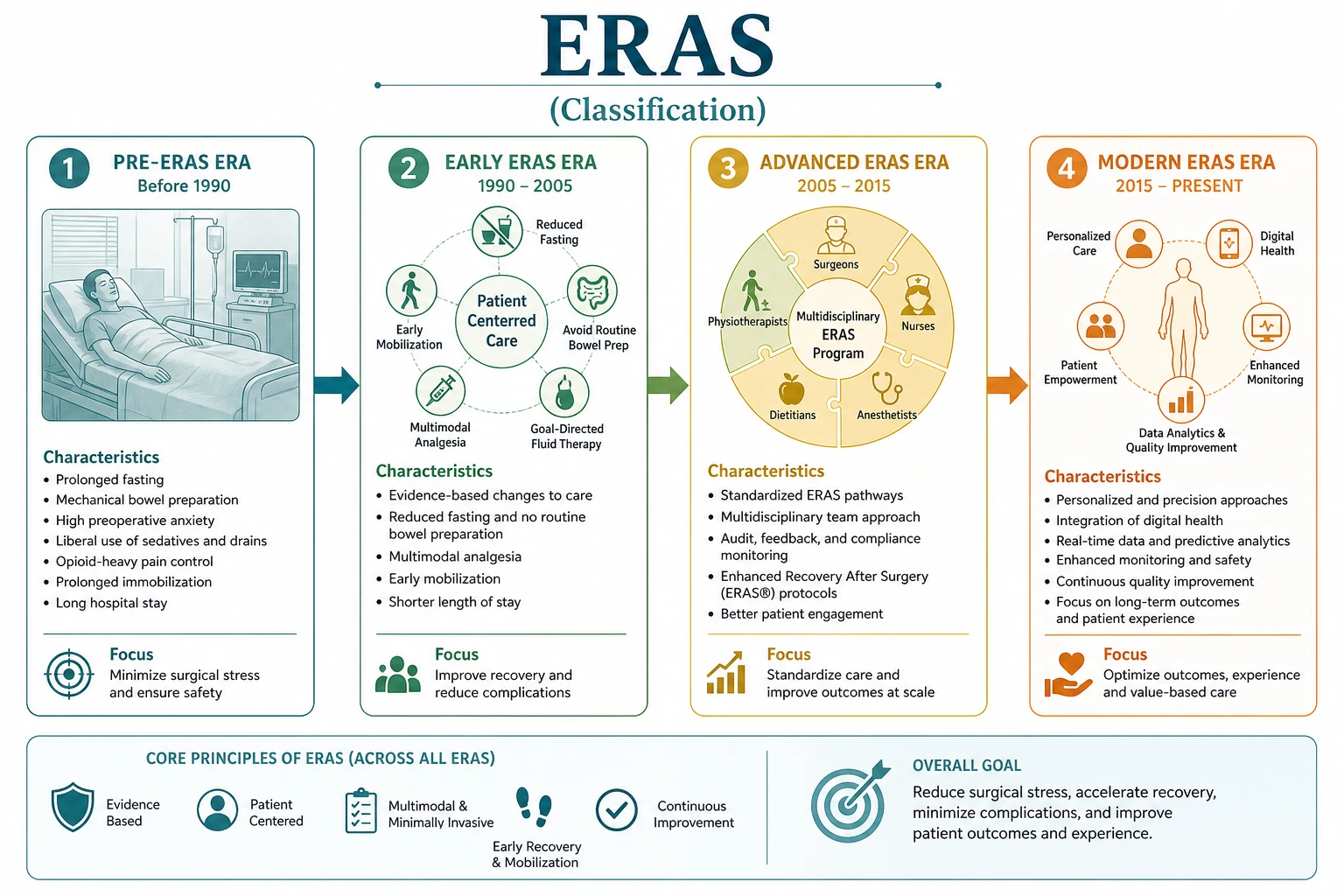
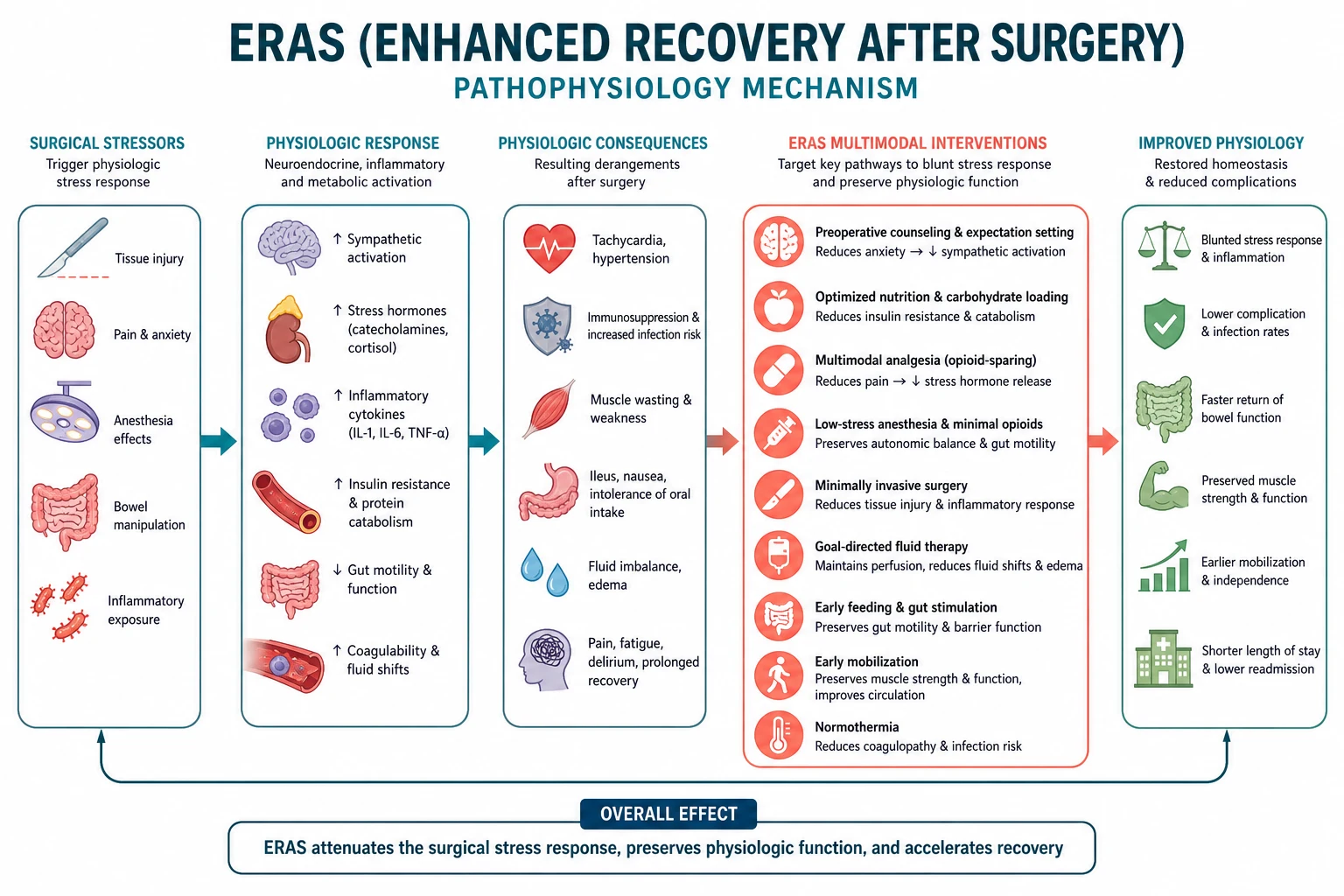
Is: a protocolised set of evidence-informed elements across the perioperative continuum that reduce surgical stress and organ dysfunction, shorten length of stay, and improve recovery quality when adherence is high. [1]
Is not: “no nasogastric tube + hope”; not zero opioids for everyone; not early discharge against clinical safety; not the anaesthetist alone. [1]
Preoperative elements examiners expect
| Element | Anaesthetic relevance |
|---|---|
| Counselling / expectation setting | Reduces anxiety, improves engagement |
| Optimise comorbidities / anaemia / smoking | PBM and risk reduction |
| Limited fasting; carbohydrate loading (when appropriate) | Reduces insulin resistance; not for all diabetics/GORD without plan |
| Avoid routine sedative premed | Faster recovery |
| VTE prophylaxis plan | Timing vs neuraxial (ASRA-compatible) |
| No prolonged mechanical bowel prep where pathway avoids it | Surgical-led; know the local colorectal bundle |
| Prehabilitation where available | Fitness for major surgery |
Intraoperative anaesthetic elements
Technique choice
- Minimally invasive surgery when suitable (surgical).
- Regional / local / fascial plane / neuraxial as opioid-sparing tools when risk–benefit fits — still count LA mg and keep lipid available.[3]
- Short-acting systemic agents; avoid deep residual sedation.
PONV
Risk-stratify; multi-modal prophylaxis; rescue plan — vomiting delays feeding and mobilisation. [1]
Fluids
Avoid both drowning and running dry. Many ERAS pathways favour near-zero balance / goal-directed approaches over liberal crystalloid. Match fluid to losses and haemodynamics; use vasopressors for anaesthetic vasodilatation rather than endless fluid when appropriate. [1]
Temperature
Active warming — hypothermia increases bleeding, infection, and shivering oxygen demand. [1]
Glycaemia and antibiotics
Avoid extreme hyperglycaemia; timely antibiotic prophylaxis. [1]
Drains, tubes, catheters
Avoid routine NG; early urinary catheter removal when safe — surgical pathway items you should not sabotage. [1]
Postoperative elements
- Multimodal oral analgesia early; avoid long background opioid infusions on wards.
- Early feeding as pathway allows.
- Early mobilisation day 0/1.
- Continue VTE prevention.
- Defined discharge criteria — not the clock alone.
- Audit complications and readmissions. [1]
Audit and adherence — the consultant mark
Outcomes track bundle compliance more than any hero move. Know your unit’s ERAS dashboard: which elements are failing (e.g. carb drinks not given, epidurals abandoned without alternative, patients not walked). Improve systems. [1]
When not to force the pathway
Emergency sepsis, uncontrolled bleeding, ICU-level organ failure, patient inability to mobilise for medical reasons, anastomotic concern with surgical instruction for NBM — safety overrides pathway ideology. Document variance. [1]
Blood conservation and antifibrinolytics appear in some specialty pathways (e.g. orthopaedics); obstetric TXA evidence (WOMAN) is a related “give early when indicated” lesson rather than core colorectal ERAS, but shows how trial evidence feeds pathway drugs.[2]
Specialty flavours (high-yield only)
- Colorectal: prototype ERAS Society recommendations — know the structure even if you cannot recite every line.[1]
- Orthopaedics / arthroplasty: spinal or regional, TXA blood conservation, early physio.
- Bariatric / gynae / HPB: specialty-modified bundles; same philosophy.
- Emergency laparotomy: “ERAS principles where safe” ≠ full elective pathway.
Anaesthetist “day of surgery” checklist
- Confirm pathway enrolment and allergies.
- Carb drink timing / diabetes plan.
- Regional plan + LAST readiness if used.[3]
- Multimodal analgesics ordered.
- Dual antiemetics if risk.
- Warming on before induction.
- Fluid plan stated.
- Avoid unnecessary tubes.
- PACU: oral meds, sit out, pathway goals handed over.
- Document variances.
SAQ scaffold
Describe the principles of ERAS and the anaesthetist’s contribution to a colorectal pathway. [1]
- Bundle definition + adherence (3).[1]
- Preop: fasting/carb, optimise, counselling (3).
- Intraop: opioid-sparing, PONV, fluids, temperature (4).
- Postop: feed, mobilise, analgesia, VTE (3).
- When not to force (2).
Viva stems
Stem 1: “Is TIVA mandatory for ERAS?”
Model: “No single technique is mandatory — opioid-sparing multimodal care, PONV control, and pathway adherence matter more than brand of hypnotic.” [1]
Stem 2: “Carbohydrate loading in insulin-dependent diabetes?”
Model: “I follow local protocol — many pathways modify or avoid standard carb loads; glycaemic plans beat dogma.” [1]
Stem 3: “Why audit?”
Model: “Benefits track compliance; without audit, ERAS becomes three posters and no change.” [1]
Stem 4: “Epidural hypotension ruining ERAS?”
Model: “Titrate, use vasopressors, or switch to alternative regional/multimodal — uncontrolled pain also ruins ERAS.” [1]
Stem 5: “Is ERAS just early discharge?”
Model: “No — recovery quality and complication reduction; unsafe early discharge is a failure.” [1]
Stem 6: “Fascial plane blocks role?”
Model: “Opioid-sparing adjuncts within the bundle when matched to surgery — with LAST discipline.”[3]
Stem 7: “Emergency bowel obstruction — full ERAS?”
Model: “I apply compatible principles (warming, antibiotics, thoughtful fluids) but do not force carb loads or early feed against surgical pathology.” [1]
Common traps
- Cherry-picking three elements
- Zero analgesia misread as opioid-sparing
- Forced discharge
- Ignoring PONV
- Liberal fluids “because ERAS said euvolemia” without thought
- No audit
- Same pathway for every emergency [1]
Worked list (how you actually deliver ERAS)
Preassessment: enrol, optimise anaemia, explain expectations.
Day of surgery: carb drink if eligible, no long premed, warm, regional + multimodal, dual antiemetics, antibiotics timed, near-zero fluid balance, no routine NG.
PACU: sit up, oral paracetamol/NSAID, sip clear fluids if allowed, document pain scores that allow walk.
Ward: walk with physio, food, catheter out, VTE shot timed with epidural rules, discharge when criteria met. [1]
How to remember (exam flashcard)
Pre: counsel, optimise, carb, limited fast.
Intra: warm, dry-ish, regional, antiemetic, short-acting.
Post: feed, walk, multimodal oral, audit. [1]
ERAS anaesthetist — BUNDLE
How ERAS interacts with regional anaesthesia and LAST
Opioid-sparing regional techniques are powerful ERAS tools, but they introduce LAST risk, motor block that can delay mobilisation if poorly chosen, and catheter logistics that clash with VTE timing. Choose motor-sparing options when early walk is the pathway goal (e.g. adductor canal over dense femoral for many knee pathways). Count every milligram of local anaesthetic including surgical infiltration. Lipid emulsion must exist on the pathway cart, not only in main theatre.[3]
Fluids: what “euvolemia” means on a viva
Say: I avoid obligatory multi-litre crystalloid for urine output alone; I replace deficits and losses; I treat anaesthetic vasodilation with vasopressors when the patient is not hypovolaemic; I use dynamic assessment when available. Zero-balance dogma without monitoring is as wrong as liberal drowning. After major open surgery, ongoing third-space myths are outdated — modern thinking is more restrictive once deficits are corrected. [1]
Carbohydrate loading — practical detail
Typical elective colorectal pathway: clear carbohydrate drink the evening before and 2–3 hours pre-induction when not contraindicated, aiming to reduce preoperative thirst/hunger and insulin resistance signals. Modify for poorly controlled diabetes, known delayed gastric emptying, emergency surgery, and aspiration-risk anatomy. Document what was given and when so induction timing is safe. [1]
Worked colorectal day (consultant narration)
“This morning’s right hemicolectomy is on the ERAS pathway. Preassessment optimised iron-deficiency anaemia and stopped smoking six weeks ago. Carb drink at 06:00, induction 09:00. Spinal or TAP/ESP plus GA multimodal, dual antiemetics, warming blanket on before prep, antibiotics at knife-to-skin minus one, near-zero fluid with noradrenaline for propofol vasodilation, no NG, catheter planned for early removal. PACU: sit out, sips if allowed, oral paracetamol/NSAID. Ward: walk with physio this evening, food as pathway, VTE dose timed around any catheter. I will document any variance and why.” [1]
That paragraph is what fellowship examiners are listening for — integrated care, not a bullet of buzzwords.[1]
Examiner mental map
- Define bundle + adherence.
- Preop elements (carb/fast/optimise).
- Intraop anaesthetic levers.
- Postop feed/walk/analgesia.
- Audit.
- When not to force. [1]
Talk like a pathway owner, not a drug catalogue. [1]
References
- [1]Gustafsson UO et al. Guidelines for perioperative care in elective colorectal surgery: Enhanced Recovery After Surgery (ERAS) Society recommendations 2025 Surgery, 2025.PMID 40783294
- [2]WOMAN Trial Collaborators Effect of early tranexamic acid administration on mortality, hysterectomy, and other morbidities in women with post-partum haemorrhage (WOMAN): an international, randomised, double-blind, placebo-controlled trial Lancet, 2017.PMID 28456509
- [3]Neal JM et al. The Third American Society of Regional Anesthesia and Pain Medicine Practice Advisory on Local Anesthetic Systemic Toxicity: Executive Summary 2017 Reg Anesth Pain Med, 2018.PMID 29356773