Anaes · Perioperative medicine
Hepatic failure and liver transplant anaesthesia
Also known as Cirrhosis anaesthesia · Acute liver failure anaesthesia · Liver transplant phases · MELD score anaesthesia · Hepatic coagulopathy rebalanced haemostasis
Exam-pass hepatic failure and liver transplant anaesthesia: ALF vs cirrhosis, MELD, rebalanced coagulopathy, encephalopathy, transplant phases high-level, drug dosing, and ICU priorities for ANZCA Final and equivalents.
On this page & tools
Your progress
Saved locally on this device.
Target exams
Red flags

Why this is examined / the one-line answer
Hepatic failure appears as cirrhotic list cases, emergency laparotomy in portal hypertension, and the liver transplant long case. Examiners want: ALF versus chronic disease priorities, MELD components, modern rebalanced haemostasis thinking, smart drug dosing, and a high-level transplant-phase map — not a hepatology textbook dump. [1]
One-liner: I separate ALF from cirrhosis, do not correct INR with plasma when not bleeding, titrate drugs for altered PK/PD, prepare for bleeding and reperfusion physiology in transplant, and plan ICU for graft and multi-organ support. [1]
ALF vs chronic liver disease
| Feature | Acute liver failure (ALF) | Cirrhosis / chronic |
|---|---|---|
| Time course | Days–weeks; no prior cirrhosis | Long-standing fibrosis/portal HTN |
| Brain | High-grade encephalopathy ± raised ICP | Encephalopathy common; ICP crisis less classic |
| Haemodynamics | Often vasodilated, multi-organ failure | Hyperdynamic circulation, varices, ascites |
| Cause examples | Paracetamol, viral, ischaemic, pregnancy-related | Alcohol, viral, NASH, cholestatic, autoimmune |
| Anaesthetic priority | Neuroprotection, glucose, ICU, transplant timing | Portal HTN bleeding, ascites, drugs, sepsis |
ALF with grade III–IV encephalopathy: treat as neurocritical — head-up, CO2 control, avoid jugular obstruction, glucose, early intubation for airway protection, discuss ICP strategies with ICU/neuro.[1]
MELD — state the components
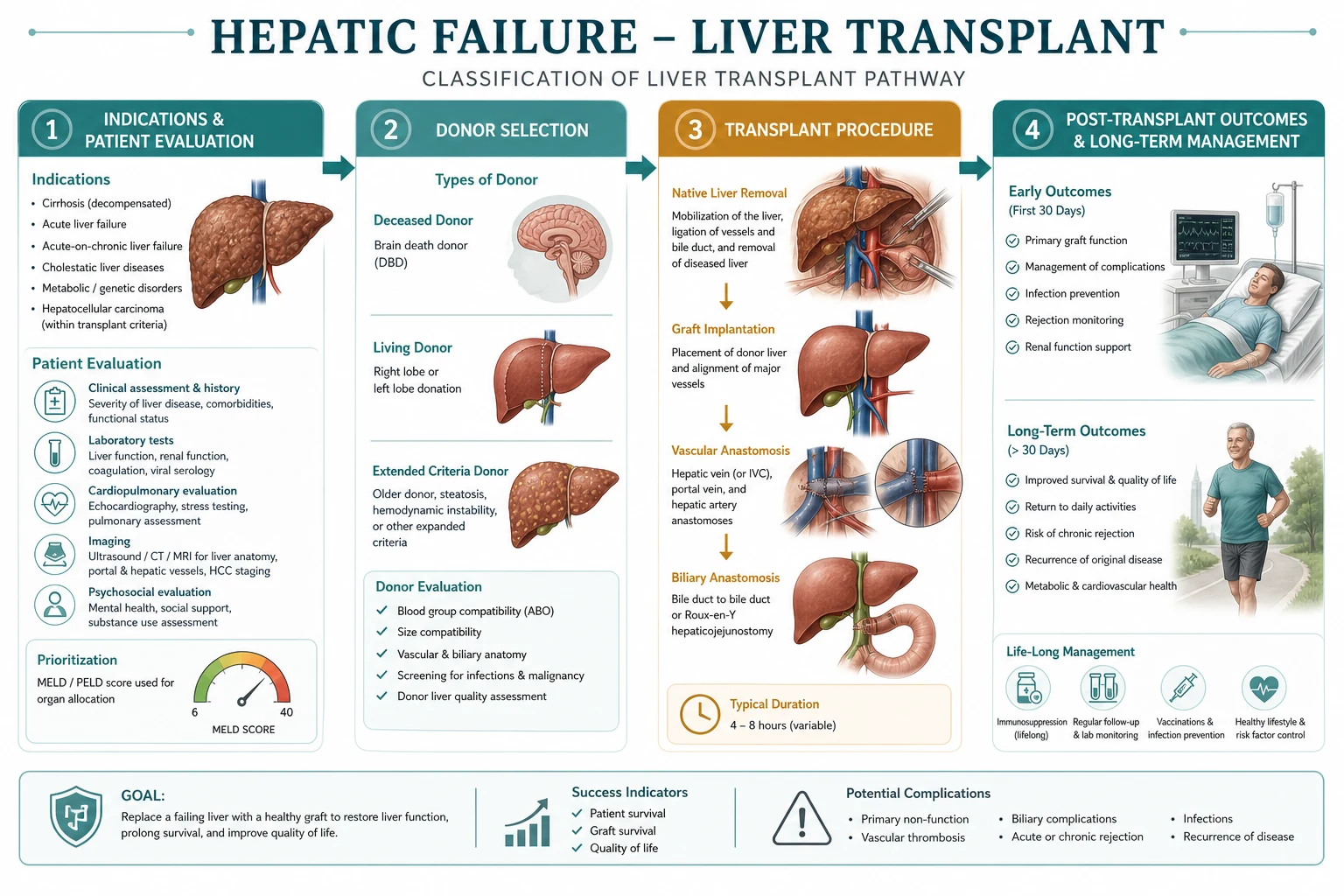
Original MELD used for end-stage liver disease survival prediction includes bilirubin, INR, and creatinine (with Na in MELD-Na variants). Higher MELD = higher wait-list mortality and generally higher perioperative risk for non-transplant surgery — use it as severity language, not a cancellation algorithm alone.[1]
Also know Child–Pugh (bilirubin, albumin, INR/PT, ascites, encephalopathy) as classic viva companion scoring. [1]
Coagulopathy — the modern viva
Cirrhosis often has rebalanced haemostasis: low procoagulant factors and low anticoagulant factors (protein C/S, antithrombin); thrombocytopenia with elevated vWF. INR reflects one side of the balance — it is a poor predictor of bleeding risk for many procedures and a terrible reason to dump FFP into a non-bleeding patient. [1]
When bleeding or for high-risk procedures: treat surgically, use viscoelastic testing where available, replace fibrinogen/platelets thoughtfully, correct calcium and temperature — principles shared with major haemorrhage guidance rather than INR cosmetics.[2][4]
Portal hypertensive bleeding is often vascular pressure and local factors, not “INR 1.8 needs four units of plasma”. [1]
Encephalopathy
Precipitants: infection, GI bleed, electrolytes, constipation, sedatives, alkalosis/hypokalaemia, TIPS. Minimise benzodiazepines; titrate opioids; prefer agents with cleaner offset when feasible. Protect airway early if grade high. [1]
Drug dosing principles
| Issue | Teaching |
|---|---|
| High CO / low albumin | Altered Vd and free fraction for some drugs |
| Reduced hepatic clearance | Prolonged effect of highly liver-metabolised agents |
| Opioids / benzos | Sensitive brain; start low, titrate |
| NMBA | Atracurium/cisatracurium attractive (Hofmann/ester); rocuronium may prolong; sux may prolong if low cholinesterase |
| Volatiles | Usable; maintain haemodynamics |
| Paracetamol | Caution in ALF/acute injury; chronic cirrhosis dosing per local guidance |
Liver transplant phases (high-level — examiners love the map)
- Dissection / pre-anhepatic: bleeding from portal hypertension collaterals; large-bore access; vasoactive readiness.
- Anhepatic: native liver out — no hepatic clearance; acidosis, hypocalcaemia (citrate if transfusing), haemodynamic swings; sometimes venovenous bypass/portocaval shunt strategies.
- Reperfusion: unclamping can cause profound vasoplegia, hyperkalaemia, bradycardia, acidosis, pulmonary hypertension — anticipate with calcium, vasopressors, electrolytes, communication before clamp release.
- Neohepatic: graft starts working — watch bile, lactate trend, glucose, coagulation evolution; surgical bleeding vs medical ooze. [1]
Massive transfusion principles apply when blood loss is extreme: balanced products, calcium, temperature, TXA where used by unit protocol — PROPPR-style ratio thinking is trauma-derived context for balanced resuscitation language.[4][2]
Non-transplant hepatic surgery / cirrhosis list cases
Cholecystectomy, hernia with ascites, trauma, emergency laparotomy for perforation/bleed: [1]
- Assess MELD/Child, ascites, encephalopathy, varices, renal function (HRS risk).
- Avoid elective surgery in decompensated cirrhosis when possible.
- Neuraxial only with careful coagulation/platelet judgement — not INR alone.
- RSI if tense ascites/full stomach risk.
- Haemodynamic: hyperdynamic baseline, low SVR — vasopressors common.
- Restrictive transfusion philosophy still relevant when not actively exsanguinating.[3]
Anaesthetic goals
- Correct classification (ALF vs cirrhosis).
- Protect brain in ALF.
- Smart coagulation management (bleed-directed).
- Titrate drugs; protect residual organ function.
- For transplant: phase-based haemodynamic and metabolic readiness.
- ICU plan for organ support and graft surveillance. [1]
Monitoring and equipment
Arterial line; large-bore access; central access for vasoactives; temperature; urine output; frequent ABG/electrolytes/glucose/lactate; point-of-care Hb and VET if available; rapid infuser for transplant/major bleed; cell salvage per unit policy; blood bank communication. [1]
Crisis pivots
Massive bleeding during dissection
Surgical control + balanced products + calcium + warm + VET; do not chase INR with endless plasma while ignoring platelets/fibrinogen/temperature.[2]
Reperfusion collapse
Pre-empt with team countdown; calcium ready; vasopressors; treat hyperkalaemia (calcium, insulin-glucose, hyperventilation, bicarbonate as context); support RV if pulmonary pressure surge; rarely return to bypass/support. [1]
Rising ICP concerns (ALF)
Optimise ventilation, head position, sedation, osmotherapy pathways with ICU — transplant may be definitive therapy. [1]
Hypoglycaemia
Impaired gluconeogenesis — check glucose frequently; treat promptly. [1]
Variceal bleed in PACU/ward
Resuscitate, airway protection, terlipressin/octreotide pathways per GI protocol, urgent endoscopy, balloon tamponade rare rescue. [1]
Postoperative / ICU
After non-transplant surgery: watch encephalopathy, ascites leak, renal function, infection, wound healing. After transplant: graft function (lactate clearance, glucose, bile, coags), bleeding, vessel patency (ultrasound), infection/immunosuppression, renal support, glucose control. [1]
SAQ answer scaffold
A 54-year-old with alcohol-related cirrhosis, MELD 22, for emergency laparotomy with peritonitis. Outline anaesthetic management. [1]
- Severity (2): MELD components, decompensation features.[1]
- Coagulation (3): rebalanced haemostasis; treat bleeding not cosmetic INR.
- Induction/drugs (3): RSI if indicated, titrate, avoid heavy benzos, NMBA choice.
- Intraop (3): haemodynamics, fluids, sepsis source control, glucose.
- Postop (2): ICU, renal/encephalopathy watch.
Viva stem bank and model phrases
Stem 1: “INR 2.1, not bleeding, needs central line — FFP first?”
Model: “Not routinely. Cirrhotic haemostasis is rebalanced; I assess platelets/fibrinogen/VET and procedure risk rather than automatic plasma for INR.” [1]
Stem 2: “MELD components?”
Model: “Bilirubin, INR, and creatinine — with sodium in MELD-Na variants.”[1]
Stem 3: “Reperfusion syndrome features?”
Model: “Vasoplegia, hyperkalaemia, acidosis, bradyarrhythmia, sometimes pulmonary hypertension — anticipate before unclamping.” [1]
Stem 4: “ALF grade IV encephalopathy priorities?”
Model: “Airway protection, neuroprotective ventilation and positioning, glucose, ICU, transplant pathway — think intracranial hypertension risk.” [1]
Stem 5: “Why atracurium?”
Model: “Organ-independent elimination pathways make it attractive when hepatic clearance is unpredictable.” [1]
Stem 6: “Massive bleed ratios?”
Model: “I use balanced product resuscitation and fix calcium/temperature; trauma ratio trials inform the language of balanced therapy.”[4]
Stem 7: “Transfuse to Hb 100 always?”
Model: “No — restrictive thresholds apply when bleeding is controlled; context matters.”[3]
Common traps
- Cosmetic FFP for INR in non-bleeders
- Treating ALF like stable cirrhosis
- Heavy premed benzos in encephalopathic patients
- No reperfusion plan
- Ignoring hypoglycaemia
- Neuraxial without thinking platelets/procedure risk
- Assuming all liver patients are auto-anticoagulated and never thrombotic [1]
Transplant phases — DARN
Portal hypertension practicalities for non-transplant lists
Assume varices if advanced cirrhosis until imaging says otherwise — prefer careful airway instrumentation, avoid unnecessary NG trauma, and have a massive bleed plan for unexpected variceal rupture. Ascites affects FRC, aspiration risk, and abdominal wall compliance; drain tense ascites pre-induction only when coordinated with the surgical plan and volume replacement thinking. Spontaneous bacterial peritonitis can present as decompensation — cultures and antibiotics early if suspected. [1]
Hyponatraemia and hepatorenal signals
Chronic hyponatraemia is common; avoid rapid overcorrection. Rising creatinine may signal hepatorenal physiology — maintain perfusion pressure, avoid nephrotoxins, involve hepatology/ICU early. These details separate list-safe cirrhosis care from transplant-centre theatre. [1]
Examiner mental map
- ALF vs cirrhosis.
- MELD components.
- Rebalanced haemostasis (no cosmetic FFP).
- Drug dosing.
- Transplant phases (DARN).
- ICU graft and organ support. [1]
That map carries both the list case and the transplant viva. [1]
References
- [1]Kamath PS, Wiesner RH, Malinchoc M, et al. A model to predict survival in patients with end-stage liver disease Hepatology, 2001.PMID 11172350
- [2]Spahn DR, Bouillon B, Cerny V, et al. The European guideline on management of major bleeding and coagulopathy following trauma: fifth edition Crit Care, 2019.PMID 30917843
- [3]Mazer CD, Whitlock RP, Fergusson DA, et al.; TRICS Investigators. Restrictive or Liberal Red-Cell Transfusion for Cardiac Surgery N Engl J Med, 2017.PMID 29130845
- [4]Holcomb JB, Tilley BC, Baraniuk S, et al.; PROPPR Study Group. Transfusion of plasma, platelets, and red blood cells in a 1:1:1 vs a 1:1:2 ratio and mortality in patients with severe trauma: the PROPPR randomized clinical trial JAMA, 2015.PMID 25647203