Anaes · Perioperative medicine
Perioperative management of pacemakers and ICDs
Also known as CIED perioperative management · Pacemaker magnet mode · ICD disable for surgery · DDD pacing anaesthesia · Electromagnetic interference pacemaker
Exam-exhaustive CIED perioperative care: NBG modes at high level, pacing dependence, magnet behaviour (pacemaker vs ICD), diathermy EMI mitigation, reprogramming indications, ICD therapy suspension, external defibrillation readiness, and post-op interrogation for ANZCA Final and equivalents.
On this page & tools
Your progress
Saved locally on this device.
Target exams
Red flags
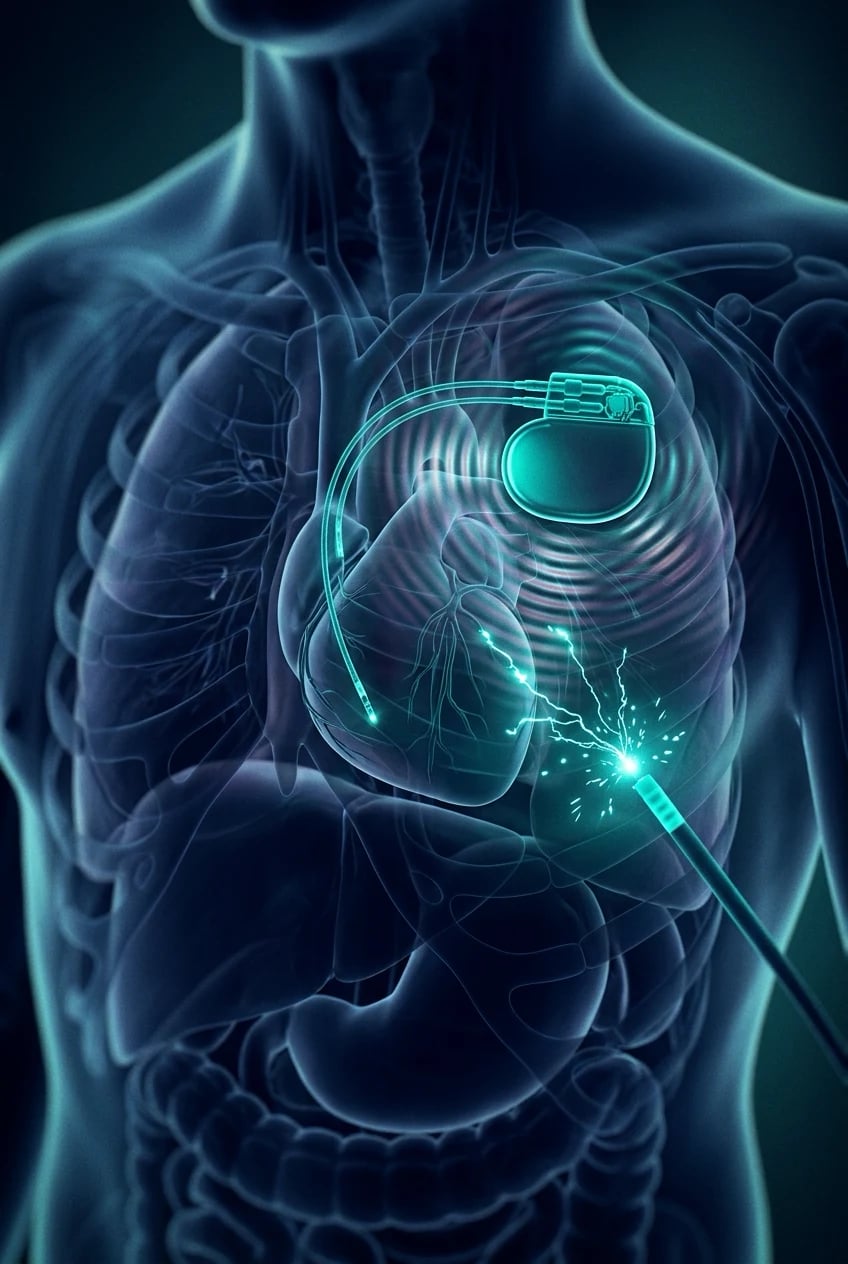
Why this is examined / the one-line answer
Almost every general list has a patient with a pacemaker or ICD. Examiners test whether you can decode the problem, not recite cardiology textbooks. The viva turns on four discriminators: what does the device do, is the patient pacing-dependent, what will diathermy do to it, and magnet versus reprogramming versus ICD therapy off.[1][2]
One-liner: I confirm device type and indication, assess pacing dependence, minimise EMI, use magnet or reprogramming as indicated, disable ICD shock therapies with external defibrillation ready, and restore/check the device after surgery. [1]
ASA 2020 Practice Advisory and HRS/ASA consensus provide the named frameworks examiners expect.[1][2]
Preoperative assessment and risk stratification
What you must know before induction
| Item | Why it changes the plan |
|---|---|
| Device type | Pacemaker only vs ICD (± pacing) vs CRT-P/CRT-D vs leadless/S-ICD |
| Indication | Sinus node disease, AV block, primary/secondary prevention SCD, heart failure |
| Manufacturer / model | Magnet response varies; interrogation software differs |
| Implant date and last check | Battery, lead thresholds, recent shocks |
| Pacing dependence | No reliable intrinsic rhythm → EMI inhibition is catastrophic |
| Rate-response sensors | EMI/vibration may drive inappropriate high-rate pacing |
| Special features | Minute ventilation sensors, antitachycardia pacing, subcutaneous ICD |
Pacing dependence (exam definition): absence of a reliable haemodynamically adequate intrinsic escape rhythm. Clues: underlying complete heart block, prior asystole when pacing suspended at clinic, 100% paced on ECG/device report, symptoms when rate falls. When unsure, treat as dependent until proven otherwise.[3]
Preoperative interrogation — when mandatory / strongly preferred
- Elective major surgery with significant EMI risk (monopolar above umbilicus, near generator)
- ICD patients when therapy will be suspended
- Unknown device function, recent shocks, battery alerts, or long interval since check
- Pacing-dependent patients
- Emergency: do not delay life-saving surgery for formal programming if magnet + pads + monitoring can temporise — document and arrange earliest interrogation.[1][2]
Ask the patient for their device card. If unavailable, CXR may show generator/leads; ECG may show pacing spikes. [1]
Investigations and optimisation
Recent electrolytes (especially K+ — hypo/hyperkalaemia alter capture thresholds), ECG, consider echo if heart failure/CRT, continue usual cardiac meds unless specific reason to hold. Document anticoagulation if recent lead revision (rare acute issue). [1]
Applied physiology / device logic (high-yield, not encyclopaedic)
NBG code — the letters you must decode
Pacemaker modes are classically three (or more) letters: [1]
- Chamber paced: O = none, A = atrium, V = ventricle, D = dual (A+V)
- Chamber sensed: O / A / V / D
- Response to sensing: O = none, T = triggered, I = inhibited, D = dual (triggered + inhibited)
- (Often) Rate modulation: R = rate-responsive
- (Sometimes) Multisite pacing [1]
Exam workhorses: [1]
| Mode | Plain-English | Perioperative note |
|---|---|---|
| DDD | Dual chamber pacing and sensing; tracks atrium, paces ventricle if needed | Common modern mode; EMI may inhibit or track noise |
| VVI | Ventricular demand pacing | Simple; EMI can inhibit → asystole if dependent |
| AAI | Atrial demand | Intact AV conduction assumed |
| DOO / VOO | Asynchronous dual/ventricular pacing | Magnet or programmed EMI-safe mode — no sensing of noise |
| DDDR / VVIR | Rate-responsive | Sensors may misread EMI/shivering as exercise |
You do not need every obscure code. You need: sensing can be fooled by EMI; asynchronous modes ignore EMI for pacing decisions; ICDs add a shock layer on top. [1]
EMI mechanisms (theatre focus)
Monopolar diathermy is the classic source. Noise may be sensed as: [1]
- Intrinsic QRS → pacing inhibition (dangerous if dependent)
- Tachyarrhythmia → ICD charge/shock (inappropriate)
- Rate-response drive → inappropriate tachycardia
- Rare: reset/reprogram, or power-on reset to backup mode [1]
Bipolar diathermy has a short current path and is preferred when surgically acceptable. Ultrasonic scalpels have lower EMI risk than monopolar RF but are not zero-risk.[2][3]
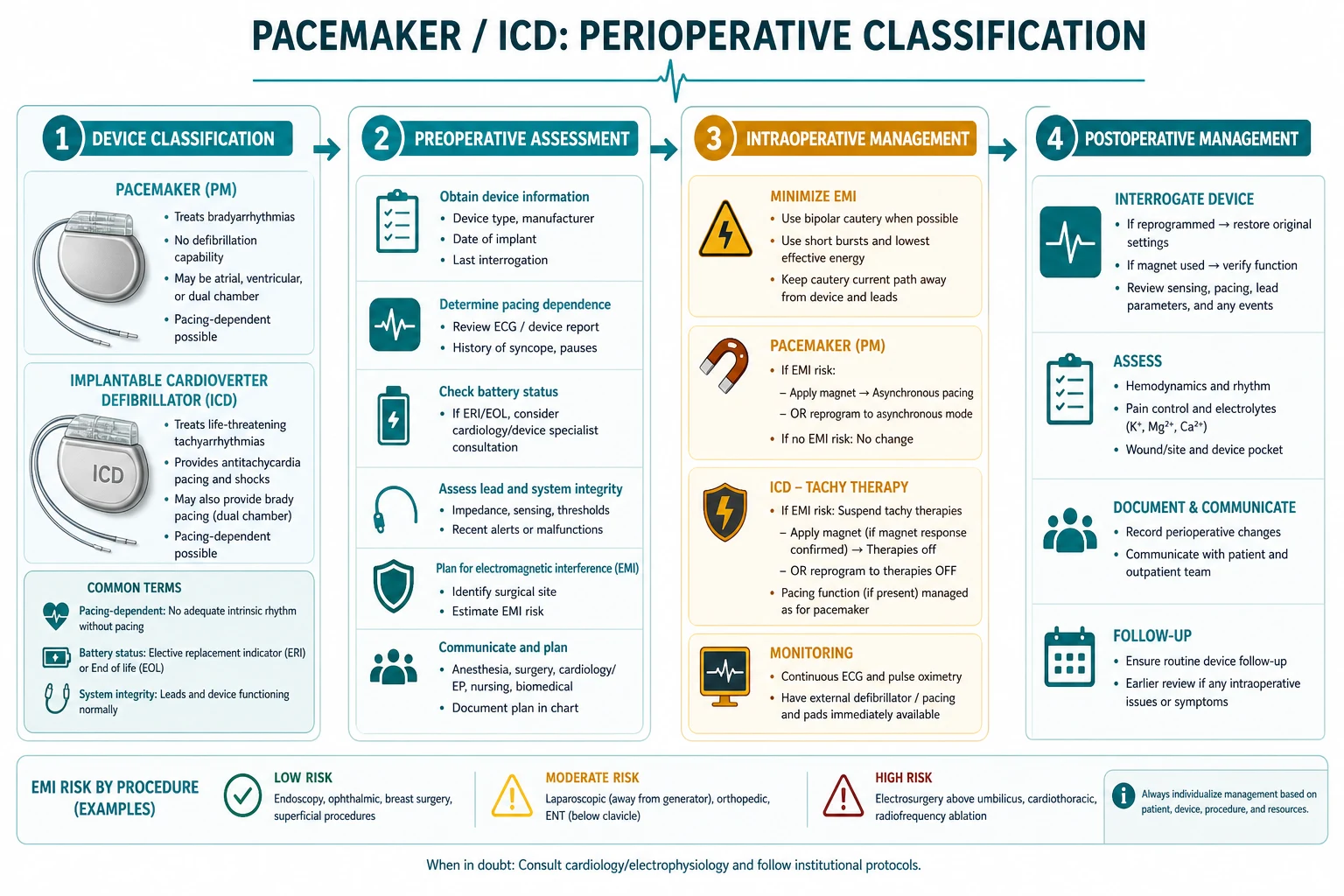
Anaesthetic goals
- Maintain capture and cardiac output — never leave a dependent patient without a pacing plan.
- Minimise EMI or make the device ignore it (asynchronous pacing / ICD therapy off).
- Keep external defibrillation/pacing immediately available when ICD therapies suspended.
- Avoid extremes of K+, acid–base, and ischaemia that raise capture threshold.
- Restore correct device function before unsupervised ward care. [1]
Technique options and decision matrix
Magnet vs reprogramming
Magnet teaching mantra: Pacemaker magnet → asynchronous pacing. ICD magnet → shock therapies off, pacing usually unchanged. Always state you will confirm magnet behaviour against manufacturer/device report because exceptions exist.[1][3]
When to reprogram (high-yield list)
- Pacing-dependent patient + monopolar EMI likely near generator/leads
- ICD + surgery with sustained EMI risk (suspend detection/therapies)
- Rate-response or minute-ventilation sensors that may malfunction with EMI/ventilation changes
- Unreliable magnet access (prone, generator site in field, sterile exclusion)
- Complex CRT or recent device issues [1]
Diathermy practical rules (say them cleanly)
- Prefer bipolar or ultrasonic where possible.
- If monopolar essential: place return pad so current path does not cross generator/heart (e.g. ipsilateral thigh for arm surgery away from generator path).
- Keep active electrode away from generator (classic teaching distance often quoted around 15 cm — state principle, not magic number alone).
- Short intermittent bursts (commonly taught <5 s), lowest effective power.
- Full monitoring; watch for missing paced beats or VT/VF alarms.
- Magnet immediately available; programmer if planned.[2][3]
ICD disable for surgery — the exam algorithm
- Confirm ICD (transvenous or S-ICD).
- Risk of EMI → suspend tachy therapies (reprogram preferred for planned major EMI; magnet if urgent/short).
- Apply external multifunction pads in axis that avoids generator when possible; connect to defibrillator.
- Continuous ECG (note: device magnet may alter pacing display).
- After surgery: re-enable therapies and document; interrogate if any concern.
- Until therapies restored, patient needs monitored environment with defibrillator access.[1][2]
Monitoring and equipment
- Standard ASA monitoring + attention to pulse oximeter / arterial waveform as mechanical pulse confirmation if ECG is noisy
- External pads on before incision when ICD therapies off or high EMI risk
- Magnet labelled and in theatre
- CIED team / cardiology contact number
- Emergency drugs for arrhythmia and support (adrenaline, amiodarone per ALS, isoprenaline rarely for brady if capture lost — but external pacing/defib first)
- Avoid placing central lines / subclavian wires blindly ipsilateral to fresh leads without indication awareness (lead injury risk) [1]
Intraoperative management
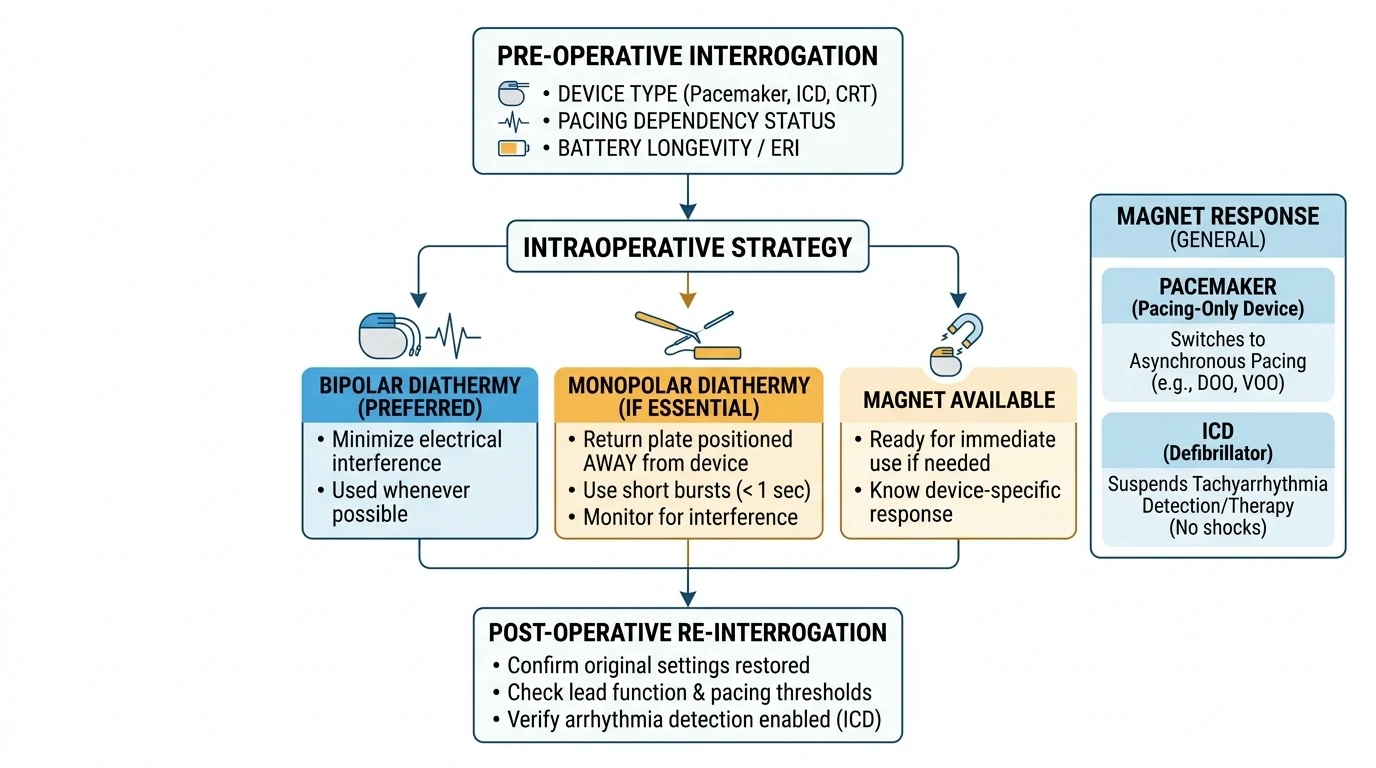
Induction: standard agents; avoid profound bradycardia/hypotension in low EF CRT patients. Succinylcholine fasciculations rarely discussed as EMI-like noise — usually not a practical issue with modern devices but beware in dependent patients if ECG noise appears. [1]
Maintenance: communicate with surgeon on diathermy timing. If inhibition occurs: stop diathermy, apply magnet (pacemaker), support circulation, call for help/programmer. [1]
Positioning: prone cases — magnet may not stay; prefer reprogramming. [1]
Lithotripsy / RF ablation / ECT / MRI: special protocols — generally disable ICD therapies, protect generator from shock wave focus, MRI only if conditional device + protocol (cross-link MRI topic). [1]
Crisis pivots
Asystole / severe bradycardia during diathermy
Stop EMI → 100% oxygen → magnet for pacemaker → external pacing/pads → CPR if needed → emergency reprogramming → correct reversible causes (K+, ischaemia, drugs). [1]
Inappropriate ICD shock under anaesthesia
Stop EMI → magnet to suspend further therapies if not already → treat any resultant arrhythmia → interrogate → continue only with therapies managed and pads on. [1]
Failure to capture
Check connections/ECG lead-off vs true failure; optimise electrolytes; increase external pacing output; urgent cardiology — possible lead issue or threshold rise. [1]
Power-on reset / unexpected mode
Assume backup mode (often VVI-like at fixed rate); arrange urgent interrogation; do not discharge to unmonitored ward. [1]
Postoperative / PACU plan
- Re-enable ICD therapies before leaving monitored care whenever suspended
- Re-interrogate after reprogramming, major EMI, shocks, or haemodynamic events
- Document mode, therapies status, and next cardiology follow-up
- Ward: continuous monitoring until device function confirmed if any doubt
- Analgesia standard; no special CIED interaction with most analgesics [1]
Special populations and devices
CRT-D: loss of LV pacing may drop output — haemodynamic vigilance. [1]
Leadless pacemaker: still EMI-aware; magnet/programmer specifics differ — check manufacturer pathway. [1]
S-ICD: no transvenous pacing (usually); magnet/therapy suspend still relevant for shocks; pads placement careful. [1]
Paediatric CIEDs: smaller generators, growth-related leads — same EMI principles, lower threshold for specialist involvement. [1]
Emergency surgery at night: magnet + pads + bipolar preference + earliest daytime interrogation is acceptable temporising strategy when programmer unavailable.[1]
SAQ answer scaffold
A 72-year-old with a dual-chamber pacemaker for complete heart block presents for laparoscopic hemicolectomy. How will you manage the CIED perioperatively? [1]
- Assess (3): device card/interrogation, pacing dependence (likely high), battery/leads, ECG.
- EMI plan (3): prefer bipolar; if monopolar, return pad path, short bursts, distance from generator.
- Device strategy (4): asynchronous pacing via magnet or reprogramming; rate-response off if programmed; continuous monitoring + external pads available.
- Post-op (2): restore original settings; re-interrogate; monitored recovery until safe.[1][2]
Viva stem bank and model phrases
Stem 1: “What does DDD mean?”
Model: “Dual chamber paced, dual chamber sensed, dual response — it paces and senses both atrium and ventricle with inhibition and tracking as programmed.” [1]
Stem 2: “Magnet on ICD?”
Model: “In most ICDs a magnet suspends tachyarrhythmia detection and therapies; it does not convert pacing to asynchronous mode the way a pacemaker magnet typically does.”[3]
Stem 3: “Patient is pacing-dependent — diathermy causes asystole.”
Model: “Stop diathermy, apply magnet for asynchronous pacing, external pace/defibrillate as needed, support ABC, arrange emergency programming.” [1]
Stem 4: “Surgery below the umbilicus — any issue?”
Model: “Lower EMI risk if current path remote, but monopolar can still affect devices; I still identify dependence and keep a magnet available.”[2]
Stem 5: “When must you reprogram?”
Model: “When magnet is impractical, when ICD therapies need reliable suspension for major EMI, when sensors are problematic, or when dependence plus high EMI risk demands a programmed asynchronous mode.” [1]
Stem 6: “Where do you put the diathermy plate?”
Model: “So the current path between active electrode and return pad does not cross the generator and heart.” [1]
Stem 7: “ICD therapies off — destination?”
Model: “Monitored bed with defibrillator until therapies re-enabled and device checked.” [1]
Common traps
- Treating ICD magnet like pacemaker magnet (assuming asynchronous pacing)
- Leaving ICD off on the ward
- No external pads when therapies suspended
- Long continuous monopolar bursts over the chest
- Ignoring pacing dependence
- Forgetting to restore settings after reprogramming
- Assuming “below umbilicus = no risk” without thinking [1]
CIED theatre brief — PACE
Examiner mental map
- Identify device and dependence.
- Predict EMI.
- Choose magnet vs reprogram.
- Protect ICD patient with therapy suspend + external defib.
- Mitigate diathermy.
- Restore and document.
Hit those six without waffle and you pass the CIED viva. [1]
References
- [1]American Society of Anesthesiologists Practice Advisory for the Perioperative Management of Patients with Cardiac Implantable Electronic Devices: Pacemakers and Implantable Cardioverter-Defibrillators 2020: An Updated Report by the American Society of Anesthesiologists Task Force on Perioperative Management of Patients with Cardiac Implantable Electronic Devices: Erratum Anesthesiology, 2020.PMID 32032098
- [2]Crossley GH, Poole JE, Rozner MA, et al. The Heart Rhythm Society (HRS)/American Society of Anesthesiologists (ASA) Expert Consensus Statement on the perioperative management of patients with implantable defibrillators, pacemakers and arrhythmia monitors: facilities and patient management this document was developed as a joint project with the American Society of Anesthesiologists (ASA), and in collaboration with the American Heart Association (AHA), and the Society of Thoracic Surgeons (STS) Heart Rhythm, 2011.PMID 21722856
- [3]Stone ME, Salter B, Fischer A Perioperative management of patients with cardiac implantable electronic devices Br J Anaesth, 2011.PMID 22156267