Anaes · Perioperative fluid & goal-directed therapy
Perioperative fluid & goal-directed therapy
Also known as Goal-directed therapy · GDT · Fluid responsiveness · Stroke volume optimisation · Restrictive fluid · Liberal fluid · Balanced crystalloid
Exam-exhaustive perioperative fluid: liberal vs restrictive vs GDT, crystalloid vs colloid at high level, vasopressor vs fluid for vasodilation, oliguria interpretation, dynamic indices, and RELIEF/OPTIMISE-level evidence framing.
On this page & tools
Your progress
Saved locally on this device.
Target exams
Red flags
Why this is examined / one-line answer
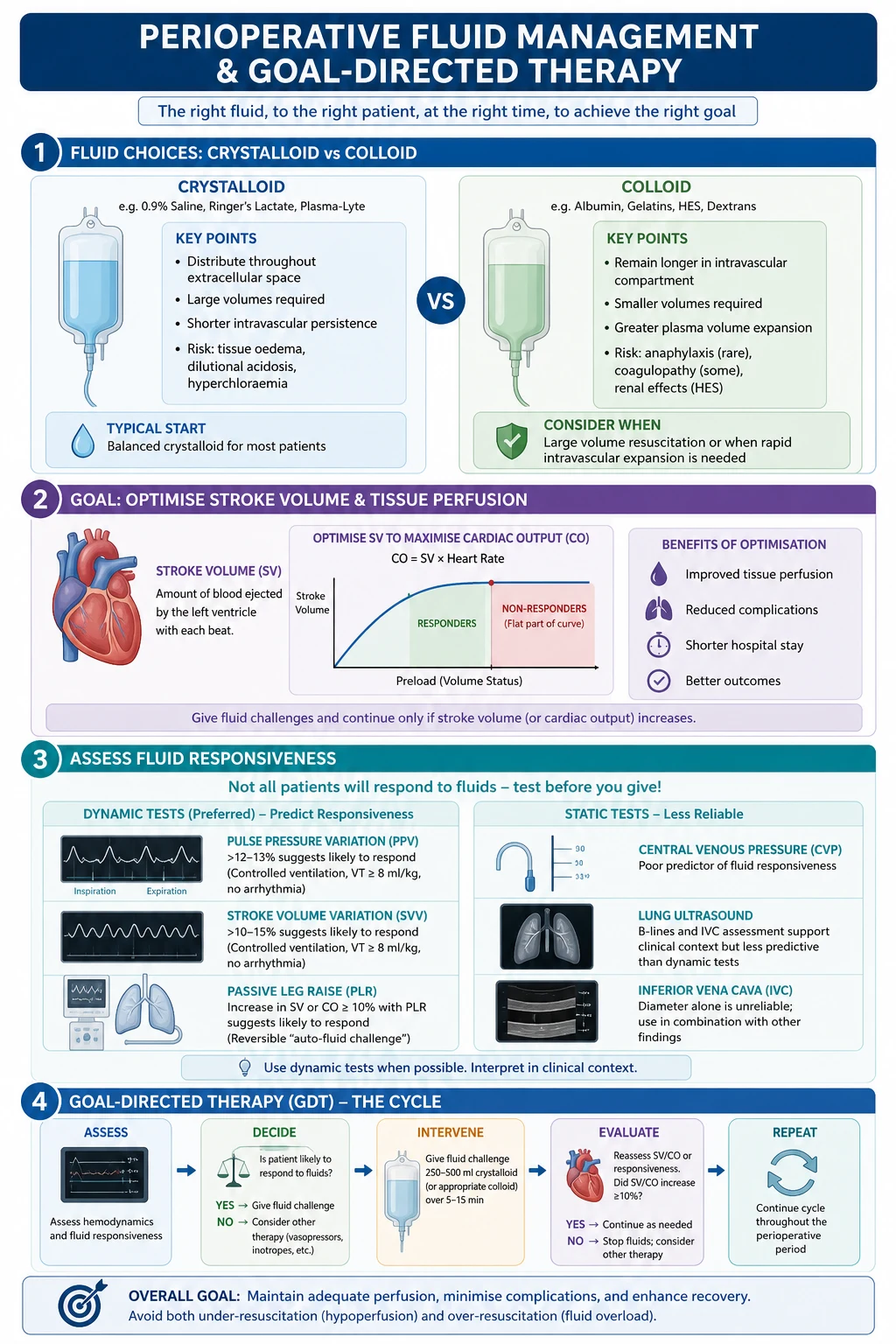
Fluid therapy is a decision science, not a default infusion rate. Examiners want you to contrast liberal vs restrictive vs GDT, know when fluid helps vs when vasopressors help, interpret oliguria, and cite major trials (RELIEF, OPTIMISE) without turning the viva into a statistics seminar. One-liner: I aim for euvolaemia with balanced crystalloid, test fluid responsiveness before stacking boluses, use vasopressors for anaesthetic vasodilation, and I never treat a urine bag in isolation. [1]
Physiology in one minute
- Total body water ~60% body weight; 2/3 intracellular, 1/3 extracellular (of which ~1/4 plasma, 3/4 interstitial).
- Crystalloid distributes across ECF — only a fraction remains intravascular after equilibration.
- Colloid stays intravascular longer (until glycocalyx injury/inflammation).
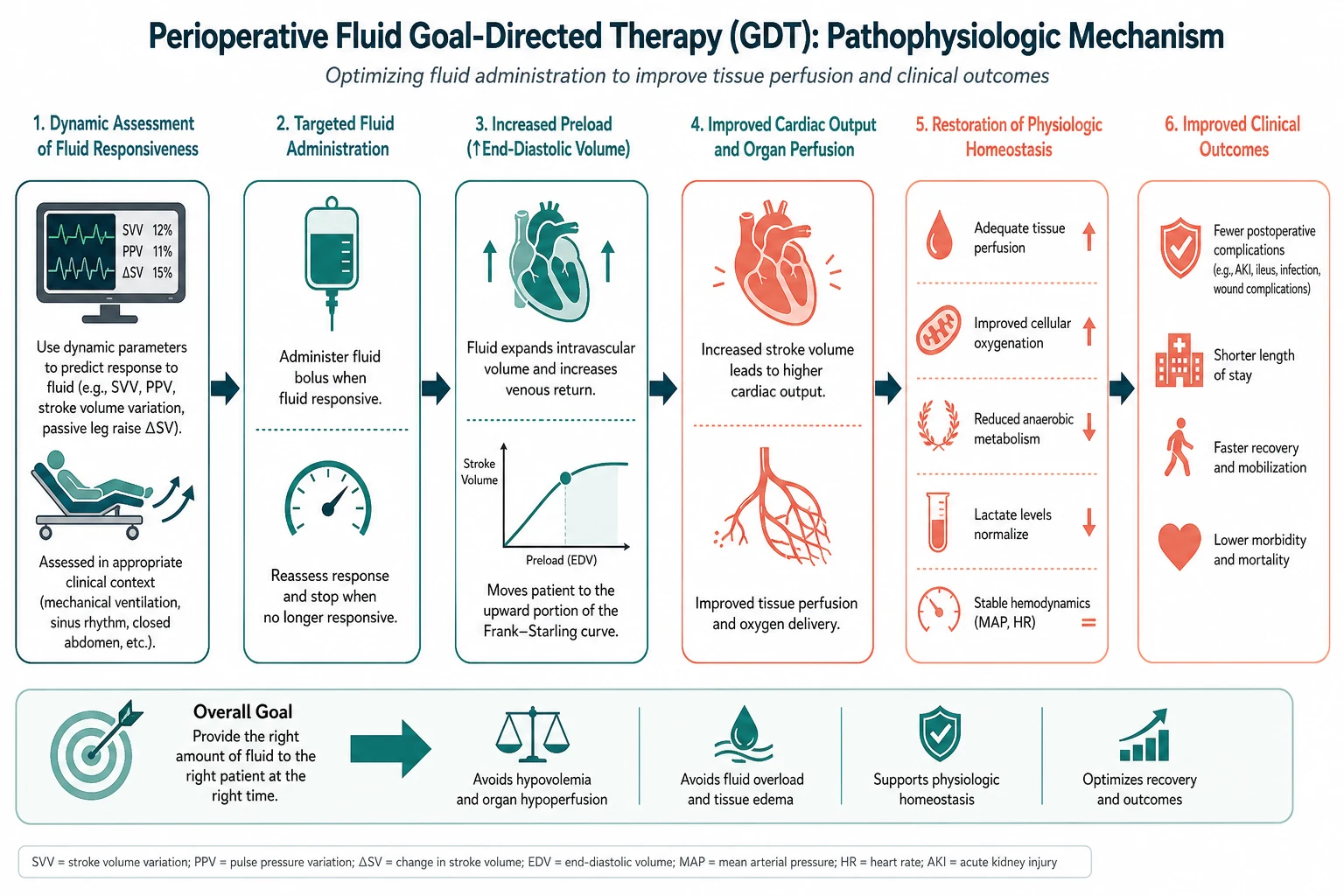
- Cardiac output depends on preload, contractility, afterload, rate/rhythm — fluid only helps if the ventricle is on the steep part of the Frank–Starling curve (fluid responsive).
- Anaesthesia (volatiles, neuraxial, propofol) causes veno-/vasodilation → BP falls with near-normal blood volume — vasopressors restore tone; blind fluid creates oedema. [1]
Three strategies (say the contrast cleanly)
1. Liberal fluid
Historic “replace fasting + third space + maintenance at 5–7+ mL/kg/h crystalloid.” Prevents occult hypovolaemia but risks interstitial oedema, gut oedema, delayed ileus, pulmonary oedema, and wound problems.
2. Restrictive / zero-balance (ERAS-aligned)
Limit crystalloid, replace only measured losses + modest maintenance (~1–3 mL/kg/h), accept vasopressors for tone. Reduces oedema; too restrictive risks hypovolaemia and AKI if blood loss/insensible losses underestimated. [1]
3. Goal-directed therapy (GDT)
Individualise: measure a flow variable (SV, SVI, CO), give small boluses while responsive, stop when no longer responsive, use inotropes/vasopressors for other phenotypes. Modern “personalised haemodynamics.”
RELIEF (major abdominal surgery): a restrictive regimen was not superior to a liberal regimen for disability-free survival; restrictive arm had more AKI — extreme restriction is not a free win.[1]
OPTIMISE: cardiac output–guided algorithm vs usual care in major GI surgery — signals toward fewer complications in meta-context; know that algorithm quality and compliance matter.[2]
Exam synthesis: avoid both drowning and drying; use GDT tools when available for high-risk major surgery; default ERAS euvolaemia with balanced crystalloid and early vasopressors for vasodilated states. [1]
Fluid responsiveness — how to decide on a bolus
Definition: ≥10% increase in stroke volume (or CO) after a small fluid challenge. [1]
| Tool | Idea | Caveats |
|---|---|---|
| PPV / SVV | Respiratory swing of pressure/SV on IPPV | Needs controlled ventilation, no spontaneous breaths, regular rhythm, adequate VT (~8 mL/kg ideal body weight classically), closed chest; open chest / laparoscopy limits validity |
| Passive leg raise | Auto-transfuse ~250–300 mL | Needs CO/SV monitor; hard mid-surgery |
| Fluid challenge | 250 mL crystalloid (or colloid) over ~5 min | Gold standard but commits volume |
| End-expiratory occlusion | 15 s hold → SV rise if responsive | Needs ventilator cooperation |
| Echo IVC / LV filling | Visual volume status | Operator-dependent; not binary alone |
| ETCO2 rise after challenge | Crude CO surrogate | Adjunct only |
GDT loop (stroke-volume optimisation):
- Measure baseline SV.
- Bolus ~250 mL balanced crystalloid (or colloid per unit protocol).
- If SV ↑ ≥10% → still responsive → consider further bolus.
- If SV ↑ <10% → stop fluid; reassess tone (vasopressor) and contractility (inotrope).
- Reassess after bleeding, position change, epidural top-up. [1]
Vasopressor vs fluid — the decision fork
| Picture | First move |
|---|---|
| Soft BP after induction, warm, flat arterial line but SV not responsive / PPV low | Vasopressor (e.g. metaraminol / phenylephrine / noradrenaline infusion) |
| Tachycardia, high PPV/SVV, bleeding, empty heart on TEE | Fluid / blood |
| Low CO, high lactate, volume replete, poor contractility | Inotrope ± expert help |
| Neuraxial sympathectomy | Vasopressor + modest fluid; not litres |
| Sepsis / SIRS | Often both: volume for true deficits + noradrenaline for tone |
Teaching agents (unit variation): metaraminol boluses common in ANZ/UK; phenylephrine common in US; noradrenaline infusion for ongoing vasoplegia; ephedrine if also bradycardic/low HR needed. [1]
Crystalloid vs colloid (high-level, examinable)
Crystalloids
| Fluid | Points |
|---|---|
| Balanced crystalloid (Hartmann’s / Plasma-Lyte / Ringer’s) | Preferred default; lower chloride load |
| 0.9% saline | [Cl−] 154 mmol/L → hyperchloraemic acidosis, association with AKI in large volumes — avoid as sole large-volume fluid |
| Dextrose solutions | Not for resuscitation; free water after glucose metabolism |
Colloids
| Fluid | Points |
|---|---|
| Hydroxyethyl starch (HES) | Not routine — AKI and bleeding signals in critically ill; restricted/banned contexts |
| Gelatin | Short intravascular effect; allergy risk; limited outcome data |
| Albumin 4–5% | Physiologic colloid; costly; selected use (liver, large drains) — not default for every GDT algorithm |
| Blood products | For oxygen carriage / clotting — not volume expanders of first resort when Hb adequate |
For most elective major surgery: balanced crystalloid first-line; blood for blood loss; vasopressors for tone. [1]
Maintenance, replacement, and blood loss
Conceptual prescription:
- Maintenance: low-rate balanced crystalloid (ERAS often 1–3 mL/kg/h when eating soon).
- Deficit: modern short fasting → small; do not “replace 8 hours NPO with 1 L automatically.”
- Ongoing losses: measured blood, urine, drains, evaporative (open abdomen).
- Third space: historically overestimated — avoid imaginary large third-space recipes.
- Blood: product ratios and Hb triggers per PBM / bleeding severity (see massive transfusion topic for trauma). [1]
Oliguria interpretation (classic trap)
Urine output <0.5 mL/kg/h is a sign, not a diagnosis. [1]
Differential:
- Hypovolaemia / low CO — fluid responsive? bleeding?
- Hypotension / high venous pressure — MAP inadequate for kidneys; venous congestion (RV failure, high PEEP, abdominal compartment).
- ADH response to stress/pain/nausea — oliguria with normal volume.
- Anaesthetics / opioids / NSAIDs / ACEI effects.
- Blocked catheter — examine first.
- Established AKI — fluid will not fix tubular injury and may harm. [1]
Approach: ABC and volume status first → assess responsiveness → optimise MAP (often ≥65 mmHg, higher if chronic HTN) → check catheter → avoid fluid stacking if overloaded → consider advanced haemodynamics / ICU if major surgery and rising lactate/creatinine. [1]
Monitoring toolbox
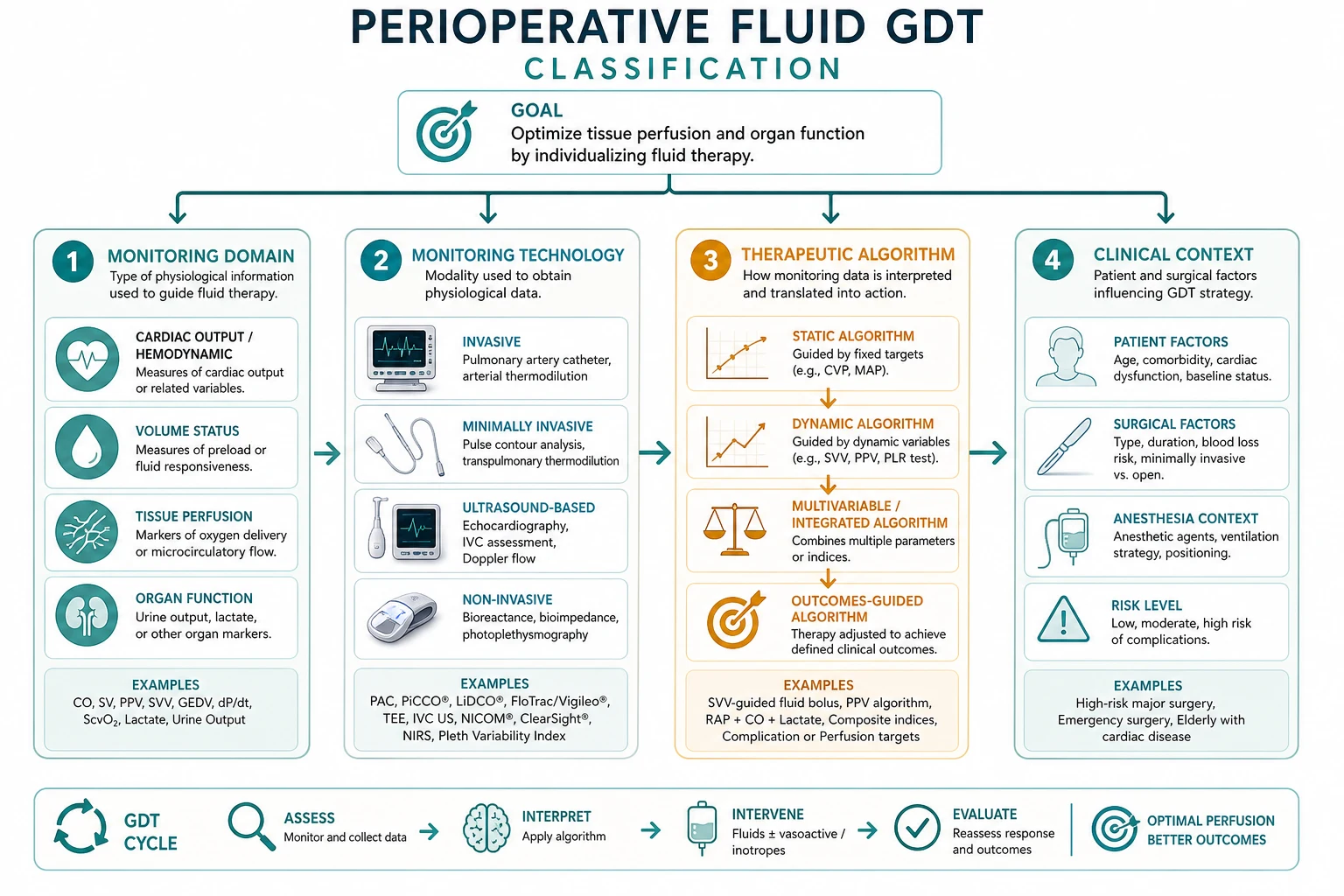
- Basic: HR, NIBP/art line, SpO2, ETCO2, urine, lactate, base deficit.
- Arterial line: waveform, beat-to-beat BP, sampling, PPV if conditions met.
- Flow monitors: pulse contour (calibrated/uncalibrated), oesophageal Doppler, bioreactance — know limitations.
- Echo/TOE: structure and volume.
- Clinical: capillary refill, surgical field ooze, drain output — still count. [1]
Special contexts
- ERAS colorectal: near-zero balance, early oral intake, vasopressors acceptable.
- Emergency laparotomy / sepsis: more volume initially, then de-escalate; source control.
- Cardiac failure: tight fluid, inotropes/vasodilators per phenotype.
- Neurosurgery: avoid hypo-osmolar free water excess; isotonic fluids.
- Paediatrics: weight-based; avoid hyponatraemic hypotonic maintenance (use isotonic maintenance per modern guidance).
- Day-case: minimal fluid; encourage early oral intake. [1]
SAQ scaffold
- Define fluid responsiveness and one dynamic index with caveats (3)
- Liberal vs restrictive vs GDT (3)
- RELIEF headline result (2)
- Crystalloid choice and HES stance (2)
- Oliguria differential and approach (3)
- Vasopressor vs fluid decision (2) [1]
Viva stems
“BP 80/40 after propofol — next fluid?” — often vasopressor first if no bleeding.
“PPV 18% during laparotomy.” — likely responsive if validity criteria met → bolus and reassess.
“Urine 10 mL in 2 hours.” — catheter, volume, MAP, not automatic litre.
“Why not HES?” — AKI/bleeding evidence; crystalloid first.
“What did RELIEF show?” — restrictive not better; more AKI when too dry. [1]
Common traps
- Treating MAP with fluid only under GA.
- Believing PPV in AF or spontaneous breathing.
- Chasing 1 mL/kg/h urine with litres in a euvolaemic stressed patient.
- Saline mega-litres → hyperchloraemic acidosis.
- Ignoring ongoing surgical bleeding while “GDT-ing” crystalloid. [1]
BOLUS check
Liberal
- High mL/kg/h
- Less occult hypovolaemia
- Oedema risk
- Ileus / lungs
Restrictive
- Near-zero balance
- Less oedema
- AKI if too dry
- RELIEF caution
GDT
- SV-guided boluses
- Stop when unresponsive
- Vasopressor/inotrope phenotypes
- High-risk major surgery
Red flags
[1] [1] [1] [1]References
- [1]Myles PS, Bellomo R, Corcoran T, et al. Burosumab Therapy in Children with X-Linked Hypophosphatemia N Engl J Med, 2018.PMID 29791829
- [2]Pearse RM, Harrison DA, MacDonald N, et al. Peri-operative complications in pediatric and adolescent shoulder arthroscopy J Child Orthop, 2014.PMID 24880815
- [3]Older PO, Levett DZH. Cardiopulmonary Exercise Testing and Surgery Ann Am Thorac Soc, 2017.PMID 28511024