Anaes · Preoperative assessment & risk
Preoperative assessment and risk stratification
Also known as Preoperative assessment · ASA-PS · METs · RCRI · Revised cardiac risk index · CPET · Shared decision-making
Exam-exhaustive preoperative assessment: functional capacity in METs, exact ASA-PS classes, RCRI six predictors with risk steps, when to order tests, shared decision-making for high-risk surgery, and day-of-surgery cancel thresholds.
On this page & tools
Your progress
Saved locally on this device.
8 MCQs with explanations
Target exams
Red flags
Why this is examined / one-line answer
Preoperative assessment is the intellectual backbone of safe anaesthesia. Examiners want structure (not a rambling history), exact ASA-PS wording, MET thresholds, the six RCRI predictors, a rule for when tests change care, and the courage to cancel or escalate when risk is uncontrolled. One-liner: I triage urgency, exclude active cardiac conditions, estimate METs and RCRI, optimise what is modifiable, order only decision-changing tests, and agree a plan including critical care and what would stop us tomorrow morning. [1]
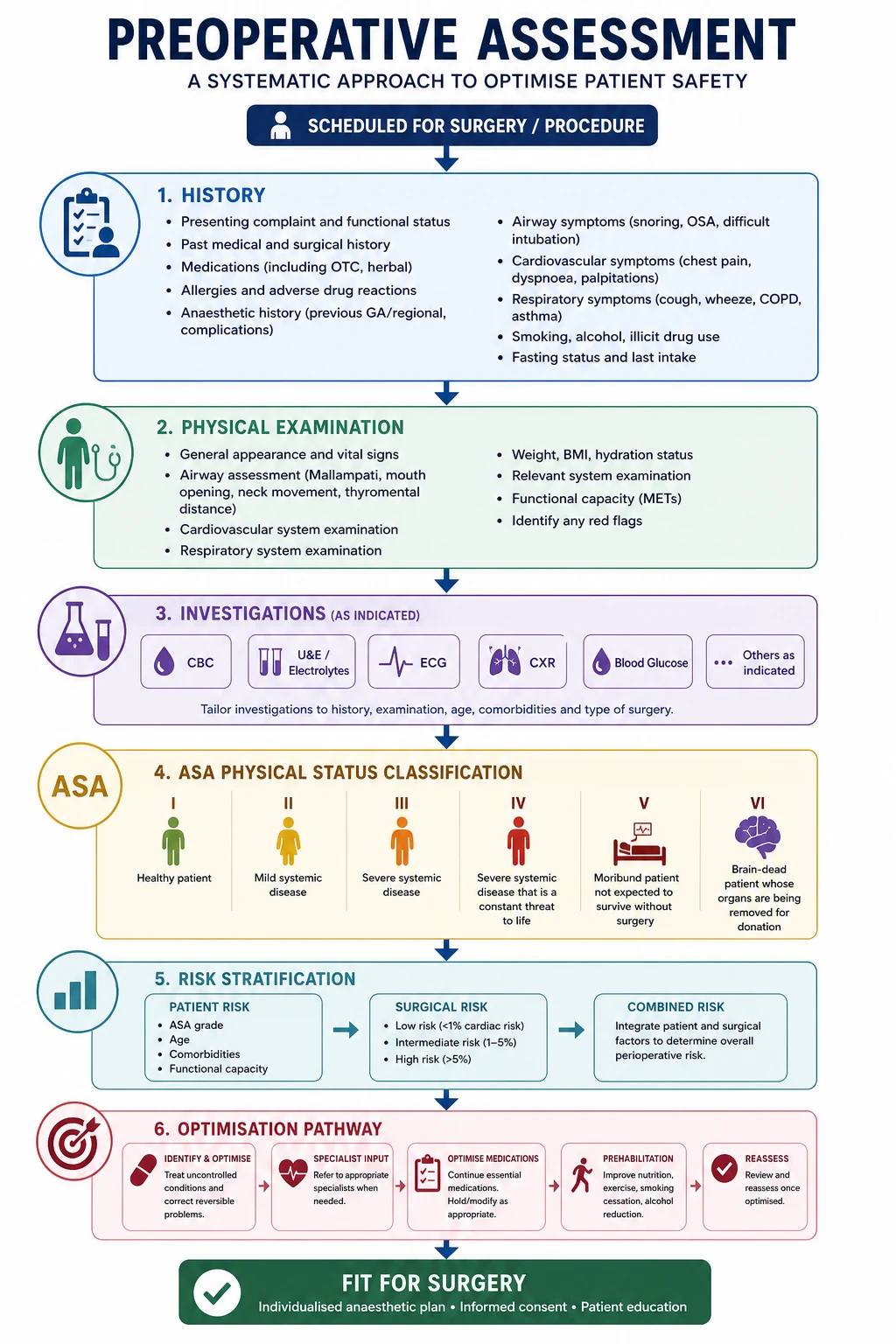
Purpose of the preoperative visit
- Identify disease, airway risk, medications, allergies, prior anaesthetic events.
- Stratify cardiac, respiratory, and overall risk proportionate to surgery.
- Optimise anaemia, diabetes, smoking, heart failure, infection, nutrition.
- Plan technique, monitoring, blood, ICU, analgesia, VTE, PONV.
- Consent with individualised risk discussion and alternatives (including non-operative care).
- Document and communicate to the day-of team. [1]
Proportionate assessment: minor low-risk procedures in fit patients need focused evaluation, not a CPET. [1]
Urgency first (ESC/ESA spirit)
| Category | Approach |
|---|---|
| Emergency (life/limb minutes–hours) | Proceed; limited assessment; resuscitate in parallel |
| Urgent (days) | Focused optimisation if time (e.g. potassium, anticoagulation plan) |
| Time-sensitive elective (cancer, progressive disease) | Balance delay risk vs optimisation gain |
| Elective pure | Full pathway; postpone for active conditions |
Never delay catastrophic bleeding for an echocardiogram that will not change immediate management.[2]
ASA Physical Status — exact classes (say them cleanly)
| ASA | Definition (classic teaching) | Examples |
|---|---|---|
| I | Normal healthy patient | Fit, non-smoker, minimal alcohol |
| II | Mild systemic disease | Controlled HTN/DM, mild obesity, smoker, pregnancy |
| III | Severe systemic disease | Poorly controlled DM/HTN, COPD, ESRD on dialysis, prior MI, morbid obesity |
| IV | Severe systemic disease that is a constant threat to life | Recent MI, ongoing cardiac ischaemia, severe valve disease, sepsis, DIC |
| V | Moribund; not expected to survive without operation | Ruptured AAA with shock, massive trauma |
| VI | Declared brain-dead organ donor | Organ procurement |
| E | Emergency modifier | Append to any class (e.g. IIIE) |
ASA is not a cardiac risk score alone and is subjective — use it with METs/RCRI, not instead of them. [1]
Functional capacity — METs
1 MET ≈ resting oxygen consumption (~3.5 mL O2/kg/min). [1]
| Activity | Approx METs |
|---|---|
| Resting / eating | 1 |
| Walk on level ground 2–3 mph | 2–3 |
| Climb one flight of stairs / walk uphill / heavy housework | ~4 |
| Run short distance / moderate recreation | ≥6–7 |
| Strenuous sports | ≥10 |
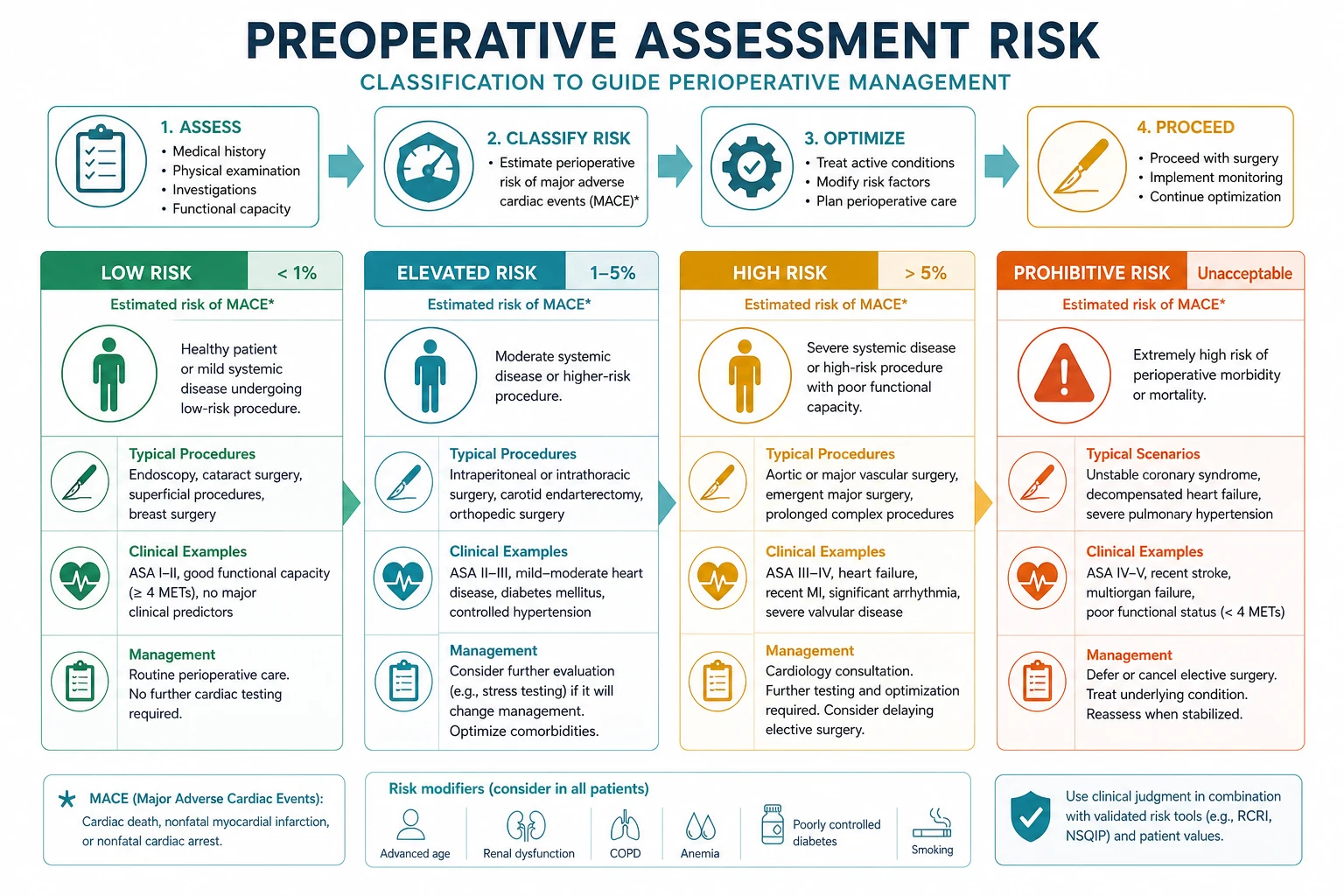
Poor functional capacity: <4 METs (cannot climb a flight of stairs without stopping) — higher perioperative risk; for intermediate/high-risk surgery consider further evaluation (echo, stress test, CPET, cardiology) depending on urgency and whether results change care.[2]
Good capacity (≥4 METs) without active cardiac conditions often allows major surgery without further non-invasive testing. [1]
Use the Duke Activity Status Index (DASI) where available — more reproducible than a single question. [1]
Revised Cardiac Risk Index (Lee) — six predictors
Independent predictors of major cardiac complications after major noncardiac surgery:[1]
- High-risk surgery — intraperitoneal, intrathoracic, or suprainguinal vascular
- Ischaemic heart disease — history of MI, positive exercise test, current angina, nitrate use, Q waves
- History of congestive heart failure
- History of cerebrovascular disease — stroke or TIA
- Diabetes mellitus treated with insulin
- Preoperative creatinine >177 µmol/L (2.0 mg/dL) [1]
| Number of predictors | Approx major cardiac event risk |
|---|---|
| 0 | ~0.4% |
| 1 | ~0.9–1% |
| 2 | ~7% |
| ≥3 | ~11% |
RCRI underestimates some modern populations and does not replace clinical judgement, but it is the bedside score examiners expect by name.[1]
Structured cardiac pathway (decision forks)
- Emergency? → proceed.
- Active cardiac condition? → evaluate/postpone elective (unstable coronary syndromes, decompensated HF, significant arrhythmia, severe symptomatic valvular disease).[2]
- Low-risk surgery? → proceed without further testing in most cases.
- METs ≥4 and no active conditions? → generally proceed; continue beta-blockers/statins as indicated.
- METs <4 or unknown + elevated RCRI / high-risk surgery? → consider non-invasive testing only if it will change management (revascularisation rarely indicated solely to “get through surgery”; may change monitoring, technique, ICU plan, or decision to operate).
- Shared decision with patient and surgeon when residual risk is high.
When to order tests
| Test | When useful | When not |
|---|---|---|
| FBC | Major surgery, anaemia symptoms, bleeding risk, chronic disease | Healthy minor day-case often not needed |
| U&E | Diuretics, ACEI/ARB, CKD, major surgery, age/context | Not universal for all lists |
| ECG | Cardiac history, risk factors, major surgery, age per local protocol | Not for all young ASA I minor cases |
| CXR | Acute respiratory symptoms, heart failure signs | Not routine screening |
| Echo | Murmur + symptoms, known/suspected significant valve/HF, unexplained dyspnoea | Asymptomatic with good METs before low-risk surgery |
| Stress testing | High surgical risk + poor capacity + it will alter care | Delay without pathway |
| CPET | Major elective (e.g. AAA, major abdo, complex cancer) for risk/ICU triage | Not for minor surgery |
| HbA1c | Known/suspected diabetes before elective major surgery | — |
| Coagulation | Bleeding history, liver disease, anticoagulants, neuraxial planned | Not routine in healthy patients |
CPET numbers (high yield)
- Anaerobic threshold (AT) <11 mL/kg/min — high-risk cohort for major surgery.
- Peak VO2 <15 mL/kg/min — elevated risk.
- Use to plan critical care, prehabilitation, and shared decisions — not as a single go/no-go robot.[3]
Airway, aspiration, and medication review
- Airway: Mallampati, mouth opening, thyromental distance, neck movement, dentition, prior difficult airway letter, OSA.
- Aspiration risk: reflux, pregnancy, obstruction, delayed gastric emptying — RSI/antacid plan.
- Fasting: typically 2 h clears, 6 h solids (unit protocols; paediatric milk rules differ).
- Medications:
- Continue most beta-blockers, statins, anticonvulsants, antiparkinson drugs, immunosuppressants as advised.
- ACEI/ARB: many units hold morning of major surgery (hypotension risk) — follow local ERAS protocol.
- Anticoagulants/antiplatelets: procedure-specific bleeding vs thrombosis risk; ASRA timing if neuraxial.
- SGLT2 inhibitors: hold per local guidance (euglycaemic DKA risk).
- GLP-1 agonists: aspiration risk discussion — evolving guidance.
- Herbal medicines: often stop 1–2 weeks pre-op when elective. [1]
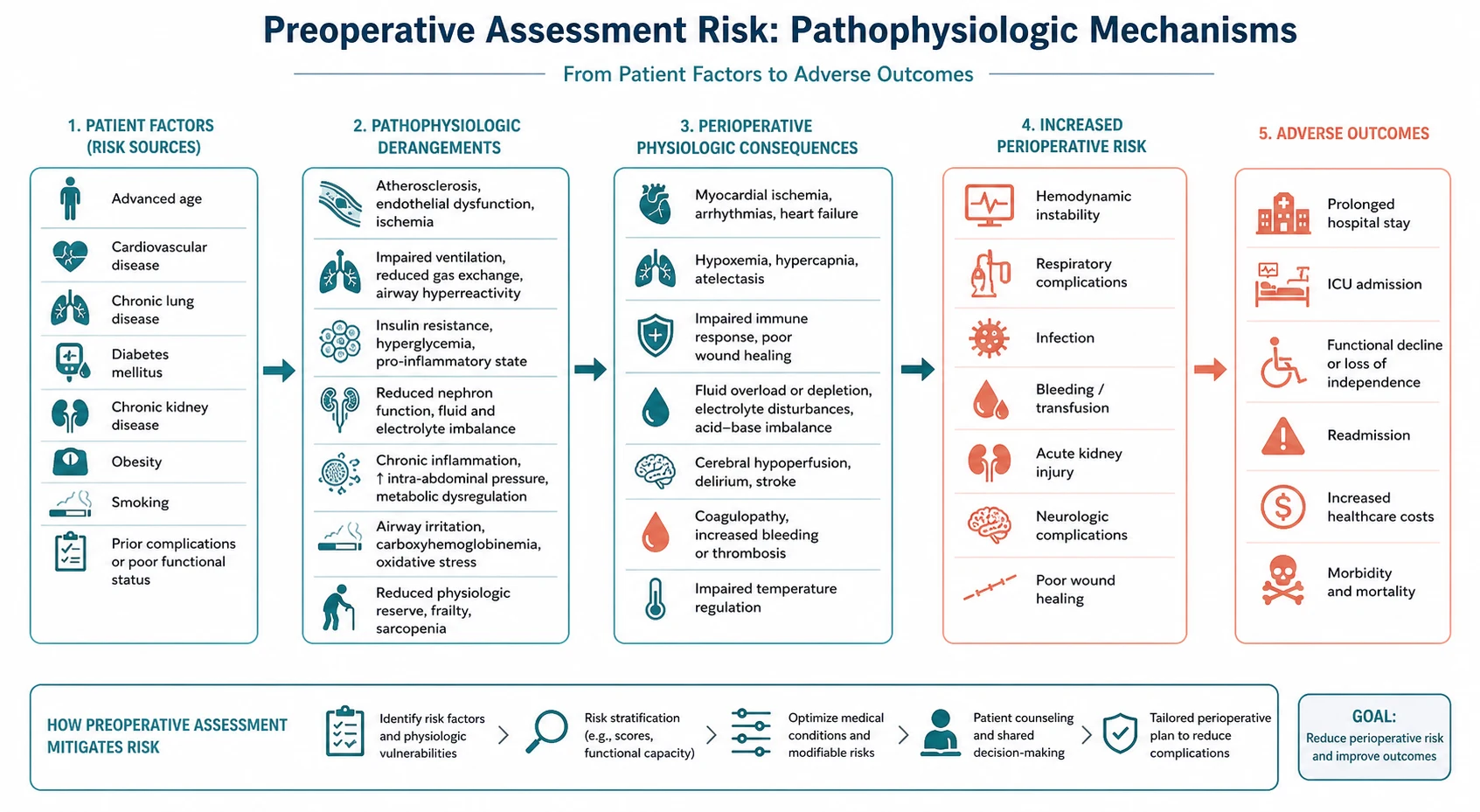
Optimisation targets (modifiable risk)
- Anaemia: investigate iron deficiency; IV/oral iron weeks before elective major surgery (PBM).
- Diabetes: elective targets often HbA1c <69 mmol/mol (8.5%) in many UK/ANZ pathways — balance against cancer delay.
- Smoking: cessation ≥4 weeks ideal for wound/respiratory benefit.
- Heart failure / CAD: optimise volume status, ischaemia work-up if active symptoms.
- OSA: CPAP compliance, opioid-sparing plan, overnight monitoring if inpatient.
- Frailty: Comprehensive Geriatric Assessment; shared decision on benefit vs burden.
- Nutrition / prehabilitation: protein, exercise programmes before major elective. [1]
Shared decision-making for high-risk surgery
High-risk = poor METs + high RCRI + major surgery, AT <11, ASA IV, frailty, or limited life expectancy. [1]
Discuss explicitly:
- Absolute risks in plain language (cardiac event, death, prolonged ventilation, dialysis, dependence).
- Alternatives: less invasive surgery, embolisation, medical management, palliative pathways.
- What “success” means to the patient (time at home, cognition, independence).
- Ceiling of treatment / ICU willingness.
- Document MDT discussion when relevant (high-risk anaesthetic clinic). [1]
Day-of-surgery cancel / postpone thresholds
Strong reasons to postpone elective surgery:
- Acute coronary syndrome, decompensated heart failure, uncontrolled tachyarrhythmia.
- Acute severe respiratory infection with systemic features (context-dependent for minor cases).
- Uncontrolled hyperglycaemia with ketosis / hyperosmolar state.
- New neurological deficit needing work-up.
- Inadequate fasting for GA without urgent indication.
- Anticoagulation not managed for high-bleed or neuraxial procedures.
- Missing critical information (e.g. unknown severe aortic stenosis murmur + poor capacity + major case).
- No escort for planned day-case GA pathway. [1]
Usually not cancel alone: mild isolated hypertension if no end-organ crisis; anxiety; late arrival without clinical risk (process issue). Severe asymptomatic hypertension management is unit-specific — treat and proceed vs delay for very high readings with end-organ concern. [1]
Communicate early with surgeon and patient; convert to inpatient or alternative technique when that is safer than cancel. [1]
SAQ scaffold
- List six RCRI predictors and risks at 0 vs ≥3 (4)
- Define METs and 4-MET threshold activities (2)
- ASA III vs IV with examples (2)
- When to order echo/CPET (3)
- Day-of cancel criteria (3) [1]
Viva stems
“Patient cannot climb stairs before colectomy.” — <4 METs; review RCRI; consider echo/CPET; ICU plan; shared decision.
“What is RCRI?” — six predictors, % risks.
“Does everyone need bloods?” — no; proportionate.
“HbA1c 10% for elective knee.” — optimise if pure elective; balance.
“New murmur, breathless, AAA repair.” — active valve/HF work-up before elective. [1]
Common traps
- Ordering a battery of tests that never get reviewed.
- Using ASA as the only risk tool.
- Forgetting insulin-treated diabetes and creatinine in RCRI.
- Cancelling for mild issues while missing true active cardiac disease.
- No airway plan documented.
- Consent as a signature, not a conversation. [1]
PREOP risk
Bedside tools
- ASA-PS
- METs / DASI
- RCRI
- Airway exam
Advanced tools
- Echo
- Stress test
- CPET
- Cardiology MDT
Stop elective
- Unstable ACS/HF
- Severe untreated valve disease
- Acute major medical illness
- Unsafe social/day-case factors
Red flags
[1] [1] [1] [1]References
- [1]Lee TH, Marcantonio ER, Mangione CM, et al. Derivation and prospective validation of a simple index for prediction of cardiac risk of major noncardiac surgery Circulation, 1999.PMID 10477528
- [2]Kristensen SD, Knuuti J, Saraste A, et al. 2014 ESC/ESA guidelines on noncardiac surgery: Cardiovascular assessment and management : Are the differences clinically relevant? The European perspective J Nucl Cardiol, 2017.PMID 27538569
- [3]Older PO, Levett DZH. Cardiopulmonary Exercise Testing and Surgery Ann Am Thorac Soc, 2017.PMID 28511024