Anaes · Perioperative medicine
Anaesthesia for renal failure and dialysis
Also known as ESKD anaesthesia · CKD perioperative management · Haemodialysis and surgery · AV fistula precautions anaesthesia · Hyperkalaemia perioperative
Exam-exhaustive anaesthesia for CKD and dialysis: potassium and fluid strategy, dialysis timing, renally adjusted drug dosing, AV fistula protection, uraemic bleeding, haemodynamic goals, and hyperkalaemia crisis management for ANZCA Final and equivalents.
On this page & tools
Your progress
Saved locally on this device.
Target exams
Red flags

Why this is examined / the one-line answer
CKD and dialysis patients appear on every list: vascular access surgery, transplant, orthopaedics, emergency laparotomy. Examiners want a practical plan: potassium, volume, drugs, fistula, and when to dialyse — not a lecture on nephron segments.[1][2]
One-liner: I define residual function vs dialysis dependence, check recent K+ and volume status, time dialysis appropriately, protect AV access, adjust drug choice and doses, avoid further kidney hits when residual function matters, and plan post-op monitoring and dialysis. [1]
Preoperative assessment and risk stratification
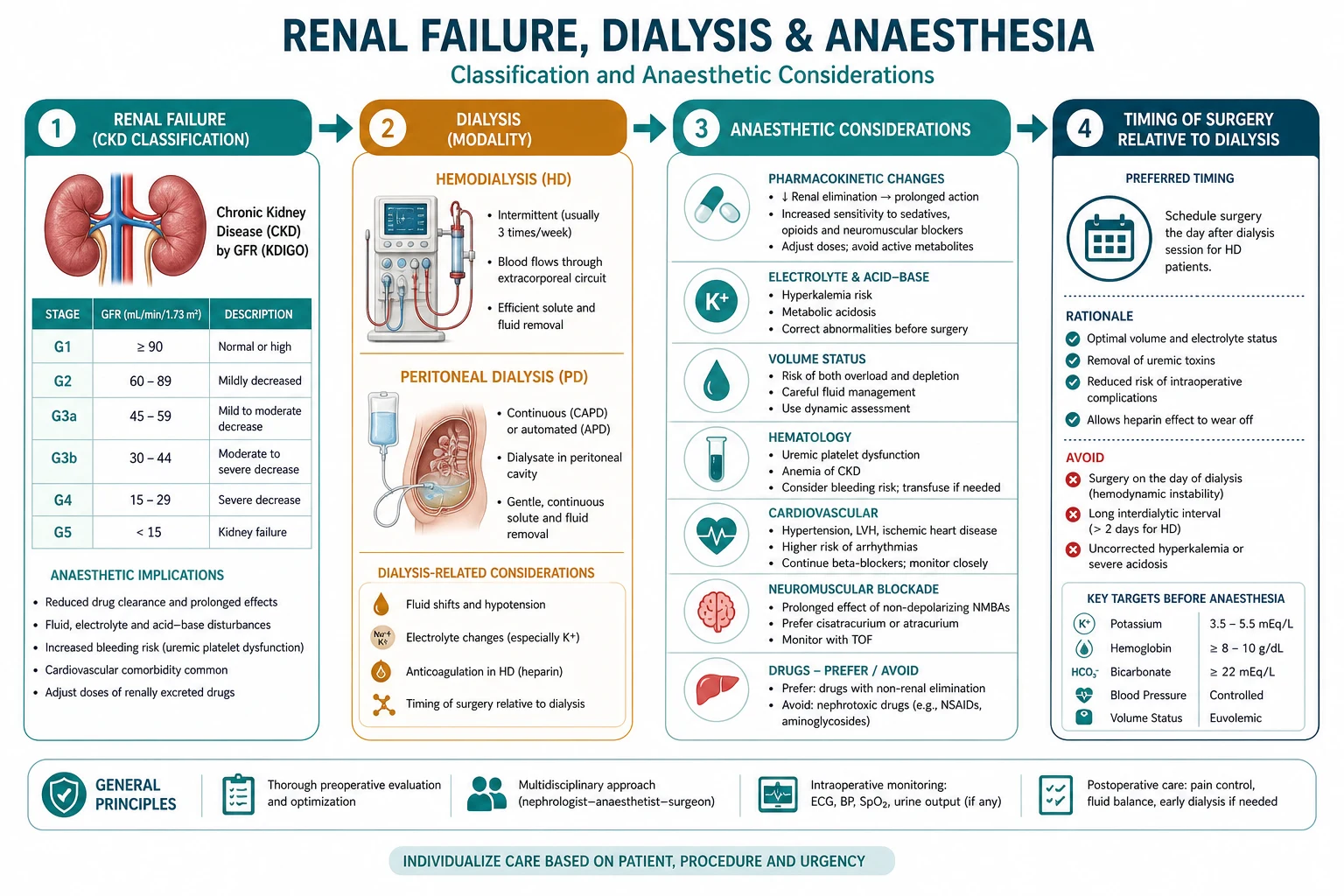
Classify the problem
| Category | Anaesthetic focus |
|---|---|
| CKD G3–G4 (not on dialysis) | Preserve residual GFR; avoid nephrotoxins; dose adjust; PO-AKI risk high |
| ESKD on haemodialysis | K+, volume, access protection, drug clearance zero for many agents |
| Peritoneal dialysis | Dry abdomen timing for laparoscopy/abdominal surgery; PD prescription with nephrology |
| Transplant (functioning) | Treat as CKD on immunosuppression — infection, drug interactions, protect graft |
KDIGO-style CKD staging by eGFR/albumin is useful language; for theatre the actionable split is residual function vs dialysis-dependent.[1][4]
Systems review that changes the plan
Cardiovascular: hypertension, LVH, IHD, heart failure, pulmonary hypertension, autonomic dysfunction — higher cardiovascular event risk. [1]
Volume status: interdialytic weight gain, dry weight, oedema, orthopnoea, last dialysis ultrafiltration volume. Overload → desaturation, difficult ventilation; underfilled post-dialysis → induction hypotension.[2]
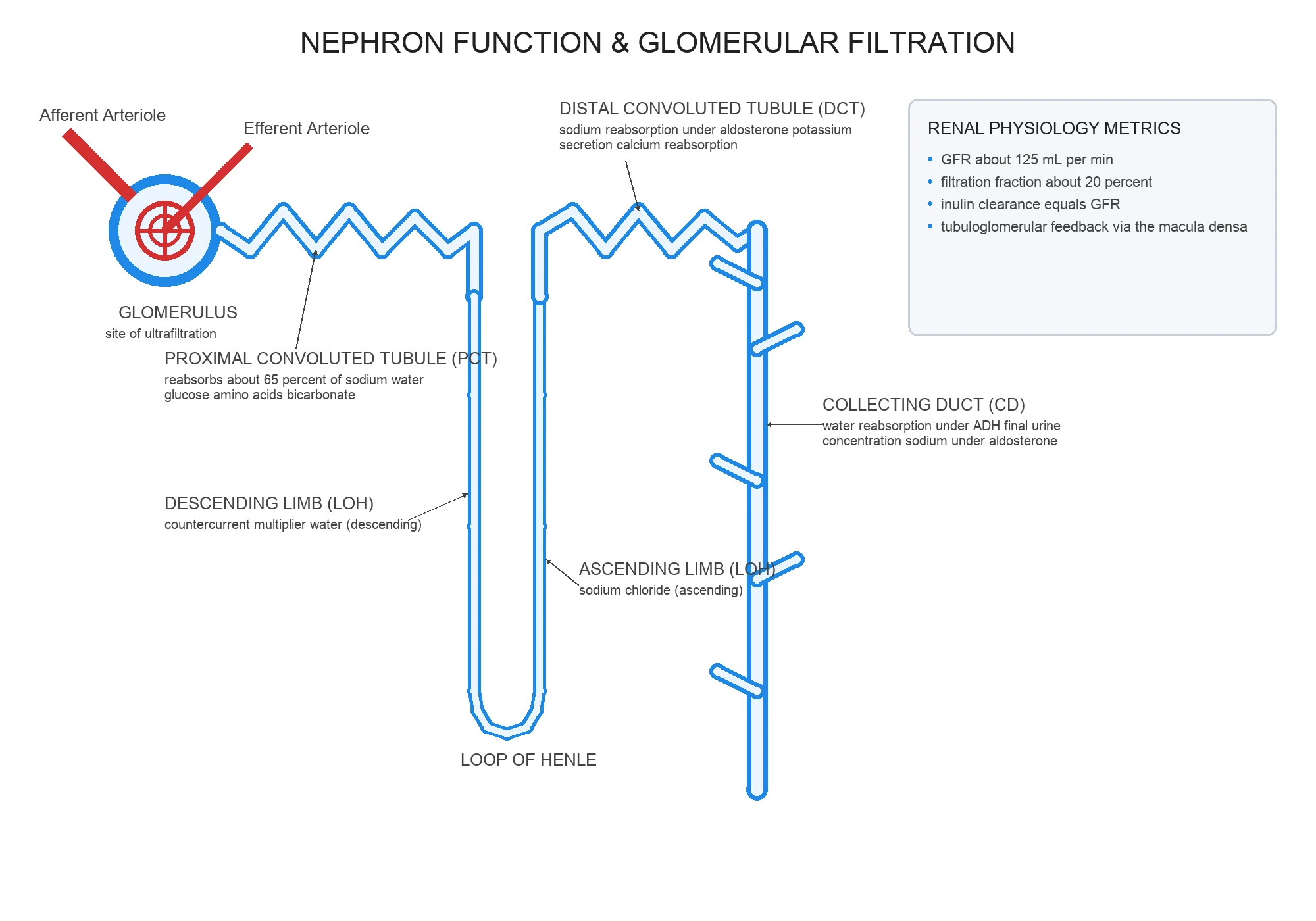
Electrolytes: K+, Na+, Ca2+, phosphate, bicarbonate. Potassium is the gatekeeper for elective lists.[3][4]
Haematology: chronic anaemia (usually tolerated if chronic), uraemic platelet dysfunction (normal platelet count ≠ normal haemostasis), anticoagulation around dialysis (heparin). [1]
Access: AV fistula/graft arm, tunnelled catheter, PD catheter — document and label the arm. [1]
Glucose: many are diabetic; adjust hypoglycaemics; avoid glucose-free long starvation without plan. [1]
Preoperative tests (exam list)
U&E (including K+ day of surgery for dialysis patients when feasible), FBC, coagulation if bleeding risk/regional planned, ECG, CXR if volume unclear, blood gas if acidotic/hyperkalaemic suspicion, crossmatch if major surgery. Echo if structural disease/poor functional capacity.[4]
Dialysis timing
Elective major surgery (classic teaching): haemodialysis within 24 hours before surgery, ideally the day before or morning of, coordinated so the patient is neither fluid-overloaded nor profoundly hypovolaemic/hypokalaemic. Confirm post-dialysis K+ when possible.[2][4]
Emergency: do not delay life-saving surgery solely for dialysis if hyperkalaemia can be temporised medically and monitored; involve nephrology early for intraoperative/early post-op CRRT/HD pathway. [1]
Post-op dialysis: plan access to HD/CRRT if major fluid shifts, rising K+, or overload expected. [1]
Applied physiology / pharmacology that changes the plan
Potassium
Hyperkalaemia risk rises with missed dialysis, suxamethonium, acidosis, rhabdomyolysis, transfusion, ACEI/ARB/spironolactone, and tissue trauma.[3]
Practical theatre thresholds (local policies vary — state principles): [1]
- Elective: many units postpone if K+ significantly elevated (commonly concern around ≥5.5–6.0 mmol/L depending on chronicity and ECG) until dialysis/medical control
- ECG changes (peaked T, flattened P, wide QRS, sine wave) → treat immediately, do not wait for elective ideals
- Chronic dialysis patients may tolerate higher K+ than AKI patients — still treat dangerous ECG changes and coordinate dialysis [1]
Emergency hyperkalaemia treatment stack (say doses): [1]
- Calcium (e.g. calcium gluconate 10 mL of 10% IV over 5–10 min) — membrane stabilisation if ECG changes (repeat if needed)
- Insulin–glucose (e.g. 10 units actrapid in 25–50 mL of 50% glucose or local protocol) — shifts K+ in
- Salbutamol nebulised high-dose — adjunct shift
- Sodium bicarbonate — if metabolic acidosis; not sole therapy for hyperkalaemia without acidosis
- Remove K+ — dialysis is definitive in ESKD; resins limited acute role
- Stop ongoing loads; hyperventilate carefully if ventilated (pH effect) [1]
Fluid and acid–base
Zero urine output means every millilitre counts. Use blood products and crystalloid deliberately; avoid “keep-up” liberal fluid. Balanced crystalloids preferred over large 0.9% saline loads when possible (chloride/acidosis issues), but follow local dialysis unit practice for sodium/potassium content of fluids.[1][2]
Drug dosing — viva gold table
| Drug / class | CKD/ESKD approach | Rationale |
|---|---|---|
| Propofol / volatiles | Standard titration | Hepatic/redistribution; titrate to effect |
| Thiopental | Reduce dose/titrate | Reduced protein binding, sensitivity |
| Fentanyl / alfentanil | Titrate; often modest reduction | Safer than morphine accumulation profile |
| Remifentanil | Useful infusion | Ester hydrolysis; predictable offset |
| Morphine | Avoid or marked reduce | M6G accumulation → prolonged sedation/resp depression |
| Pethidine | Avoid | Norpethidine seizures |
| Oxycodone | Reduce dose/extend interval | Partial renal clearance |
| Rocuronium | Reduce dose / expect longer block | Partial renal clearance; use quantitative NMM; sugammadex still effective |
| Atracurium / cisatracurium | Preferable NMBA classically | Hofmann / ester metabolism |
| Suxamethonium | Avoid if hyperkalaemic | K+ rise |
| Sugammadex | Usable; complex in severe CKD | Complex may persist — clinical recovery still useful; follow local guidance |
| Midazolam | Reduce | Active metabolite accumulation |
| NSAIDs | Avoid if residual function | Afferent constriction, AKI |
| Gentamicin / vancomycin | Level-guided, extended interval | Nephro/ototoxicity; clear protocols |
| LMWH | Reduce / anti-Xa guided | Renal clearance; bleeding risk |
| Antibiotics | Check renally adjusted dosing table | Under- and overdosing both common |
Anaesthetic goals
- Safe K+ and volume for induction and recovery.
- Protect dialysis access.
- Right drugs, right doses, full neuromuscular recovery.
- Haemodynamic stability — coronary and residual renal perfusion (if any).
- Bleeding awareness — uraemic platelet dysfunction, heparin from dialysis.
- Clear post-op dialysis and monitoring plan. [1]
Technique options and decision matrix
Fistula / graft precautions (non-negotiable)
- No BP cuff, tourniquet, arterial line, or IV on access arm
- Pad and expose access for inspection; thrill check pre and post
- Prefer contralateral arm or foot IVs; ultrasound for difficult access
- Central venous access: avoid subclavian if possible (stenosis risk for future access); femoral/IJ per local transplant/vascular advice
- Document access site on consent and WHO checklist [1]
Monitoring
Standard + consider arterial line for major surgery/labile BP (on non-fistula arm). Quantitative NMM if NMBA used. Temperature, glucose. CVP rarely helpful alone for volume — use clinical + echo if needed. [1]
Intraoperative management
Induction: expect hypotension if recently ultrafiltered — have vasopressors drawn (metaraminol/phenylephrine; noradrenaline infusion ready for major cases). Reduce induction doses; titrate. [1]
Ventilation: avoid excessive hypercapnia/acidosis (shifts K+ out). Lung-protective settings; many have fluid-related poor compliance. [1]
Maintenance fluids: restrictive, goal-directed only with clear endpoints; replace losses, not “maintenance for anuria.” [1]
Transfusion: chronic anaemia — transfuse to clinical need, not normal Hb; coordinate with dialysis (volume, K+ in stored blood). [1]
Analgesia: paracetamol safe; avoid NSAIDs if residual function; regional where possible; fentanyl/oxycodone reduced rather than morphine PCA defaults. [1]
Crisis pivots
Hyperkalaemia with ECG changes on table
Calcium → insulin–glucose → salbutamol → correct acidosis → emergency dialysis/CRRT pathway → stop K+ sources → ALS if arrhythmia.[3]
Pulmonary oedema / desaturation
Sit up, FiO2, PEEP, diuretics only if residual urine and overloaded; ultrafiltration/dialysis; consider cardiogenic vs fluid. [1]
Fistula thrombosis suspected post-op
Urgent vascular/nephrology review — loss of access is catastrophic for the patient. [1]
Unexplained bleeding
Uraemic platelet dysfunction: optimise haematocrit, consider desmopressin in selected uraemic bleeding (specialist advice), correct fibrinogen/platelets as indicated, dialysis may improve uraemic bleeding over time. [1]
Rising creatinine in CKD not on dialysis
Treat as PO-AKI prevention/management: haemodynamics, avoid nephrotoxins, glucose control, monitor; ADQI/POQI principles.[5]
Postoperative / HDU criteria
- Monitored bed if major surgery, unstable K+/volume, significant comorbidity, or difficult pain control
- Early nephrology review for dialysis timing
- Fluid balance chart; daily weights when feasible
- Watch for delayed respiratory depression from opioids
- VTE prophylaxis: renally adjusted anticoagulants; mechanical methods important [1]
Special populations
PD patients: drain abdomen before laparoscopy; plan temporary HD if PD interrupted. [1]
Transplant recipients: protect graft perfusion pressure; continue immunosuppression with pharmacy; infection precautions; avoid nephrotoxins. [1]
Diabetic ESKD: gastroparesis, silent ischaemia, autonomic neuropathy — RSI thinking when indicated; careful glucose. [1]
Emergency hyperkalaemic arrest: calcium early in ALS algorithm context for suspected hyperkalaemic PEA/wide-complex. [1]
SAQ answer scaffold
A 58-year-old on thrice-weekly HD with a left radiocephalic fistula needs emergency laparotomy. K+ 5.8 mmol/L post last night’s dialysis. Outline anaesthetic management. [1]
- Assess (3): volume status, ECG for hyperkalaemia, access arm, comorbidities, coagulation/heparin timing.
- K+ plan (3): ECG-guided treatment thresholds; calcium/insulin–glucose if indicated; nephrology for post-op HD; avoid sux.[3]
- Access & lines (2): right arm/foot IVs; arterial line opposite fistula; no cuff on left.
- Drugs (3): titrated induction; cisatracurium or reduced rocuronium + NMM; fentanyl not morphine; vasopressors ready.[1]
- Post-op (2): HDU, early dialysis plan, fluid restriction, adjusted VTE prophylaxis.[2]
Viva stem bank and model phrases
Stem 1: “Which arm for the BP cuff?”
Model: “Never the fistula arm — contralateral arm or alternative site, and I document that on the checklist.” [1]
Stem 2: “Morphine PCA?”
Model: “I avoid morphine because morphine-6-glucuronide accumulates in renal failure; I prefer fentanyl-based regimens with reduced dosing.” [1]
Stem 3: “When do you dialyse before elective THR?”
Model: “I coordinate HD within about a day pre-op so potassium and volume are optimised without rendering the patient intravascularly empty at induction.”[2]
Stem 4: “K+ 6.3 with peaked T waves.”
Model: “Immediate membrane stabilisation with IV calcium, shift with insulin–glucose and salbutamol, address acidosis, and arrange urgent dialysis — I do not proceed with elective care until safe.”[3]
Stem 5: “RSI agent if K+ 5.9?”
Model: “I avoid suxamethonium; I use rocuronium with sugammadex available and ensure full monitoring of the airway plan.” [1]
Stem 6: “Why is cisatracurium popular in ESKD?”
Model: “Hofmann elimination and ester hydrolysis reduce reliance on renal clearance, giving more predictable recovery than steroidal NMBAs in anuria.” [1]
Stem 7: “Residual urine 400 mL/day — any change?”
Model: “Yes — I treat residual function as precious: avoid NSAIDs and hypotension, renally adjust drugs, and involve nephrology early if oliguria worsens.”[5]
Common traps
- BP cuff on fistula arm
- Morphine default PCA
- Suxamethonium despite high K+
- Liberal fluid in anuria
- Proceeding electively with unchecked dangerous K+
- Forgetting heparin from recent dialysis before neuraxial
- No post-op dialysis plan after major surgery [1]
Dialysis patient prep — KAVED
Examiner mental map
- K+ and ECG.
- Volume vs dry weight.
- Dialysis timing.
- Fistula protection.
- Drug table.
- Post-op dialysis destination.
Cover those six and you pass. [1]
References
- [1]Chowdhury SR, McLure HA Chronic kidney disease and anaesthesia BJA Educ, 2022.PMID 36097571
- [2]Fielding-Singh V, Vanneman MW, et al. Perioperative Management of the Patient Receiving Maintenance Hemodialysis Anesthesiology, 2025.PMID 40923826
- [3]Ayach T, Nappo RW, Paugh-Miller JL, Ross EA Postoperative hyperkalemia Eur J Intern Med, 2015.PMID 25698564
- [4]Nasr R, Abdel Mageed H Preoperative Evaluation in Patients With End-Stage Renal Disease and Chronic Kidney Disease Health Serv Insights, 2017.PMID 35185335
- [5]Prowle JR, Forni LG, Bell M, et al. Postoperative acute kidney injury in adult non-cardiac surgery: joint consensus report of the Acute Disease Quality Initiative and PeriOperative Quality Initiative Nat Rev Nephrol, 2021.PMID 33976395