Anaes · Measurement & monitoring physics
Bias and confounding in clinical research
Also known as Bias · Confounding · Selection bias · Performance bias · Detection bias · Attrition bias · Reporting bias · Effect modification · Propensity scoring
Every anaesthetic reads the literature, and every paper is threatened by two families of error that can make a useless intervention look effective or a harmful one look safe — bias and confounding. The model rests on eleven exam-critical ideas. First, BIAS is a SYSTEMATIC error that distorts the study findings in a particular direction, unlike RANDOM error (chance) which is unsystematic and handled by p-values and confidence intervals. Second, SELECTION BIAS is a systematic difference between those selected for study and those not — the healthy-worker effect, self-selection, and loss to follow-up are the classical forms — minimised by randomisation in trials and representative sampling in observational work. Third, PERFORMANCE BIAS is a systematic difference in the care provided to the groups apart from the intervention itself, minimised by blinding participants and clinicians. Fourth, DETECTION BIAS is a systematic difference in how outcomes are assessed, minimised by blinded outcome assessors and standardised measurement. Fifth, ATTRITION BIAS is systematic loss of participants during follow-up that differs between groups, minimised by intention-to-treat analysis, high retention, and imputation. Sixth, REPORTING BIAS is the selective publication or reporting of favourable results — publication bias produces funnel-plot asymmetry and is reduced by prospective trial registration and the CONSORT statement. Seventh, a CONFOUNDER is a third variable associated with BOTH the exposure and the outcome but NOT on the causal pathway between them — smoking confounds the coffee-cancer association, age confounds the anaesthesia-outcome relationship. Eighth, CONFOUNDING is a nuisance to be eliminated whereas EFFECT MODIFICATION is a real biological interaction to be reported — a drug that works in one sex but not the other is effect modification, not confounding. Ninth, in the DESIGN phase, RANDOMISATION is the only method that controls for both known and UNKNOWN confounders; restriction, matching and stratification control only known confounders. Tenth, in the ANALYSIS phase, stratified analysis, multivariable regression (logistic, linear, Cox) and PROPENSITY-SCORE MATCHING create comparable groups from observational data by matching on the predicted probability of treatment. Eleventh, RESIDUAL CONFOUNDING from unmeasured or imperfectly measured variables always limits observational studies, which is why randomised controlled trials sit atop the evidence hierarchy. Built on the postoperative hepatic dysfunction risk-factor meta-analysis (Liu 2026), the vaginal estrogen SEER analysis (Mitchel 2026), the perioperative biologic DMARD safety study (Peng 2026), the propensity-matched cholangiocarcinoma survival analysis (Tian 2026), the propensity-matched dens fracture surgery study (Khan 2026), the preoperative PPI complications cohort (Pollmann 2026), the periodontal therapy systematic review (Ramaglia 2026), and the acupuncture cancer-fatigue meta-analysis (Yang 2026).
On this page & tools
Your progress
Saved locally on this device.
8 MCQs with explanations
Target exams
Red flags

Why this matters to the anaesthetist
Anaesthesia is an evidence-based speciality, and the evidence is only as trustworthy as the methods that produced it. When an observational study reports that a preoperative drug reduces complications, when a registry analysis claims a survival benefit for one surgical strategy over another, or when a trial of a perioperative bundle reports a dramatic effect, the anaesthetist must ask the two questions at the heart of critical appraisal: is the result biased, and is it confounded? Bias is a systematic error built into the design or conduct of the study; confounding is the distortion of a true exposure-outcome relationship by a third variable. Failing to recognise either leads to adopting interventions that do not work, or abandoning ones that do. The recent perioperative literature is full of examples where these threats are live: the postoperative hepatic dysfunction risk-factor meta-analysis, the SEER-based survival analyses, the perioperative biologic DMARD safety study, and the preoperative PPI complications cohort are all observational designs whose conclusions hinge on how well they have controlled for bias and confounding [1][3][6]. Mastering bias and confounding is what separates a reader who is persuaded by a paper from one who can appraise it.
What is bias?
Bias is a systematic error that distorts the findings of a study in a particular direction — toward exaggerating an effect, toward shrinking it, or toward manufacturing one that does not exist. The defining word is systematic: the error is built into the design, the conduct, or the analysis, so it does not average out by adding more patients. This is the crucial distinction from random error (chance), which is the unsystematic noise that a larger sample does smooth away and that p-values and confidence intervals quantify. A study can be statistically significant and wholly wrong, because a tiny p-value measures chance, not bias [1].
Bias is conventionally grouped by where in a study it acts — on who gets in (selection), on what happens during follow-up (performance), on how the outcome is measured (detection), on who drops out (attrition), or on what gets published (reporting). Each has a matching defence built into the randomised controlled trial, which is why the RCT is the design most protected against bias. [1]
Selection bias
Selection bias is a systematic difference between those selected for the study (or for one group within it) and those not selected, so that the groups differ in prognostic factors from the outset. Three classical forms recur in exams and in the perioperative literature: [1]
- The healthy-worker effect — working populations are healthier than the general population (the severely ill are not in work), so comparisons between workers and the general public under-estimate harm. The same logic applies to "elective surgery" cohorts, who are by definition fit enough to be offered an operation.
- Self-selection / volunteer bias — people who consent to a study or who choose a treatment differ systematically from those who do not; the worried, the wealthier, and the sicker opt in at different rates.
- Loss to follow-up that differs between groups — if more patients are lost from one arm, the survivors left in that arm are a selected, non-representative subset. [1]
Selection bias is minimised by randomisation with allocation concealment in trials (so the investigator cannot steer a given patient to a given arm), and by representative sampling and consecutive enrolment in observational studies. The SEER-based survival analyses illustrate both the power and the limit of using a population registry to reduce selection bias, while a single-centre cohort is far more vulnerable to it [2][4].
Performance bias
Performance bias is a systematic difference in the care provided to the groups apart from the intervention under test. If clinicians look after patients in one arm more carefully, offer them extra co-interventions, or change their behaviour because they know which treatment a patient is receiving, the groups no longer differ only by the intervention, and the comparison is corrupted. The defence is blinding — masking participants and clinicians to the allocated treatment so that care, attention and co-interventions are equalised. When blinding is impossible (a surgical technique, an anaesthetic technique that produces a recognisable physiological signature), performance bias is hard to exclude and is a frequent reason an open-label trial is downgraded in a GRADE appraisal [3].
Detection bias
Detection bias is a systematic difference in how outcomes are assessed between the groups. If an unblinded assessor believes the intervention works, they may look harder for recovery in the treatment arm or record subjective outcomes more favourably; if they believe it harms, they may over-record adverse events. Subjective outcomes (pain scores, nausea, satisfaction, "recovery quality") are far more vulnerable than objective ones (mortality, blood pressure, biomarker concentrations). The defence is blinded outcome assessors and standardised, pre-specified measurement — the same instrument, applied the same way, by someone who does not know the allocation [3].
Attrition bias
Attrition bias is systematic loss of participants during follow-up that differs between the groups. If patients drop out because of side-effects in the treatment arm, or because of lack of efficacy in the placebo arm, the patients who remain are a selected subset, and the comparison of survivors only is biased. The defence has three parts: [1]
- Intention-to-treat (ITT) analysis — analysing every patient in the group to which they were randomised, regardless of the treatment actually received or of withdrawal; ITT preserves the equal distribution of confounders that randomisation created and is the primary protection against attrition bias.
- High retention — designing the study and supporting patients to minimise loss to follow-up; a loss greater than 20 percent threatens validity.
- Imputation — statistically handling missing data (multiple imputation is preferred over last-observation-carried-forward) rather than simply dropping the patients with missing values [8].
Reporting bias
Reporting bias is the selective publication or selective reporting of favourable results. Its most important form is publication bias — the tendency for studies with positive, "significant" findings to be published (and published faster, in higher-impact journals, in English) while studies with negative or null findings remain unpublished or languish in a file drawer. Because the published record is then a skewed sample of the truth, a meta-analysis of it can produce a precise but exaggerated pooled estimate. Publication bias is detected by funnel-plot asymmetry: a plot of each study's effect size against its precision should be a symmetric inverted funnel, and asymmetry — a gap where the small negative studies should sit — signals that small negative studies are missing. The defences are prospective trial registration (a trial is logged, with its pre-specified outcomes, before it recruits, so it cannot quietly disappear) and reporting standards such as CONSORT for trials and PRISMA for systematic reviews [8].
What is a confounder?
A confounder is a third variable that is associated with the exposure AND associated with the outcome, but which is not on the causal pathway between them. Because it drives both the exposure and the outcome, it manufactures an apparent exposure-outcome association that disappears once it is controlled for. The textbook example is the coffee-cancer association: coffee drinkers are more likely to smoke, and smoking causes cancer, so coffee appears to cause cancer until you adjust for smoking — smoking is the confounder. In anaesthesia, age confounds almost every exposure-outcome relationship because older patients both receive different anaesthetic plans and have worse outcomes for almost every endpoint. Smoking, ASA physical status, comorbidity burden, and surgical complexity are the dominant confounders in the perioperative literature [1][6].
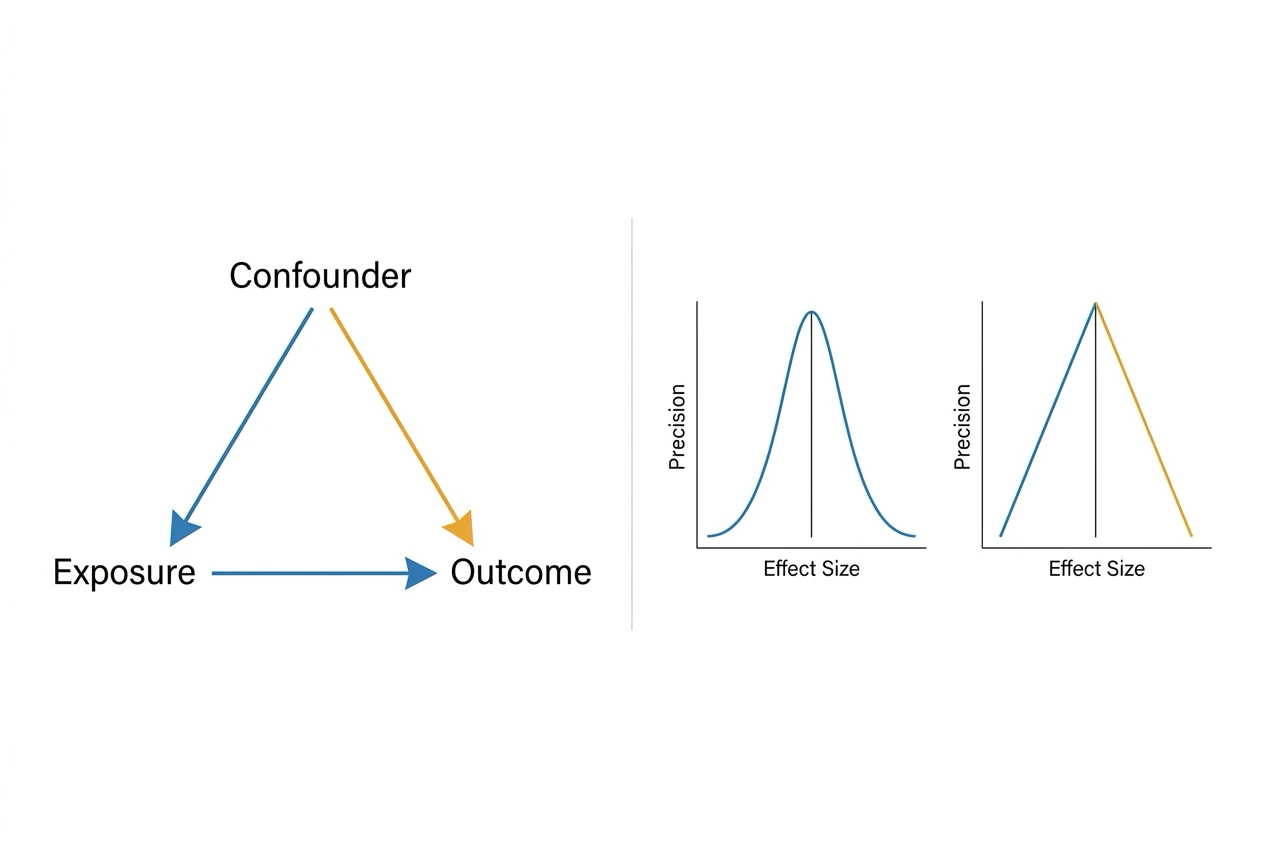
A crucial boundary: a variable that lies on the causal pathway between the exposure and the outcome is a mediator, not a confounder, and must not be adjusted for. If a new anaesthetic technique reduces postoperative nausea by reducing opioid use, then opioid use is a mediator; adjusting for it would strip out the very benefit the technique produces. [1]
Confounding versus effect modification
Confounding and effect modification look similar — both involve a third variable changing the exposure-outcome relationship — but they are opposites in meaning and in handling. [1]
- Confounding is a nuisance. It is a distortion of the truth, and the analyst's job is to eliminate it (by randomisation, matching, stratification, regression or propensity methods) so that the exposure-outcome estimate is unbiased. The goal is a single clean estimate.
- Effect modification (interaction) is a real biological phenomenon. It means the effect of the exposure genuinely differs across levels of the third variable — a drug works in one sex but not the other, an intervention benefits the young but not the old. The analyst's job is to report it, not to remove it: the result should be stratified and presented separately for each subgroup (a 30 percent benefit in men, no benefit in women), never averaged into a single misleading pooled estimate. [1]
The practical test is what you do with the variable: if you adjust it away, it is confounding; if you stratify and display it, it is effect modification. Mistaking one for the other either hides a real interaction or manufactures a false one [3].
Methods to control confounding — the design phase
Confounding can be controlled at two stages, and the design phase is the more powerful. Four design-phase methods exist: [1]
- Randomisation — the cornerstone of the RCT. By randomly assigning patients to groups, randomisation distributes prognostic factors equally between arms, and — uniquely — it does so for unknown and unmeasured confounders as well as known ones. No other method controls for unknown confounders, which is why the RCT sits atop the evidence hierarchy.
- Restriction — limiting the study to one level of the confounder (only non-smokers, only one age band). It removes that confounder entirely but sacrifices generalisability.
- Matching — pairing each exposed subject with an unexposed subject who has the same value of the confounder (age, sex). Powerful for one or two confounders, unwieldy for many.
- Stratification — organising the analysis into strata of the confounder and combining the stratum-specific estimates. Works for a handful of confounders but collapses under many. [1]
The first three are design choices made before data collection; stratification straddles design and analysis. Randomisation is the only one that does not require the confounder to have been measured [5].
Methods to control confounding — the analysis phase
When randomisation is not possible — and most perioperative safety and outcomes questions cannot ethically or practically be randomised — confounding must be handled in the analysis, which can only adjust for confounders that were measured. Three analysis-phase methods dominate: [1]
- Stratified analysis — the Mantel-Haenszel approach computes a summary estimate across strata of the confounder; suited to a single confounder with few levels.
- Multivariable regression — the workhorse of modern epidemiology, modelling the outcome as a function of the exposure plus several confounders simultaneously. Logistic regression suits a binary outcome (complication yes/no), linear regression a continuous one (length of stay), and Cox proportional-hazards regression a time-to-event outcome (survival). Each returns an effect estimate adjusted for every confounder in the model.
- Propensity-score matching — a two-stage method for observational data. First, a logistic regression estimates each patient's predicted probability of receiving the treatment (the propensity score) given their measured confounders. Then each treated patient is matched to an untreated patient with a similar score, creating two groups that are comparable on all measured confounders as if they had been randomised, and the outcomes are compared in the matched pairs. [1]
Propensity matching is the modern answer to confounding in surgical and anaesthetic observational studies: the cholangiocarcinoma survival comparison and the dens-fracture surgery analysis both use it to create comparable groups from registry or cohort data when randomisation is impossible [4][5].
Residual confounding and its implications
No analysis-phase method is complete, because no dataset measures every confounder, and no measurement of a confounder is perfect. The difference between the true confounder and the measured proxy leaves residual confounding — a lingering distortion that observational studies can never fully escape. Smokers may be classified as "ever or never" with no detail on pack-years; comorbidity may be captured by a crude score that misses severity; frailty may not be measured at all. Residual confounding is the reason a well-conducted observational study can still be wrong, and it is the single most important reason the randomised controlled trial sits atop the evidence hierarchy — randomisation, by distributing even the unmeasured factors, is the only design that escapes it [1][4].
The practical implication for the anaesthetist reading the literature is a standing scepticism toward observational claims: a registry analysis showing that a perioperative practice "improves survival" may reflect the fact that healthier, fitter patients were selected for that practice in the first place. The stronger the design (randomised, blinded, intention-to-treat, pre-registered), the more confidence a result deserves; the more observational, the more the question "what did they not measure?" should be asked [6][8].
Clinical
- Standard approach
- Evidence-based
Alternative
- Modified technique
- Risk-benefit
Red flags
[1]References
- [1]Liu H, et al. Risk factors and prognosis of postoperative hepatic dysfunction after Stanford type A aortic dissection repair: a systematic review and meta-analysis J Cardiothorac Surg, 2026.PMID 42363187
- [2]Mitchel OR, et al. Survival Outcomes in Breast Cancer Patients With Use of Vaginal Estrogen Therapy: A SEER Analysis JCO Oncol Pract, 2026.PMID 42361283
- [3]Peng K, et al. Safety of Biologic and Targeted Synthetic Disease-Modifying Antirheumatic Drugs in Rheumatoid Arthritis: A Longitudinal Analysis Drug Saf, 2026.PMID 42360669
- [4]Tian J, et al. Comparative analysis of survival outcomes and prognostic factors between intrahepatic and extrahepatic cholangiocarcinoma after surgical resection: a propensity score-matched study based on the SEER database Langenbecks Arch Surg, 2026.PMID 42364046
- [5]Khan Z, et al. Does early surgical intervention for type II dens fractures improve survival in octogenarians? A propensity-matched analysis Br J Neurosurg, 2026.PMID 42364088
- [6]Pollmann L, et al. Preoperative proton pump inhibitor therapy and its influence on postoperative complications following major liver resection Langenbecks Arch Surg, 2026.PMID 42363997
- [7]Ramaglia L, et al. Effects of non-surgical periodontal therapy on intrabony periodontal defects at different re-evaluation time points: A systematic review of randomized controlled trials and clinical recommendations Periodontol 2000, 2026.PMID 42363664
- [8]Yang Z, et al. Effects of acupuncture on cancer-related fatigue and quality of life in breast cancer survivors: A systematic review and meta-analysis of randomized controlled trials Medicine (Baltimore), 2026.PMID 42363469