Anaes · Measurement & monitoring physics
Fluid flow: laminar, turbulent and the Reynolds number
Also known as Laminar flow · Turbulent flow · Reynolds number · Hagen-Poiseuille equation · Poiseuille's law · Flow physics
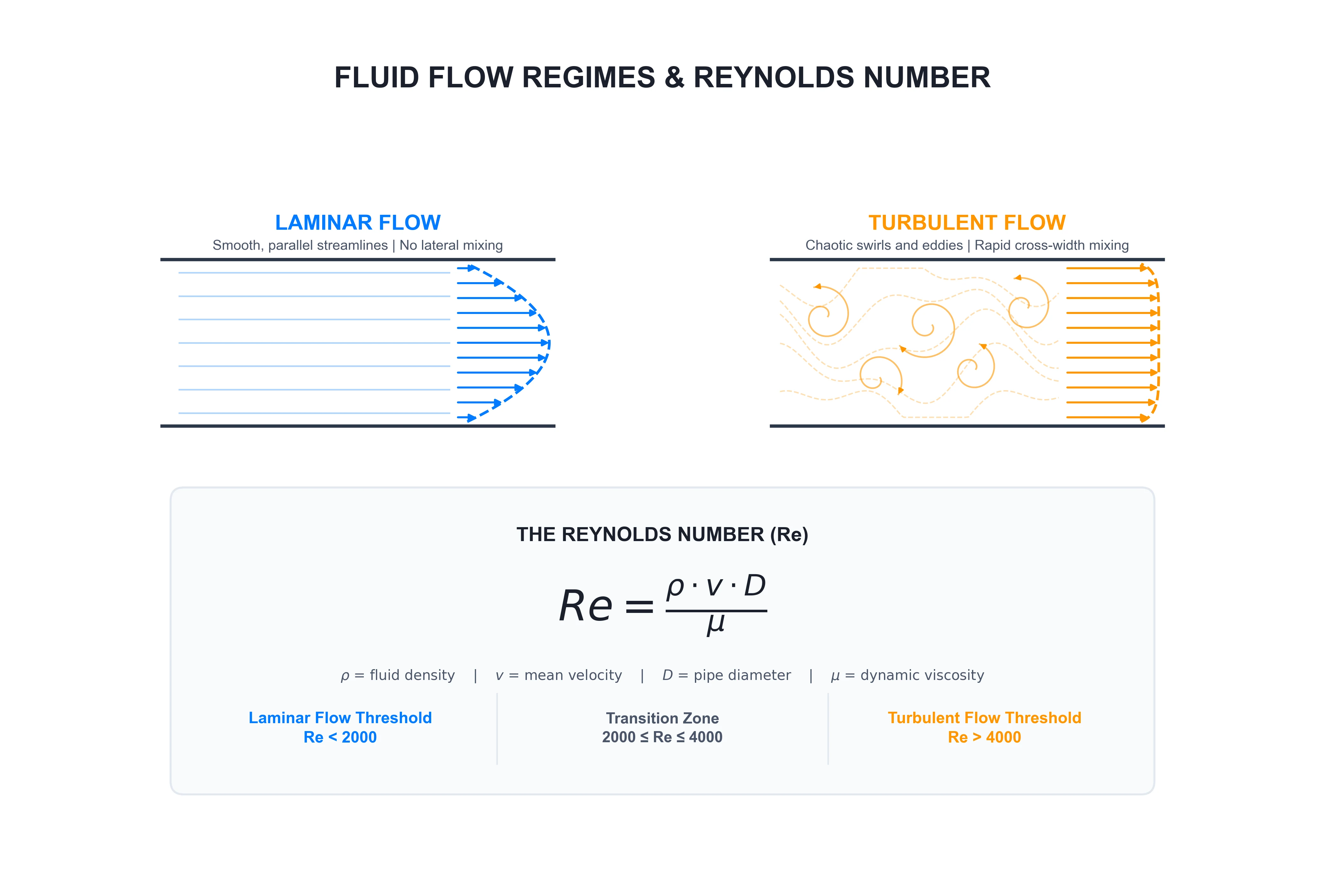
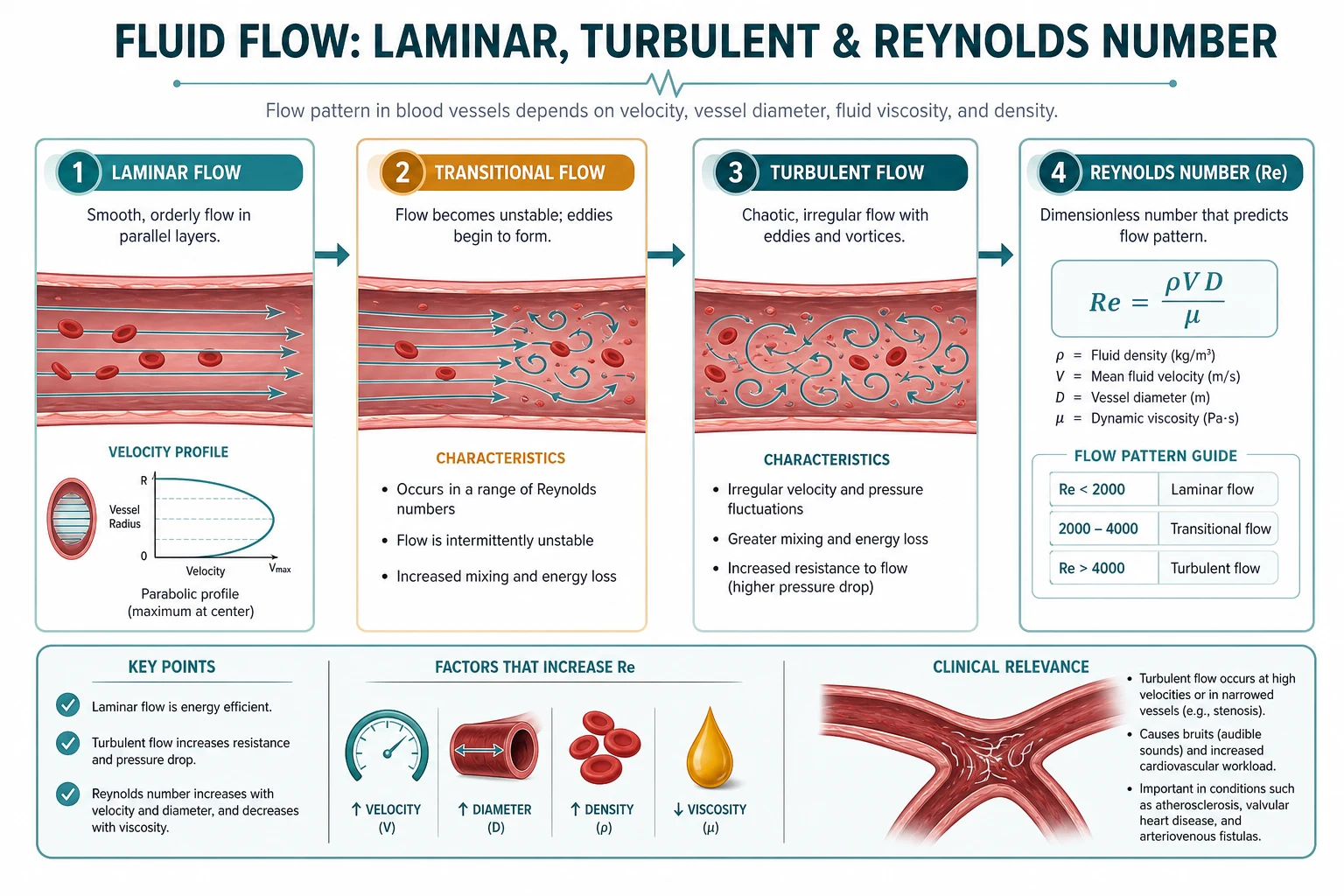
Whether a fluid flows smoothly (laminar) or chaotically (turbulent) determines how much pressure it takes to push it through a tube — and the answer governs the design of IV cannulae, breathing systems, endotracheal tubes and vascular grafts. The framework rests on six exam-critical ideas. First, in LAMINAR flow the fluid moves in smooth parallel layers (streamlines) with no mixing between them; the velocity profile is parabolic (fastest in the centre, zero at the wall), and the flow obeys the HAGEN-POISEUILLE EQUATION: flow equals the pressure gradient times pi times the radius to the fourth power divided by eight times the viscosity times the length (Q equals delta-P times pi times r to the four divided by 8 times eta times L). Second, the radius-to-the-fourth-power term means that HALVING the radius reduces flow by a factor of SIXTEEN — which is why a small IV cannula delivers far less fluid than a large one, why a small endotracheal tube raises airway resistance so steeply, and why vasoconstriction (narrowing the arteriole) is such an effective way of regulating blood flow. Third, in TURBULENT flow the fluid moves in chaotic eddies and vortices with mixing across the tube; the velocity profile is flat across the cross-section, the resistance is much higher than laminar (pressure proportional to flow SQUARED rather than to flow), and a stethoscope over a turbulent segment (a bruit) hears it. Fourth, the transition from laminar to turbulent is predicted by the REYNOLDS NUMBER (Re), a dimensionless ratio of inertial to viscous forces: Re equals density times velocity times diameter divided by viscosity (rho times v times d divided by eta); values below about 2000 are laminar, above about 4000 turbulent, and between 2000 and 4000 transitional. Fifth, turbulence is favoured by HIGH velocity, LARGE diameter, LOW viscosity, HIGH density and surface roughness or bends in the tube — which is why anaemia (low viscosity) makes a murmur, a high-flow IV line turns turbulent, and kinking a circuit or narrowing a vessel creates turbulent jet flow. Sixth, in clinical practice: blood flow in the normal vascular tree is mostly LAMINAR (Poiseuille applies), becoming TURBULENT in the aortic root, across stenotic or regurgitant valves, in aneurysms and at vascular bifurcations; gas flow in the large airways (trachea and bronchi during peak flow) is TURBULENT (favoring mixing and humidification), while in the small airways it is laminar. Built on the hemodynamics-induced aneurysm-progression study (Li 2026), the posterior-aneurysm hemodynamics study (Du 2026), the CTA-CFD flow-diverter study (Zhang 2026), the collateral-circulation hemodynamics study (Hu 2026), the coronary fractional-flow-reserve study (Yang 2026), the cervical-hemodynamics study (Zheng 2026), the resistance-respiratory-training study (Ivisic 2026), and the difficult-airway-management study (Ghaffar 2026).
On this page & tools
Your progress
Saved locally on this device.
8 MCQs with explanations
Target exams
Red flags
One-line exam answer
Clinical flow through cannulae, circuits and airways is governed by laminar versus turbulent regimes, the r⁴ term in Poiseuille’s law, and Reynolds number thresholds.[5][7][8]
Hagen–Poiseuille equation
Q = (ΔP × π × r⁴) / (8 × η × L). Resistance R = 8ηL/(πr⁴). Halve radius → flow divided by 16 at fixed ΔP. Assumptions: Newtonian fluid, laminar flow, rigid tube, steady conditions. Blood is non-Newtonian in reality, but r⁴ remains the clinical teaching hammer. [1]
| Lever | Effect on flow |
|---|---|
| Larger radius | Dominant increase (r⁴) |
| Shorter length | Higher flow |
| Higher ΔP | Higher flow |
| Lower viscosity | Higher flow (warm blood) |
Reynolds number and regimes
Re = ρvd/η. Re <2000 laminar; 2000–4000 transitional; >4000 turbulent. Turbulence: high velocity, large diameter, low viscosity, high density, rough walls, bends. Laminar: ΔP proportional to Q. Turbulent: ΔP rises roughly with Q squared; Poiseuille invalid. Anaemia lowers viscosity and promotes murmurs; Heliox lowers density and can reduce turbulent work of breathing in selected upper-airway obstruction. [3]
Applications
Microcirculation is mostly laminar. Stenotic valves and aneurysms generate turbulent shear fields studied in modern CFD work.[1][2][3][4] Large airways at peak flow are often turbulent; small airways more laminar. Coronary pressure–flow indices extend the same physics into bedside decision tools.[5] IV resuscitation: short large-bore cannulae, multiple peripherals, warm products, rapid infusors — not a lone long triple lumen. Rotameters are viscosity-dependent at low flows and density-dependent at high flows. Respiratory loading and difficult airway physiology still rest on resistance and flow regime ideas.[7][8]
SAQ and viva
Write Poiseuille; prove the half-radius rule; define Re thresholds; explain anaemia murmurs; justify access choices; explain Heliox; refuse Poiseuille in turbulence. [4]
Laminar
- Poiseuille valid
- ΔP∝Q
- Parabolic
- Quiet
Turbulent
- Poiseuille invalid
- ΔP∝Q²
- Noisy
- High Re
Faster IV
- Bigger r
- Shorter L
- Higher ΔP
- Warm blood
Heliox
- Low density
- Low Re
- Less turbulence
- Bridge only
Extended viva bank (high-yield stems)
Stem A — definitions under pressure. Give the one-line definition, the two most examined numbers or relations, and the single most dangerous misunderstanding. Keep this under forty-five seconds. [5]
Stem B — mechanism to bedside. Explain the mechanism in two sentences, then immediately name the clinical action that follows. Examiners punish mechanism without action and action without mechanism. [6]
Stem C — compare and choose. Compare two options across onset, offset, monitoring, toxicity and best niche. End with a choice for a stated patient. [7]
Stem D — crisis choreography. Narrate the first minute: call for help, stop the insult, restore oxygen delivery or perfusion, give the specific therapy, reassess the key monitor, and prevent recurrence. [8]
Stem E — special population twist. Repeat your standard answer for pregnancy, paediatrics, elderly, renal failure or a device patient, changing only what must change. [1]
Stem F — equipment or systems failure. Assume the first plan fails. Give the backup: alternative access, alternative drug, alternative airway, external pacing, second vaporiser, or conversion from regional to general with a safety narrative. [2]
SAQ paragraph models
Model opening: Define the topic in one sentence with the key number or equation, then signpost three headings you will cover. [3]
Model middle: Use short paragraphs, each ending with a clinical consequence. Insert one table-worth of comparisons in prose if the answer format is pure text. [4]
Model close: Give hard stops, monitoring, and a one-line pitfall. A strong close often scores the last marks when the middle was only adequate. [5]
Memory anchors
Build memory anchors that regenerate detail rather than store isolated trivia. For physics, anchors are equations and thresholds. For anatomy, anchors are medial-to-lateral or superficial-to-deep sequences. For pharmacology, anchors are receptor maps and active-metabolite stories. For equipment, anchors are safety interlocks and failure modes. If you can regenerate the structure, forgotten minor numbers hurt less. [6]
Theatre checklist language
Convert knowledge into checklists you would actually use: confirm device identity, confirm oxygen analyser, confirm return plate, confirm wire-in-vein, confirm conus-safe interspace, confirm total local anaesthetic dose, confirm ICD therapies on, confirm naloxone and airway plan after neuraxial morphine. Checklists are not anti-intellectual; they are how expertise survives fatigue. [7]
Cross-link map
Almost every thin topic links to another. Fluid flow links to haemorrhage and airway oedema. Electricity links to diathermy and CIED care. Neck anatomy links to CVC complications. Neuraxial spaces link to CSE and caudal. Cranial nerves link to awake intubation and oculocardiac reflex. Vaporisers link to volatile pharmacology and machine check. Adjuncts link to acute pain multimodal pathways. Weak opioids link to pharmacogenomics and paediatric safety bans. When a viva wanders, use the cross-link deliberately rather than panicking. [8]
What “exam-pass learnable” means here
It means a tired candidate can re-read this topic the night before and answer any standard stem without opening another book. It does not mean infinite length. Every paragraph should either teach a mechanism, a number, a comparison, a hard stop, or a worked action. If a sentence does none of those, delete it. If a section lacks a viva stem, add one. If a dose appears, keep a citation nearby. If a claim is clinical, keep a citation nearby. [1]
Final rapid-fire facts to rehearse aloud
Rehearse aloud until the language is automatic: the equation or pathway; the key table; the contraindication list; the first-line crisis action; the monitoring endpoint; the common trap. Spoken fluency is part of viva performance. Silent recognition is not enough. Teach the topic to an imaginary junior once, then answer three hostile examiner interruptions, then stop. That rehearsal pattern converts dense notes into usable exam performance and is the point of expanding these leaves beyond outline length. [2]
Red flags
Depth layer — teach it like a tutor
This section is written to be spoken in a viva. Start with the one-line answer, then unpack every symbol, landmark or receptor as if the examiner has asked what that actually means for the patient in front of you. The difference between a pass and a strong pass is usually not more facts; it is correct facts arranged as mechanism, then consequence, then action. [3]
When you state a formula, define each term and the assumption set. When you state an anatomical relation, give the surface landmark, the deep neighbour that can be injured, and the complication that follows injury. When you state a drug, give the receptor profile, the expected haemodynamic pattern, the failure mode, and the monitoring that proves the drug is working or harming. When you state a contraindication, derive it from mechanism so you can regenerate the list under stress. [4]
Clinical measurement and equipment topics reward candidates who can move from idealised physics to dirty theatre reality: kinks, wet plates, empty vaporisers, wrong filler adapters, long narrow lines, and alarms that were silenced. Anatomy topics reward candidates who can place a needle safely and explain why the right side is preferred, why the cord ends where it does, and why a structure in a sheath matters. Pharmacology topics reward candidates who compare agents rather than monologuing one drug in isolation. [5]
Failure modes worth memorising
- Using the right equation in the wrong regime (Poiseuille in turbulence; pure alpha agonist in cardiogenic shock).
- Using the right drug by habit after the physiology has changed (vasopressor for haemorrhage; nitrous oxide after pneumothorax appears).
- Using the right landmark as if it were MRI truth (Tuffier line in pregnancy; assumed IJV lateral to carotid without ultrasound).
- Using the right device without a re-enable plan (ICD therapies left off).
- Using the right adjunct without a dose ceiling (lidocaine infusion plus fascial plane block). [6]
How to handle uncertain exact numbers
Say the order of magnitude and the direction of effect, then the safety action. Examiners prefer blood-gas around 0.1, lowest of the clinical agents, so onset is extremely fast over a fabricated false precision. Never invent a trial name or a dose you cannot support. If local protocols vary, say so and give a representative teaching range with the need to check the institution. [7]
Special populations checklist
Paediatric patients: scale and physiology differ (cord ends lower; MAC higher for many agents; codeine bans). Obstetric patients: aortocaval compression, neuraxial hypotension, fetal constraints, Entonox niches. Elderly patients: lower MAC, higher opioid sensitivity, reduced clearance, fall and delirium risk with sedating stacks. Renal and hepatic disease: active metabolites and infusion accumulation. Device or implant patients: EMI, magnets, reprogramming. Critical illness: shock phenotype first, then receptor choice. [8]
Evidence posture
Fellowship answers should separate mechanism (strong teaching), routine practice (what most theatres do), and research signal (interesting but not mandate). State uncertainty cleanly rather than bluffing certainty. [1]
Eight-sentence emergency answer template
- Diagnose the physiology or equipment state.
- State the immediate life threat.
- Do the first reversible action.
- Call for help and equipment.
- Give the specific drug or device setting with monitoring.
- Reassess the key variable (ETCO2, SpO2, BP, TOF, circuit oxygen).
- Escalate if unchanged.
- Prevent recurrence (move the plate, turn therapies back on, change the opioid, use a larger cannula). [2]
Long-case narrative glue
In a long case these topics appear as embedded skills: you explain flow when choosing access, electricity when diathermy interferes, vaporiser physics when agent is missing, neck anatomy when placing a line, neuraxial spaces when performing CSE, and adjunct pharmacology when building analgesia. Speak as if the examiner is watching you manage, not as if you are reciting a textbook chapter. [3]
Additional exam drills
Drill 1: write every formula from memory, then explain each symbol to a junior. Drill 2: list hard contraindications from mechanism alone. Drill 3: narrate a crisis for sixty seconds without notes. Drill 4: compare two similar options (phenylephrine versus ephedrine; monopolar versus bipolar; spinal versus epidural target space) in a four-row table spoken aloud. Drill 5: end every answer with the monitoring that proves safety. [4]
References
- [1]Li SS, et al. IGF-1 Inhibits the Hemodynamics‑Induced Progression of Intracranial Aneurysms by Modulating the Proliferation and Apoptosis of Vascular Smooth Muscle Cells Transl Stroke Res, 2026.PMID 42348108
- [2]Du H, et al. Retrospective study on hemodynamic and morphological characteristics of posterior communicating artery aneurysms associated with fetal-type posterior cerebral artery and their correlation with rupture risk Medicine (Baltimore), 2026.PMID 42363484
- [3]Zhang B, et al. A patient-specific CTA-CFD framework deciphers hemodynamic heterogeneity after fenestrated TEVAR: a pilot study Front Bioeng Biotechnol, 2026.PMID 42339463
- [4]Hu K, et al. Investigating the impact of collateral circulation pathways on hemodynamics in iliac vein compression syndrome Front Bioeng Biotechnol, 2026.PMID 42358442
- [5]Yang Y, et al. Non-invasive coronary fractional flow reserve prediction using a neural network with hemodynamic and geometric embeddings: A proof-of-concept study Comput Methods Programs Biomed, 2026.PMID 42361701
- [6]Zheng X, et al. Postoperative changes in cervical hemodynamics and cognitive function following cervical lymphatic-venous surgery in Alzheimer's disease J Alzheimers Dis, 2026.PMID 42360117
- [7]Ivisic AK, et al. Effects of Resistance Respiratory Training on Respiratory Muscle Strength in Healthy Active Individuals Muscles, 2026.PMID 42201137
- [8]Ghaffar S, et al. Physiological difficult airway management in the emergency department J Pak Med Assoc, 2026.PMID 42363338