Anaes · Measurement & monitoring physics
The gas laws
Also known as Gas laws · Boyle's law · Charles's law · Ideal gas equation · Dalton's law · Henry's law
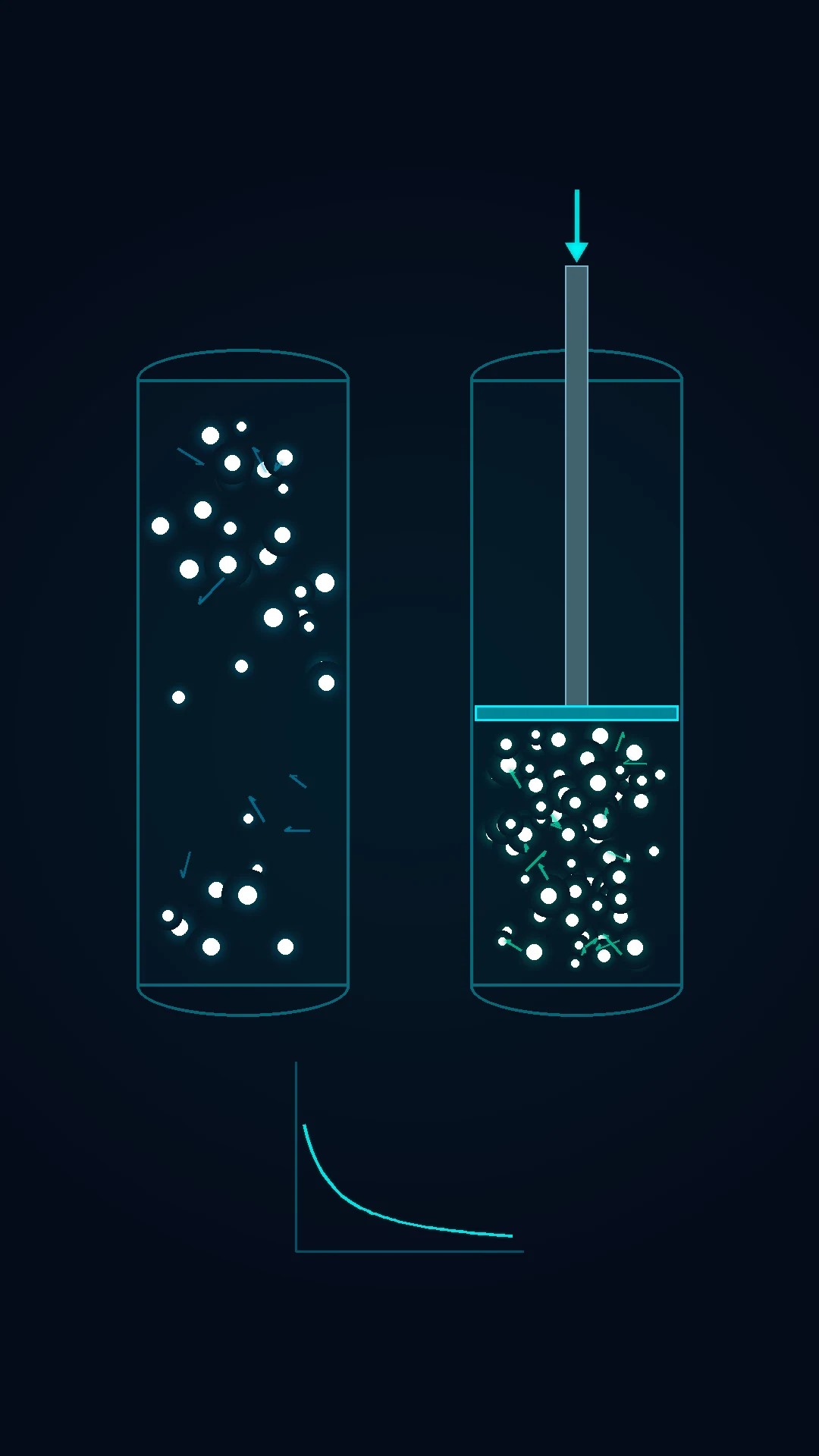
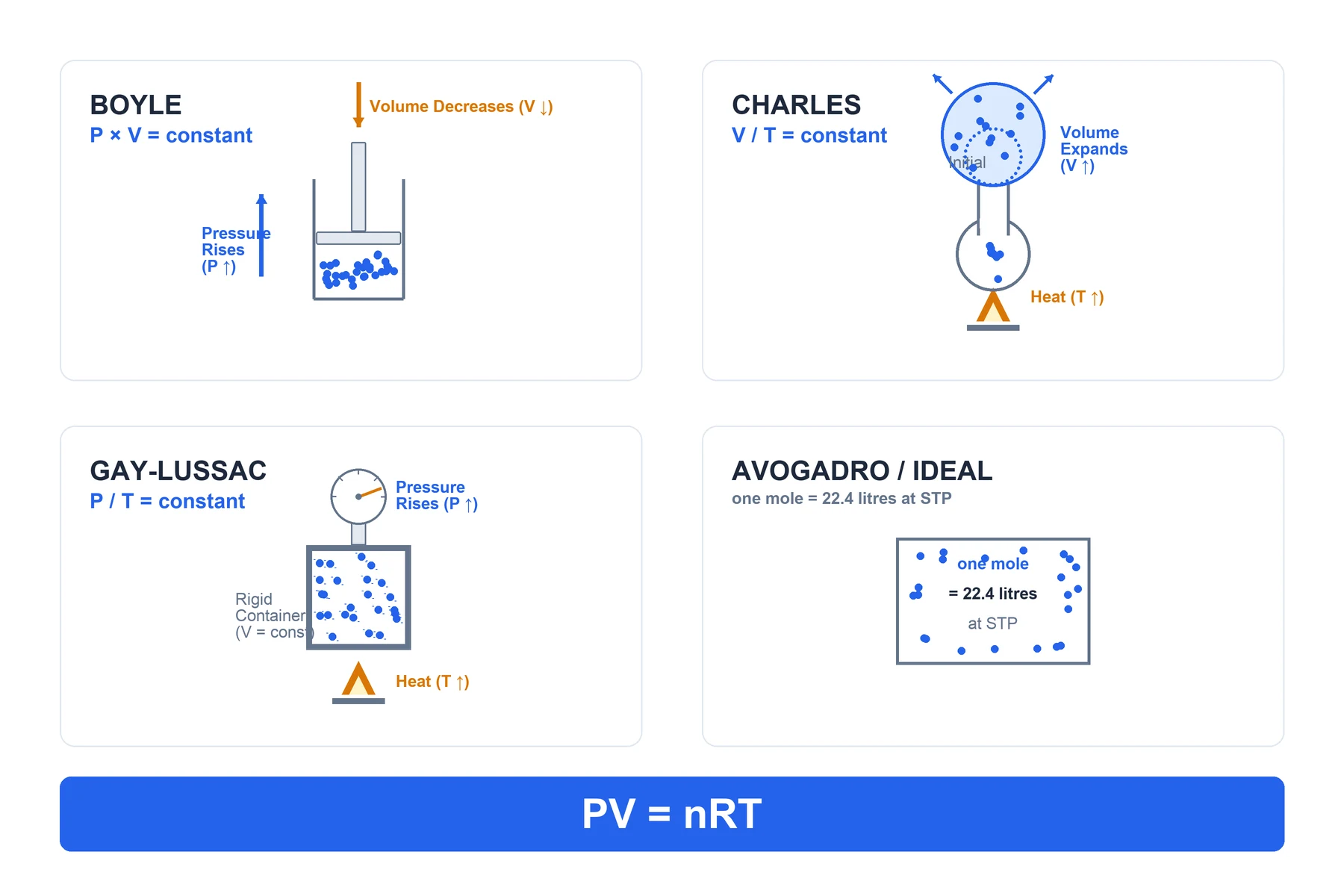
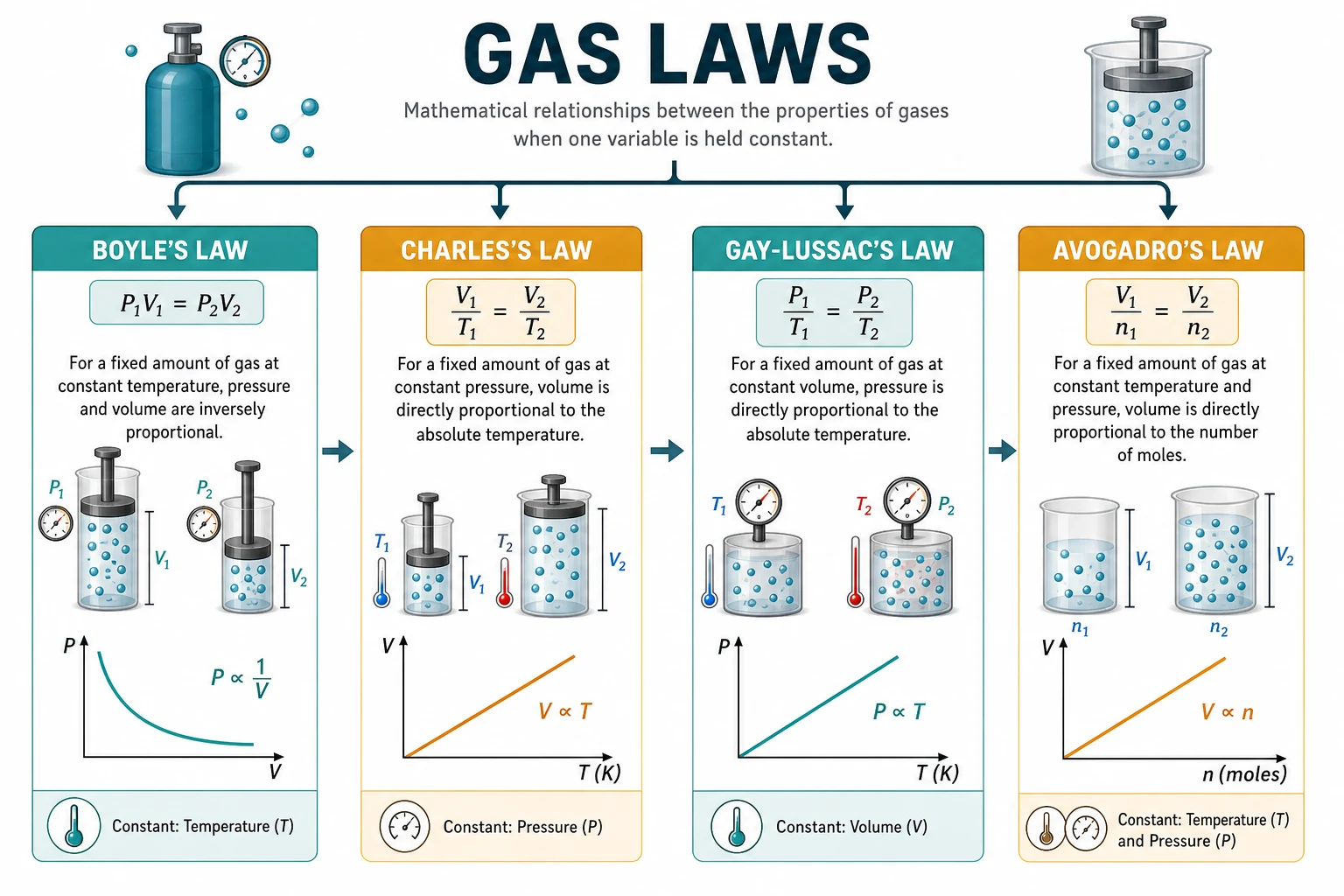
Anaesthesia is the science of gases under pressure — the contents of a cylinder, the volume in a breathing system, the partial pressures that drive uptake and diffusion, and the physics of altitude and hyperbaric therapy all obey the gas laws. The framework rests on six exam-critical ideas. First, the ideal-gas assumption: a gas is a cloud of point molecules in random motion exerting a pressure by collision with the walls, and its state is summarised by the four variables pressure (P), volume (V), temperature (T) and amount (n). Second, BOYLE'S LAW holds that at constant temperature the pressure of a fixed mass of gas is inversely proportional to its volume (P times V is constant) — the basis of how a gas is compressed into a cylinder and how a squeeze-bag ventilator works. Third, CHARLES'S LAW holds that at constant pressure the volume is proportional to the absolute temperature (V divided by T constant), and GAY-LUSSAC'S LAW that at constant volume the pressure is proportional to the absolute temperature — together explaining why a gas warms as it is compressed and cools as it expands. Fourth, AVOGADRO'S HYPOTHESIS — equal volumes of different gases at the same temperature and pressure contain equal numbers of molecules — links the amount of gas to its volume and defines the mole and the molar volume at STP (22.4 litres per mole). Fifth, these combine into the UNIVERSAL (IDEAL) GAS EQUATION, PV equals nRT (where R is the universal gas constant, 8.314 joules per mole per kelvin), from which any one variable can be found given the other three. Sixth, two mixture laws govern the behaviour of gas mixtures: DALTON'S LAW, that the total pressure of a gas mixture is the sum of the partial pressures of its individual gases (so the partial pressure of oxygen in air is 21 percent of the total), and HENRY'S LAW, that the amount of a gas dissolved in a liquid is proportional to its partial pressure — the basis of oxygen and anaesthetic uptake by the blood and of decompression sickness. Real gases deviate from ideal behaviour at high pressure or low temperature; nitrous oxide, whose critical temperature is above room temperature, liquefies in the cylinder and so shows a constant pressure (its saturated vapour pressure) until the liquid is exhausted, unlike oxygen which remains gaseous and shows a pressure proportional to its contents. Built on the partial-pressure-of-oxygen primer (Hoecker 2026), the hyperbaric-physics review (Jones 2026), the hypobaric-oxygenator physics study (Chotimol 2025), the nitrous-oxide-piped-supply-loss report (Hirata 2026), the greener-nitrous-oxide report (Yadav 2026), the chronic-hypoxaemia study (Ricco 2026), the decompression-sickness-at-altitude report (Ben-Ari 2026), and the pulse-oximetry review (Moon 2026).
On this page & tools
Your progress
Saved locally on this device.
8 MCQs with explanations
Target exams
Red flags
Why this matters
Cylinders, vaporisers, altitude, hyperbaric therapy, dissolved gases and decompression all obey the gas laws. Primary physics SAQs are pure application of named laws with absolute temperature and correct cylinder interpretation [1][2].
Ideal-gas model
Gas = many molecules in random motion; pressure from wall collisions; temperature ∝ mean kinetic energy. State variables: P, V, T, n. Ideal behaviour is a good approximation at clinical pressures; fails near liquefaction / very high P. [1]
Named laws (commit the conditions)
| Law | Constant | Relation | Clinical hook |
|---|---|---|---|
| Boyle | T, n | P ∝ 1/V ; P1V1 = P2V2 | Cylinder compression; squeeze-bag ventilation |
| Charles | P, n | V ∝ T (kelvin) | Gas expands on warming |
| Gay-Lussac | V, n | P ∝ T (kelvin) | Hot cylinder pressure rise |
| Avogadro | P, T | V ∝ n | Equal volumes → equal molecules |
| Ideal gas | — | PV = nRT | Combined calculator |
| Dalton | — | P_total = Σ p_i | FiO2 × P_bar = PO2 inspired [1] |
| Henry | T | dissolved amount ∝ p_gas | Uptake; decompression bubbles [7] |
Always use kelvin: 0 °C = 273 K; 20 °C = 293 K; 37 °C = 310 K. [1]
Constants and molar volume
| Quantity | Value |
|---|---|
| R (universal gas constant) | 8.314 J·mol⁻¹·K⁻¹ (also 0.08314 L·bar·mol⁻¹·K⁻¹) |
| Molar volume ideal gas at STP (0 °C, 101.325 kPa) | 22.4 L·mol⁻¹ |
| Approx. at room temp / 1 atm | ≈ 24 L·mol⁻¹ |
| Avogadro number | 6.022 × 10²³ mol⁻¹ |
Worked examples (exam style)
1. Boyle — cylinder contents (oxygen, dry ideal gas):
A size E oxygen cylinder, water capacity 4.7 L, gauge 137 bar (gauge ≈ absolute for this purpose ≈ 138 bar abs if pedantic; exams often treat gauge as working P).
Approximate free gas volume ≈ 137 × 4.7 ≈ 640 L of O2 (order of magnitude). At 10 L/min, ≈ 64 minutes.
(Use local cylinder tables in practice; principle is Boyle: contents ∝ P for permanent gases.) [1]
2. Dalton — altitude:
Sea level P_bar ≈ 101 kPa; PIO2 ≈ 0.21 × (101 − 6.3) kPa after airway water vapour ≈ 20 kPa inspired dry concept; at altitude P_bar falls → PIO2 falls proportionally → hypoxia [1][6].
3. Henry — hyperbaric O2:
At 3 atm absolute, dissolved O2 in plasma rises roughly threefold vs 1 atm at same FO2 — basis of HBOT for CO poisoning and bubble disease [2].
Critical temperature and cylinder behaviour
| Gas | Critical temperature | In cylinder at room temp | Gauge meaning |
|---|---|---|---|
| Oxygen | −118 °C | Permanent gas | Pressure proportional to contents |
| Nitrous oxide | +36.5 °C | Liquid + vapour | Pressure ≈ SVP (~52 bar) until liquid gone — not contents [4] |
| CO2 | +31 °C | Liquid + vapour | Weigh for contents |
| Air / N2 / He | Far below room temp | Gas | Pressure ∝ contents |
Applied anaesthesia map
| Domain | Laws | Point |
|---|---|---|
| Cylinders / pipeline | Boyle, critical T | Contents calculation; N2O weighing [4] |
| Breathing systems | Boyle/Charles | Compression volume; BTPS conversions |
| Volatile uptake | Henry + partition | Partial pressure drives content in blood |
| Altitude | Dalton | Lower PO2 despite same FiO2 [6] |
| Hyperbaric | Boyle, Dalton, Henry | Raised dissolved O2; bubble compression [2] |
| Decompression / altitude DCS | Henry | Dissolved N2 → bubbles on rapid depressurisation [7] |
| Oximetry context | Dalton + dissociation curve | SpO2 follows PaO2, not FiO2 alone [8] |
Real-gas note
Finite molecular volume and intermolecular forces cause deviation (van der Waals). Clinical exams mainly care about critical temperature and liquefaction of N2O/CO2, not full van der Waals algebra. [1]
SAQ scaffold
- State Boyle/Charles/Gay-Lussac with constants held fixed.
- Write PV = nRT and define R and STP molar volume.
- Calculate approximate O2 litres from cylinder P and water capacity.
- Explain why N2O gauge fails as contents meter.
- Apply Dalton + Henry to altitude hypoxia and HBOT. [1]
Viva phrases
- "What is Boyle's law?" → "At constant temperature, pressure inversely proportional to volume; P1V1 = P2V2."
- "How full is this N2O cylinder?" → "Cannot tell from pressure while liquid remains — weigh it." [1]
Common traps
- Using Celsius in Charles/Gay-Lussac.
- Reading N2O pressure as contents.
- Forgetting water vapour when discussing alveolar PO2.
- Mixing gauge and absolute pressure carelessly. [1]
Oxygen cylinder
- Permanent gas
- P ∝ contents
- Critical T −118 °C
- Gauge useful
N2O cylinder
- Liquid + vapour
- P ≈ SVP until empty
- Critical T +36.5 °C
- Weigh for contents
Dalton
- Partial pressures add
- PIO2 = FO2 × P_bar
- Altitude hypoxia
- Gas mixtures
Henry
- Dissolved ∝ partial P
- Uptake of O2/anaesthetics
- Decompression bubbles
- HBOT rationale
Red flags
[1]Primary exam expansion — dense examiner pack
Kinetic theory assumptions (ideal gas)
Point masses; elastic collisions; no intermolecular forces; random motion; temperature proportional to mean kinetic energy. Failures: high pressure, near liquefaction, critical point phenomena — exactly where N2O/CO2 cylinder behaviour lives. [1]
Named laws with constants held fixed (recite condition first)
| Law | Held constant | Equation | Clinical |
|---|---|---|---|
| Boyle | T, n | P1V1=P2V2 | Cylinder contents of permanent gases; compressible volume in circuits |
| Charles | P, n | V1/T1=V2/T2 | Expansion on warming; BTPS |
| Gay-Lussac | V, n | P1/T1=P2/T2 | Cylinder left in heat → pressure rise |
| Avogadro | P, T | V ∝ n | Mole concept; equal volumes equal molecules |
| Combined / ideal | — | PV=nRT | Universal calculator |
| Dalton | — | Ptot=Σpi | FiO2 × Pbar; altitude; PAO2 equation inputs |
| Henry | T | C = k × p | Dissolved O2/N2/volatile; decompression |
| Graham | — | Rate ∝ 1/√M | Diffusion teaching (less central) |
| Laplace (related) | — | ΔP=2T/r | Alveoli/surfactant cousin physics |
Always convert °C to kelvin (+273). [1]
Constants board
R = 8.314 J·mol−1·K−1 = 0.08314 L·bar·mol−1·K−1. STP molar volume 22.4 L·mol−1 (0 °C, 1 atm). Room-temperature molar volume ~24 L. Absolute zero −273 °C. Critical temperature: O2 −118 °C; N2O +36.5 °C; CO2 +31 °C. [1]
Worked Boyle cylinder example (method marks)
Water capacity (internal volume) Vw. Gauge pressure Pg (bar). Approximate available litres ≈ Pg × Vw for permanent gas (ignoring atmospheric residual pedantry unless asked). Size E O2 ~4.7 L water capacity, full ~137 bar → ~640 L. Duration = litres / flow. State assumptions: isothermal, ideal, dry, gauge≈useful driving pressure. [1]
Dalton applications
Inspired PO2 = FO2 × Pbar (dry). In airways, water vapour PH2O ≈ 6.3 kPa (47 mmHg) at 37 °C reduces dry gas fraction — alveolar gas equation uses humidified inspired PO2. Altitude: Pbar falls, FO2 same 0.21, PO2 falls → hypoxia.[1][6]. Hyperbaric: raised Pbar raises PO2 at same FO2.
Henry applications
Dissolved O2 ≈ 0.003 mL/dL/mmHg × PaO2 — small at 1 atm, meaningful in HBOT.[2]. Nitrogen dissolves under pressure in diving; rapid ascent → supersaturation → bubbles (DCS).[7]. Volatile anaesthetics: partial pressure in blood related to solubility (partition coefficients) — Henry framework.
Adiabatic processes (viva spice)
Rapid compression heats gas (diesel principle); rapid expansion cools (cryotherapy, cryoprobe, Joule–Thomson for real gases). Opening O2 cylinder valve rapidly can heat regulator dust → fire risk teaching — open slowly. [1]
N2O cylinder physics deep dive
Critical temperature above room temperature → liquid–vapour equilibrium. Gauge reads saturated vapour pressure (~52 bar at room T) until liquid exhausted, then gas law pressure fall. Contents by weight (tare). Cooling on rapid use can drop vapour pressure (frosting). Entonox: 50:50 O2/N2O; Poynting effect keeps N2O gaseous in mix down to lower temperatures; still risk of separation if very cold stored — store supine/warm protocols. [1]
SAQ: gas laws in anaesthesia (10 marks)
State Boyle/Charles/Gay-Lussac with constants (3). Ideal gas equation + R (2). Dalton + Henry clinical (2). O2 vs N2O cylinder (3). [1]
Viva
Q: Fullness of N2O cylinder? A: Weigh it — pressure plateaus while liquid remains. Q: Why kelvin? A: Charles/Gay-Lussac proportional to absolute temperature; 0 °C is not zero thermal energy. Q: Effect of altitude on FiO2 vs PaO2? A: FiO2 unchanged; partial pressure falls with Pbar. [1]
High-yield viva battery and numbers lock-in
Rapid-fire law → constant → equation → example
Boyle — T fixed — P1V1=P2V2 — O2 cylinder litres. Charles — P fixed — V/T — gas expands when warmed. Gay-Lussac — V fixed — P/T — heated closed cylinder pressure rise. Ideal — PV=nRT — any missing variable. Dalton — partial pressures add — altitude hypoxia. Henry — dissolved ∝ p — HBOT and DCS. [1]
Alveolar gas equation link
PAO2 = PIO2 − PaCO2/R (+ small F). PIO2 depends on FO2 × (Pbar − PH2O). Gas laws + respiratory physiology join here — classic combined Primary question. [1]
Critical temperature versus critical pressure one-liners
Critical temperature: above it substance cannot be liquefied by pressure alone. Critical pressure: pressure needed to liquefy at critical temperature. O2 critical T −118 °C → always gas in cylinder at room T. N2O +36.5 °C → liquid present. [1]
Full viva dialogue (additional)
Examiner: Calculate approximate contents of an oxygen cylinder. [1]
Candidate: For a permanent gas I multiply the gauge pressure in bar by the water capacity in litres. A size E cylinder with water capacity about 4.7 litres at 137 bar holds roughly 640 litres of oxygen, which at 10 litres per minute lasts on the order of an hour, acknowledging ideal-gas assumptions. [1]
Examiner: Why must temperature be absolute in Charles's law? [1]
Candidate: Volume is proportional to absolute thermal energy scale; zero volume extrapolates to absolute zero, not to 0 °C. Using Celsius breaks the direct proportion — doubling from 10 to 20 °C is not doubling absolute temperature. [1]
Exam traps
- Celsius in Charles/Gay-Lussac.
- N2O pressure as contents.
- Forgetting water vapour in airway gas equations.
- Mixing gauge and absolute pressure carelessly. [1]
Examiner synthesis paragraph
Physics SAQs on gases are won by stating the law, the quantity held constant, the equation, then one theatre example. Boyle explains oxygen cylinder contents; Charles and Gay-Lussac force kelvin; the ideal gas equation unifies them; Dalton makes altitude hypoxic at the same FiO2; Henry underpins dissolved gas and decompression. Nitrous oxide’s critical temperature above room temperature means liquid remains in the cylinder and pressure does not read contents — weigh it. Oxygen remains a permanent gas so pressure tracks contents. Add a worked Boyle estimate and you have a full-mark skeleton. [1]
Worked SAQ mark plan — gas laws (10)
Boyle Charles Gay-Lussac each with constant held fixed (3). Ideal gas PV=nRT and R value (2). Dalton partial pressure altitude example (1). Henry dissolved gas clinical pair HBOT or decompression (1). Oxygen versus nitrous oxide cylinder critical temperature and contents measurement (3). [1]
References
- [1]Hoecker RN. Partial Pressure of Oxygen 2026.PMID 29630271
- [2]Jones MW, et al. Hyperbaric Physics 2026.PMID 28846268
- [3]Chotimol P, et al. Hypobaric type oxygenators - physics and physiology Perfusion, 2025.PMID 38323543
- [4]Hirata M, et al. Substantial nitrous oxide loss from a centrally piped hospital supply system: single-centre quantitative analysis Br J Anaesth, 2026.PMID 42135090
- [5]Yadav K, et al. Reducing Nitrous Oxide Utilization as Part of a Greener Anesthesia Program: Outcomes from a Tertiary Care Center Ann Afr Med, 2026.PMID 41943509
- [6]Ricco GMG, et al. Prevalence, Clinical and Functional Determinants of Chronic Hypoxemia and Respiratory Failure in Patients with Stable COPD J Clin Med, 2026.PMID 42355773
- [7]Ben-Ari O, et al. Decompression Sickness; Not Only in Divers: Altitude as a Risk Factor Isr Med Assoc J, 2026.PMID 42345225
- [8]Moon K, et al. Pulse Oximetry-A Perioperative Perspective Diagnostics (Basel), 2026.PMID 42351472