Anaes · Measurement & monitoring physics
Study design and the hierarchy of evidence
Also known as Hierarchy of evidence · Study design · Evidence-based anaesthesia · Critical appraisal · GRADE · Randomised controlled trials · Systematic reviews · Meta-analysis
Every anaesthetic decision — which induction agent, which airway device, which perioperative bundle — should be anchored in the best available evidence, and the framework that ranks that evidence is the hierarchy of study design. The model rests on six exam-critical ideas. First, the HIERARCHY OF EVIDENCE PYRAMID ranks designs from weakest to strongest: expert opinion and anecdote at the base, then case reports and case series, then case-control studies, then cohort studies, then randomised controlled trials, and systematic reviews with meta-analyses at the apex. Second, a CASE-CONTROL study is RETROSPECTIVE — it starts with the outcome and looks back for exposure — and reports an ODDS RATIO, making it the design of choice for rare diseases but vulnerable to recall bias. Third, a COHORT study is PROSPECTIVE — it starts with the exposure and follows forward for the outcome — and reports a RELATIVE RISK, suiting it to common exposures and rare outcomes, but it is subject to selection bias and confounding. Fourth, a CROSS-SECTIONAL study takes a single SNAPSHOT, reports PREVALENCE, and cannot establish causality or temporality. Fifth, the RANDOMISED CONTROLLED TRIAL is the gold standard for therapy because RANDOMISATION distributes known and unknown confounders equally between groups, BLINDING minimises performance and detection bias, ALLOCATION CONCEALMENT prevents selection bias, and INTENTION-TO-TREAT analysis preserves the benefits of randomisation; the CONSORT statement guides its reporting. Sixth, SYSTEMATIC REVIEWS and META-ANALYSES (PRISMA guidelines) pool the RCT evidence for a single weighted estimate, with heterogeneity assessed by I-squared, visualised on a forest plot, and publication bias assessed by a funnel plot; the GRADE framework then rates the overall quality of that evidence as high, moderate, low or very low based on design, risk of bias, inconsistency, indirectness, imprecision and publication bias. Critical appraisal of an RCT uses the PICO framework, and clinical practice guidelines (NICE, ASA, ESAIC) synthesise the evidence into graded recommendations. Built on the regional-versus-general anaesthesia meta-analysis (Li 2026), the vNOTES randomised trial (Peng 2026), the auricular acupressure trial (Dong 2026), the dens-fracture surgery cohort (Khan 2026), the preoperative PPI cohort (Pollmann 2026), the residual-back-pain risk-factor study (Lou 2026), the antimicrobial prophylaxis guideline (Dona 2026), and the testosterone-therapy RCT appraisal (Tienforti 2026).
On this page & tools
Your progress
Saved locally on this device.
8 MCQs with explanations
Target exams
Red flags

Why this matters to the anaesthetist
Anaesthesia is an evidence-based speciality. Whether the question is whether regional or general anaesthesia gives better outcomes after a given operation, whether a perioperative drug bundle reduces complications, or whether a monitor changes outcome, the answer must come from the best available study design — not from anecdote, expert habit, or a single small trial. The hierarchy of evidence is the tool that ranks those designs, and the anaesthetist who reads the literature must know which design answers which question, what measure of effect each produces, and where each sits on the pyramid. A therapy question is best answered by a randomised controlled trial or, better, a meta-analysis of trials; a rare adverse effect is best captured by a case-control study; the incidence of a complication is best measured by a cohort study; the prevalence of a practice is best captured by a cross-sectional survey. Matching the question to the design — and appraising the design for bias — is the core skill of evidence-based anaesthesia [1][8].
The hierarchy of evidence pyramid
Study designs are ranked in a pyramid from the weakest evidence at the base to the strongest at the apex. Climbing the pyramid means fewer studies but larger samples, more rigorous control of bias, and greater certainty. [1]
From bottom to top: [1]
| Level | Design | Key strength | Key weakness |
|---|---|---|---|
| Base | Expert opinion, anecdote, narrative review | Fast, reflects experience | Most biased, not reproducible |
| 2 | Case report, case series | Generates hypotheses | No control group, no denominator |
| 3 | Case-control study | Good for rare diseases | Recall bias, retrospective |
| 4 | Cohort study | Good for rare outcomes, temporal sequence | Selection bias, confounding |
| 5 | Cross-sectional study | Measures prevalence | Cannot prove causality |
| 6 | Randomised controlled trial (RCT) | Minimises confounding | Costly, may lack generalisability |
| Apex | Systematic review and meta-analysis | Pooled, appraised evidence | Limited by the quality of inputs |
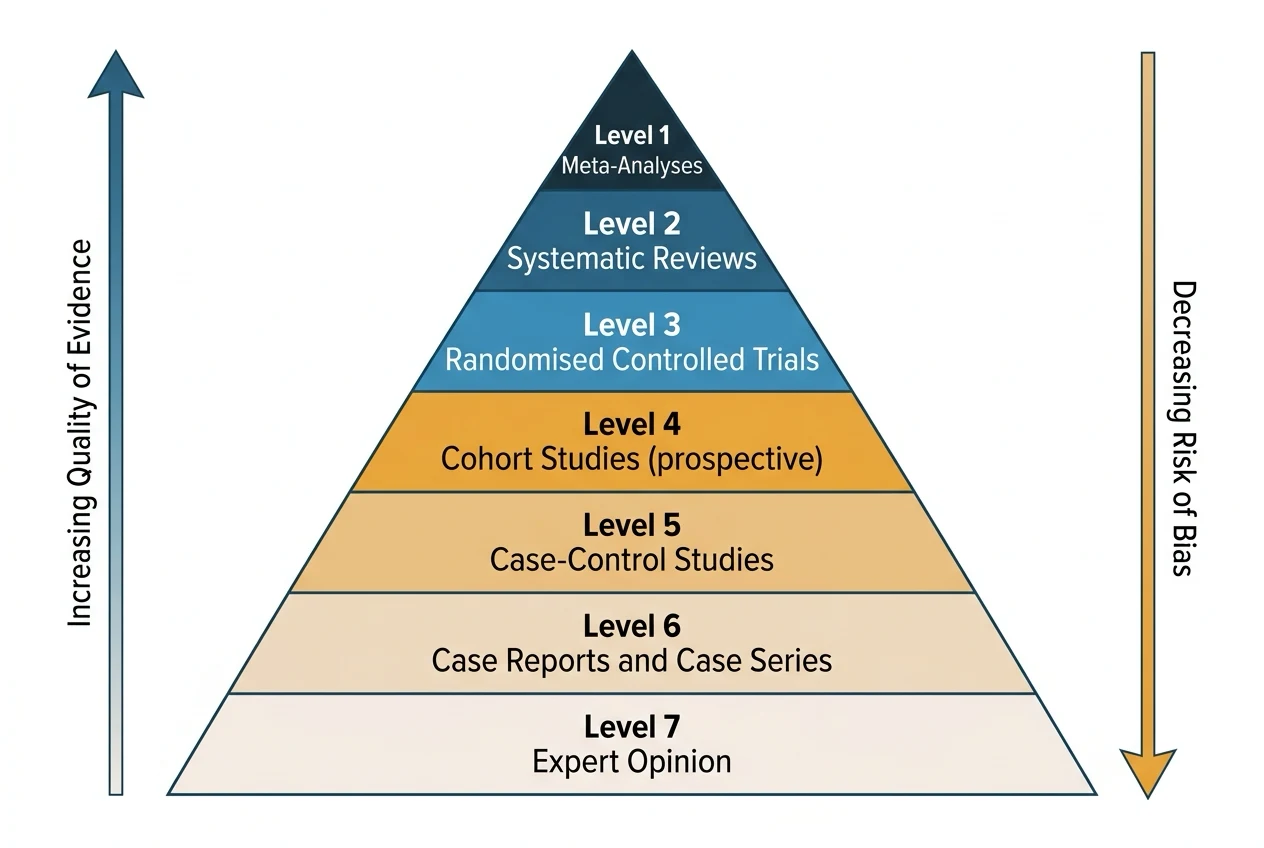
Two principles govern the pyramid. First, higher is not always better — the best design is the one that answers the question (a case-control study is the right design for a rare adverse effect). Second, the apex is only as good as the trials beneath it: a meta-analysis of flawed RCTs produces a precise but wrong answer [1].
Case reports and case series
A case report describes a single patient; a case series describes a small group with the same condition or outcome. Both are descriptive — they have no control group and no denominator, so they cannot measure risk or establish causality. Their value is hypothesis-generating: they are often the first signal of a new disease, a rare drug side-effect, or a novel technique. Malignant hyperthermia was first recognised as a cluster of case reports. Their weakness is that they are subject to publication and selection bias, and an uncontrolled observation can mislead — a reported improvement may reflect the natural history of the disease rather than any intervention. [1]
Case-control studies
A case-control study is retrospective: it starts with the outcome (cases) and a matched group without the outcome (controls), then looks back for the exposure. It reports an odds ratio (the odds of exposure in cases divided by the odds of exposure in controls). Its strength is efficiency for rare diseases or rare outcomes — a cohort study would need to follow tens of thousands to capture a handful of events, whereas a case-control study assembles the cases directly. Its weakness is recall bias (cases recall exposures differently from controls) and the difficulty of choosing valid controls. Case-control is the classical design for rare adverse drug reactions and for investigating anaesthetic-related harm [4].
Cohort studies
A cohort study is prospective: it starts with the exposure and follows participants forward in time to observe the outcome. It reports a relative risk (the incidence in the exposed divided by the incidence in the unexposed). Cohort studies are well suited to common exposures and rare outcomes, and — because exposure is recorded before the outcome — they establish temporality, a prerequisite for causality. Their weaknesses are selection bias (the groups may differ in ways other than exposure) and confounding (a third factor drives both exposure and outcome), which randomisation in an RCT is specifically designed to defeat. A surgical cohort can map the natural history and risk factors of a condition or intervention over time [4][5].
Cross-sectional studies
A cross-sectional study takes a snapshot of a population at one time point, recording exposure and outcome simultaneously. It reports prevalence, not incidence. Because exposure and outcome are measured together, cross-sectional studies cannot determine temporality or causality — they can show association but not which came first. They are cheap and fast, useful for estimating the burden of a problem (for example, the prevalence of residual postoperative symptoms at a single clinic visit) and for generating hypotheses for stronger designs [6].
Randomised controlled trials
The randomised controlled trial (RCT) is the gold standard for evaluating a therapeutic intervention. Patients are randomly allocated to intervention or control, so that — in a large enough trial — known and unknown prognostic factors are distributed equally between groups, minimising confounding and selection bias. Four design features protect validity: [1]
- Randomisation — distributes confounders equally; the only method that controls for unknown confounders.
- Allocation concealment — ensures the randomisation sequence cannot be foreseen, preventing selection of which patient goes into which group.
- Blinding — masking participants and clinicians (performance bias) and outcome assessors (detection bias); a double-blind design addresses both.
- Intention-to-treat (ITT) analysis — analysing every patient in the group to which they were randomised, regardless of the treatment actually received, which preserves the equal distribution of confounders and protects against attrition bias. [1]
The CONSORT statement (Consolidated Standards of Reporting Trials) guides RCT reporting. Examples in the anaesthesia and surgical literature include randomised comparisons of surgical approaches and of perioperative adjuncts [2][3]. The RCT is not always feasible — it may be unethical to randomise a harmful exposure, and some questions (rare outcomes, long latency) are better served by observational designs.
Systematic reviews and meta-analyses
A systematic review is a structured, reproducible synthesis of all the relevant evidence on a question, with an explicit search strategy, inclusion criteria, and appraisal of bias. A meta-analysis adds a statistical pooling of the included studies to produce a single weighted pooled estimate of effect. Reporting follows the PRISMA guideline (Preferred Reporting Items for Systematic Reviews and Meta-Analyses). Three appraisal tools are central: [1]
- Heterogeneity is quantified by I-squared, the proportion of total variation in effect estimates that is due to genuine between-study differences rather than chance; values near zero are consistent, high values call the pooled estimate into question.
- The forest plot displays each study as a point estimate with a confidence interval and a diamond for the pooled estimate.
- The funnel plot screens for publication bias — the tendency for small negative studies to remain unpublished, producing an asymmetric funnel. [1]
The Cochrane Collaboration is the leading producer of systematic reviews in healthcare. The apex of the pyramid is only as reliable as the trials beneath it: garbage in, garbage out [1].
Levels of evidence and GRADE
The GRADE framework (Grading of Recommendations Assessment, Development and Evaluation) rates the quality of evidence for an outcome across all study designs. Randomised trials begin as high quality and observational studies as low, then GRADE moves the rating down for: [1]
- risk of bias,
- inconsistency (heterogeneous results),
- indirectness (population, intervention or outcome differs from the question),
- imprecision (wide confidence intervals, small sample),
- publication bias. [1]
Strong, consistent, direct and precise evidence with no bias can be rated high; evidence with serious limitations falls to moderate, low or very low. GRADE also grades the strength of a recommendation as strong or weak, informed by the quality of evidence, the balance of benefits and harms, patient values, and resource use [7][8].
Bias types
Bias is a systematic error that distorts the estimate of effect. Five principal types: [1]
| Bias type | Definition | Minimised by |
|---|---|---|
| Selection bias | Systematic differences in how groups are assembled | Randomisation, allocation concealment |
| Performance bias | Differences in care provided apart from the intervention | Blinding participants and clinicians |
| Detection bias | Differences in how outcomes are assessed | Blinding outcome assessors |
| Attrition bias | Withdrawals differ between groups | Intention-to-treat analysis |
| Reporting bias | Selective reporting of favourable outcomes | Trial registration, CONSORT reporting |
Randomisation and allocation concealment address selection bias; blinding addresses performance and detection bias; ITT analysis addresses attrition bias; and prospective trial registration plus reporting checklists address reporting bias [2][3].
Critical appraisal of an RCT
A structured appraisal of a randomised trial follows a checklist: [1]
- PICO — frame the question: Population, Intervention, Comparator, Outcome.
- Randomisation method — computer-generated or a random-number table (not odd-even or date of birth, which are predictable).
- Allocation concealment — was the sequence hidden until assignment?
- Blinding — participants, clinicians, outcome assessors; was it feasible and maintained?
- Baseline characteristics — were the groups similar at baseline despite randomisation?
- Primary outcome — was it predefined, clinically important, and measured objectively?
- Effect size — absolute and relative risk reduction, number needed to treat.
- Confidence intervals — do they exclude clinically important effects; is the result precise?
- ITT versus per-protocol — was the primary analysis by intention to treat?
- Generalisability — do the trial patients resemble your patient? [1]
A trial that randomises properly, conceals allocation, blinds all parties, reports an ITT analysis and shows a precise, clinically important effect on a patient-centred outcome provides high-quality evidence [8].
Clinical practice guidelines
Clinical practice guidelines synthesise the totality of evidence into graded recommendations for care. Modern guidelines (NICE in the United Kingdom, the ASA in the United States, and ESAIC in Europe) build on a systematic review and apply a framework such as GRADE to rate both the quality of the evidence and the strength of each recommendation. A strong recommendation backed by high-quality evidence means the benefits clearly outweigh the harms across most patients; a weak recommendation or low-quality evidence means the right choice depends on individual circumstances and patient values. Guidelines are living documents, updated as new evidence appears, and they translate the hierarchy of evidence into actionable perioperative practice — for example, recommendations on antimicrobial prophylaxis are explicitly tied to the GRADE-rated evidence beneath them [7].
Clinical
- Standard approach
- Evidence-based
Alternative
- Modified technique
- Risk-benefit
Red flags
[1]References
- [1]Li P, et al. Regional versus general anesthesia for femur and hip fracture surgery: A meta-analysis of postoperative outcomes and complications J Int Med Res, 2026.PMID 42363795
- [2]Peng J, et al. vNOTES Pelvic Reconstruction and Presacral-Uterosacral Ligament Compound Suspension for Treatment of Multicompartment Pelvic Organ Prolapse: A Three-Year, Three-Arm, Open-Label, Randomized Controlled Trial J Minim Invasive Gynecol, 2026.PMID 42362014
- [3]Dong Y, et al. Auricular Acupressure for Preventing Postoperative Catheter-Related Bladder Discomfort in Male Patients Undergoing Spinal Surgery: A Randomized Controlled Trial Nurs Res Pract, 2026.PMID 42358901
- [4]Khan Z, et al. Does early surgical intervention for type II dens fractures improve survival in octogenarians? A propensity-matched analysis Br J Neurosurg, 2026.PMID 42364088
- [5]Pollmann L, et al. Preoperative proton pump inhibitor therapy and its influence on postoperative complications following major liver resection Langenbecks Arch Surg, 2026.PMID 42363997
- [6]Lou Y, et al. Risk factors for residual low back pain at twelve months after low-temperature plasma radiofrequency ablation in lumbar disc herniation: a retrospective cohort study Int Orthop, 2026.PMID 42364042
- [7]Dona D, et al. Antimicrobial Prophylaxis in Solid Organ and Hematopoietic Stem Cell Transplantation: A Survey Among Member Centers of the European Reference Network TransplantChild Pediatr Transplant, 2026.PMID 42363442
- [8]Tienforti D, et al. Testosterone replacement therapy and cardiovascular safety in older men: lessons from TRAVERSE and beyond J Endocrinol Invest, 2026.PMID 42364061