Anaes · The anaesthetic machine
The anaesthetic machine
Also known as Anaesthetic machine · Anaesthesia workstation · Gas delivery system · Circle system · Pre-use check · Vaporiser
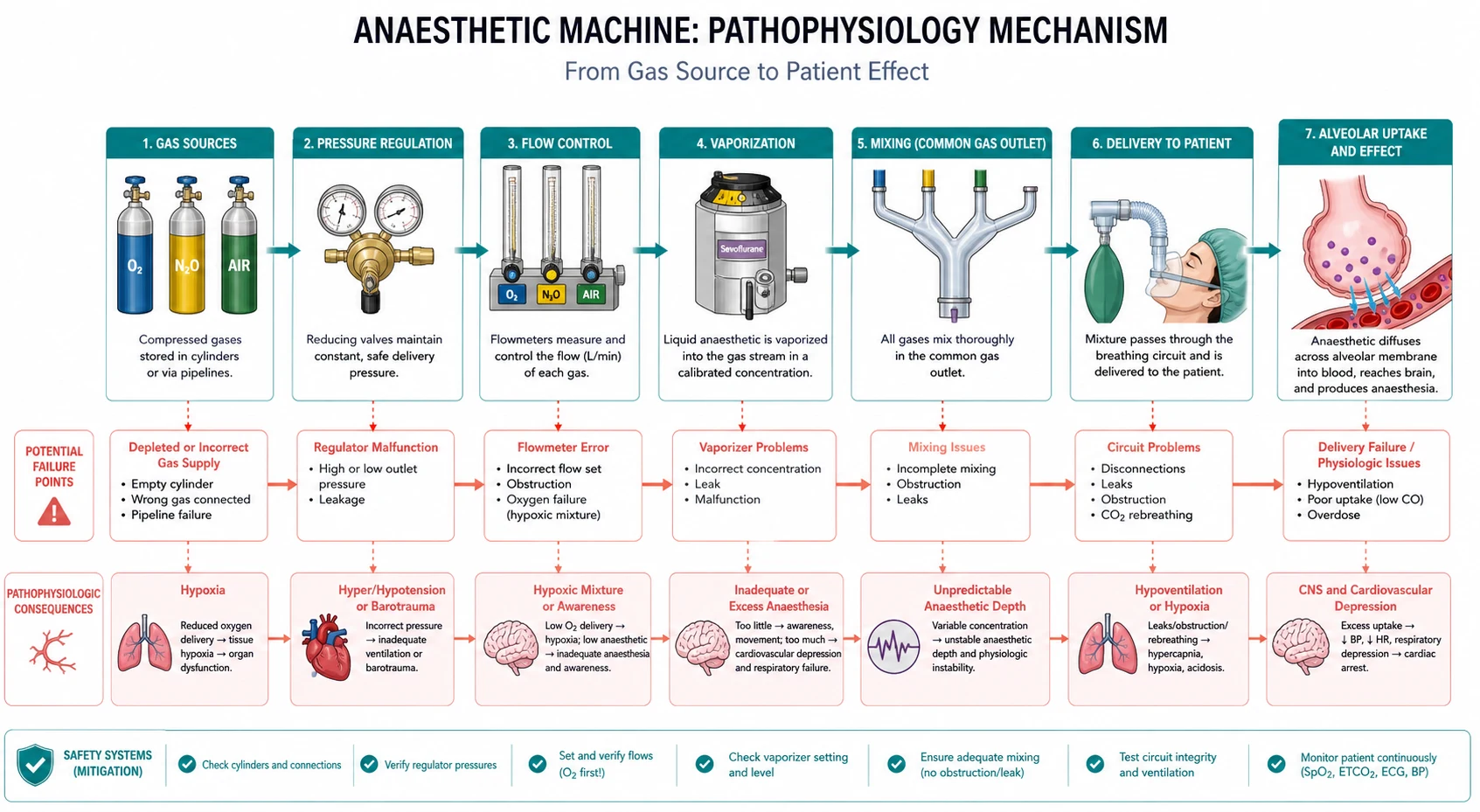
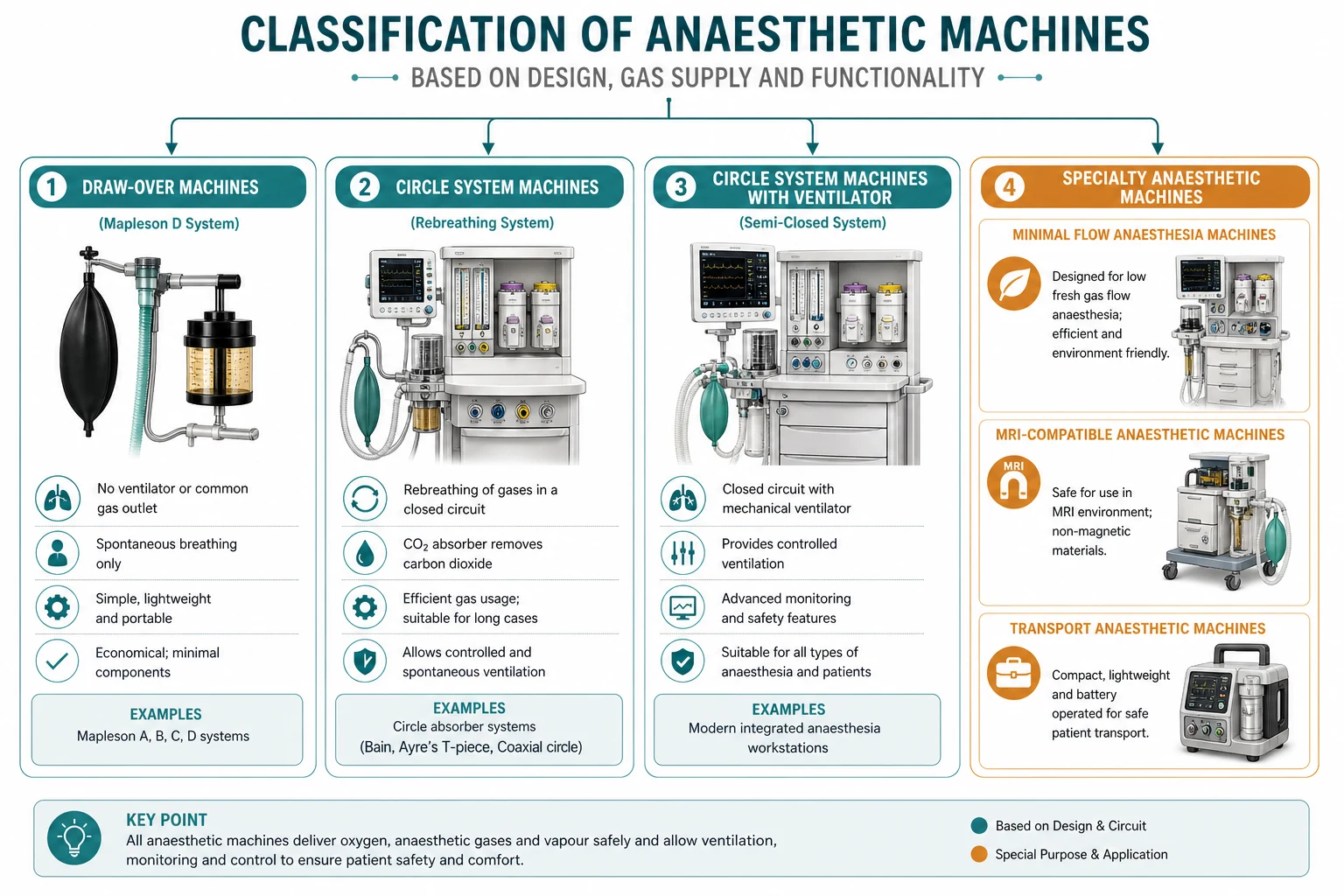
The anaesthetic machine is the device that delivers a precisely controlled mixture of gases (oxygen, nitrous oxide, medical air) and vapourised anaesthetic agents to the patient, removes the carbon dioxide, and provides the means for controlled ventilation. The framework rests on four exam-critical ideas: the gas supply (the pipeline and the cylinder, the pressure regulation, the flowmeters); the vaporiser (the variable-bypass plenum for the volatiles, the heated pressurised for desflurane); the breathing system (the circle system with the unidirectional valves, the CO2 absorber, and the APL valve); and the pre-use check (the AAGBI checklist: the power, the gas supply, the leak test, the flowmeters, the ventilator). Built on the AAGBI checking-equipment guidelines (2012), the closed-circuit review (Parthasarathy 2013), and the anaesthetic-machine assessment test (Tiviraj 2016).
On this page & tools
Your progress
Saved locally on this device.
Target exams
Red flags

Functional layout (learn the order)
- Gas inlets — pipeline (~4 bar) and cylinder yokes with pin index
- Primary pressure regulation — cylinder high pressure → intermediate
- Secondary regulation / filters / non-return valves
- Flowmeters (rotameters or electronic mixers) — O2, air, N2O
- Vaporiser back bar with interlock
- Common gas outlet (CGO) / connection to circle or Mapleson
- Oxygen flush valve (bypasses flowmeters/vaporisers)
- Scavenging interface for waste gas
- Ventilator and bag/ventilator switch on modern workstations
- Monitoring integration and alarms [1]
Gas supply side
| Item | Role |
|---|---|
| Pipeline hoses | Primary supply; NIST/DISS identity |
| Reserve cylinders | Backup; check full and open test then close per local checklist culture |
| Pressure gauges | Pipeline and cylinder displayed |
| Non-return valves | Stop reverse flow between sources |
| Oxygen failure warning | Audible when O2 pressure falls |
Flowmeters
Classical rotameter: variable-orifice tube, float, reading at float top (design-specific). Low flows more laminar (viscosity-dependent); high flows more turbulent (density-dependent) → tubes calibrated for specific gas. Modern machines use electronic flow control and digital displays but the hypoxic guard philosophy remains. [1]
Hypoxic guard / proportioning system: prevents dialling a hypoxic O2:N2O mixture (e.g. minimum ~25% O2 linkage). Still can deliver hypoxia if circuit issues or wrong connections exist — not a complete safety net. [1]
Vaporisers on the back bar
See vaporiser monograph: variable-bypass or desflurane special; interlock; keyed fillers. Positioned downstream of flowmeters so dialled concentrations refer to FGF composition. [1]
Circle breathing system essentials
| Component | Function |
|---|---|
| Inspiratory/expiratory unidirectional valves | Direct flow; prevent rebreathing of CO2 if competent |
| Reservoir bag | Manual ventilation; visual monitoring |
| Adjustable pressure-limiting (APL) valve | Limits pressure in manual mode |
| CO2 absorber (soda lime) | Removes CO2 for rebreathing low-flow anaesthesia |
| Fresh gas inlet | From machine CGO |
| Y-piece to patient | Interface |
| Ventilator bellows / piston | Mechanical ventilation mode |
Soda lime reactions (exam)
CO2 + H2O → H2CO3; then with NaOH/KOH/Ca(OH)2 cascade to CaCO3 + heat + water. Indicators change colour when exhausted. Compound A / carbon monoxide risks with certain agent–absorbent combinations when desiccated — avoid dry absorbent and know sevoflurane/desflurane teaching points. [1]
Oxygen flush
Delivers high-flow O2 (often 35–75 L/min) bypassing vaporisers. Uses: emergency oxygenation, leak checks, filling bellows. Hazards: awareness if used instead of checking empty vaporiser; barotrauma if stuck open on a closed APL; dilutes anaesthetic agent (light anaesthesia). [1]
Scavenging
Collects waste gas from APL/ventilator exhaust to protect staff. Active systems need correct pressure balance — excessive suction can steal gas from the circuit; inadequate allows theatre pollution (N2O/volatiles). [1]
AAGBI 2012 machine check spine (commit structure)
Perform at start of day / after machine change; abbreviated checks between cases [1]:
- Self-inflating bag available
- Perform manufacturer's electronic check if present
- Power supply
- Gas supplies — pipeline and cylinder pressures; O2 cylinder available
- Flowmeters operate; hypoxic guard
- Vaporisers seated, filled, interlock, no leaks
- Breathing system whole: leaks, valves, soda lime, filters
- Ventilator check
- Scavenging
- Suction
- Monitors configured with alarms [1]
Never start without a working alternative ventilation plan (self-inflating bag + oxygen). [1]
Critical incident patterns
| Problem | Clues | First response |
|---|---|---|
| Oxygen pipeline failure | Alarms, falling O2 gauge | Open O2 cylinder; reduce usage; TIVA; bag |
| Wrong gas | Unexpected hypoxia/hyperoxia | Disconnect suspect pipeline; pure cylinder O2 |
| Circle obstruction / stuck valve | High pressures, can't ventilate | Switch to bag, alternative circuit, self-inflating bag |
| Exhausted absorbent | Rising inspired CO2 | Increase FGF, change absorbent |
| Empty vaporiser | Falling ET agent, awareness risk | Refill/replace; deepen with IV agent |
| Stuck O2 flush | Overdistension | Disconnect patient; fix valve |
Low-flow and closed-circuit anaesthesia
Low-flow (<1 L/min FGF) and closed-circuit techniques conserve heat, humidity and agent and cut pollution/cost but demand: competent circle valves, fresh absorbent, accurate monitoring of FiO2 and agent, and understanding that vaporiser output and uptake interact [3]. Oxygen consumption continues (~250 mL/min adult basal) — FGF and FiO2 must cover metabolic use.
SAQ scaffold
- Trace gas from wall to alveolus naming safety devices.
- Explain hypoxic guard limits.
- Circle components and soda lime chemistry outline.
- Oxygen flush uses and dangers.
- Full machine check sequence.
- Pipeline O2 failure management. [1]
Viva phrases
- "What is the first thing on the checklist?" → "A self-inflating bag that works — your brain and hands if the machine dies."
- "Why can the patient still become hypoxic with a proportioning system?" → "It only links flowmeter settings; it cannot fix wrong supply gas, circuit leaks, or oxygen consumption exceeding delivery in closed systems without monitoring." [1]
Common traps
- Checking the machine without a backup bag present.
- Relying on N2O cylinder pressure for contents.
- Leaving vaporiser on during oxygen flush pre-oxygenation confusion.
- Ignoring inspired CO2 as absorbent failure. [1]
Supply safety
- Pin index
- NIST/DISS
- Regulators
- O2 failure alarm
Mixture safety
- Flowmeter design
- Hypoxic guard
- FiO2 monitoring
- Not foolproof alone
Agent safety
- Keyed fillers
- Vaporiser interlock
- Agent analyser
- Fill levels
Ventilation safety
- Self-inflating bag
- Disconnect alarms
- APL competence
- Alternative circuit
Red flags
[1]Primary exam expansion — dense examiner pack
Gas path order (narrate upstream → patient)
Pipeline/cylinder → pressure regulators (high → intermediate ~4 bar) → oxygen failure devices / alarms → flowmeters (rotameters or electronic) with hypoxic guard linkage → vaporiser backbar (selectatec interlock) → common gas outlet → breathing system → patient. Oxygen flush: high-flow O2 from intermediate pressure direct to CGO, bypasses vaporisers and flowmeters — dilutes agent; risk of barotrauma if applied to closed system with APL closed. [1]
Pressure regulation stages
Cylinder ~137 bar → first stage regulator ~4 bar matches pipeline. Second stage/further regulation to flowmeter supply pressures as designed. Pipeline already ~4 bar. Non-return valves prevent backflow into pipeline from cylinder. [1]
Flowmeters physics
Traditional: Thorpe tube, bobbin/ball, gas-specific (different viscosities/densities — not interchangeable). Read at top of bobbin or centre of ball per design. Oxygen downstream of N2O (right-hand O2 in many regions) so leaks preferentially lose air/N2O before losing all O2 — hypoxic guard philosophy. Electronic mixers: solenoids/proportional valves with software; still need O2 analyser. [1]
Hypoxic guard and proportioning
Mechanical chain/link or pneumatic ratio systems prevent setting pure N2O without O2 (e.g. minimum ~25% O2 teaching). Limitations: does not prevent hypoxic mixture from other causes (wrong pipeline gas, low O2 cylinder with air dilution patterns, helium mixes, exhaustedsystems) — hence inspired O2 analysis mandatory. [1]
Vaporiser on backbar
Variable bypass; agent-specific; temperature/flow compensation designs; keyed fillers; interlock allows only one agent. Never tip carelessly (liquid in bypass). Desflurane tech: heated pressurised injector different physics. Check filling, seating, lock, lean/rich tests as per checklist culture. [1]
Breathing system interfaces (machine side)
CGO connector standards; adjustable pressure limiting valve competence; bag; scavenger interface (open/closed active systems) — obstructed scavenger can block expiration. Ventilator switching: bag/ventilator selector errors classic critical incident. [1]
Key safety features list (exam dump structured)
- Colour/PIN/NIST identity. 2. Non-interchangeable connectors. 3. Pressure gauges and regulators. 4. Oxygen failure alarm + N2O cut-off. 5. Hypoxic mixture prevention link. 6. Oxygen analyser. 7. Vaporiser interlock and keyed fillers. 8. Pressure relief valves. 9. Suction independent. 10. Self-inflating bag always present. 11. Disconnect/high-pressure/apnoea alarms on ventilator. 12. Capnography (standard of care monitor, machine-adjacent). [1]
AAGBI machine check philosophy (2012 classic reference in many syllabi)
Power; gas supplies pipeline+cylinder; O2 flush; flowmeters; vaporisers; breathing system leak and unidirectional valves; ventilator; scavenger; probes/monitors; airway equipment; suction. Two-bag test concepts. Check every case/session per local policy — verbalise you would follow current association checklist not memory alone. [1]
Common critical incidents mapped to components
| Incident | Think |
|---|---|
| Cannot ventilate after induction | Circuit disconnect, APL closed wrong, selector wrong, severe bronchospasm, oesophageal tube |
| Rising inspired CO2 | Exhausted absorbent, incompetent valves, inadequate FGF in Mapleson |
| Hypoxia | Wrong gas, low flow O2, shunt patient factors, analyser truth |
| Awareness | Empty vaporiser, leak, TIVA disconnect |
| Barotrauma | O2 flush into closed system, ventilator high pressure, scavenger block |
SAQ: safety features of the anaesthetic machine (10 marks)
Group by supply, mixture, agent, delivery, monitoring, backup ventilation (2 each area). Mention analyser and self-inflating bag explicitly. [1]
Viva
Q: Path of oxygen flush? A: Intermediate pressure O2 to CGO bypassing flowmeters and vaporisers. Q: Why O2 flowmeter downstream? A: Leak proximal loses other gases first — reduces hypoxic mixture risk. Q: Is hypoxic guard enough? A: Necessary not sufficient — need O2 analyser and correct pipeline identity. [1]
High-yield viva battery and numbers lock-in
Oxygen failure protection devices
Supply pressure failure alarm; hypoxic guard links; N2O cut-off or proportioning halt when O2 fails; some systems deliver air; still need cylinder and self-inflating bag. Verbalise the drill every viva. [1]
Two-bag / leak test concepts
Pressurise system to 30 cmH2O, observe stability; operate APL; check ventilator bellows/bag movement; ensure unidirectional valves flutter appropriately; scavenger not obstructing. Electronic machines have self-tests — still understand manual logic. [1]
Electronic vs pneumatic machines
Electronic: flow sensors, electronic mixers, piston/turbine ventilators, comprehensive self-test, data logging; failure modes include power loss (battery backup), software, sensor faults. Pneumatic: more mechanical transparency. Either way: backup ventilation independent of machine power. [1]
Full viva dialogue (additional)
Examiner: Trace oxygen from wall outlet to patient. [1]
Candidate: Pipeline oxygen at about 4 bar enters via an indexed connector and filter, passes non-return valves and pressure sensors for failure alarms, supplies the oxygen flow control and hypoxic protection system, mixes with other gases, passes through the selected vaporiser on the backbar if in circuit, exits the common gas outlet into the breathing system, and after soda lime and valves reaches the patient connection — with continuous inspired oxygen and carbon dioxide monitoring. [1]
Examiner: What are the dangers of the oxygen flush? [1]
Candidate: It delivers high-flow oxygen that bypasses vaporisers, so it dilutes anaesthetic agent and can lighten anaesthesia, and if the system is closed with the APL shut it can rapidly barotrauma the lungs. It is for emergency oxygenation and circuit purge with caution, not routine ventilation. [1]
Exam traps
- Hypoxic guard as sole protection.
- No self-inflating bag on machine check.
- Flush into patient with closed APL.
- Ignoring rising FiCO2 as absorbent/valve problem. [1]
References
- [1]Association of Anaesthetists of Great Britain and Ireland (AAGBI). Checking anaesthetic equipment 2012: association of anaesthetists of Great Britain and Ireland Anaesthesia, 2012.PMID 22563957
- [2]Parthasarathy S, Ravishankar M. The closed circuit and the low flow systems Indian J Anaesth, 2013.PMID 24249885
- [3]Tiviraj S, et al. Development of An Assessment Test for An Anesthetic Machine J Med Assoc Thai, 2016.PMID 27501622