Anaes · Medical gases & gas supply
Medical gases and gas supply
Also known as Medical gas supply · Cylinder · Pipeline · Pin-index · Gas laws · Entonox
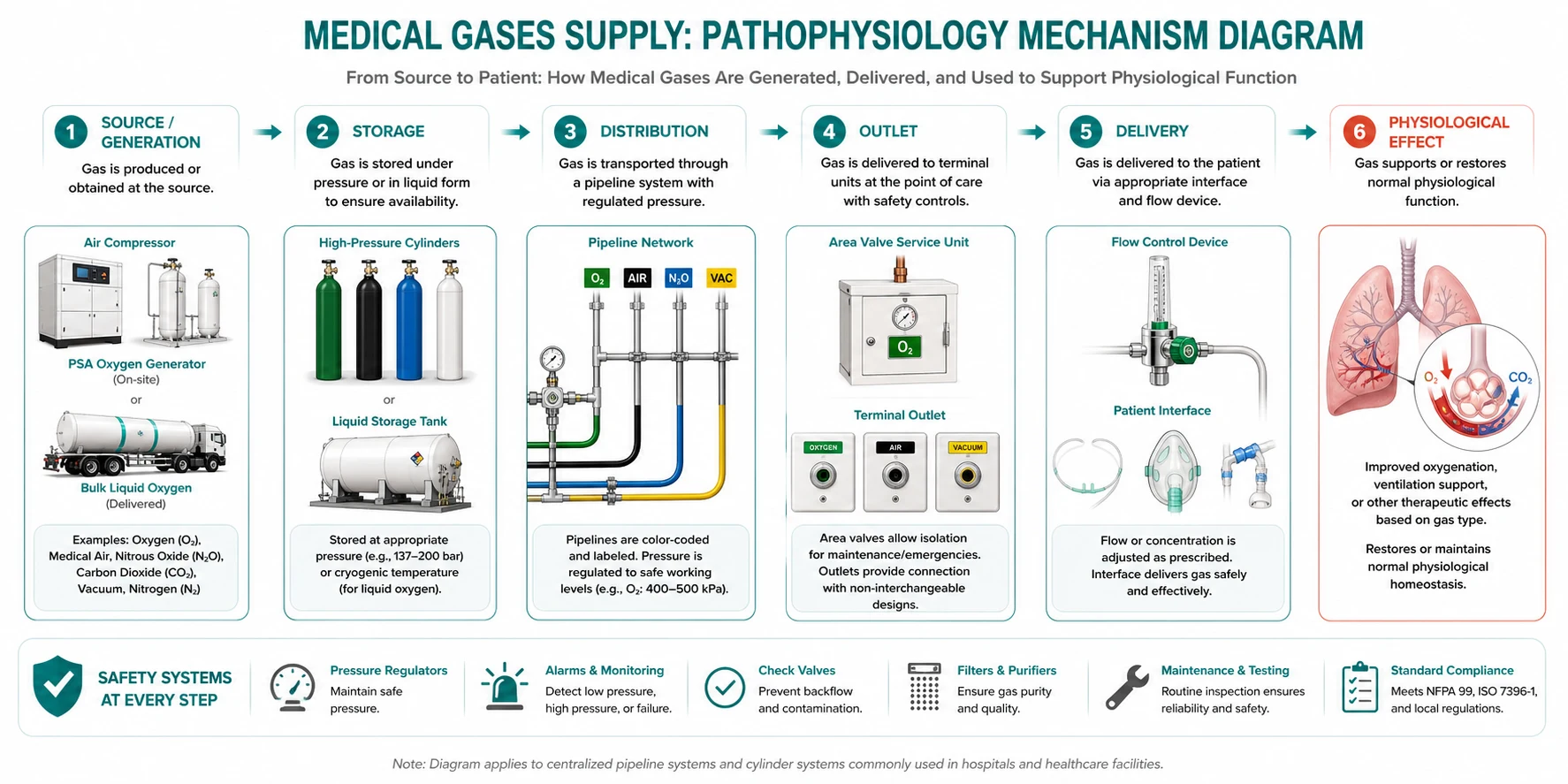
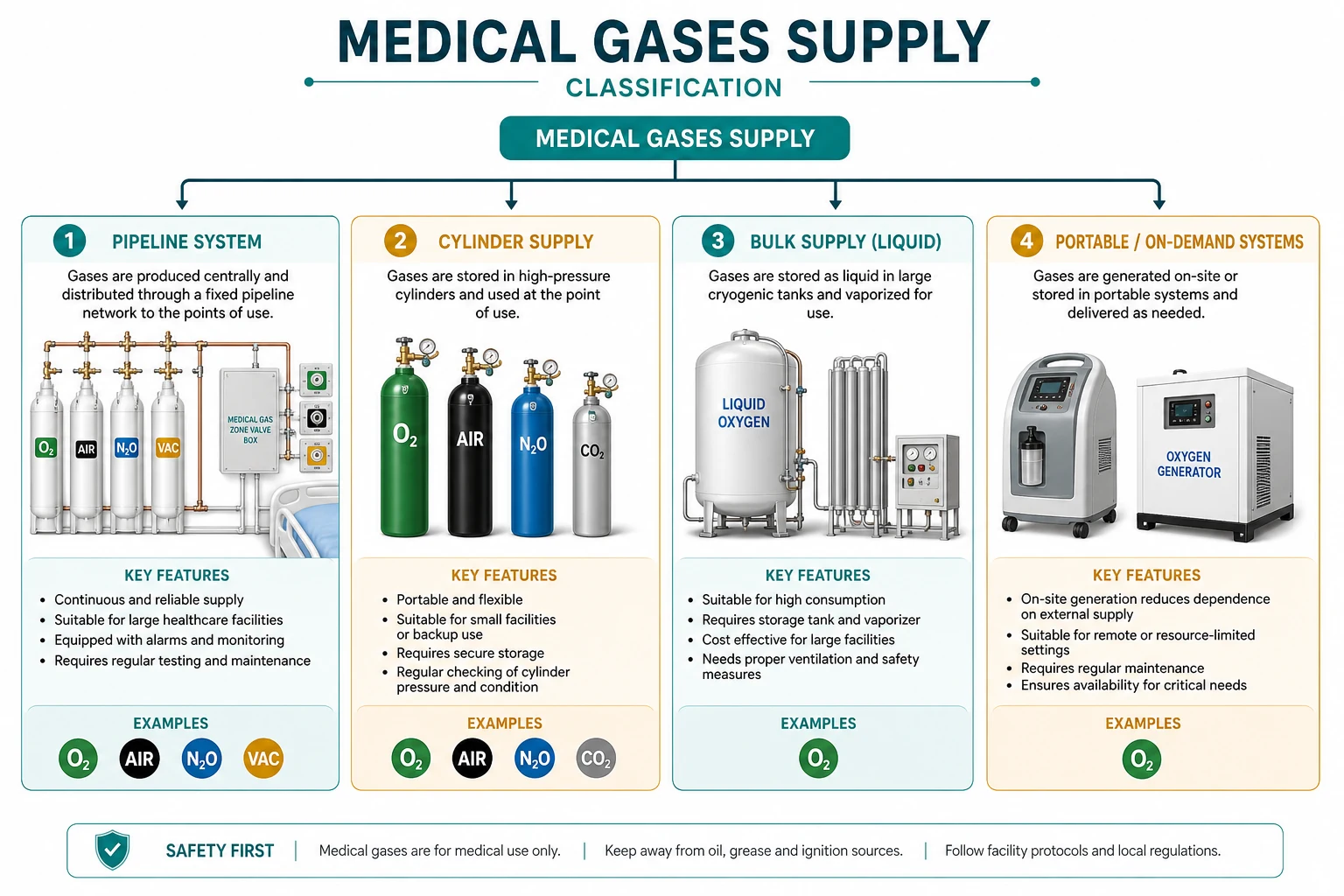
The medical gas supply provides the oxygen, the nitrous oxide, the medical air and the carbon dioxide used in anaesthesia. The framework rests on four exam-critical ideas: the two supply systems — the hospital pipeline (the primary, at 4 bar) and the cylinders (the backup, at up to 200 bar, identified by the colour code and the pin-index); the pressure regulation that reduces the high cylinder pressure to the 4 bar working pressure; the gas laws (the Boyle, the Charles, the universal gas law) that govern the cylinder content and the flow; and the safety systems (the pin-index, the Schrader probe, the colour code, the oxygen failure device) that prevent the wrong gas being delivered to the patient. Built on the AAGBI checking guidelines (2012), the anaesthetic machine assessment (Tiviraj 2016), and the closed-circuit review (Parthasarathy 2013).
On this page & tools
Your progress
Saved locally on this device.
8 MCQs with explanations
Target exams
Red flags

Why this matters
Wrong gas, no gas, or contaminated gas kills. Primary physics/equipment exams test cylinder physics, pin index, pipeline pressures, VIE principles and failure modes [1].
Pipeline supply
| Feature | Detail |
|---|---|
| Source | Central plant rooms / manifolds / VIE |
| Wall outlet pressure (order) | ~4 bar (400 kPa) for O2/air/N2O pipelines (know local) |
| Identity | Gas-specific non-interchangeable connectors (NIST in UK/ANZ tradition; DISS in US tradition) |
| Continuity | Primary + secondary + reserve banks with automatic changeover |
| Alarms | Pipeline pressure failure alarms on machine and central |
Pipeline is the default for theatre; cylinders are the critical backup when pipelines fail. [1]
Cylinder supply and markings
| Topic | Exam facts |
|---|---|
| Construction | Molybdenum steel (or aluminium); tested, stamped with test dates |
| Valve | Pin-index yoke for small cylinders on machines; bullnose for large |
| Pin index | Unique pin pairs for each gas — physical anti-interchange |
| Colour (UK/ISO patterns) | O2 white shoulder; N2O blue; air black/white; CO2 grey — quote local standard carefully |
| Regulator | Two-stage often: high cylinder pressure → intermediate ~4 bar → fine control |
| Bodok seal | Neoprene washer for yoke seal — single use discipline reduces leaks |
Pin index pairs (high-yield examples)
| Gas | Pin positions (classic teaching) |
|---|---|
| Oxygen | 2 and 5 |
| Nitrous oxide | 3 and 5 |
| Air | 1 and 5 |
| CO2 | 1 and 6 |
(Confirm with local charts if examined with a physical yoke.) [1]
Cylinder contents physics
| Gas | State in cylinder | Full pressure (order) | How to know contents |
|---|---|---|---|
| Oxygen | Gas | ~137 bar (size dependent marking) | Pressure proportional (Boyle) |
| Air | Gas | Similar high pressure | Pressure proportional |
| N2O | Liquid + vapour | ~52 bar SVP at room temp | Weigh (tare); pressure flat until liquid gone |
| CO2 | Liquid + vapour | High SVP band | Weigh |
Worked mental model: free litres of O2 ≈ cylinder pressure (bar) × water capacity (L). A 137 bar gauge reading into 2 L water capacity yields order ~270 L free O2 (ignore temperature refinements in first-pass viva). [1]
Vacuum-insulated evaporator (VIE)
Bulk liquid oxygen store: double-walled insulated tank keeping O2 liquid at cryogenic temperature. Heat leak evaporates liquid to supply gas; pressure-raising coils and economiser circuits manage demand. Safety: cold burns, oxygen-enriched fire risk near spills, correct pressure relief. [1]
Medical air and vacuum
- Medical air: compressors with drying/filtration, or cylinder banks; used for ventilators and driving gas.
- Vacuum: pipeline suction — not a gas supply but part of terminal unit set.
- Oxygen concentrators: zeolite sieve, ~90–95% O2 — field/hospital backup niche. [1]
N2O supply special issues
Central N2O pipelines can leak large environmental loads; many hospitals are decommissioning or monitoring N2O manifolds carefully. Entonox (50% N2O/50% O2) has its own cylinders and demand valves; separates below critical temperature if stored cold — must re-mix by inversion/warming before use. [1]
Safety systems checklist (viva list)
- Gas-specific connectors and pin index
- Colour coding + name labels
- Pressure regulators and non-return valves
- Pipeline vs cylinder pressure gauges
- Oxygen failure alarm / hypoxic guard on machine
- Reserve cylinders checked full and seated
- Anti-confusion of air vs oxygen outlets
- Fire safety in oxygen-rich environments [1]
Failure modes and response
| Failure | Immediate action |
|---|---|
| Pipeline O2 failure | Open O2 cylinder; self-inflating bag with cylinder/wall alternative; total IV if needed; fix supply |
| Cross-connection (wrong gas) | Critical incident — pure O2 from known cylinder, disconnect pipeline, investigate |
| Empty N2O assumed full by pressure | Weigh / replace; never trust flat N2O gauge as full |
| VIE low contents | Manifold changeover; elective case postponement if both primary and reserve threatened |
SAQ scaffold
- Pipeline vs cylinder pressures and roles.
- Pin index principle with O2 and N2O examples.
- Why O2 gauge shows contents but N2O does not.
- VIE principle.
- Oxygen pipeline failure drill. [1]
Viva phrases
- "How full is the N2O cylinder?" → "Cannot tell from pressure while liquid remains — check weight against tare."
- "What prevents putting N2O on the oxygen yoke?" → "Pin-index safety system — different pin positions." [1]
Common traps
- Quoting US colours for UK exam or vice versa without care.
- Believing N2O pressure falls linearly with use.
- Forgetting cylinder check in machine checklist.
- Entonox stored cold and layered. [1]
Oxygen cylinder
- Permanent gas
- P ∝ contents
- Pin index 2+5
- Essential backup
N2O cylinder
- Liquid + vapour
- Weigh contents
- Pin index 3+5
- Flat pressure plateau
Pipeline
- ~4 bar outlets
- Primary supply
- NIST/DISS identity
- Central alarms
VIE
- Bulk liquid O2
- Cryogenic
- Hospital main store
- Fire/cold hazards
Red flags
[1]Primary exam expansion — dense examiner pack
Hospital oxygen supply chain
| Stage | Description | Failure mode |
|---|---|---|
| VIE (vacuum insulated evaporator) | Bulk liquid O2 cryogenic store | Low contents, ice, pressure build, leaks |
| Manifold cylinders | Backup banks | Empty banks, wrong connections |
| Pipeline ~4 bar | Copper pipes to terminals | Leaks, contamination, wrong gas |
| Terminal units | Wall outlets with indexed connectors | Misconnection if index defeated |
| Machine pipeline inlet | Filters/non-return | Supply failure to machine |
| Cylinder on machine | High-pressure backup | Not opened, empty, wrong pin |
Primary supply usually VIE; automatic changeover manifolds for cylinder banks; alarms at central and theatre. [1]
Pressures and colours (state region)
Pipeline work pressure ~400 kPa (4 bar). Full O2 cylinder ~137 bar (UK size E teaching). Pin index: O2 2+5; N2O 3+5; air 1+5. Colours: know local standard (UK white shoulder O2 modern ISO; older black body/white shoulder teaching still appears in exams — state ISO and that you check label/PIN not colour alone). [1]
Nitrous oxide supply peculiarities
Liquid in cylinders; weigh contents; SVP ~52 bar. Central piped N2O systems have environmental loss and greener anaesthesia issues.[1] />. Scavenging essential for theatre pollution. Entonox manifold separate considerations (Poynting, cold separation).
Safety systems preventing wrong gas
- Pin index safety system (cylinders). 2. NIST/DISS non-interchangeable pipeline connectors. 3. Sleeve index / diameter indexing. 4. Colour and labelling (unreliable alone). 5. Oxygen analyser at common gas outlet / inspired limb — ultimate clinical check. 6. Hypoxic mixture guards on machines (sister leaf). [1]
Oxygen failure drills
Alarms: oxygen supply failure alarm on machine. Immediate actions: open O2 cylinder fully; if still failing, disconnect patient from machine and ventilate with self-inflating bag on independent O2 or room air; call for help; do not rely on N2O; switch to TIVA if volatiles impossible; finish or abort surgery by priority. Pipeline failure hospital-wide: conserve, postpone electives, cylinder logistics. [1]
Vacuum and air
Medical air for ventilators and driving gas; surgical air tools sometimes separate higher pressure. Vacuum for suction — not for scavenging primary in all designs (active scavenging interfaces specific). Never use pipeline oxygen to drive pneumatic tools inappropriately (fire). [1]
Fire and oxygen enrichment
O2 and N2O support combustion. Drapes, lasers, diathermy in O2-rich fields (airway fire triad: oxidiser, fuel, ignition). Reduce FiO2 when safe for laser airway; wet packs; communication. [1]
Cylinder calculation revision
Available L ≈ cylinder pressure (bar) × water capacity (L) for permanent gases. Duration = amount / flow. Always have spare full cylinder checked. [1]
SAQ: safety features of medical gas supply (8 marks)
VIE/pipeline/cylinder hierarchy (2). Pin index and pipeline indexing (2). Pressures (1). Oxygen failure clinical actions (2). Analyser as final check (1). [1]
Viva
Q: How do you know O2 cylinder contents? A: Pressure gauge proportional for O2 (permanent gas). Q: N2O contents? A: Weight. Q: Pipeline pressure? A: About 4 bar. Q: First action total O2 failure? A: Independent ventilation with self-inflating bag — do not fix machine first while apnoeic. [1]
High-yield viva battery and numbers lock-in
Pin index table (minimum)
| Gas | Pins |
|---|---|
| Oxygen | 2 and 5 |
| Nitrous oxide | 3 and 5 |
| Air | 1 and 5 |
| CO2 | 1 and 6 (know exists) |
Check label + pin + analyser — never colour alone. [1]
VIE hazards
Cryogenic burns; oxygen-enriched fire environment; pressure-relief venting; asphyxiation in confined spill of other gases; ice on pipes; incorrect filling. Site outdoors with regulations; trained personnel only. [1]
Pipeline cross-connection nightmare answer
"If the oxygen analyser reads falling FiO2 despite oxygen flowmeter open, I treat as wrong gas or supply failure: do not trust colour, ventilate with independent cylinder/self-inflating bag on known oxygen, abort or secure safe anaesthesia, and quarantine the theatre system for engineering investigation." [1]
Full viva dialogue (additional)
Examiner: Describe the hierarchy of oxygen supply in a hospital. [1]
Candidate: Bulk liquid oxygen in a VIE is usually primary, with automatic manifold cylinder banks as reserve, pipelines delivering about 4 bar to terminal outlets with indexed connectors, and finally cylinders on the anaesthetic machine as the last immediate backup. Alarms operate centrally and at the machine. [1]
Examiner: Why is an oxygen analyser essential if we already have pin index systems? [1]
Candidate: Pin index and pipeline indexing prevent many but not all wrong-gas scenarios — manufacturing errors, defeated indexes, and downstream faults still occur. The analyser measures what the patient is actually about to inspire and is the final physiological safety net. [1]
Exam traps
- Colour as sole identity.
- N2O gauge for contents.
- Troubleshooting machine while patient apnoeic without bagging.
- Forgetting theatre fire risk in O2-rich fields. [1]
Examiner synthesis paragraph
Medical gas safety is identity, pressure and continuity. Hospitals feed theatres from a VIE and manifolds through roughly 4 bar pipelines with non-interchangeable connectors; machines add pin-index cylinders as immediate backup. Oxygen contents follow pressure; nitrous oxide contents follow weight. Pin index oxygen 2 and 5, nitrous oxide 3 and 5 — but the inspired oxygen analyser is the final check because mechanical indexes can fail. On supply failure, open the cylinder and, if needed, abandon the machine for a self-inflating bag on known oxygen before troubleshooting plumbing while the patient is apnoeic. [1]
Worked SAQ mark plan — medical gas safety (8)
Describe VIE pipeline cylinder hierarchy and ~4 bar pipeline pressure (2). Pin index oxygen 2+5 nitrous 3+5 and non-interchangeable pipeline connectors (2). Oxygen pressure proportional to contents versus nitrous weigh (2). Oxygen failure drill with self-inflating bag and analyser as final check (2). [1]
References
- [1]AAGBI, Hartle A, Anderson E. Checking anaesthetic equipment 2012: association of anaesthetists of Great Britain and Ireland Anaesthesia, 2012.PMID 22563957
- [2]Tiviraj S, et al. Development of An Assessment Test for An Anesthetic Machine J Med Assoc Thai, 2016.PMID 27501622
- [3]Parthasarathy S, Ravishankar M. The closed circuit and the low flow systems Indian J Anaesth, 2013.PMID 24249885