Anaes · Applied cardiovascular & respiratory physiology
ADME and routes of drug administration
Also known as ADME · Absorption distribution metabolism excretion · Routes of administration · Bioavailability · First-pass metabolism · pH partition hypothesis
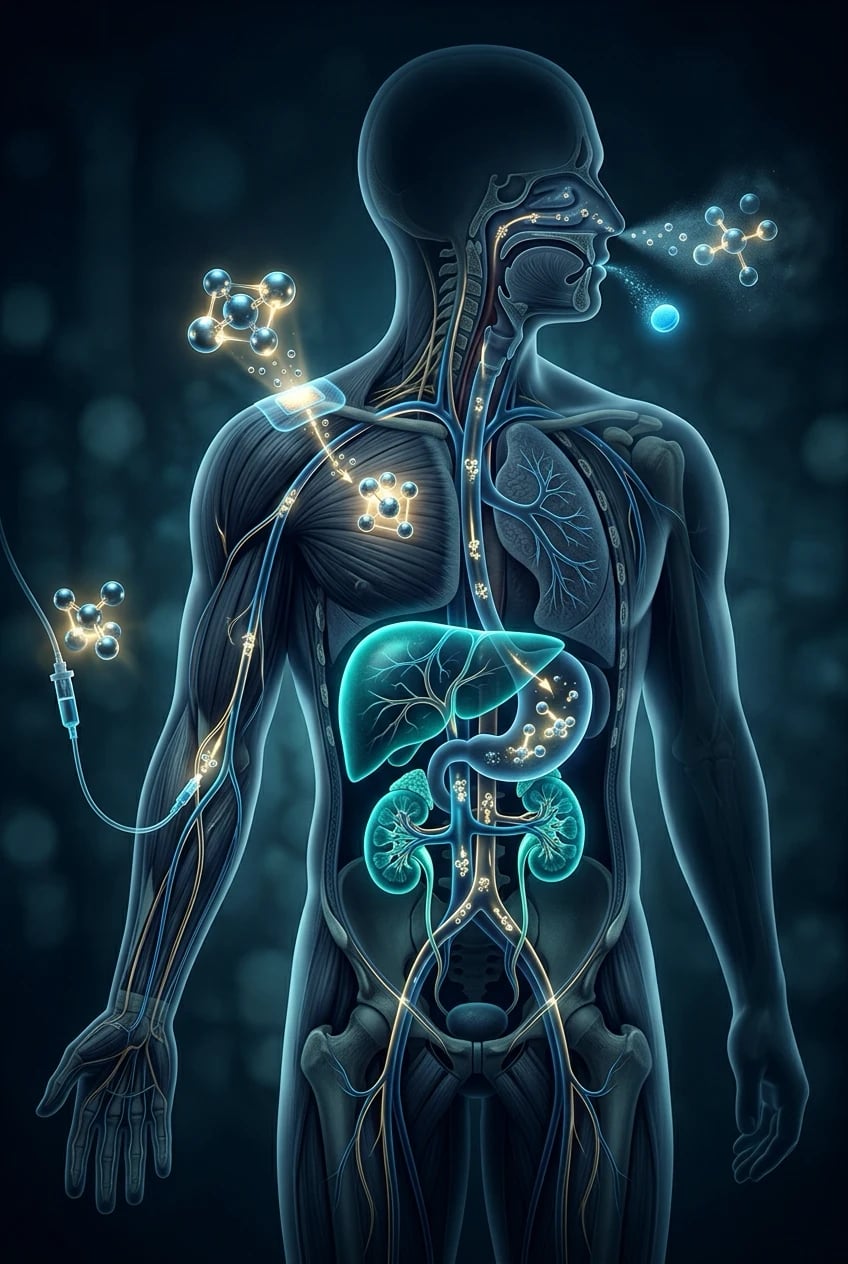
ADME — absorption, distribution, metabolism and excretion — is the pharmacokinetic backbone that determines how much of a drug reaches its site of action, how quickly, and how long it stays. The route of administration sets the starting point of that journey and is one of the most important practical decisions in anaesthetic practice. The framework rests on six exam-critical ideas. First, the four ADME processes are sequential and interactive: a drug must be absorbed into the systemic circulation (unless given intravenously), distributed to its site of action, metabolised (chiefly by the liver) to a more water-soluble form, and excreted (chiefly by the kidney). Second, bioavailability is the fraction of the administered dose that reaches the systemic circulation unchanged; it is 1.0 (100 percent) for an intravenous dose and is reduced for oral drugs by incomplete absorption and by first-pass (presystemic) metabolism in the gut wall, the portal blood and the liver, which is why an oral dose is almost always larger than the equivalent intravenous dose. Third, the common routes differ sharply in onset and bioavailability: intravenous is instantaneous and complete (100 percent bioavailability) but irreversible; intramuscular and subcutaneous are near-complete and take minutes; inhalational is rapid (the lung is a superb absorption surface with a huge area and thin barrier) and titratable; oral is convenient but slow and limited by first-pass metabolism; transdermal is slow and sustained; sublingual and intranasal bypass first-pass metabolism. Fourth, absorption across a biological membrane depends on surface area, blood flow, and most fundamentally on the drug's ionisation — only the unionised (lipid-soluble) fraction crosses lipid membranes, described by the pH partition hypothesis and the Henderson-Hasselbalch equation. Fifth, drug metabolism occurs in two phases: Phase I (oxidation, reduction, hydrolysis, chiefly by the cytochrome P450 superfamily) which often unmasks or introduces a functional group, and Phase II (conjugation with glucuronide, sulphate, acetate or glutathione) which makes the molecule more water-soluble for excretion; many drugs are administered as inactive prodrugs that require Phase I or II conversion to their active form. Sixth, excretion is mainly renal (glomerular filtration, active tubular secretion, and passive tubular reabsorption that is pH-dependent) and biliary, with enterohepatic recirculation prolonging the action of some drugs. Built on the oral S-ketamine pharmacokinetic study (van Mechelen 2026), the CYP450 metaboliser phenotype study (Oskay 2026), the subcutaneous absorption modelling review (Siemiątkowska 2026), the transdermal patch permeation study (Garg 2026), the mycophenolic-acid enterohepatic-recirculation report (Śmiertka 2026), the intranasal administration review (Jafarbeglou 2026), the intestinal-fluid solubilisation and lipophilicity study (Boyanov 2026), and the renal-impairment pharmacokinetic study (Kojima 2026).
On this page & tools
Your progress
Saved locally on this device.
8 MCQs with explanations
Target exams
Red flags
Why this matters to the anaesthetist
The anaesthetist chooses a route of administration for almost every drug given, and the choice is governed by ADME. An intravenous induction agent reaches the brain in one arm-to-brain circulation because it bypasses absorption entirely; an oral premedication is delayed and attenuated by first-pass metabolism; an inhalational agent is titratable minute-to-minute because the lung offers an enormous, thin absorption surface; a neuraxial opioid acts locally because it is placed beside its target. Understanding absorption, bioavailability, first-pass metabolism, ionisation, the two phases of biotransformation, and renal versus biliary excretion is what lets you predict onset, peak, duration and dose — and dose correctly in organ failure [1][8].
The four processes: ADME
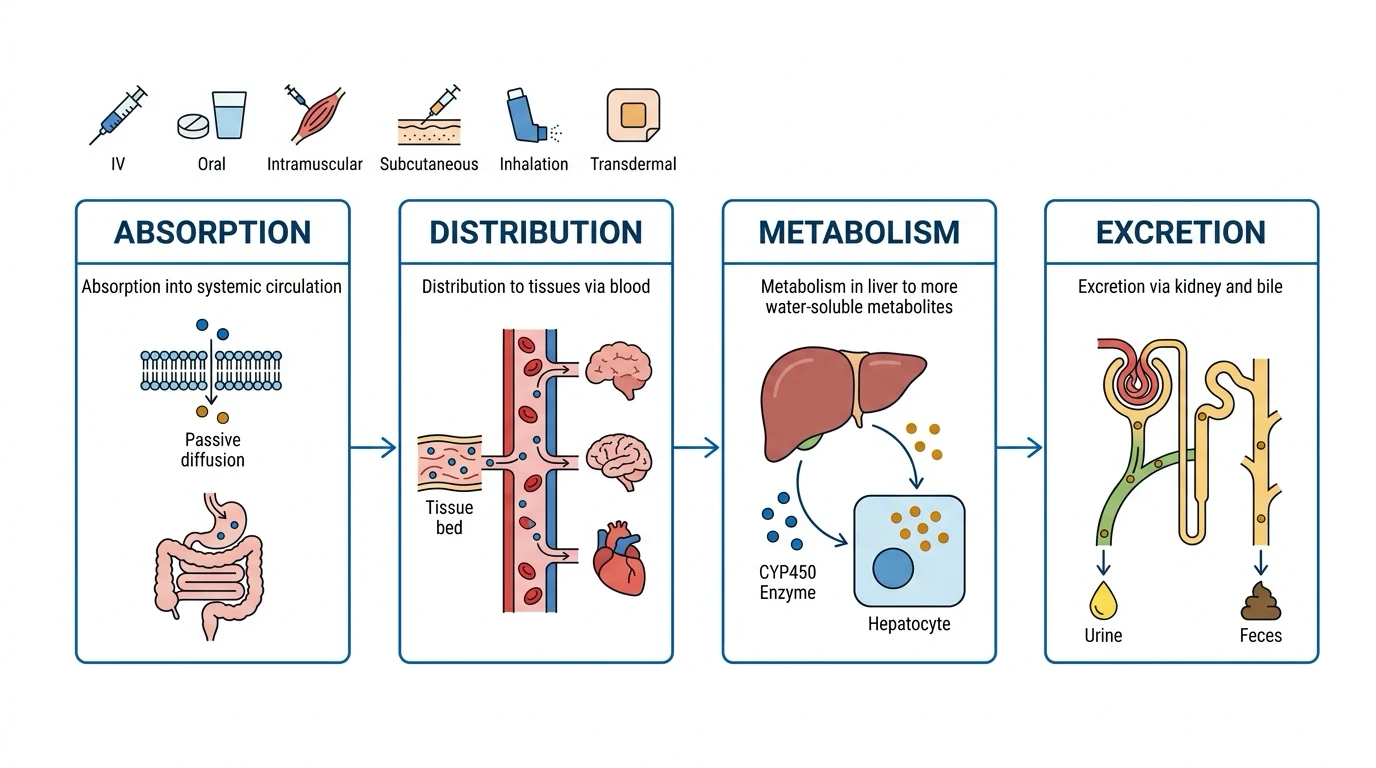
A drug's fate in the body is described by four sequential, interactive processes: [1]
- Absorption — the movement of the drug from its site of administration into the systemic circulation. For an intravenous dose this step is bypassed entirely (the drug is placed directly into the blood).
- Distribution — the reversible transfer of drug from the blood to the tissues, determined by blood flow, capillary permeability, the drug's lipophilicity and protein binding, and described by the volume of distribution.
- Metabolism — the chemical transformation of the drug, chiefly by the liver, generally to a more polar (water-soluble) and less active form that can be excreted.
- Excretion — the irreversible removal of the drug or its metabolites from the body, chiefly by the kidney (in the urine) and the liver (in the bile). [1]
Together, absorption and distribution determine onset, while metabolism and excretion determine offset and duration. The interplay of all four determines the plasma concentration at any moment. [1]
Routes of administration
| Route | Onset | Bioavailability | Anaesthetic examples |
|---|---|---|---|
| Intravenous (IV) | Seconds (one arm-to-brain circulation) | 100 percent (by definition) | Propofol, fentanyl, rocuronium |
| Inhalational | Minutes (rapid, titratable) | High (lung absorption surface) | Sevoflurane, desflurane, nitrous oxide |
| Intramuscular (IM) | 5 to 20 minutes | Near-complete | Ketamine, suxamethonium (historically) |
| Subcutaneous (SC) | Slow, sustained | Near-complete | Heparin, local anaesthetic infiltration [3] |
| Sublingual | Minutes (bypasses first-pass) | High | Glyceryl trinitrate, buprenorphine |
| Oral | 30 to 90 minutes | Variable (reduced by first-pass) | Paracetamol, diazepam, oral ketamine [1] |
| Rectal | 15 to 30 minutes | Variable (partial first-pass bypass) | Paracetamol, diclofenac (paediatrics) |
| Transdermal | Hours (slow, sustained) | Variable | Fentanyl patch, lidocaine patch, GTN patch [4] |
| Intranasal | Minutes (bypasses first-pass) | Moderate to high | Dexmedetomidine, fentanyl, ketamine (paediatrics) [6] |
| Neuraxial (epidural/intrathecal) | Minutes (local effect) | Local only | Bupivacaine, fentanyl, intrathecal morphine |
The intravenous route is the anaesthetist's default for inducing and maintaining anaesthesia because it is instantaneous, complete and titratable — but it is also irreversible: once injected, the drug cannot be retrieved. The inhalational route shares the titratability advantage because the lung is an enormous, thin, well-perfused absorption surface, so alveolar and blood partial pressures equilibrate rapidly. [1]
Bioavailability and first-pass metabolism
Bioavailability (F) is the fraction of the administered dose that reaches the systemic circulation in the active, unchanged form. By definition the intravenous dose has a bioavailability of 1.0 (100 percent). For every other route, bioavailability is less than 1 because some drug fails to be absorbed and some is eliminated before reaching the systemic circulation. [1]
The most important determinant of low oral bioavailability is first-pass (presystemic) metabolism. Drugs absorbed from the gut travel in the portal vein to the liver before entering the systemic circulation, and a fraction is metabolised on that first pass through the gut wall, the portal blood and the liver. Drugs with a high hepatic extraction ratio — propranolol, morphine, lidocaine, verapamil — are so extensively metabolised on first pass that their oral bioavailability is low (often 20 to 40 percent), which is why the oral dose is many times the intravenous dose. Oral S-ketamine, for example, has a bioavailability of only about 10 to 20 percent because of extensive first-pass metabolism to norketamine [1]. Routes that bypass the portal circulation — sublingual, intranasal, transdermal, rectal (partially) — avoid first-pass metabolism and so achieve higher bioavailability.
Absorption: what determines it
Absorption across a biological membrane depends on: [1]
- Surface area. The larger the absorbing surface, the faster the absorption. The lung alveoli (about 70 square metres) and the intestinal villi are the two great absorption surfaces in the body, which is why inhaled and oral drugs are absorbed so efficiently.
- Blood flow. A well-perfused site maintains a concentration gradient that favours absorption (the absorbed drug is swept away, keeping the local concentration low). Muscle is better perfused than subcutaneous fat, so intramuscular absorption is faster than subcutaneous.
- The drug's physicochemical properties — above all its ionisation and lipophilicity. Only the unionised, lipid-soluble fraction of a drug crosses a lipid membrane readily, a relationship governed by the pH partition hypothesis [7].
- Formulation and route. Subcutaneous absorption is predictable enough to be modelled quantitatively for depot and long-acting injectables [3]; transdermal absorption is limited by the stratum corneum and is enhanced by formulation (patches, penetration enhancers) [4].
Ionisation and the pH partition hypothesis
Most drugs are weak acids or weak bases that exist in equilibrium between an unionised (lipid-soluble, membrane-permeant) and an ionised (water-soluble, membrane-impermeant) form. The ratio of the two forms at a given pH is set by the drug's pKa and the Henderson-Hasselbalch equation: [1]
- For a weak acid, the unionised form predominates in an acidic environment.
- For a weak base, the unionised form predominates in an alkaline environment. [1]
Because only the unionised form crosses lipid membranes readily, absorption is favoured where the drug is unionised. Aspirin (a weak acid) is largely unionised in the acidic stomach and is absorbed there; most drugs, being weak bases, are unionised in the alkaline small intestine and are absorbed there despite the larger surface area of the bowel. This also underlies ion trapping: a weak acid concentrates in an alkaline compartment (e.g. salicylate trapped in alkaline urine) and a weak base in an acidic compartment (e.g. local anaesthetic trapped in the acidic inflamed tissue, which is why infection reduces local-anaesthetic efficacy). The solubility and permeation of an oral drug in intestinal fluid depend directly on its charge state and lipophilicity [7].
Distribution
Once in the systemic circulation, a drug distributes to the tissues according to: [1]
- Blood flow. Highly perfused organs (brain, heart, kidneys, liver) receive the drug first — which is why an intravenous induction agent puts the patient to sleep within one arm-to-brain circulation.
- Capillary permeability. Lipid-soluble drugs cross capillary walls (and the blood-brain barrier); water-soluble and ionised drugs do not.
- Protein binding. Only the unbound (free) drug is pharmacologically active and available for distribution, metabolism and excretion. Acidic drugs bind albumin; basic drugs bind alpha-1-acid glycoprotein. Hypoalbuminaemia (liver disease, critical illness) raises the free fraction of highly bound drugs, increasing their effect and toxicity.
- Lipophilicity and tissue binding. Lipophilic drugs (thiopental, fentanyl) distribute extensively into fat, giving a large volume of distribution. [1]
Metabolism: Phase I and Phase II
Drug metabolism occurs chiefly in the liver (but also the gut wall, lung, kidney and plasma) and proceeds in two phases: [1]
- Phase I — oxidation, reduction or hydrolysis, most often catalysed by the cytochrome P450 (CYP) superfamily of enzymes (notably CYP3A4, CYP2D6, CYP1A2, CYP2C9). Phase I usually unmasks or introduces a polar functional group (hydroxyl, amine, sulphydryl), making the drug modestly more water-soluble. It can inactivate the drug, activate a prodrug, or generate a reactive (toxic) intermediate. Genetic polymorphism in CYP enzymes — the basis of poor, intermediate, extensive and ultra-rapid metaboliser phenotypes — explains much inter-individual variability in drug response [2].
- Phase II — conjugation of the drug (or its Phase I metabolite) with a polar endogenous molecule: glucuronic acid (glucuronidation), sulphate, acetate, glutathione or an amino acid. Phase II almost always produces a more water-soluble, pharmacologically inactive conjugate destined for excretion.
Prodrugs are administered in an inactive form and require metabolic conversion to become active — for example, codeine (to morphine by CYP2D6), enalapril (to enalaprilat), prednisone (to prednisolone), and levodopa (to dopamine). Because activation depends on a functional metabolic enzyme, prodrug action is impaired in severe liver disease and altered by CYP polymorphism. [1]
Excretion
Excretion removes the drug or its metabolites from the body: [1]
- Renal excretion has three mechanisms: glomerular filtration of the unbound (free) drug; active tubular secretion of acids and bases by separate proximal-tubule transporters (which is why probenecid competes with penicillin for the acid transporter and prolongs its action); and passive tubular reabsorption, which is pH-dependent (ionised drug is trapped in the tubule and excreted, the basis of urinary alkalinisation in salicylate poisoning). Renal impairment prolongs the half-life of renally cleared drugs and requires dose reduction or avoidance [8].
- Biliary excretion — larger or conjugated molecules are secreted into bile and eliminated in the faeces. Some drugs secreted into bile are reabsorbed from the gut (after bacterial deconjugation) and returned to the liver, establishing an enterohepatic recirculation that prolongs the drug's residence time and half-life. Mycophenolic acid is the classic example — its enterohepatic recirculation produces secondary plasma peaks and contributes to its variable exposure after transplantation [5]. Morphine, oral contraceptives and the benzodiazepines undergo enterohepatic recirculation to varying degrees.
Special routes for anaesthesia
- Intravenous — instantaneous, complete, titratable, irreversible. The default for induction and bolus maintenance.
- Inhalational — rapid equilibration between alveolus, blood and brain via the huge thin alveolar surface; titratable minute-to-minute; eliminated largely unchanged by exhalation for the poorly soluble agents.
- Neuraxial (epidural, intrathecal) — drug placed beside the nerve roots or spinal cord for a selective local effect with low systemic concentration; intrathecal morphine provides prolonged analgesia; bupivacaine for surgical anaesthesia.
- Intramuscular and subcutaneous — near-complete absorption over minutes (IM) or more slowly and predictably (SC), useful when IV access is unavailable [3].
- Transdermal — sustained slow absorption over hours to days, ideal for stable background analgesia (fentanyl patch) but useless for acute titration [4].
- Sublingual and intranasal — bypass first-pass metabolism for rapid effect: sublingual glyceryl trinitrate for angina; intranasal dexmedetomidine, fentanyl or ketamine for needle-free paediatric sedation [6].
Factors that alter ADME
- Age. Neonates have immature hepatic metabolism (especially glucuronidation — the basis of grey-baby syndrome from chloramphenicol) and reduced glomerular filtration; the elderly have reduced renal clearance and a higher free fraction from hypoalbuminaemia.
- Liver disease. Reduced Phase I and Phase II metabolism and reduced albumin synthesis prolong the action of hepatically cleared drugs (benzodiazepines, opioids, most induction agents).
- Renal disease. Reduced clearance of renally cleared drugs and their active metabolites (e.g. morphine-6-glucuronide, many neuromuscular blockers) requires dose reduction [8].
- Pharmacogenomics. CYP polymorphism alters Phase I metabolism and prodrug activation, producing poor or ultra-rapid metabolisers with correspondingly exaggerated or absent drug responses [2].
Clinical
- Standard approach
- Evidence-based
Alternative
- Modified technique
- Risk-benefit
Red flags
[1]References
- [1]van Mechelen JC, et al. Pharmacokinetics and pharmacodynamics of orally administered S-ketamine in healthy participants J Psychopharmacol, 2026.PMID 42345469
- [2]Oskay A, et al. CYP450 Metabolizer Phenotypes in a Turkish Emergency Cardiac Patient Cohort: A Descriptive Pharmacogenomic Study Pharmaceuticals (Basel), 2026.PMID 42356431
- [3]Siemiątkowska A, et al. Pharmacokinetic modeling and quantitative prediction of subcutaneous absorption of antibody-based therapeutics - An update Adv Drug Deliv Rev, 2026.PMID 42251864
- [4]Garg I, et al. Understanding drug diffusion and permeation in transdermal patches: A kinetic perspective Eur J Pharm Biopharm, 2026.PMID 42315040
- [5]Śmiertka A, et al. Elevated mycophenolic acid levels after kidney transplantation: avoiding unnecessary dose reduction through team-based TDM interpretation Folia Med Cracov, 2026.PMID 42295072
- [6]Jafarbeglou M, et al. A Multispecies Systematic and Critical Review of Intranasal Administration in Veterinary Anaesthesia and Emergency Care: Promising Evidence and Overlooked Challenges Vet Med Sci, 2026.PMID 42313899
- [7]Boyanov T, et al. Drug Solubilization in Simulated Intestinal Fluids vs Lipophilicity: Does Charge Matter? Mol Pharm, 2026.PMID 41574874
- [8]Kojima T, et al. Effects of renal impairment on the pharmacokinetics, safety, and tolerability of pudexacianinium (ASP5354) after IV administration: a mechanistic exploration Eur J Clin Pharmacol, 2026.PMID 42032338