Anaes · Applied cardiovascular & respiratory physiology
Applied physiology of the elderly
Also known as Geriatric physiology · Ageing and anaesthesia · Frailty · Elderly pharmacology · MAC reduction in elderly · Postoperative cognitive dysfunction
Ageing changes every organ system, reducing physiological reserve and increasing the sensitivity to anaesthetic drugs, and the elderly patient is the fastest-growing surgical demographic. The framework rests on five exam-critical ideas: the cardiovascular system loses vessel elasticity (raising systolic BP, lowering diastolic, widening pulse pressure) and beta-receptor sensitivity, reducing cardiac reserve; the respiratory system loses chest wall compliance and hypoxic ventilatory drive, worsening V/Q mismatch and increasing postoperative pulmonary complications; the renal and hepatic systems decline (reduced GFR, reduced drug clearance), prolonging drug action; the central nervous system loses mass and sensitivity (MAC falls 30 to 50 percent from age 20 to 80, and the elderly are at high risk of postoperative delirium and cognitive dysfunction); and pharmacokinetics change (more body fat increases Vd for lipophilic drugs, less albumin raises free drug fraction, and slower clearance prolongs every drug) — so the elderly need less drug, given more slowly, with careful monitoring. Built on the elderly intrathecal morphine study (Bursik 2026), the geriatric pulmonary complications study (Han 2026), the frailty outcomes study (Cho 2026), the age-vs-risk study (Girnyi 2026), the frailty cardiac risk study (Chatziperi 2026), and the EEG sedation study (Popovici 2026).
On this page & tools
Your progress
Saved locally on this device.
8 MCQs with explanations
Target exams
Red flags
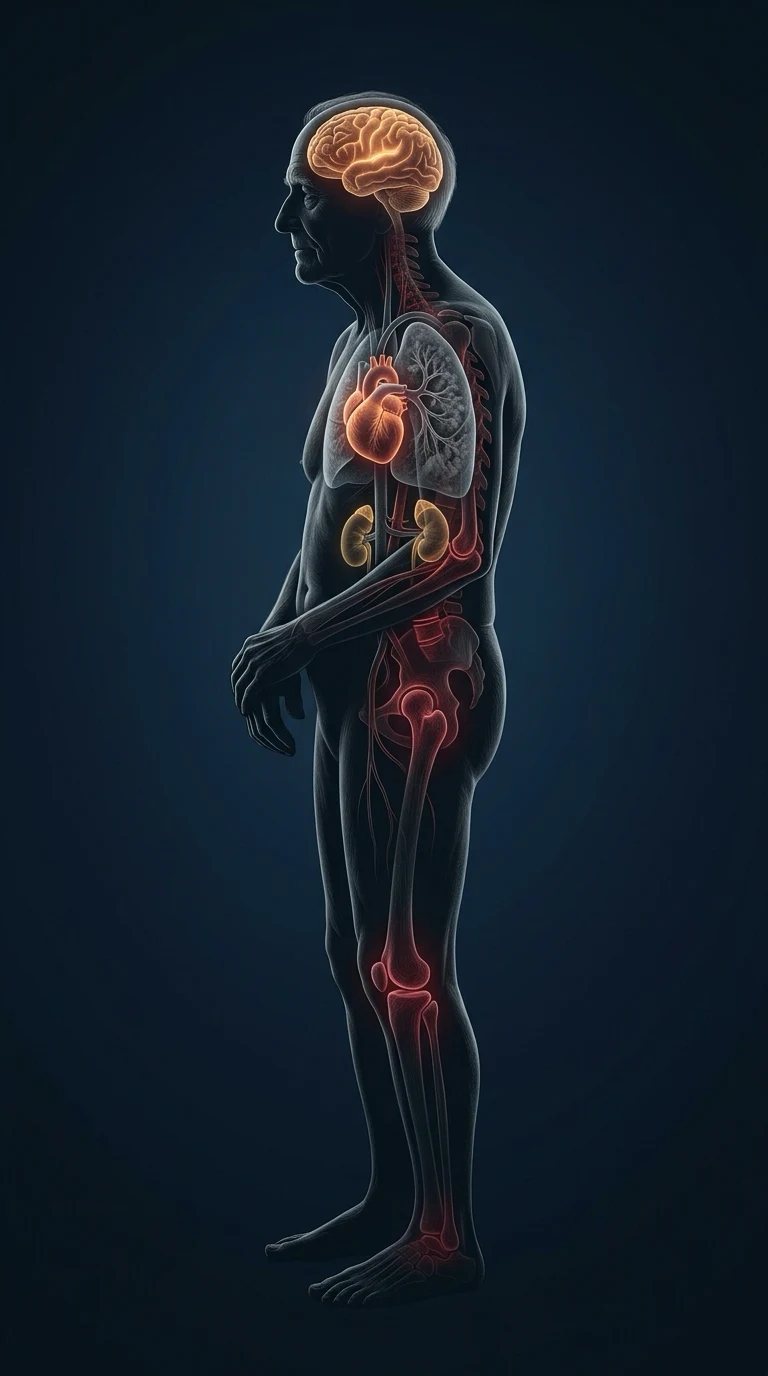
Why this matters to the anaesthetist
The elderly dominate elective and emergency lists. Primary wants system-by-system physiological change; Final wants dose reduction, aspiration risk, delirium, fragility of blood pressure, and renally cleared drugs. Age is not a disease — reserve loss is.[1]
One-liner: Stiffer arteries and heart, blunted β-response, lower FRC near CC, falling GFR, reduced hepatic flow, lower MAC, higher body fat and lower albumin — give less drug more slowly and expect less autoregulatory buffer. [1]
Cardiovascular ageing
- ↑Arterial stiffness → ↑pulse pressure, higher SBP, higher LV afterload.
- LV hypertrophy/diastolic dysfunction common → preload sensitive; atrial kick matters (AF poorly tolerated).
- β-receptor responsiveness declines; reliance more on Frank–Starling and vascular tone.
- Baroreflex blunted → orthostatic and post-induction hypotension.
- Maximal HR falls (~220 − age teaching).
- Coronary disease prevalence high even if silent. [1]
Anaesthetic: slow titration, careful vasopressors ready, maintain preload, avoid extreme tachycardia/bradycardia, treat AF seriously. [1]
Respiratory
- Loss of elastic recoil; chest wall stiffer → compliance pattern changes, ↑RV, ↑CC.
- Closing capacity rises toward/above FRC when supine — basal airway closure, V/Q mismatch, faster desaturation.
- ↓ventilatory response to hypoxia/hypercapnia.
- Weaker muscles and cough → sputum retention, atelectasis, pneumonia risk.
- Blunted protective airway reflexes → aspiration risk. [1]
Anaesthetic: preoxygenate carefully, head-up, PEEP/recruitment thinking, multimodal analgesia to protect breathing, avoid residual NMBA. [1]
Renal
- GFR declines ~1 mL/min/year after ~40 (variable) — creatinine may look “normal” with low muscle mass.
- Impaired concentrating/diluting ability; Na handling less flexible → fluid/electrolyte vulnerability.
- Renally cleared drugs accumulate (morphine-6-G, gabapentinoids, some antibiotics, LMWH caution). [1]
Hepatic / PK-PD
- ↓Liver blood flow and mass → reduced clearance high-E drugs.
- Phase I often more affected than II (variable).
- ↑Body fat → ↑Vd lipophilic drugs (benzos, some volatiles context) → prolonged context-sensitive recovery.
- ↓Muscle/water → ↓Vd for hydrophilic drugs (higher peak concentrations).
- ↓Albumin → higher free fraction of acidic bound drugs (complex steady-state story — titrate).
- MAC falls ~6% per decade after 40 (teaching figure).
- Brain sensitivity to sedatives/opioids ↑ → delirium and respiratory depression risk. [1]
CNS / neuromuscular
- Brain mass/neurones reduce; neurotransmitter changes; cognitive reserve down.
- Higher postoperative delirium and POCD risk — age, cognitive baseline, infection, pain, benzos, anticholinergics, anaemia, hypoxia.
- Muscle mass ↓; NMBA dosing and monitoring still mandatory; residual block catastrophic. [1]
Thermoregulation & endocrine
- Impaired vasoconstriction/shivering thresholds under anaesthesia → faster hypothermia.
- Glucose intolerance common; stress hyperglycaemia.
- Autonomic neuropathy if diabetic. [1]
Frailty vs chronological age
Frailty (weight loss, weakness, slow gait, exhaustion, low activity) predicts complications better than age alone. Functional capacity and cognition beat birthday number in risk talk. [1]
Practical anaesthetic board
| Issue | Action |
|---|---|
| Hypotension at induction | Small incremental doses; expect SNS dependence |
| Neuraxial | Lower dose; expect higher block for volume; vasopressors ready |
| Airway reflexes | RSI/modified when indicated; careful extubation |
| Analgesia | Multimodal; reduce opioid; regional where possible |
| Delirium prevention | Orient, glasses/hearing, avoid deliriogenic drugs, treat pain |
| Renal drugs | Adjust intervals; watch cumulative opioids |
| Temperature | Active warming from start |
Numbers board
- MAC ↓ ~6%/decade after 40
- GFR decline ~1 mL/min/year (rule of thumb)
- Closing capacity rises with age
- Maximal HR ≈ 220 − age [1]

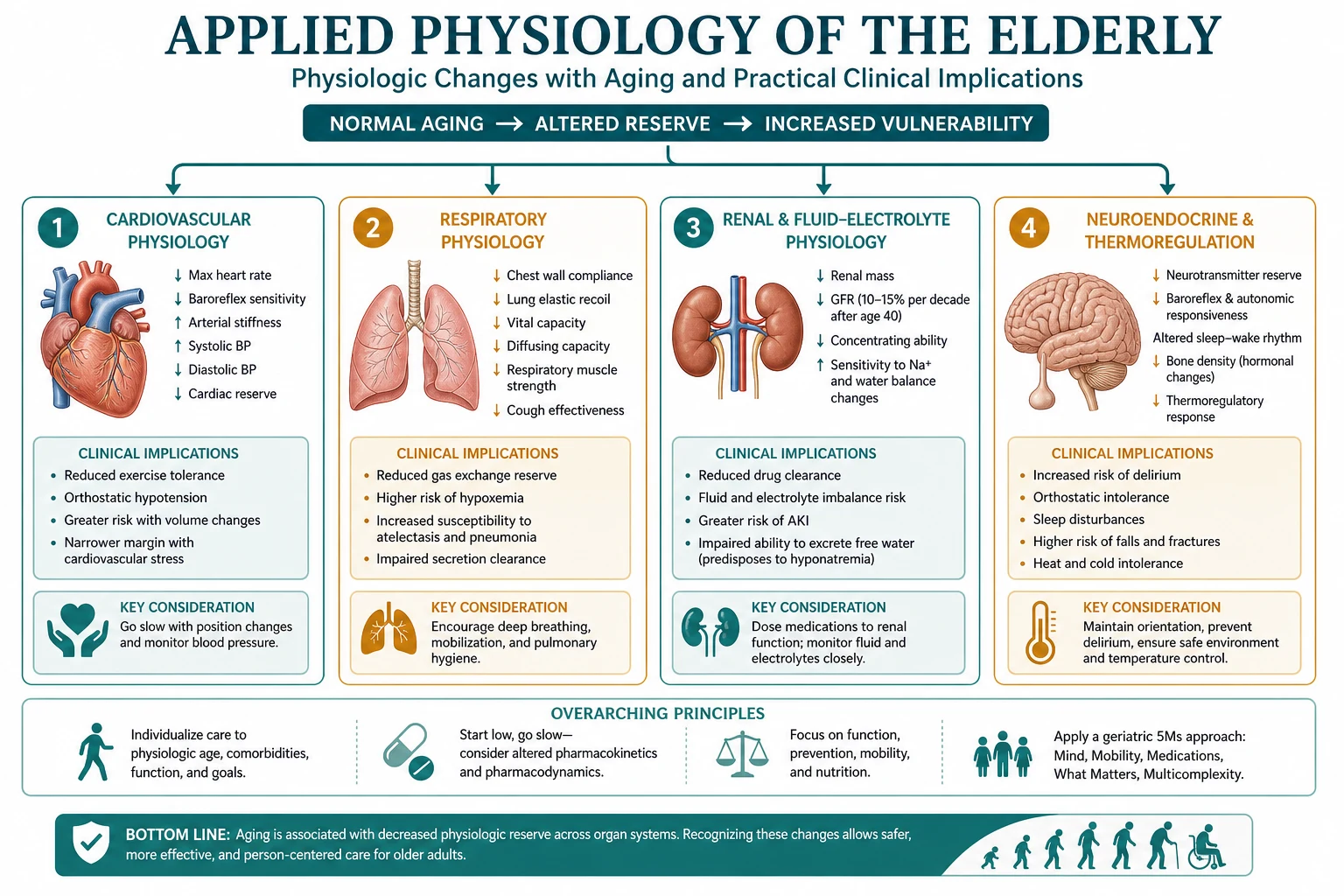
Physiological change
- Stiff CVS
- CC vs FRC
- ↓GFR
- ↓MAC / ↑sensitivity
Anaesthetic response
- Slow small doses
- PEEP/head-up
- Renal adjust
- Delirium hygiene
Viva scripts
List CVS changes of ageing and induction implications. [1]
Explain why desaturation is faster when supine. [1]
Why reduce morphine dose/frequency? [1]
Extended viva dialogue
Examiner: How does ageing change the response to volatile anaesthetics? [1]
Candidate: MAC falls roughly 6 percent per decade after forty, and recovery can be slowed by increased fat stores and reduced clearance of concurrent drugs. Titrate to effect and expect sensitivity. [1]
Examiner: Why is diastolic dysfunction important? [1]
Candidate: A stiff left ventricle needs adequate filling time and atrial kick. Tachycardia or AF drops stroke volume; excess fluid raises filling pressure into pulmonary oedema without much CO gain. [1]
Clinical synthesis: Elderly physiology is reduced buffer in every control system — your technique must be slower, smaller, warmer, and more monitored. [1]
Pharmacodynamic sensitivity list
- ↑sensitivity to propofol, volatiles (MAC↓), opioids, benzos.
- Anticholinergic delirium risk (avoid atropine-heavy, oxybutynin-type thinking).
- Reduced baroreflex → post-induction hypotension.
- Polypharmacy → interaction density. [1]
Postoperative delirium physiology hooks
Neuroinflammation, anticholinergic tone, sleep disruption, pain, hypoxia, infection, metabolic derangement, sensory deprivation. Prevention is multimodal physiology hygiene, not a single drug. [1]
Worked SAQ
SAQ: Describe cardiovascular changes of ageing relevant to anaesthesia (8 marks)
Arteries stiffen, pulse pressure widens, and left ventricular afterload rises with hypertrophy and diastolic dysfunction. Beta-receptor responsiveness falls so cardiac output depends more on preload and vascular tone. Baroreflexes blunt, making orthostatic and post-induction hypotension common. Maximum heart rate falls. Atrial contribution to filling becomes critical; AF is poorly tolerated. Anaesthetic technique uses smaller incremental doses, ready vasopressors, and careful rate/rhythm control. [1]
Respiratory numbers with age
Closing capacity increases roughly linearly with age; FRC falls supine. By the mid-60s, CC often exceeds FRC when supine in many patients — basal airway closure at rest, lower PaO2, higher A–a gradient. Combined with reduced hypoxic ventilatory drive, opioid sensitivity becomes dangerous on the ward. [1]
Renal dosing worked examples (conceptual)
Morphine → M6G accumulates when GFR low → delayed respiratory depression. Gabapentinoids renally cleared → falls/sedation. LMWH accumulation → bleeding. eGFR equations using creatinine overestimate function in sarcopenia — when in doubt, extend intervals and reduce cumulative opioid. [1]
Cognitive reserve and consent
Physiology of ageing brain (reduced grey matter, neurotransmitter changes, white matter disease) lowers reserve against delirium. Consent discussions should include delirium risk after major surgery as a physiological expectation in the frail, not a freak complication. [1]
Extended viva add-on
Examiner: How do you modify a spinal anaesthetic in an 85-year-old for hip fracture? [1]
Candidate: Expect higher block for a given volume because of reduced CSF volume and compliance changes; use lower dose, careful positioning, anticipate hypotension from reduced SNS reserve and diastolic dysfunction, maintain blood pressure for coronary and cerebral perfusion, and plan multimodal analgesia to spare systemic opioids that precipitate delirium and respiratory depression. [1]
Primary exam expansion — dense examiner pack
Systems table — age-related change and anaesthetic consequence
| System | Physiological change | Consequence |
|---|---|---|
| Brain | ↓ neuronal mass, ↓ MAC need, ↑ sensitivity to centrals | Delirium risk; reduce doses; avoid deep excess |
| CVS | ↓ β-receptor responsiveness, stiff arteries, LV diastolic dysfunction, conduction disease | Labile BP; need sinus/atrial kick; careful afterload |
| RS | ↑ CC, ↓ elastic recoil, ↓ PaO2, weaker muscles, blunted responses | Desaturation; atelectasis; aspiration risk |
| Renal | ↓ GFR, ↓ concentrating ability | Drug accumulation; fluid/electrolyte fragility |
| Hepatic | ↓ mass/flow | Reduced clearance high-E drugs |
| Body comp | ↑ fat, ↓ muscle/water | Vd lipophilic ↑; sarcopenia dosing traps |
| Airway | Edentulous, stiff neck, arthritis | Mask seal; intubation difficulty patterns |
| Thermoreg | Impaired | Hypothermia rapid |
| Haematology | Marrow reserve ↓ | Anaemia less tolerated sometimes |
| PK/PD | Polypharmacy | Interactions; falls risk post-op |
Cardiovascular detail examiners want
Arterial stiffening → wide pulse pressure, high systolic BP, diastolic may be normal/low → coronary perfusion concerns. Diastolic dysfunction: need adequate filling time (avoid extreme tachycardia) and preload; atrial fibrillation loss of kick poorly tolerated. Baroreflex impaired → post-induction hypotension common. Fixed CO states (AS) catastrophic with vasodilation — assess murmurs. [1]
Respiratory detail
FRC vs closing capacity: CC rises with age; FRC falls supine → tidal airway closure → V/Q mismatch. Blunted hypoxic/hypercapnic ventilatory drive with opioids. Postoperative pulmonary complications rise — analgesia strategy, mobilisation, physiotherapy, avoid residual NMB. [1]
Pharmacology in the elderly
- Induction agents: reduce dose 20–50% teaching; slow circulation time → delay between dose and effect — avoid stacking.
- Opioids: increased sensitivity; use multimodal; renally cleared metabolites dangerous if GFR low.
- Benzodiazepines: delirium and prolonged sedation — minimise.
- NMB: delayed onset possible; residual block poorly tolerated; quantitative TOF.
- Locals: dose carefully; nerve blocks excellent opioid-sparing if no contraindication.
- MAC decreases roughly 6% per decade after 40 (teaching rule of thumb). [1]
Cognitive outcomes
Emergence delirium vs postoperative delirium vs POCD concepts. Risk factors: age, cognitive baseline, infection, electrolyte, pain, hypoxia, benzodiazepines, major surgery. Prevention: orient, glasses/hearing, mobilise, sleep, treat pain without oversedation, avoid deliriogenic drugs, treat infection/urinary retention. [1]
Frailty versus chronological age
Frailty (weight loss, weakness, exhaustion, slow gait, low activity) predicts better than age alone. Shared decision-making, ceilings of care, prehabilitation if time. [1]
Thermoregulation and bleeding
Vasoconstriction/shivering thresholds impaired under GA more problematic; hypothermia → coagulopathy, infection, delayed drug clearance. Active warming standard of care. [1]
SAQ: physiological changes of ageing relevant to anaesthesia (10 marks)
Structure by system (CVS, RS, renal, CNS, PK/PD) with one clinical implication each — tables score well. [1]
Viva
Q: Why does induction hypotension hit the elderly hard? A: Stiff vasculature, diastolic dysfunction, blunted compensatory tachycardia, concurrent antihypertensives, reduced blood volume reserve. Q: Why reduce MAC? A: Age-related increase in anaesthetic sensitivity / decrease in anaesthetic requirement. Q: Why is residual NMB more dangerous? A: Reduced respiratory reserve and airway protection. [1]
High-yield viva battery and numbers lock-in
Dose adjustment philosophy paragraph
"I assume increased pharmacodynamic sensitivity to anaesthetic agents, reduced clearance for many renally excreted drugs, longer circulation time so I give smaller induction doses slowly and wait before redosing, avoid long-acting benzos, use quantitative neuromuscular monitoring, and plan multimodal opioid-sparing analgesia to protect respiration and cognition." [1]
Postoperative pulmonary complication risk stack
Age, smoking/COPD, upper abdominal/thoracic surgery, residual NMB, inadequate analgesia (splinting) or over-opioid, delirium immobility, aspiration risk, anaemia. Mitigation: stop smoking if time, physio, regional, TOF zero residual, sit up, incentive spirometry, early mobilise. [1]
Cardiovascular drug interactions common in elderly
ACEI/ARB + induction = hypotension. Beta-blockers blunt compensatory tachy. Diuretics → hypovolaemia/electrolytes. Anticoagulants → neuraxial timing. Anticholinergics/antihistamines → delirium. Polypharmacy CYP interactions. [1]
Full viva dialogue (additional)
Examiner: How does diastolic dysfunction change your anaesthetic? [1]
Candidate: The stiff left ventricle needs adequate preload and enough diastolic time, so I avoid profound hypovolaemia and extreme tachycardia, maintain sinus rhythm if possible because atrial kick matters, and treat hypotension with careful vasopressors while watching for pulmonary oedema if I fluid-load indiscriminately. [1]
Examiner: Why is delirium a physiological as well as social problem? [1]
Candidate: It is associated with increased mortality, prolonged stay, falls, failed discharge home and long-term cognitive decline. Physiologically it reflects vulnerable brain plus insults — hypoxia, infection, drugs, sleep disruption, pain, metabolic derangement — so prevention is multi-system care, not just a sedative prescription. [1]
Exam traps
- Same mg/kg induction as young adults given fast.
- Ignoring ACEI/ARB morning dose effects.
- Attributing all confusion to 'age' without searching causes.
- Omitting active warming. [1]
References
- [1]Bursik D, et al. Low-Dose Morphine Intrathecal Analgesia in Elderly Patients with Hip Fracture Undergoing Single Spinal Anesthesia: A Randomized Controlled Trial Local Reg Anesth, 2026.PMID 42152855
- [2]Han X, et al. Prediction of Postoperative Pulmonary Complications in Geriatric Patients with Hip Fracture Using Lung Ultrasonography Score and Diaphragmatic Mobility Clin Interv Aging, 2026.PMID 42078008
- [3]Cho J, et al. A High Frailty Burden is a Strong Predictor of Adverse Postoperative Outcomes in Geriatric Lumbar Spine Surgery: A Retrospective Cohort Study Global Spine J, 2026.PMID 42359918
- [4]Girnyi S, et al. Does Chronological Age Adequately Stratify Perioperative Risk? A Prospective Multicenter Cohort Study Using Frailty and Handgrip Strength J Clin Med, 2026.PMID 42279048
- [5]Chatziperi A, et al. Frailty Status and Preoperative Cardiac Risk Stratification in Older Adults Undergoing Noncardiac Surgery: A Multicenter Prospective Cohort Study J Am Heart Assoc, 2026.PMID 42261947
- [6]Popovici SE, et al. EEG-Derived Entropy Monitoring During Propofol Sedation for ERCP: Sedation Profiles, Age-Related Effects, and Implications for Procedure-Specific Target Ranges Medicina (Kaunas), 2026.PMID 42356061