Anaes · Applied cardiovascular & respiratory physiology
Cell membrane & action potential
Also known as Membrane potential · Action potential · Resting membrane potential · Nernst equation · Goldman equation · Sodium-potassium pump
Excitable cells — nerve, skeletal and cardiac muscle — generate and conduct electrical signals because ion concentrations differ across the lipid bilayer and the membrane is selectively permeable. The framework rests on five exam-critical ideas: the resting membrane potential (around minus 70 millivolts in nerve) is set chiefly by the outward leak of potassium, formalised by the Nernst equation for a single ion and the Goldman-Hodgkin-Katz equation for the mixed-ion reality; the sodium-potassium ATPase is an electrogenic pump that maintains the gradients against the leak; the action potential is an all-or-nothing, regenerative reversal of the membrane potential driven by voltage-gated sodium inflow then potassium outflow; conduction velocity is determined by axon diameter and myelination (saltatory conduction); and the whole system is the molecular target of anaesthetic drugs — local anaesthetics block the voltage-gated sodium channel, general anaesthetics modulate ligand-gated channels, and inherited channel defects (channelopathies) cause disease. Built on the Goldman-equation analysis (Silverstein 2025), the sodium-gradient and membrane-potential work (Nicholls 2024), the Na,K-ATPase FXYD-regulator review (Li 2026), the voltage-gated sodium-channel structural review (Kuznetsov 2025), the neuronal electrical-activity model (Rafati 2025), the cardiac ion-channel cardiotoxicity review (Orts 2026), the sudden-cardiac-death genetics review (Lovric Bencic 2025), and the local-anaesthetic-resistance review (Kanchetty 2026).
On this page & tools
Your progress
Saved locally on this device.
8 MCQs with explanations
Target exams
Red flags
Why this matters to the anaesthetist
This is foundation Primary science for Nernst/Goldman, resting membrane potential, AP phases in nerve, myelination/saltatory conduction, and local anaesthetic Na-channel block. Cardiac AP detail lives also in the cardiac EP leaf — here emphasise general excitable cell physics.[1]
One-liner: RMP ≈ −70 mV (neuron) from high K conductance; threshold opens voltage-gated Na channels → depolarisation; Na inactivate + K open → repolarisation; LAs block open/inactivated Na channels from inside. [1]
Ionic basis of resting potential
- Membrane more permeable to K+ than Na+ at rest (leak channels).
- K+ leaves down concentration gradient → inside negative until electrical gradient balances — Nernst equilibrium. [1]
Nernst equation (teaching form):
E_ion = (RT/zF) ln([ion]_o/[ion]_i) ≈ (61/z) log10([ion]_o/[ion]_i) mV at body temperature. [1]
Approximate equilibrium potentials: [1]
| Ion | E_ion (mV, order) |
|---|---|
| K+ | −90 |
| Na+ | +60 |
| Cl− | −70 (near RMP) |
| Ca2+ | very positive |
Goldman–Hodgkin–Katz: RMP is weighted average of equilibrium potentials by permeabilities. At rest P_K ≫ P_Na → RMP near E_K but slightly less negative because of slight Na leak. [1]
Na/K-ATPase: 3 Na out / 2 K in — maintains gradients; small direct electrogenic contribution; essential long-term. [1]
Graded potentials vs action potentials
- Graded: local, decremental, summate (synaptic EPSPs/IPSPs).
- Action potential: all-or-nothing once threshold (~−55 mV teaching) reached; regenerates along axon. [1]
Nerve action potential phases
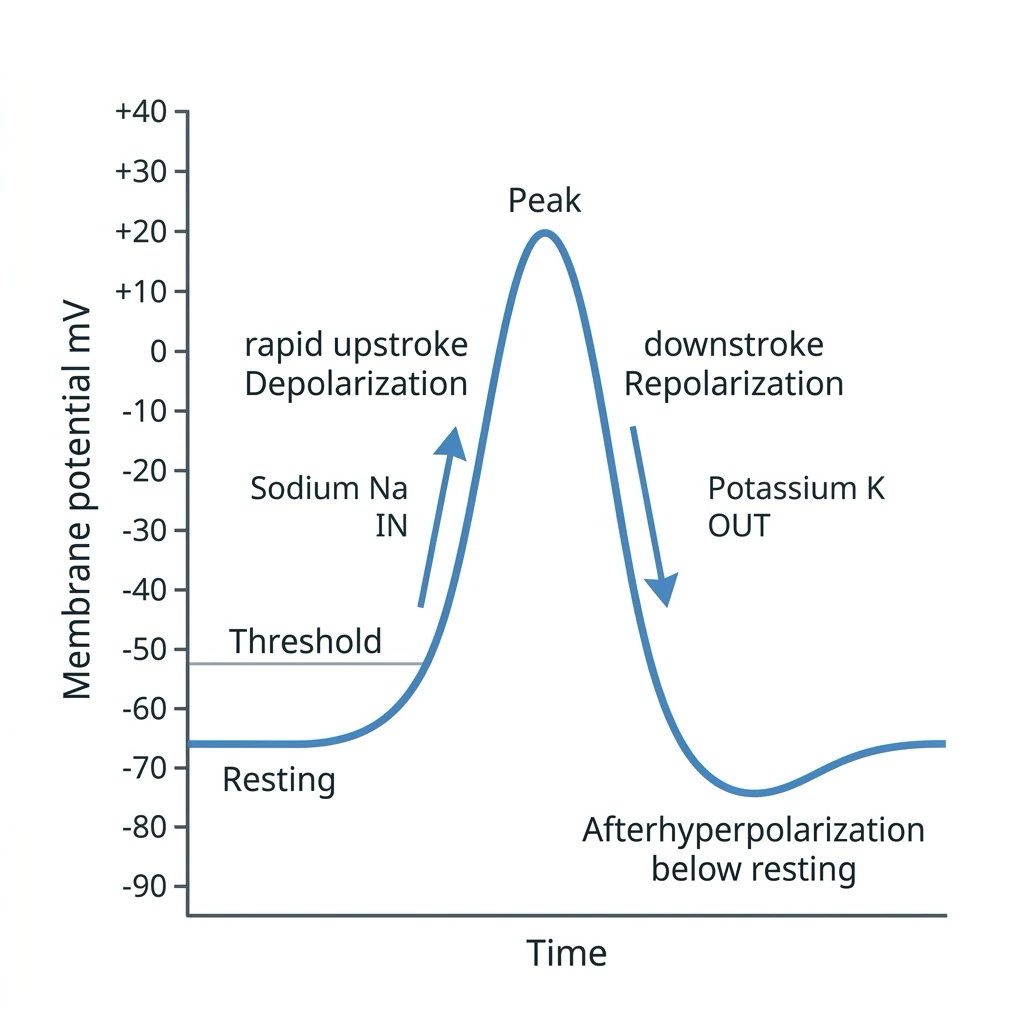
- Stimulus → threshold
- Depolarisation: voltage-gated Na channels open → Na influx → overshoot toward E_Na
- Peak / Na inactivation
- Repolarisation: voltage-gated K open, K efflux
- After-hyperpolarisation sometimes (K still open)
- Restoration of gradients via pump (few ions actually move per AP) [1]
Refractory periods: absolute (Na inactivated) then relative — limit firing frequency and enforce unidirectional propagation behind the AP. [1]
Propagation and myelination
- Local circuit currents depolarise adjacent membrane.
- Myelin increases membrane resistance and decreases capacitance → faster conduction; AP jumps nodes of Ranvier (saltatory).
- Large myelinated motor fibres faster than small unmyelinated C pain fibres — differential LA block patterns (size/myelination/position in nerve). [1]
Fibre classification (brief): Aα motor/proprioception; Aδ sharp pain/temp; C dull pain (unmyelinated); B preganglionic autonomic. [1]
Synaptic transmission (bridge)
AP → Ca entry presynaptic → vesicle release → postsynaptic receptors (nicotinic NMJ is specialised leaf). CNS synapses: glutamate excitatory, GABA/glycine inhibitory — anaesthetic targets. [1]
Local anaesthetics — molecular physiology
- Weak bases; cross membrane unionised; re-ionise intracellularly; bind inner vestibule of voltage-gated Na channel.
- Prefer open/inactivated states → use dependence (more block in rapidly firing fibres).
- Use-dependent + state-dependent block explains sensory vs motor nuances and frequency dependence.
- pKa, lipophilicity, protein binding → onset, potency, duration (pharmacology leaf detail).
- Inflamed acidic tissue → more ionised exterior drug → slower onset. [1]
Electrolyte effects on excitability
- ↓Ca (ionised): lower threshold, tetany, long QT.
- ↑K: depolarises RMP → inactivation of Na channels → inexcitability (weakness, wide QRS in heart).
- ↓K: hyperpolarisation/arrhythmia risk complex in heart. [1]
Numbers board
- Neuron RMP ~−70 mV; skeletal muscle ~−90 mV
- Threshold ~−55 mV teaching
- Nernst 61 mV factor at ~37 °C for monovalent ions
- AP duration nerve ~1 ms vs cardiac myocyte hundreds of ms (plateau) [1]
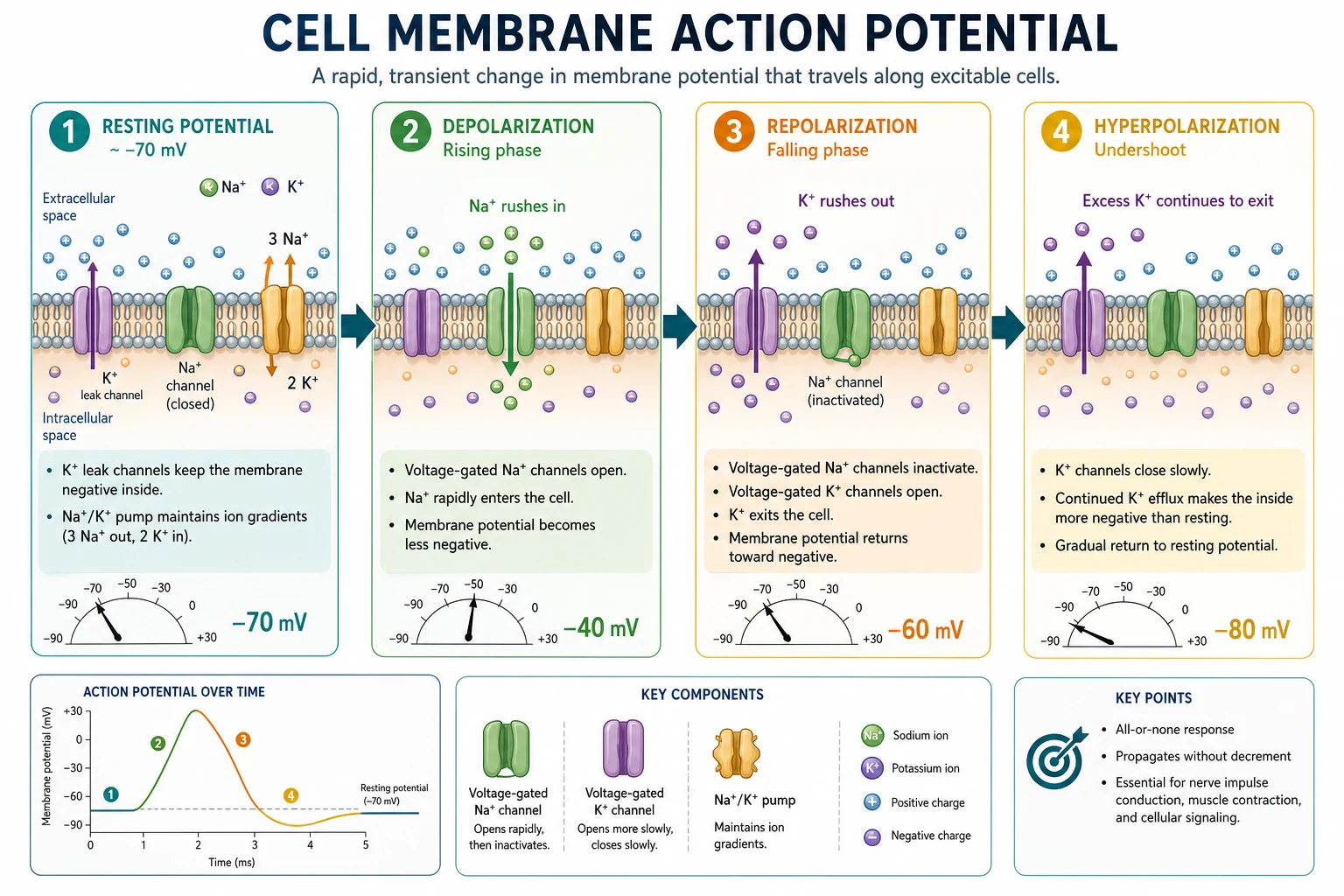
Resting membrane
- High P_K
- Near E_K
- Pump maintains gradients
- ≈ −70 mV neuron
Action potential
- Na phase 0
- All-or-nothing
- Refractory periods
- LA target NaV
Viva scripts
Write Nernst for K and explain why RMP ≈ −70 not −90. [1]
Draw nerve AP and mark Na/K. [1]
Explain saltatory conduction. [1]
LA mechanism in four steps. [1]
Extended viva dialogue
Examiner: Derive the idea of equilibrium potential. [1]
Candidate: For potassium, chemical drive out of the cell continues until the inside-negative electrical force pulls K back equally — that voltage is E_K from the Nernst equation. The resting membrane sits near E_K because potassium permeability dominates. [1]
Examiner: How does demyelination slow conduction? [1]
Candidate: Loss of myelin decreases transverse resistance and increases capacitance, current leaks, nodal depolarisation fails, conduction slows or blocks — clinically weakness and sensory loss; related to some LAST-vulnerable fibre discussions only loosely. [1]
Clinical synthesis: Membrane physics → spike → wire speed → drug block. Keep equations, phases and LA mechanism as a single story. [1]
Cable theory intuition
Length constant λ and time constant τ determine how far and how fast local currents spread. Myelin increases λ effectively; demyelination shortens it. No need for full derivation — define that local circuit current must bring adjacent membrane to threshold. [1]
NMJ link one step
Nerve AP → voltage-gated Ca at terminal → ACh quanta → nicotinic receptors → end-plate potential → muscle AP if threshold. (Full NMJ leaf elsewhere.) [1]
Worked SAQ
SAQ: Explain resting membrane potential using Nernst concepts (7 marks)
The Nernst equation gives the equilibrium potential for each ion from its concentration ratio. At rest the membrane is far more permeable to potassium than sodium, so resting potential lies near EK (about −90 mV) but is slightly less negative because of a small sodium leak, as described by the Goldman equation. The Na/K-ATPase maintains the concentration gradients that make these diffusion potentials possible. [1]
Primary exam expansion — dense examiner pack
Nernst and Goldman — writeable equations
Nernst equation (equilibrium potential for ion X): E_X = (RT/zF) ln([X]_o/[X]_i). At 37 °C for monovalent cation, often taught as E_X ≈ 61 log10([X]_o/[X]_i) mV with correct sign convention for the ion. [1]
| Ion | E_ion (approx) | Rest contribution |
|---|---|---|
| K+ | −90 mV | Dominant at rest |
| Na+ | +60 mV | Small rest leak |
| Cl− | near rest (cell-dependent) | Stabilising |
| Ca2+ | strongly positive | Trigger roles |
Goldman–Hodgkin–Katz voltage equation weights ions by permeability — resting membrane potential sits near EK because P_K ≫ P_Na at rest. During phase 0, P_Na surges and Vm approaches ENa. [1]
Resting membrane potential maintenance
- Selective permeability (K+ leak channels). 2. Na+/K+-ATPase (3 Na out / 2 K in) — electrogenic contribution small but essential for long-term gradients. 3. Impermeant intracellular anions (Donnan teaching). Hypoxia or ischaemia → pump failure → depolarisation → conduction block and arrhythmias. [1]
Nerve action potential phases
| Phase | Ions | Membrane event |
|---|---|---|
| Rest | K+ leak | Vm ≈ −70 mV nerve |
| Threshold | Local Na in | Regenerative if threshold met |
| Upstroke | Fast voltage-gated Na+ | Vm → +30 mV |
| Repolarisation | Na inactivation + K+ efflux | Return toward EK |
| After-hyperpolarisation | Residual K conductance | Relative refractory nuances |
Absolute refractory period: Na channels inactivated — no new spike. Relative refractory period: needs larger stimulus. [1]
Local anaesthetic mechanism (must link here)
Local anaesthetics: unionised fraction crosses membrane; ionised fraction binds inner vestibule of voltage-gated Na channel → stabilise inactivated state / block Na current → raise threshold, slow upstroke, fail conduction. Use-dependence: more block in rapidly firing pain fibres. pKa and pH: infected acidic tissue → more ionised LA extracellularly → slower onset. Myelinated nerves: nodes of Ranvier are functional targets for saltatory conduction block. [1]
Myelination and saltatory conduction
Myelin increases transmembrane resistance and decreases capacitance → local circuit current jumps node-to-node → increased conduction velocity, energy efficient. Demyelination slows or blocks conduction without necessarily killing the axon immediately. [1]
Cable theory parameters
Length constant λ: how far passive depolarisation spreads. Time constant τ = Rm × Cm: how quickly membrane charges. Larger λ and smaller τ favour faster, more secure propagation. Myelin optimises both. [1]
Cardiac versus nerve AP compare
| Feature | Nerve / skeletal | Ventricular myocyte |
|---|---|---|
| Duration | ~1 ms | ~200–400 ms |
| Plateau | No | Yes (Ca2+ window) |
| Pacemaker | No (except specialised) | SA/AV spontaneous |
| Refractory | Short | Long (protects tetany) |
Shared Na/K physics links to LA and class I antiarrhythmic Na-channel block. [1]
Calcium and transmitter release (NMJ bridge)
Presynaptic AP opens voltage-gated Ca channels → Ca influx → vesicle fusion → ACh quanta. Magnesium competes; aminoglycosides impair release; botulinum blocks fusion machinery — all viva-ready effects at the NMJ. [1]
Electrolyte disturbances rapid fire
| Disturbance | Membrane effect | Clinical |
|---|---|---|
| Hyperkalaemia | Depolarises then inactivates Na channels | Weakness, peaked T, sine-wave risk |
| Hypokalaemia | Hyperpolarises; arrhythmias | U waves, digoxin synergy |
| Hyponatraemia | Mostly CNS osmotic | Seizures if acute severe |
| Hypocalcaemia | Increases neuromuscular excitability | Tetany, prolonged QT |
| Hypercalcaemia | Decreases excitability | Weakness, short QT |
SAQ: resting potential and action potential (8 marks)
Define RMP → Nernst/GHK idea → Na/K pump role → threshold and regenerative Na influx → repolarisation → refractory periods → one clinical link (LA or hyperkalaemia). [1]
Viva drill
Q: Why is RMP close to EK? A: At rest potassium permeability dominates; GHK voltage weighted toward EK. Q: Why does hyperkalaemia cause both irritability and then inexcitability? A: Mild rise depolarises toward threshold; further depolarisation inactivates Na channels. Q: How do local anaesthetics stop pain impulses? A: Use-dependent Na channel block raises firing threshold and collapses action potential propagation in sensory fibres. [1]
Numbers board
| Item | Value / fact |
|---|---|
| Nerve RMP | ~−70 mV |
| EK | ~−90 mV |
| ENa | ~+60 mV |
| Spike duration nerve | ~1 ms |
| LA target | Voltage-gated Na channel inner pore |
High-yield viva battery and numbers lock-in
Equation board (write cleanly)
- Nernst: E = (RT/zF) ln([ion]o/[ion]i) ≈ (61/z) log10(ratio) mV at 37 °C teaching form
- Driving force on ion: Vm − E_ion
- Capacitance relation: I = C dV/dt (why rapid Na current needed for fast upstroke)
- Length constant λ and time constant τ (cable theory qualitative) [1]
Local anaesthetic pKa and onset logic
Most amide LAs are weak bases (pKa ~7.7–8.1). At physiological pH a fraction is unionised and crosses the axon membrane; intracellular re-ionisation allows binding to the Na channel from inside. Inflamed acidic tissue increases ionised extracellular fraction → slower onset. Bicarbonate additives raise free base fraction in syringe (compatibility limits). Frequency-dependent block explains preferential effects on pain fibres firing rapidly. [1]
Hyperkalaemia membrane story (stepwise)
Raised [K]o → EK less negative (Nernst) → RMP depolarises → initially closer to threshold (ectopy) → persistent depolarisation inactivates Na channels → slowed conduction, wide QRS, sine wave, asystole risk. Treatment physiology: calcium stabilises membrane; insulin-glucose/beta-agonists shift K in; removal via resins/dialysis. [1]
Full viva dialogue (additional)
Examiner: Why does myelin speed conduction? [1]
Candidate: Myelin increases transmembrane resistance and decreases capacitance so local circuit current spreads farther with less loss, allowing depolarisation to jump between nodes of Ranvier — saltatory conduction — which is faster and more energy efficient than continuous propagation. [1]
Examiner: Link the action potential to neuromuscular transmission in one chain. [1]
Candidate: Nerve action potential invades the terminal, opens voltage-gated calcium channels, calcium triggers vesicular acetylcholine release, ACh opens postsynaptic nicotinic receptors, end-plate potential brings the muscle membrane to threshold, and a muscle action potential triggers calcium release from the sarcoplasmic reticulum. [1]
Exam traps
- Saying sodium is the main resting permeant ion.
- Forgetting Na/K-ATPase maintains gradients long-term even if not the main instantaneous RMP generator.
- Mixing equilibrium potential with resting potential.
- Claiming LA only acts on unmyelinated fibres. [1]
References
- [1]Silverstein TP. Explaining neuronal membrane potentials: The Goldman equation vs. Lee's TELC hypothesis Neuroscience, 2025.PMID 39755228
- [2]Nicholls DG. Does a transmembrane sodium gradient control membrane potential in mammalian mitochondria? Cell Calcium, 2024.PMID 39488142
- [3]Li X, et al. The functions of FXYD family members in human health and disease Genes Dis, 2026.PMID 41630949
- [4]Kuznetsov VG, et al. Voltage-Gated Sodium Channel Substitutions Underlying Tetrodotoxin Resistance in Nemerteans: Ecological and Evolutionary Implications Int J Mol Sci, 2025.PMID 41465217
- [5]Rafati AH, et al. A Model-Based Approach to Neuronal Electrical Activity and Spatial Organization Through the Neuronal Actin Cytoskeleton Methods Protoc, 2025.PMID 40700314
- [6]Orts DJB, et al. Chemically induced cardiotoxicity: Role of voltage dependent ion channels Curr Top Membr, 2026.PMID 42082304
- [7]Lovric Bencic L, et al. Genetics of Sudden Cardiac Death Diseases, 2025.PMID 41590224
- [8]Kanchetty N. Local Anesthetic Resistance: Pathophysiology, Clinical Recognition, and Management Strategies Curr Pain Headache Rep, 2026.PMID 41995765