Anaes · Applied cardiovascular & respiratory physiology
Context-sensitive half-time
Also known as CSHT · Context-sensitive half time · Recovery from infusion · Drug accumulation · Remifentanil CSHT · Ester metabolism
The context-sensitive half-time (CSHT) is the time for the plasma drug concentration to fall by 50 percent after stopping an infusion of a given duration, and it is the clinically relevant measure of recovery — far more useful than the terminal half-life for drugs given by infusion. The framework rests on five exam-critical ideas: the CSHT is NOT the same as the terminal elimination half-life, because during prolonged infusion the drug accumulates in the peripheral compartments (muscle, fat), and when the infusion stops the drug redistributes BACK from the periphery into the central compartment, slowing the decline in plasma concentration; for lipophilic drugs with a large Vd (fentanyl, thiopental), the CSHT increases dramatically with infusion duration — fentanyl CSHT rises from about 30 minutes after a 1-hour infusion to about 5 hours after 8 hours; for drugs with organ-independent ester metabolism (remifentanil), the CSHT is constant at about 3 to 5 minutes regardless of infusion duration — no accumulation occurs; the CSHT determines how quickly a patient will recover after stopping an infusion, and therefore which drugs are suitable for long cases (remifentanil, remimazolam) versus short cases only (fentanyl boluses are fine, but a fentanyl infusion is a poor choice for a case needing rapid emergence); and the CSHT is the pharmacokinetic rationale for the modern balanced anaesthetic technique — using a rapidly titratable, non-accumulating opioid (remifentanil) alongside a volatile or propofol for depth. Built on the remimazolam review (Dong 2025), the remifentanil postoperative pain study (Nagasaka 2014), the ultra-short-acting opioids review (Davis 2005), the paracetamol co-administration PK study (Raffa 2018), the opioids-in-organ-failure review (Hohne 2004), and the dexmedetomidine PK/TCI review (Tsai 2026).
On this page & tools
Your progress
Saved locally on this device.
8 MCQs with explanations
Target exams
Red flags

Why this matters to the anaesthetist
Terminal half-life lies about recovery after long infusions. CSHT answers: when I stop this infusion now, how long until the level halves? Primary examiners love the definition, the graph shape, and remifentanil vs fentanyl contrast.[2][3]
One-liner: CSHT = time to 50% fall in plasma concentration after stopping an infusion that ran for time T; rises with T for drugs that fill peripheral compartments; stays flat when clearance is huge and organ-independent (remifentanil). [1]
Definition — precise language
Context-sensitive half-time: time required for the central compartment (plasma) concentration to decrease by 50% after terminating a continuous infusion of a specified duration (the “context”). [1]
Related but different: [1]
- Terminal elimination half-life (t½β): time for concentration to halve during the terminal log-linear phase after distribution equilibrium — a fixed drug property in linear kinetics, not the recovery time after infusions.
- Decrement time: generalisation (e.g. 20% or 80% decrement times for wake-up vs analgesia offset).
- Effect-site decrement: may lag plasma if hysteresis (ke0). [1]
Why CSHT rises with infusion duration
During infusion, drug distributes into V2 (rapid peripheral) and V3 (slow/fat). Longer infusions → more mass in peripherals. On stopping: [1]
- Elimination clears drug from V1.
- Redistribution back from V2/V3 into V1 sustains plasma levels.
- Net plasma decline is slower when peripherals are loaded. [1]
Lipophilic, large-Vd drugs (fentanyl, thiopental) show steep CSHT vs duration curves. Drugs with high clearance and small effective accumulation show flatter curves.[5]
The classic graph (describe/draw)
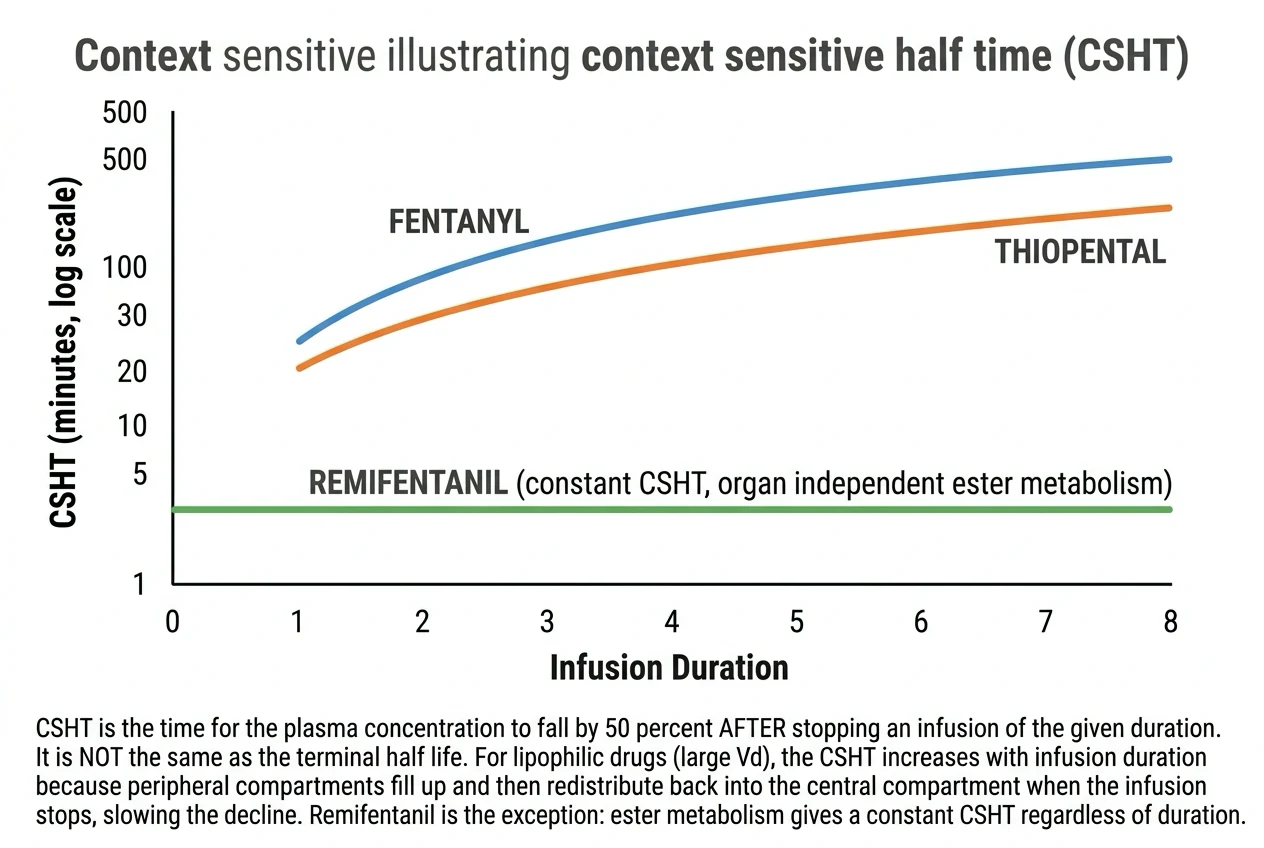
Axes: X infusion duration (min–hours); Y CSHT (log often). [1]
Curves to memorise: [1]
| Drug | Pattern | Teaching numbers |
|---|---|---|
| Remifentanil | Flat | ~3–5 min any duration |
| Esmolol / remimazolam | Flat (ester) | Short, near-constant |
| Propofol | Modest rise | ~10 min after 1 h → ~40 min after ~8 h (order-of-magnitude teaching) |
| Fentanyl | Steep rise | tens of min → hours after long infusion |
| Thiopental | Steep rise | poor infusion anaesthetic for long cases |
| Diazepam | Extreme | huge Vd, slow CL |
Exact numbers vary by model — examiners care about shape and ranking, not false precision. [1]
Organ-independent ester metabolism exception
Remifentanil hydrolysed by non-specific plasma/tissue esterases → clearance so high and ubiquitous that peripheral accumulation does not dictate offset. CSHT nearly context-insensitive. [1]
Clinical corollary: analgesia vanishes within minutes of stopping — must plan transition opioid or regional before emergence.[2]
Same ester idea: esmolol, clevidipine, remimazolam (and suxamethonium for bolus, not infusion CSHT story). [1]
CSHT vs “how soon will they wake?”
Wake-up needs concentration to fall from maintenance Ce to emergence threshold, not necessarily 50%. If you run very deep, even a short CSHT drug needs more absolute decrement. Still, CSHT ranks recovery liability after long infusions better than t½β. [1]
Organ failure
- Hepatic failure: lengthens CSHT for hepatically cleared agents; remifentanil relatively spared.
- Renal failure: active metabolites (morphine-6-G) matter more than parent CSHT alone.
- Low CO: high-extraction drug clearance falls → longer effective CSHT. [1]
Anaesthetic decision board
| Scenario | Prefer | Avoid as sole long infusion |
|---|---|---|
| Long case, need rapid wake | Remifentanil + transition plan; propofol TIVA carefully | High-dose fentanyl infusion all case |
| Liver failure opioid | Remifentanil | Long-acting hepatic-dependent infusions |
| ICU sedation days | Know accumulation (midazolam, fentanyl) | Ignore CSHT concept |
| Short case | Many opioids fine as boluses | Overthinking CSHT |
Numbers board
- Remifentanil CSHT ~3–5 min
- Fentanyl CSHT after long infusion: hours
- Propofol intermediate
- Terminal t½ fentanyl ~3–7 h range teaching — still not equal to CSHT story [1]
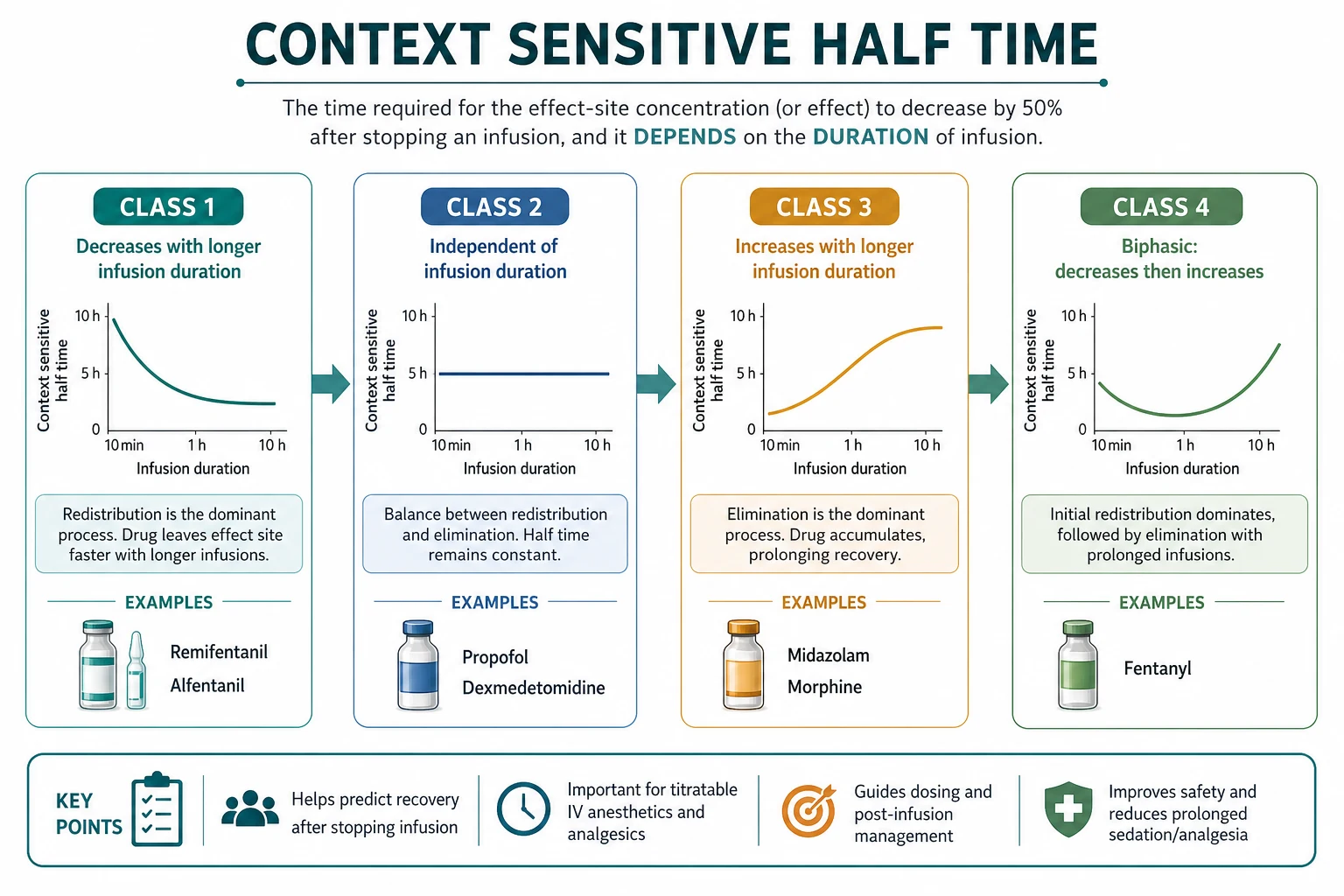
Rising CSHT
- Fentanyl, thiopental
- Large Vd load
- Back-diffusion
- Longer infusion worse
Flat CSHT
- Remifentanil
- Ester clearance
- Little accumulation
- Plan transition pain cover
Viva scripts
Define CSHT in one sentence without saying half-life alone. [1]
Draw remifentanil vs fentanyl curves. [1]
Why does peripheral compartment filling slow recovery? [1]
Extended viva dialogue
Examiner: Why is terminal half-life misleading for infusion recovery? [1]
Candidate: Terminal half-life describes the slowest elimination phase after distribution equilibrium. After infusions, the early decline that determines wake-up is shaped by both elimination and redistribution from tissues, which depends on how long tissues were loaded — that dependence is exactly what CSHT captures. [1]
Examiner: Give two drugs with context-insensitive half-time. [1]
Candidate: Remifentanil and esmolol — both undergo rapid ester hydrolysis, so offset stays short regardless of infusion duration. [1]
Clinical synthesis: Rank your infusion drugs by CSHT shape, not by marketing half-lives on the ampoule. [1]
20% and 80% decrement times
Wake-up from propofol may need ~50% fall from maintenance Ce; longer residual opioid effect may need different decrement percentages. Hughes concept generalises beyond 50%. Mentioning decrement times shows depth beyond memorised CSHT table. [1]
Propofol infusion syndrome link
Very long high-dose propofol infusions (classically ICU) — mitochondrial failure phenotype, metabolic acidosis, rhabdomyolysis — separate from CSHT but related to “long infusion toxicity” discussion. [1]
Worked SAQ
SAQ: Define context-sensitive half-time and contrast remifentanil with fentanyl (8 marks)
CSHT is the time for plasma concentration to fall by 50% after stopping an infusion of a stated duration. For fentanyl, prolonged infusion loads peripheral compartments so that after stopping, redistribution back into plasma slows the decline and CSHT rises steeply with duration. Remifentanil undergoes widespread ester hydrolysis, so CSHT remains about 3–5 minutes regardless of duration, but analgesia disappears quickly and transition analgesia must be planned. [1]
Primary exam expansion — dense examiner pack
Formal definition you must recite without hesitation
Context-sensitive half-time (CSHT) is the time required for the central compartment plasma concentration to fall by 50 percent after stopping a continuous infusion that has run for a specified duration (the context). It is a property of the drug–model–duration triad, not a single fixed drug constant like a published terminal half-life on an ampoule insert. [1]
Why the curve rises: mass balance story
During infusion at rate R, drug enters V1 and distributes to V2 and V3 until net transfer slows as gradients shrink. Total drug in body = amount in V1 + V2 + V3. When infusion stops: elimination removes drug from V1 (CL × Cp), but drug still returns from peripherals down concentration gradients. The greater the peripheral mass, the more back-diffusion sustains Cp — so time to halve Cp lengthens. Lipophilicity and large V3 exaggerate this (fentanyl, thiopental). Extremely high clearance that continues after stopping (remifentanil esterases) can dominate back-diffusion — curve stays flat. [1]
Decrement times generalisation
CSHT is the 50 percent decrement time. Wake-up from hypnotics may need ~20–50 percent fall from maintenance effect-site concentration depending how deep you ran. Analgesic offset may need different percentage. Hughes-style decrement time graphs generalise CSHT — mentioning 20 percent and 80 percent decrement times signals advanced understanding. [1]
Drug ranking table (shapes, not false precision)
| Drug | CSHT vs duration | Teaching numbers | Clinical use note |
|---|---|---|---|
| Remifentanil | Flat | 3–5 min any duration | Transition analgesia mandatory |
| Esmolol | Flat | Minutes | Titratable beta-blockade |
| Remimazolam | Near-flat (ester) | Short | Sedation/GA research-practice evolving |
| Propofol | Modest rise | ~10 min after ~1 h → tens of min after many hours | TIVA emergence planning |
| Alfentanil | Lower rise than fentanyl | Intermediate | Shorter cases / spikes |
| Fentanyl | Steep rise | Minutes → hours after long infusion | Bolus-biased for long cases |
| Thiopental | Steep | Poor long infusion | Induction only modern practice |
| Midazolam | Rises; active metabolite issues | Context + organ failure | ICU sedation accumulation |
| Diazepam | Extreme | Huge Vd | Avoid infusion thinking |
Effect-site and hysteresis caveat
Plasma CSHT is not effect-site decrement time if ke0 is small. Fentanyl effect lags plasma more than remifentanil. Processed EEG wake-up tracks effect site more than pure plasma maths. [1]
Organ failure modifiers
Hepatic failure prolongs CSHT for hepatically cleared drugs. Remifentanil relatively spared (esterases). Renal failure: parent CSHT may look acceptable while active metabolites (morphine-6-glucuronide) prolong effect — metabolite story can trump parent CSHT. Low cardiac output reduces clearance of high-extraction drugs → longer effective recovery. [1]
TIVA practical algorithm using CSHT thinking
- Choose hypnotic (propofol) knowing modest CSHT rise with duration. 2. Choose opioid backbone: remifentanil if need rapid wake and can plan multimodal/transition; fentanyl boluses if short case. 3. Avoid stacking midazolam infusion + fentanyl infusion + renal failure. 4. Toward end: reduce propofol target stepwise; stop remifentanil only after transition opioid/regional on board. 5. If delayed wake: check residual NMB, hypothermia, CO2, glucose, stroke — not only PK. [1]
Context-insensitive does not mean consequence-free
Remifentanil: acute tolerance / opioid-induced hyperalgesia debates; chest wall rigidity; bradycardia; instant pain on stop. Flat CSHT solves emergence delay, not pain architecture. [1]
Graph viva (draw in 30 seconds)
X-axis: infusion duration 0–8 h. Y-axis: CSHT minutes (log optional). Draw remifentanil horizontal line at ~4 min. Draw fentanyl rising curve. Draw propofol intermediate. Label axes and say “not terminal half-life.” [1]
SAQ: define CSHT and contrast remifentanil with fentanyl (8 marks)
Definition with “context = duration” (2). Mechanism of rise via peripheral loading and back-diffusion (2). Remifentanil esterase flat curve with numbers (2). Clinical implication for case planning and transition analgesia (2). [1]
Extra viva
Q: Is CSHT the same after a bolus? A: Bolus is extreme short context; distribution dominates early decline. Q: Why not use terminal half-life for wake-up prediction? A: Terminal phase may contribute little to the early concentration fall that crosses emergence threshold after short infusions. Q: Name two flat-CSHT drugs. A: Remifentanil and esmolol (plus remimazolam as modern ester example). [1]
High-yield viva battery and numbers lock-in
Definition micro-checklist (all must appear)
- Time for plasma concentration to fall 50%
- After stopping infusion
- Of stated duration (context)
- Not terminal elimination half-life
- Explained by peripheral compartment loading and back-diffusion versus clearance [1]
Remifentanil postoperative planning script
"Before stopping remifentanil I ensure multimodal analgesia is on board: paracetamol, NSAID if suitable, regional or long-acting opioid titrated to respiratory rate, then wean remifentanil so the patient is not pain-free then instantly in severe pain as esterases clear the drug within minutes." [1]
ICU sedation accumulation contrast
Midazolam and fentanyl infusions over days: rising CSHT, active metabolites, delirium risk — daily sedation holds, prefer lighter targets, dexmedetomidine/propofol strategies per unit protocol. CSHT thinking prevents "just keep the drip." [1]
Full viva dialogue (additional)
Examiner: Draw CSHT versus time for remifentanil and fentanyl and narrate. [1]
Candidate: X-axis infusion duration, Y-axis CSHT. Remifentanil is nearly horizontal at about three to five minutes. Fentanyl starts low after short infusions and rises toward hours as peripheral compartments fill. Propofol sits between them with a moderate rise. The graph shows why I avoid long high-dose fentanyl infusions when rapid wake is required. [1]
Examiner: What is a decrement time? [1]
Candidate: The time for concentration to fall by a chosen percentage after stopping an infusion of given duration. CSHT is the 50 percent decrement time; other percentages better match wake-up or analgesic offset thresholds. [1]
Exam traps
- Quoting terminal half-life as recovery time after TIVA.
- Stopping remifentanil without transition analgesia.
- Infusing thiopental for long cases.
- Ignoring organ failure effects on non-ester drugs. [1]
References
- [1]Dong Y. Remimazolam in anesthesia and sedation: A narrative review J Anesth Transl Med, 2025.PMID 41929379
- [2]Nagasaka Y. [Efficacy and safety of remifentanil-based regimen for postoperative pain management in abdominal surgery patients: a double-blind study with low-dose remifentanil infusion of 0.02 microg x kg(-1) x min(-1)] Masui, 2014.PMID 24783622
- [3]Davis PJ. The use of ultra-short-acting opioids in paediatric anaesthesia: the role of remifentanil Clin Pharmacokinet, 2005.PMID 16029065
- [4]Raffa RB, et al. Pharmacokinetics of Oral and Intravenous Paracetamol (Acetaminophen) When Co-Administered with Intravenous Morphine in Healthy Adult Subjects Clin Drug Investig, 2018.PMID 29214506
- [5]Hohne C. [Opioids during anesthesia in liver and renal failure] Anaesthesist, 2004.PMID 15074320
- [6]Tsai YF, et al. Dexmedetomidine Dosing Strategies in Sedation and Anesthesia: Pharmacokinetics, Safety, and Clinical Applications - A Narrative Review Drug Des Devel Ther, 2026.PMID 42232093