Anaes · Applied cardiovascular & respiratory physiology
Control of arterial pressure
Also known as Blood pressure regulation · Mean arterial pressure · Baroreceptor reflex · Systemic vascular resistance · RAAS · Pressure natriuresis
Arterial pressure is the perfusing pressure of every organ, and the body defends it across time-scales from seconds to days. The framework rests on five exam-critical ideas: mean arterial pressure equals cardiac output times systemic vascular resistance (the Ohm's-law analogue), and approximates to diastolic plus one-third of the pulse pressure; the moment-to-moment defence is the baroreceptor reflex, a negative-feedback loop from the carotid sinus and aortic arch stretch receptors through the medulla to the autonomic outputs; medium-term defence uses the renin-angiotensin-aldosterone system and vasopressin to restore volume and tone; long-term defence is the kidney, whose pressure-natriuresis curve sets the eventual steady-state arterial pressure; and individual beds autoregulate, holding flow roughly constant across a range of pressure. Built on the carotid-sinus baroreflex study (Gothelf 2026), the RAAS-in-hypertension review (Albritton 2026), the renal-medulla-in-hypertension review (Cowley 2024), the renal sodium-excretion study (Ostergaard 2026), and the hypothalamic vasopressin blood-pressure-circuit study (Lin 2026).
On this page & tools
Your progress
Saved locally on this device.
8 MCQs with explanations
Target exams
Red flags
Why this matters to the anaesthetist
Induction hypotension, hypertensive emergencies, vasopressor choice, spinal anaesthesia, and autoregulation of brain and kidney are pressure-control physiology. Primary candidates must write MAP equations, describe the baroreflex arc, outline RAAS and vasopressin, state long-term pressure-natriuresis, and distinguish pressure from flow. [1]
Mean arterial pressure and its determinants
MAP ≈ DAP + (SAP − DAP)/3 for a normal waveform (more accurately the time-weighted integral of arterial pressure). Also: [1]
MAP = CO × SVR (when RAP is neglected; more precisely MAP − CVP = CO × SVR) [1]
So every MAP change is a CO change, an SVR change, or both. A low MAP with narrow pulse pressure often means low stroke volume; a low MAP with wide pulse pressure and warm extremities often means low SVR (sepsis, anaphylaxis, vasodilating drugs). [1]
Short-term control: the baroreceptor reflex
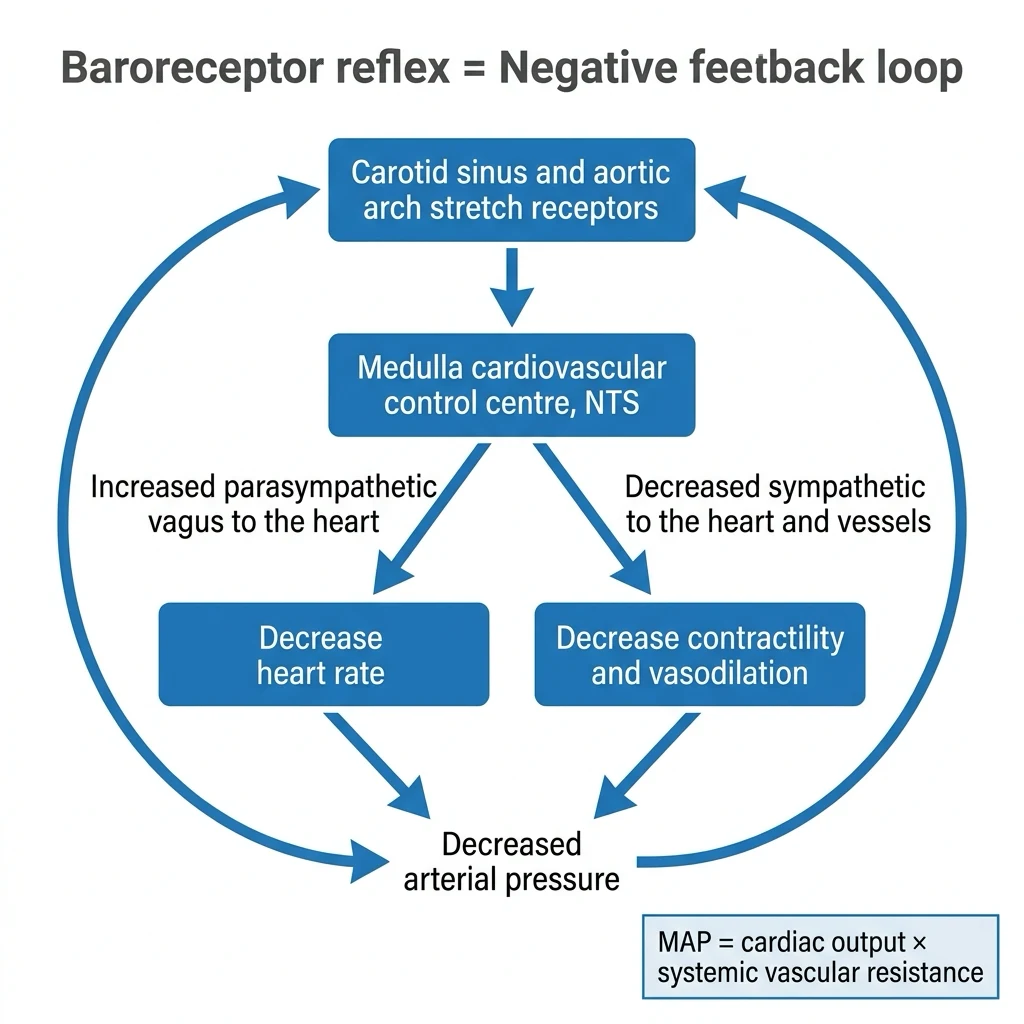
Sensors: stretch receptors in carotid sinus (CN IX) and aortic arch (CN X). Fire more when MAP or pulse pressure rises. [1]
Central integration: NTS in medulla → inhibit RVLM (vasomotor) and excite vagal nuclei when pressure is high. [1]
Effectors:
- ↑ MAP → ↑ baroreceptor fire → ↑ vagal tone + ↓ sympathetic → ↓ HR, ↓ contractility, vasodilatation
- ↓ MAP → opposite → tachycardia and vasoconstriction [1]
Time scale: seconds. Resets over hours to days — therefore chronic hypertension is not "fixed" by baroreflex; the reflex defends whatever the prevailing pressure becomes. Baroreflex failure (neck irradiation, bilateral carotid surgery, autonomic neuropathy) produces volatile blood pressure. [1]
Low-pressure cardiopulmonary receptors in atria/veins modulate volume and ADH/sympathetic tone (Bainbridge-related physiology). [1]
Chemoreceptors and adrenal medulla
Peripheral chemoreceptors (severe hypoxia, hypercapnia, acidosis) raise ventilation and can raise sympathetic outflow — the cardiovascular chemoreflex. The adrenal medulla dumps adrenaline in stress, amplifying CO and redistributing flow. CNS ischaemic response (Cushing) is an extreme brainstem ischaemia pressor response when MAP falls below ICP critically. [1]
Medium-term: RAAS
Fall in renal perfusion, NaCl delivery to macula densa, or increased renal sympathetic nerve activity → renin from JG cells → angiotensinogen → angiotensin I → (ACE, lung endothelium) → angiotensin II. [1]
Ang II effects: potent arteriolar vasoconstriction (↑SVR); aldosterone release (Na+ reabsorption, K+/H+ loss); ADH release; thirst; enhanced sympathetic transmission; cardiac and vascular remodelling chronically. [1]
Time scale: minutes for vasoconstriction; hours for volume effects of aldosterone. ACE inhibitors / ARBs interrupt this axis — perioperative hypotension risk with volume depletion. [1]
Vasopressin (ADH)
Released from posterior pituitary with high osmolarity or severe hypovolaemia/hypotension (baroreceptor-mediated). V1 receptors: vasoconstriction (especially useful in catecholamine-resistant vasodilatory shock). V2 receptors: renal aquaporin-2 insertion → water reabsorption. Stress doses of vasopressin are exploited pharmacologically in theatre and ICU. [1]
Long-term control: kidney and pressure-natriuresis
Guyton's thesis: long-term MAP is set by the renal fluid-volume feedback. Higher pressure → natriuresis and diuresis → lower volume → lower CO → lower MAP until intake and output balance. Sustained hypertension requires a shifted pressure-natriuresis curve (renal disease, excess aldosterone, high salt with impaired kidneys). Baroreflexes cannot set the long-term level because they reset. [1]
Autoregulation of individual beds
Brain, kidney, heart maintain relatively constant flow across a MAP range (~50–150 mmHg cerebral classic teaching, with rightward shift in chronic hypertension). Mechanisms: myogenic and metabolic. Outside the range, flow becomes pressure-passive — critical for CPP = MAP − ICP and for renal perfusion under anaesthesia. [1]
Anaesthetic relevance
- Volatiles and induction agents → ↓SVR ± ↓CO → ↓MAP; blunted baroreflex.
- Neuraxial → chemical sympathectomy → ↓SVR and venodilation; treat with vasopressors (phenylephrine/metaraminol/noradrenaline) and volume as appropriate; obstetrics often favours phenylephrine infusions for spinal hypotension.
- Positive pressure ventilation → ↓VR → ↓CO → ↓MAP.
- Chronic antihypertensives (ACEI/ARB) exaggerate induction hypotension.
- Autonomic failure: no compensatory tachycardia — use direct-acting agents.
- Do not equate MAP with tissue perfusion; integrate lactate, urine output, ScvO2, mental status, skin. [1]
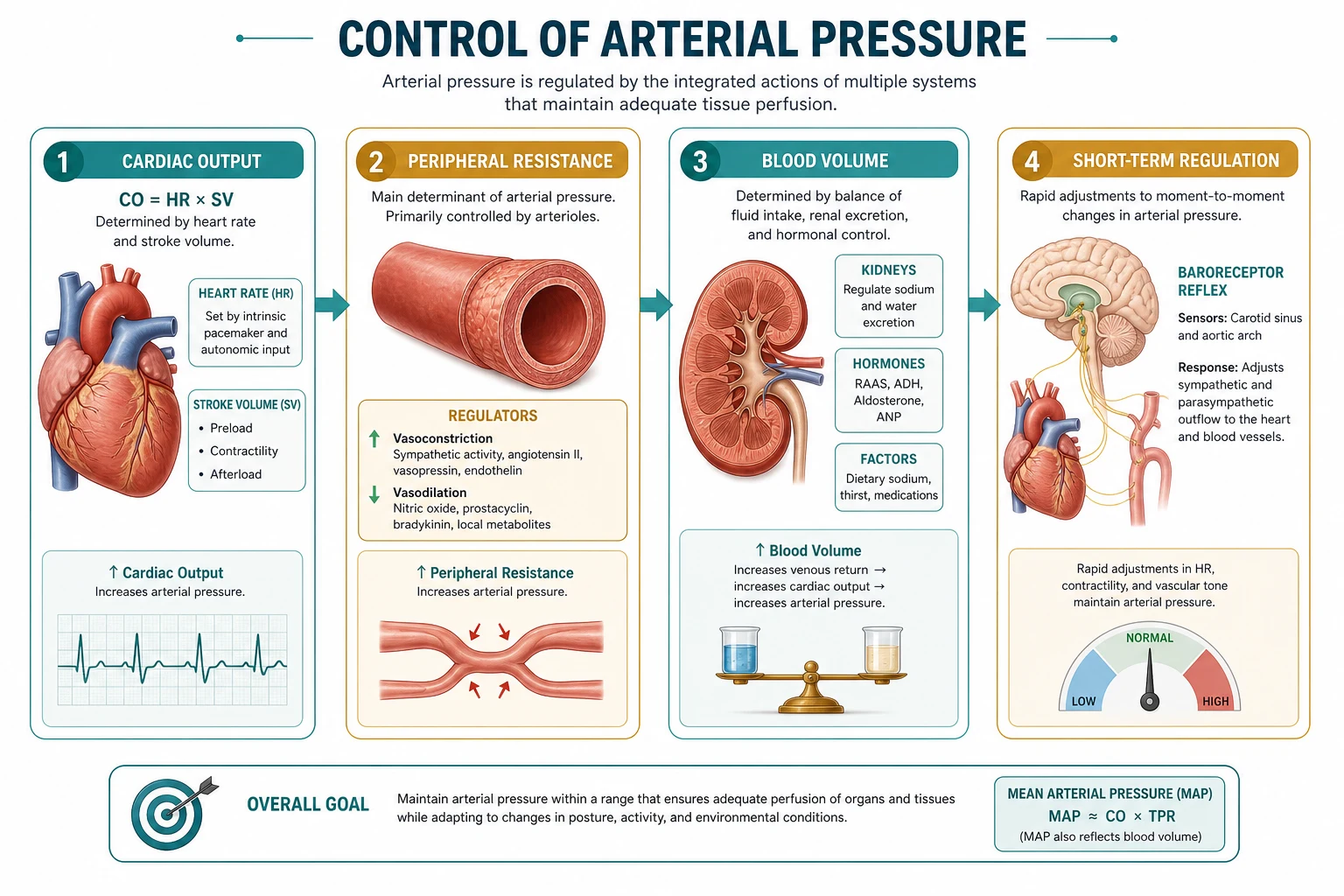
Short-term
- Baroreflex seconds
- Chemoreflex / adrenal
- Autonomic effectors
- Resets chronically
Long-term
- Pressure-natriuresis
- RAAS volume arm
- Renal disease shifts curve
- Sets chronic MAP level
Equations board
- MAP ≈ DAP + 1/3 pulse pressure
- MAP − CVP = CO × SVR
- SVR = 80 × (MAP − CVP) / CO
- CPP = MAP − ICP (or RAP if higher)
- Coronary perfusion pressure ≈ DAP − LVEDP [1]
Viva traps
- Chronic HTN is not baroreflex failure primarily — it is renal/volume set-point physiology.
- Pressure ≠ perfusion.
- Carotid sinus massage ↑ baroreceptor fire → bradycardia (diagnostic/therapeutic in SVT historically).
- ACEI block Ang II formation — not a pure "diuretic."
- Vasopressin is useful when catecholamine receptors are downregulated. [1]
Integrated shock taxonomy by MAP determinants
| Shock type | CO | SVR | Typical MAP problem |
|---|---|---|---|
| Hypovolaemic | ↓ | ↑ | Low CO dominates |
| Cardiogenic | ↓ | ↑ | Low CO dominates |
| Distributive | ↑ or normal | ↓↓ | Low SVR dominates |
| Obstructive | ↓ | ↑ | Low CO from obstruction |
SAQ: short medium long term control
"Arterial pressure is stabilised second-to-second by the baroreceptor reflex. Carotid sinus and aortic arch stretch receptors modulate vagal and sympathetic outflow to heart and vessels. Over minutes the renin–angiotensin–aldosterone system and vasopressin alter vascular tone and sodium-water balance. Over days to weeks the kidney sets the long-term pressure level through pressure-natriuresis: higher pressure increases sodium excretion until volume and pressure return to the equilibrium set by renal function and salt intake." [1]
Hypertensive emergency physiology
End-organ hypoperfusion paradoxically occurs with high MAP when autoregulation fails or acute endothelial injury occurs. Cerebral autoregulation curve shifts in chronic hypertension — abrupt normalisation to "normal" MAP can cause cerebral ischaemia. Controlled reduction targets are organ-specific. [1]
Phenylephrine vs ephedrine vs noradrenaline — pressure edition
Phenylephrine: pure α1, raises SVR, often reflex bradycardia, good for low SVR with adequate contractility (spinal). Ephedrine: mixed direct/indirect, raises HR and contractility, crosses placenta more fetal acidosis historically in obstetrics. Noradrenaline: α1 + β1, first-line in many vasodilated shock states. Match receptor profile to physiology. [1]
Cardiogenic vs distributive MAP look-alikes
Both can have low MAP. Skin, pulse pressure, lactate, echo, and CO monitors separate low-flow cold shock from high-flow warm shock. Treating distributive shock with only fluids without vasopressors, or cardiogenic shock with only pure α-agonists, are classic errors. [1]
Primary exam expansion
Baroreflex set-point and gain
Gain is the change in HR or sympathetic activity per change in MAP. Anaesthesia reduces gain. Chronic hypertension resets set-point upward. Carotid endarterectomy can cause postoperative baroreflex failure with labile hypertension. [1]
Renin–angiotensin cascade details
Renin (aspartyl protease) cleaves angiotensinogen (from liver) to Ang I (decapeptide). ACE (peptidyl dipeptidase, lung endothelium rich) removes two amino acids → Ang II (octapeptide). ACE also degrades bradykinin — ACEI cough/angioedema link. AT1 receptor mediates most pressor effects (Gq). Aldosterone acts on principal cells (ENaC upregulation). [1]
Vasopressin receptor subtypes
V1a vascular smooth muscle Gq vasoconstriction; V1b pituitary; V2 renal collecting duct Gs → AQP2. Terlipressin and vasopressin exploit V1 for shock and HRS contexts; desmopressin is V2 selective for diabetes insipidus and haemostasis (vWF release). [1]
Autoregulation curves
Draw flow vs MAP: plateau between lower and upper limits; slope outside. Chronic hypertension shifts both limits right. Below lower limit, ischaemia; above upper, breakthrough hyperperfusion and oedema (hypertensive encephalopathy). [1]
Anaesthetic drugs and MAP
Propofol: ↓SVR, ↓sympathetic, blunted baroreflex. Volatiles: dose-dependent ↓SVR, some myocardial depression. Ketamine: sympathetic stimulation may support MAP if catecholamine stores present. Etomidate: more MAP-stable induction historically. Oxytocin bolus: vasodilatation and hypotension risk. Ergometrine: hypertension risk. [1]
Pregnancy blood pressure
Mid-trimester fall in MAP is normal; hypertension is pathological (gestational HTN, pre-eclampsia). Pre-eclampsia is endothelial and afterload disease with low CO sometimes — not simple SNS physiology. Treatment targets and magnesium are clinical layers on pressure control. [1]
Valsalva manoeuvre phases (exam favourite)
Phase I: brief BP rise (aortic compression). Phase II: falling BP as VR falls, then tachycardia and vasoconstriction recovery. Phase III: release, brief BP fall. Phase IV: overshoot and bradycardia. Autonomic neuropathy flattens these oscillations. [1]
Extended viva dialogue
Examiner: Write the determinants of mean arterial pressure. [1]
Candidate: MAP is approximately diastolic pressure plus one-third of pulse pressure, and physiologically MAP minus central venous pressure equals cardiac output times systemic vascular resistance. Therefore every pressure change is a flow change, a resistance change, or both. [1]
Examiner: Describe the baroreflex arc. [1]
Candidate: Stretch receptors in the carotid sinus and aortic arch send afferents via glossopharyngeal and vagus nerves to the nucleus tractus solitarius. Raised pressure increases firing, increases vagal outflow and decreases sympathetic vasomotor outflow, lowering heart rate and vascular resistance. The reflex acts in seconds but resets over days, so it does not set the long-term blood pressure level. [1]
Examiner: What sets long-term blood pressure? [1]
Candidate: Renal pressure-natriuresis. Higher pressure increases sodium and water excretion until volume and cardiac output fall enough to return pressure to the equilibrium dictated by renal function, salt intake and hormonal set-points such as aldosterone. Sustained hypertension implies a shifted renal pressure-natriuresis relationship. [1]
Examiner: Outline RAAS and vasopressin roles. [1]
Candidate: Renin releases angiotensin I, converted by ACE to angiotensin II, which vasoconstricts and stimulates aldosterone and ADH. Vasopressin vasoconstricts via V1 receptors and retains water via V2 receptors. These systems defend pressure over minutes to hours and days. [1]
Clinical synthesis: Treat the determinant. Spinal hypotension is often low SVR and low venous return; cardiogenic shock is low CO; bleeding is low stressed volume. Vasopressors are not interchangeable fairy dust. [1]
Worked SAQ model answers
SAQ: Describe the control of arterial blood pressure (10 marks)
Mean arterial pressure is determined by the product of cardiac output and systemic vascular resistance. Control systems act on different time scales. [1]
In seconds, the baroreceptor reflex stabilises pressure. Stretch receptors in the carotid sinus and aortic arch signal via the glossopharyngeal and vagus nerves to the medulla. Raised pressure increases vagal outflow and decreases sympathetic outflow, lowering heart rate and vascular resistance. The reflex is rapid but resets over days and therefore does not set the chronic pressure level. [1]
Over minutes, humoral systems act. The renin–angiotensin–aldosterone cascade produces angiotensin II, a potent vasoconstrictor that also stimulates aldosterone and vasopressin release. Vasopressin vasoconstricts via V1 receptors and retains water via V2 receptors. The adrenal medulla releases catecholamines during stress. [1]
Over days to weeks, the kidney sets long-term pressure through pressure-natriuresis. Higher pressure increases sodium excretion until volume and cardiac output fall enough to return pressure to equilibrium. Sustained hypertension implies a shifted renal pressure-natriuresis curve. [1]
Autoregulation in brain, heart and kidney keeps local flow relatively constant across a range of perfusion pressures, but fails outside that range. Anaesthetists must distinguish pressure from perfusion: a vasopressor may restore MAP while cardiac output and oxygen delivery remain inadequate. [1]
SAQ: Why does spinal anaesthesia cause hypotension? (5 marks)
Neuraxial local anaesthetic blocks preganglionic sympathetic fibres, reducing systemic vascular resistance and venous tone. Venous pooling lowers mean systemic filling pressure and venous return, so cardiac output falls. If the block reaches cardiac accelerator fibres (T1–T4), bradycardia compounds the problem. Management includes left tilt in pregnancy, fluids as appropriate, and vasopressors such as phenylephrine or noradrenaline to restore venous and arterial tone. [1]
Clinical scenario walkthroughs
Scenario 1 — Induction of the ACE-inhibitor patient
Chronic RAAS blockade removes a hormonal pressor limb. Induction blunts the baroreflex and venodilates. MAP falls more than expected. Physiology-based management: smaller induction doses, ready direct-acting vasopressors (phenylephrine, metaraminol, noradrenaline), cautious fluid, and awareness that ephedrine may be less effective if catecholamine stores or receptors are unfavourable. [1]
Scenario 2 — Carotid endarterectomy postoperative hypertension
Baroreceptor denervation or dysfunction produces labile severe hypertension. Short-term autonomic control is broken; pharmacological titration replaces the reflex. Avoid ischaemia from overshoot hypotension — the brain's autoregulation curve may be shifted. [1]
Scenario 3 — Anaphylaxis
Distributive shock: massive fall in SVR and venodilation (↓Pms), capillary leak (↓stressed volume), and possible myocardial depression. MAP = CO × SVR collapses from both sides. Adrenaline is the physiological antidote (α1 tone, β1 inotropy, β2 bronchodilation and mast-cell modulation). [1]
Scenario 4 — Raised ICP Cushing response
Hypertension with bradycardia is not "good control" — it is brainstem ischaemia physiology. Treat ICP and defend CPP deliberately; do not celebrate the number. [1]
Additional exam numerical anchors
Memorise and deploy these anchors under exam pressure: [1]
- MAP ≈ DAP + (SAP−DAP)/3; more accurately the time-weighted mean of the arterial waveform.
- SVR (dyn·s·cm−5) = 80 × (MAP − CVP) / CO(L/min); normal roughly 800–1200.
- Coronary perfusion pressure ≈ diastolic aortic pressure − LVEDP; tachycardia and diastolic hypotension devastate subendocardial supply.
- Cerebral autoregulation classic range ~50–150 mmHg MAP in normotensive adults, shifted right in chronic hypertension.
- CPP = MAP − ICP; many TBI protocols target CPP around 60 mmHg (follow current local guidelines).
- Baroreflex latency is seconds; aldosterone volume effects take hours; pressure-natriuresis is days.
- Ang II is among the most potent endogenous vasoconstrictors on a molar basis; ACE is concentrated on pulmonary endothelium.
- Vasopressin is especially effective in vasodilatory shock when catecholamine receptors are downregulated or acidotic milieux blunt responsiveness.
- Pulse pressure narrows in hypovolaemia/low SV and widens in aortic regurgitation or high stroke volume states.
- Never report "pressure is fine" without a mental model of CO and SVR. [1]
Red flags
- MAP = CO × SVR: low MAP needs a determinant diagnosis.
- Baroreflex resets — chronic level is not baroreflex-set.
- Vasopressors can normalise MAP while CO remains inadequate.
- Pressure-natriuresis sets long-term pressure.
- Autonomic failure abolishes compensatory tachycardia — induction risk. [1]
References
- [1]Gothelf I, et al. Predictors of Heart Rate Depression During Carotid Artery Stenting in Presumed Low-Risk Patients: A Retrospective Single-Center Observational Study J Clin Med, 2026.PMID 42356001
- [2]Albritton CF, et al. Myeloid cell renin-angiotensin-aldosterone system in hypertension and inflammation Curr Opin Physiol, 2026.PMID 42358614
- [3]Cowley AW Jr. Renal Medulla in Hypertension Hypertension, 2024.PMID 39344517
- [4]Ostergaard AM, et al. Impact of inorganic nitrate on renal sodium excretion during saline loading in healthy adults; secondary endpoints from a randomized crossover trial Physiol Rep, 2026.PMID 42237694
- [5]Lin W, et al. A hypothalamic VMPO-supraoptic vasopressin circuit mediates procalcitonin-induced fluid imbalance Cell Rep, 2026.PMID 42284142