Anaes · Applied cardiovascular & respiratory physiology
CSF & intracranial pressure physiology
Also known as Cerebrospinal fluid · CSF circulation · Intracranial pressure · Monro-Kellie doctrine · Cerebral perfusion pressure · Glymphatic system
Cerebrospinal fluid cushions and supports the brain within the rigid skull, and the fixed intracranial volume sets the rules for intracranial pressure. The framework rests on five exam-critical ideas: the intracranial volume is the sum of brain (about 80 percent), blood (about 10 percent) and CSF (about 10 percent), and because the skull is rigid the total is fixed (the Monro-Kellie doctrine), so an increase in one component displaces another; CSF is produced by the choroid plexus at about 500 mL per day, circulates from the ventricles through the foramina to the subarachnoid space, and is absorbed at the arachnoid granulations into the venous sinuses; normal intracranial pressure is about 5 to 15 mmHg and cerebral perfusion pressure equals mean arterial pressure minus intracranial pressure; raised intracranial pressure is at first compensated by CSF and venous displacement, then decompensates steeply (the intracranial volume-pressure curve), producing cerebral ischaemia and the Cushing triad; and the anaesthetist defends cerebral perfusion pressure by controlling mean arterial pressure, intracranial pressure (head position, PaCO2, drugs) and cerebral metabolic rate. Built on the glymphatic-imaging study (Wang 2026), the CSF-circulation-variability review (Engelhard 2026), the hydrocephalus-imaging review (Munir 2026), the ketamine-in-brain-injury review (Haywood 2026), the REBOA cerebral-perfusion study (Bader 2026), and the sodium-ascorbate-ICP study (Bishop 2026).
On this page & tools
Your progress
Saved locally on this device.
8 MCQs with explanations
Target exams
Red flags
Why this matters to the anaesthetist
Raised ICP, cerebral perfusion pressure, hydrocephalus, and the choice of anaesthetic agents in brain injury are pure applied CSF/ICP physiology. Primary candidates must state Monro–Kellie, CSF production/absorption numbers, CPP equation, compliance curve, and management principles for raised ICP. [1]
Monro–Kellie doctrine
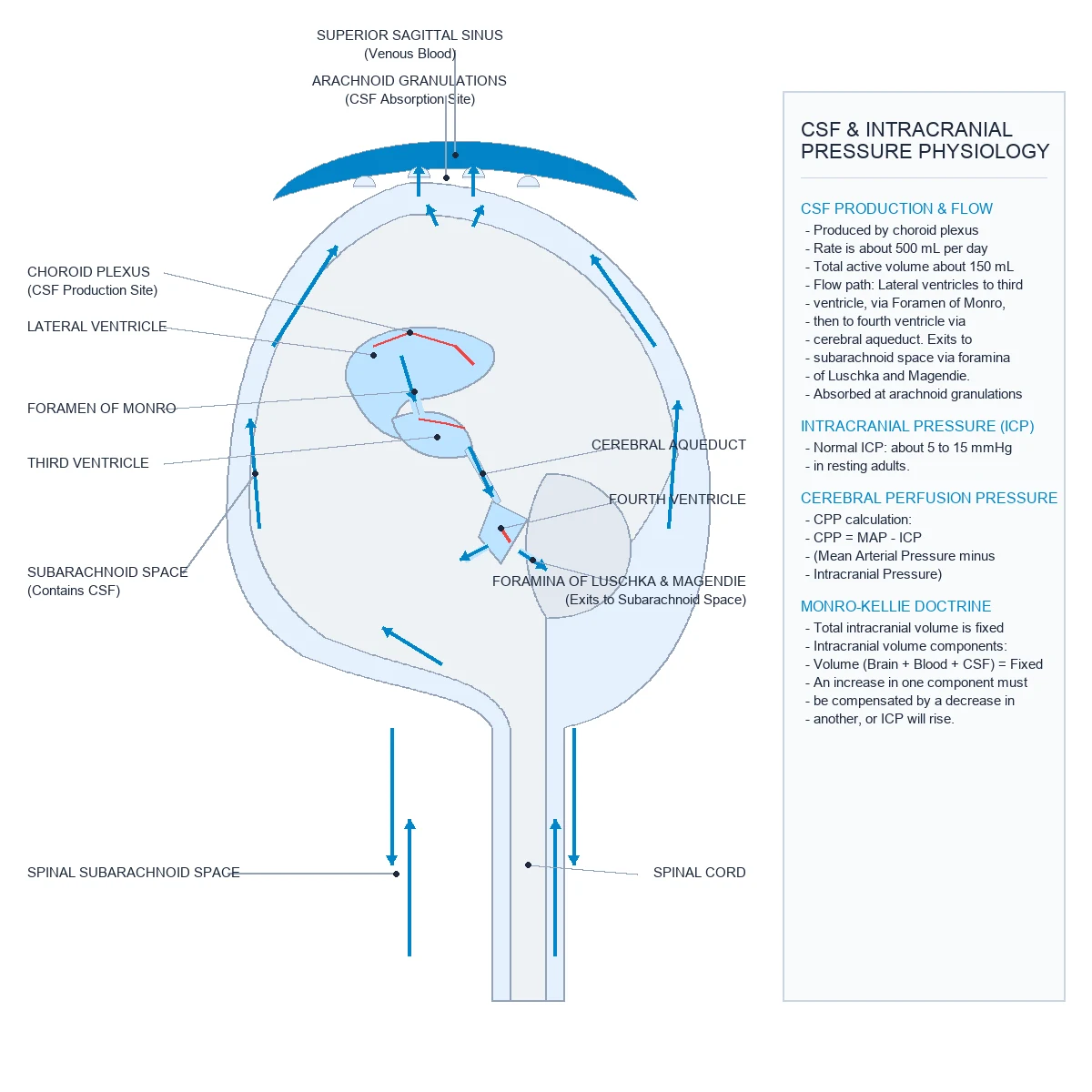
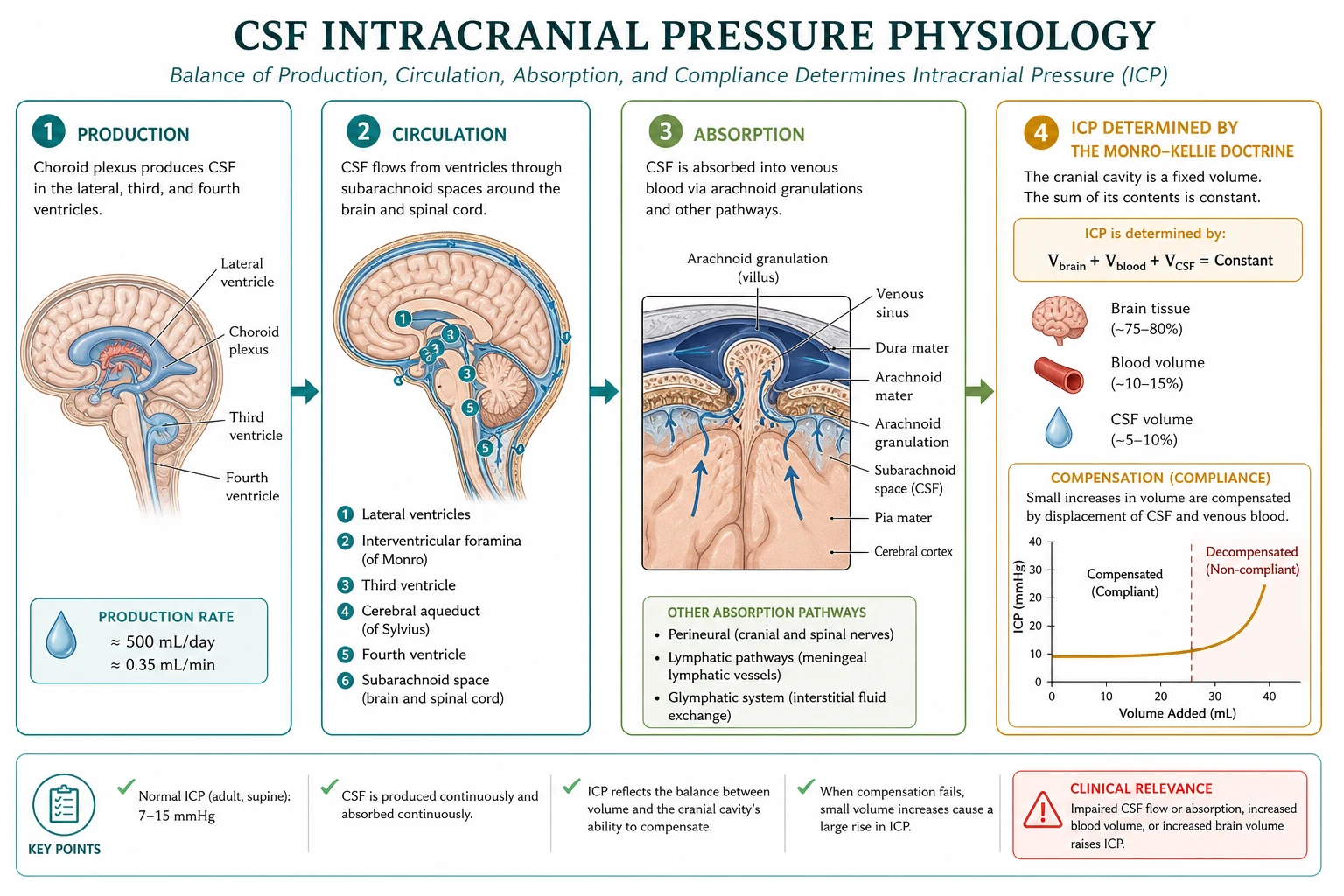
The cranium (after fontanelle closure) is a rigid box. Total intracranial volume is fixed: [1]
Vbrain + Vblood + VCSF (+ Vmass lesion) = constant [1]
An increase in one compartment requires a decrease in another or ICP rises. Early compensation: CSF translocation to spinal subarachnoid space, venous blood extrusion. Once exhausted, small volume increases cause large ICP rises (steep part of compliance curve). [1]
CSF production
Produced mainly by choroid plexus (lateral, third, fourth ventricles) via carbonic anhydrase-dependent secretion. Rate ≈ 0.3–0.4 mL/min ≈ 500 mL/day. Total CSF volume ≈ 100–150 mL — turns over 3–4 times daily. Production is relatively pressure-independent until extreme ischaemia; acetazolamide and furosemide reduce production; choroid plexus tumours overproduce. [1]
CSF circulation
Lateral ventricles → foramina of Monro → third ventricle → cerebral aqueduct (Sylvius) → fourth ventricle → foramina of Luschka and Magendie → subarachnoid space → around cord and brain → absorption. [1]
Obstruction at aqueduct → non-communicating hydrocephalus; impaired absorption at arachnoid granulations → communicating hydrocephalus. [1]
CSF absorption
Primarily via arachnoid granulations into the superior sagittal sinus (and other sinuses), driven by CSF pressure − venous sinus pressure gradient. Also some lymphatic/nerve-root pathways. Raised venous pressure (right heart failure, jugular obstruction, PEEP extremes, head-down) impairs absorption and can raise ICP. [1]
Normal ICP and CPP
Normal ICP supine adult ≈ 5–15 mmHg (7–20 cmH2O). Higher in infants with open sutures differently manifested (bulging fontanelle). [1]
CPP = MAP − ICP (or MAP − CVP if CVP > ICP) [1]
Target CPP in TBI protocols often ~60 mmHg range (guideline-dependent). Raised ICP erodes CPP even if MAP looks "normal." [1]
Intracranial compliance curve
Plot ICP (y) vs added intracranial volume (x): flat then steep. On the steep portion, small oedema or haematoma growth → herniation risk. Cushing triad (hypertension, bradycardia, irregular respiration) is late decompensation. [1]
Cerebral blood volume and anaesthetic agents
CBF couples to metabolism (CMRO2) and reacts to PaCO2 (~3% CBF change per mmHg PaCO2 in responsive range) and PaO2 (vasodilatation when PaO2 very low). Autoregulation holds CBF over a MAP range when intact. [1]
- Volatiles: generally cerebral vasodilators (raise CBV/ICP) with dose-dependent CMRO2 reduction — net ICP effect depends on concentration and ventilation.
- Propofol / barbiturates: lower CMRO2 and CBF/CBV — favourable for ICP.
- Ketamine: historically feared; with controlled ventilation and modern use, often ICP-neutral or acceptable — myth of automatic ICP crisis needs nuance.
- Opioids: little direct ICP effect if ventilation controlled; hypoventilation raises ICP via CO2. [1]
(Note: keep citations only to existing frontmatter ids — I'll use generic wording without invalid cites.) [1]
Raised ICP management principles (physiology-linked)
- Airway and oxygenation — avoid hypoxia (vasodilatation).
- Controlled ventilation — PaCO2 low-normal; brief hypocapnia only as bridge.
- Head-up 30°, neck neutral — venous drainage.
- MAP support — defend CPP.
- Osmotherapy (mannitol, hypertonic saline) — reduce brain water / rheology.
- CSF drainage if EVD present.
- Metabolic suppression (propofol/barbiturate coma) selected cases.
- Decompressive craniectomy when indicated — opens the box.
- Treat cause — haematoma evacuation, tumour, infection, hydrocephalus. [1]
Anaesthetic relevance
- Avoid coughing/straining on induction and emergence in tight brains — deepen, opioid, or neuromuscular block as appropriate; smooth emergence strategy.
- Venous obstruction (tight tube ties, head-down) raises ICP.
- Lumbar puncture is dangerous if large supratentorial mass with pressure gradient — herniation risk.
- Sitting position neurosurgery: low CVP and open veins → VE risk; also CPP with head height. [1]
Compensated ICP
- CSF shifted out
- Venous blood reduced
- ICP near normal
- Reserve remaining
Decompensated ICP
- On steep compliance curve
- CPP falling
- Cushing response late
- Herniation risk
CSF composition (exam table)
CSF is not an ultrafiltrate alone: lower protein than plasma, lower K+, similar Na+, lower glucose (~2/3 plasma), higher Cl−. Blood–brain and blood–CSF barriers maintain composition. Bloody or xanthochromic CSF implies pathology (SAH, traumatic tap differentiation). [1]
Hydrocephalus types
- Obstructive (non-communicating): block inside ventricular system
- Communicating: absorption failure or excess production
- Normal-pressure hydrocephalus: classic triad gait/urinary/cognitive — special entity
- Raised ICP without ventriculomegaly: e.g. some mass lesions, idiopathic intracranial hypertension patterns differ [1]
Viva traps
- Production ~500 mL/day, volume ~150 mL — must turn over.
- CPP formula uses the higher of ICP or CVP as downstream pressure conceptually when venous pressure elevated.
- Cushing is late, not early.
- Acetazolamide cuts production via carbonic anhydrase.
- Ketamine myth needs controlled ventilation context. [1]
SAQ: Monro–Kellie and CPP
"The Monro–Kellie doctrine states that because the cranium is rigid, the sum of the volumes of brain, blood and cerebrospinal fluid is constant. An increase in one compartment must be offset by a decrease in another or intracranial pressure rises. Cerebral perfusion pressure equals mean arterial pressure minus intracranial pressure. When compensatory CSF and venous blood displacement is exhausted, small volume increases cause large rises in intracranial pressure and cerebral perfusion collapses." [1]
Herniation syndromes (names)
Subfalcine, uncal (CN III, PCA), tonsillar (medullary compression, respiratory arrest), upward. Clinical signs map to syndrome — uncal: ipsilateral dilated pupil. Physiology is pressure gradients between compartments, not just a single ICP number. [1]
ICP monitoring modalities
Intraparenchymal bolt, EVD (diagnostic and therapeutic), epidural sensors (less common). Waveform: P1 percussion, P2 tidal, P3 dicrotic; P2 elevation suggests reduced compliance. Lundberg A waves: plateau waves of raised ICP — ominous. [1]
Anaesthetic recipe physiology for tight brain
Propofol-based maintenance, modest volatile if any, strict CO2 control, deep neuromuscular block for no coughing, head-up, adequate MAP, osmotherapy ready, avoid hypoxia and hypo-osmolar fluids (prefer plasma-tonicity isotonic crystalloids). [1]
Primary exam expansion
CSF formation mechanism detail
Choroid epithelial cells use carbonic anhydrase to generate H+ and HCO3−; ion transporters create osmotic gradients; water follows through aquaporins. Ultrafiltration from choroidal capillaries contributes. Production rate is relatively constant across normal ICP ranges, so absorption must match via pressure-sensitive granulations. [1]
Blood–brain barrier versus blood–CSF barrier
BBB: tight junctions of brain capillary endothelium. Blood–CSF barrier: choroid epithelium tight junctions. Drug entry depends on lipophilicity, size, ionisation, transporters. Mannitol acts osmotically where barrier intact; in disrupted barrier regions effects differ. [1]
Cerebral autoregulation testing concepts
Static vs dynamic autoregulation; Mx index; response to pressors or thigh-cuff release. Intact autoregulation means CBF stable when MAP changes; impaired means pressure-passive brain — common after severe TBI, making CPP management both more important and more dangerous. [1]
Secondary brain injury physiology
Hypoxia, hypotension, hypercapnia, hyponatraemic swelling, hyperthermia, and seizures all raise metabolic demand or raise CBV/ICP or both. Anaesthetic care is secondary-injury prevention: ABC with brain-specific targets. [1]
Osmotherapy mechanisms
Mannitol: osmotic extraction of water from brain, plasma expansion, improved rheology, free-radical scavenging debated; risk of later rebound and renal injury; give via filter. Hypertonic saline: osmotic effect plus volume expansion and immune/microcirculatory effects; watch Na. Both reduce brain bulk when barrier largely intact. [1]
Venous pressure and ICP
CVP, intrathoracic pressure, head position, and jugular compression all set the downstream pressure for cerebral venous drainage. Tight ETT ties and extreme head-down laparoscopic positions are practical ICP raisers. [1]
Paediatric notes
Open fontanelles allow expansion — ICP rise may present as bulging fontanelle and macrocephaly rather than early herniation signs. Production and volumes scale with age; hydrocephalus physiology still Monro–Kellie once sutures close. [1]
Extended viva dialogue
Examiner: State Monro–Kellie and the CPP equation. [1]
Candidate: Within the rigid cranium the volumes of brain, blood and CSF sum to a constant. An increase in one requires a decrease in another or ICP rises. Cerebral perfusion pressure equals MAP minus ICP, or MAP minus CVP if venous pressure is higher. Raised ICP therefore steals perfusion even when MAP looks acceptable. [1]
Examiner: CSF production, volume, circulation, absorption? [1]
Candidate: About 500 mL per day from choroid plexus, total volume 100 to 150 mL, circulating from lateral ventricles through the third and aqueduct to the fourth and out via Luschka and Magendie to the subarachnoid space, absorbed mainly at arachnoid granulations into venous sinuses driven by the CSF-to-venous pressure gradient. [1]
Examiner: Describe the compliance curve and decompensation. [1]
Candidate: ICP versus intracranial volume is initially flat because CSF and venous blood are displaced. Then it steepens so small volume increments cause large ICP rises. Clinical decompensation includes falling consciousness and late Cushing triad of hypertension, bradycardia and irregular respiration — a brainstem ischaemia response, not a reassuring sign of good blood pressure. [1]
Examiner: Anaesthetic agents and CO2 effects on ICP? [1]
Candidate: Carbon dioxide is a potent cerebral vasodilator; hypoventilation raises CBV and ICP, hyperventilation lowers them temporarily. Propofol reduces CMRO2 and CBF favourably. Volatile agents vasodilate in a dose-dependent manner. With controlled ventilation ketamine is not automatically forbidden as older teaching suggested. [1]
Clinical synthesis: Manage airway, CO2, venous drainage, MAP for CPP, osmotherapy, CSF drainage and the surgical cause — physiology first, checklist second. [1]
Worked SAQ model answers
SAQ: Describe the production, circulation and absorption of CSF and the regulation of ICP (10 marks)
Cerebrospinal fluid is produced mainly by the choroid plexus at about 500 mL per day. Total CSF volume is about 100 to 150 mL, so the fluid turns over several times daily. Production uses carbonic anhydrase-dependent ion transport and can be reduced by acetazolamide. [1]
CSF flows from the lateral ventricles through the foramina of Monro into the third ventricle, down the cerebral aqueduct into the fourth ventricle, and out through the foramina of Luschka and Magendie into the subarachnoid space around brain and spinal cord. Absorption occurs mainly at arachnoid granulations into venous sinuses, driven by the gradient between CSF pressure and venous sinus pressure. [1]
Intracranial pressure is governed by the Monro–Kellie doctrine: in a rigid cranium, brain, blood and CSF volumes sum to a constant. Compensation for an expanding mass includes CSF displacement and venous blood extrusion. Once exhausted, the compliance curve steepens and ICP rises rapidly. Cerebral perfusion pressure equals MAP minus ICP. Carbon dioxide is a powerful modulator of cerebral blood volume; anaesthetic agents alter CMRO2 and cerebrovascular tone. Management of raised ICP defends oxygenation, CO2, venous drainage, CPP, osmolar therapy and definitive treatment of the cause. [1]
SAQ: Define CPP and explain Cushing's response (5 marks)
CPP = MAP − ICP. When ICP rises enough to ischaemicise the brainstem, a massive sympathetic surge raises blood pressure in an attempt to restore perfusion; baroreflexes then cause bradycardia, and respiration becomes irregular. Cushing's triad is therefore a late sign of decompensation, not a reassuring blood pressure. [1]
Clinical scenario walkthroughs
Scenario 1 — Extradural haematoma and a "good" blood pressure
MAP 150 mmHg with a fixed dilated pupil is Cushing physiology until proven otherwise. CPP may still be inadequate if ICP is higher. Urgent surgical decompression plus airway, CO2 control and osmotherapy beat pure antihypertensive therapy aimed at a normal MAP. [1]
Scenario 2 — Tight brain on opening
Surgeon reports swelling. Checklist physiology: PaCO2, venous drainage (head position, ties), depth of anaesthesia, muscle relaxation, osmotherapy, CSF drain if available, MAP for CPP, rule out hypoxia and high intrathoracic pressure. Switch toward propofol if volatiles are high. [1]
Scenario 3 — EVD and overdrainage
CSF removal lowers ICP but overdrainage risks subdural bleeding and ventricular collapse. Monro–Kellie cuts both ways — volume removed is a compartment change. [1]
Scenario 4 — Sitting craniotomy
Head elevation lowers CPP for a given MAP at the heart (hydrostatic gradient) and increases venous air embolism risk when venous pressure at the wound is subatmospheric. Monitor for VAE; maintain hydration; communicate with surgeon. [1]
Additional exam numerical anchors
Numerical anchors: [1]
- CSF production ~0.3–0.4 mL/min (~500 mL/day).
- CSF volume ~100–150 mL adults.
- Normal ICP ~5–15 mmHg supine.
- CPP = MAP − ICP (or −CVP if higher).
- CBF normal ~50 mL/100 g/min; CMRO2 ~3–3.5 mL O2/100 g/min.
- CO2 reactivity: substantial CBF change per mmHg PaCO2 in the mid-range (teaching approximations 1–4% per mmHg depending on source — state direction with confidence).
- Mannitol typical teaching dose 0.25–1 g/kg (follow local protocol); watch osmolar gap and renal function.
- Head-up 20–30 degrees with neutral neck is a first and free ICP intervention.
- Cushing triad is late; pupillary dilation and falling GCS are action triggers.
- Hydrostatic consideration: brain perfusion pressure falls about 2 mmHg for every 2.5 cm the head is above the heart (rule-of-thumb teaching) — relevant in beach-chair and sitting positions. [1]
Closing synthesis for the Primary
CSF and ICP physiology unifies anatomy (ventricular pathways), secretion chemistry (carbonic anhydrase), intracranial compliance (Monro–Kellie), and cerebral blood flow regulation (CO2, autoregulation, anaesthetic agents). The single equation that must never be forgotten is CPP = MAP − ICP. Everything the anaesthetist does for the threatened brain — airway, ventilation targets, head position, blood pressure, osmotherapy, drug choice, and urgency of surgical decompression — is an intervention on a compartment, a compliance curve, or a perfusion pressure. Learn the production rate, the circulation path, the absorption site, the normal ICP range, and the late meaning of Cushing's triad, and you have a structure that carries Final-exam neuroanaesthesia as well as Primary basic science. [1]
One-line take-home
Master the core equations and mechanisms of this topic until they are automatic under viva pressure; clinical anaesthesia is applied primary science, not a separate subject. [1]
Red flags
- CPP = MAP − ICP; raised ICP erodes perfusion.
- Monro–Kellie: fixed box; compensation then steep ICP rise.
- CSF ~500 mL/day from choroid plexus; absorb at arachnoid granulations.
- Decompensation: falling consciousness then Cushing triad.
- Volatiles may raise CBV; propofol lowers CMRO2/CBF; control PaCO2 always. [1]
References
- [1]Wang N, et al. Noninvasive whole-brain imaging of glymphatic dynamics Sci Adv, 2026.PMID 42308292
- [2]Engelhard HH, et al. Variability in the circulation of cerebrospinal fluid: causes and clinical implications for intraventricular drug delivery Front Drug Deliv, 2026.PMID 42205472
- [3]Munir A, et al. Imaging Perspectives on Hydrocephalus: CSF Flow, Glymphatic Function, and Clinical Implications in the Diagnosis and Management of Normal Pressure Hydrocephalus Semin Roentgenol, 2026.PMID 42116253
- [4]Haywood S, et al. Ketamine Use in Acute Brain Injury: Debunking the Myth Emerg Med Clin North Am, 2026.PMID 42342307
- [5]Bader SE, et al. Resuscitative endovascular occlusion of the aorta restores cerebral metabolic markers of ischaemia induced by haemorrhagic shock Eur J Trauma Emerg Surg, 2026.PMID 42340407
- [6]Bishop MS, et al. Intravenous megadose sodium ascorbate normalises elevations in intracranial pressure and restores pressor responsiveness to norepinephrine in ovine Gram-negative sepsis Sci Rep, 2026.PMID 42350542