Anaes · Applied cardiovascular & respiratory physiology
Endocrine physiology: glucose, thyroid & adrenal
Also known as Glucose homeostasis · Insulin glucagon · Thyroid hormones · Cortisol · Stress response · Adrenal medulla
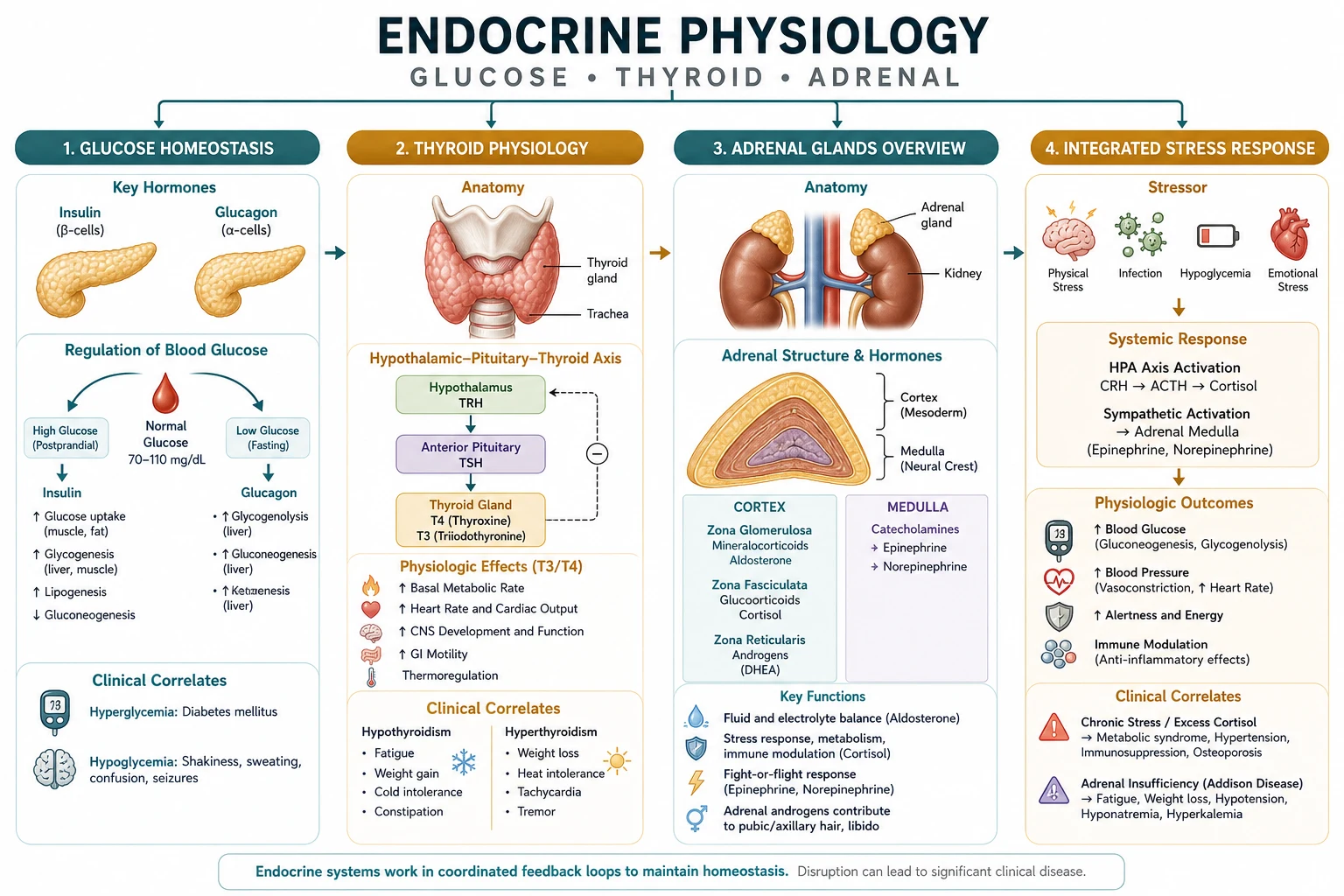
The endocrine system controls glucose, metabolic rate and the stress response, and its disorders are among the most common comorbidities the anaesthetist manages. The framework rests on five exam-critical ideas: blood glucose is held within a narrow range by insulin (beta-cell, anabolic, lowers glucose by driving it into cells and promoting glycogen and fat synthesis) and glucagon (alpha-cell, catabolic, raises glucose by glycogenolysis and gluconeogenesis); the thyroid axis (TRH then TSH then T4 and T3) sets the basal metabolic rate, heart rate and thermogenesis, and hyperthyroidism raises and hypothyroidism lowers them; the adrenal cortex makes cortisol (the stress hormone, driving gluconeogenesis and suppressing inflammation) and aldosterone (sodium and water retention); the adrenal medulla is a modified sympathetic ganglion releasing adrenaline; and the stress response to surgery raises cortisol, catecholamines, ADH and ACTH, producing hyperglycaemia, sodium retention and a catabolic state. Built on the semaglutide/GLP-1 study (Shahabian 2026), the PKA-insulin-secretion study (Liu 2026), the obesity-pharmacotherapy review (Bonafede 2026), the stress-axis review (Mancuso 2026), the cortisol-stress-reactivity study (Serin 2026), and the thyroid-hormone study (da Silva 2026).
On this page & tools
Your progress
Saved locally on this device.
8 MCQs with explanations
Target exams
Red flags
Why this matters to the anaesthetist
Endocrine physiology is examined as homeostatic control systems with crisp feedback loops — then applied to diabetes, thyrotoxicosis/myxoedema, and steroid cover. Know the axes, the hormones’ metabolic effects, and the crisis phenotypes.[1]
One-liner: Insulin stores and lowers glucose; glucagon/catecholamines/cortisol raise it; thyroid sets metabolic rate via T3; cortisol is essential stress steroid while aldosterone defends Na/volume and K. [1]
Glucose homeostasis
Insulin
- β-cell peptide; triggered primarily by glucose (GLUT2 → glucokinase → ATP → KATP channel close → depolarisation → Ca entry → exocytosis).
- Actions: GLUT4 translocation (muscle/fat), glycogen synthesis, lipogenesis, protein anabolism; suppresses glycogenolysis, gluconeogenesis, ketogenesis, lipolysis.
- Half-life short; C-peptide marks endogenous production. [1]
Glucagon
- α-cell; rises when glucose falls or with stress SNS input.
- Hepatic glycogenolysis and gluconeogenesis; opposes insulin. [1]
Counter-regulatory hierarchy (hypoglycaemia defence)
- ↓Insulin
- ↑Glucagon
- ↑Adrenaline
- ↑Cortisol and GH (slower)
- Symptoms + food-seeking [1]
Anaesthetic relevance: β-blockers and sedation can mask adrenergic hypoglycaemia warning; stressed patients run high, starved/insulin-treated patients risk low. [1]
Fed vs fasting board
| State | Dominant hormone | Fuel pattern |
|---|---|---|
| Fed | Insulin | Glycogen/fat storage |
| Early fast | Glucagon↑ | Glycogenolysis |
| Prolonged fast | Glucagon, low insulin | Gluconeogenesis, ketones |
| Stress/surgery | Counter-regulatory storm | Stress hyperglycaemia |
Thyroid physiology

- TRH (hypothalamus) → TSH (anterior pituitary) → thyroid follicular T4 (major product) and T3.
- Peripheral deiodination T4 → T3 (active) or rT3 (inactive).
- T3 genomic effects: ↑basal metabolic rate, ↑HR/contractility, ↑sensitivity to catecholamines, growth/development.
- Binding: TBG, transthyretin, albumin — free hormone is active (interpretation caveat in illness/pregnancy).
- Feedback: free T4/T3 suppress TSH. [1]
Hyperthyroidism anaesthetic themes: tachyarrhythmia, high CO, increased drug metabolism somewhat, airway if goitre, thyroid storm (hyperthermia, tachycardia, failure — differentiate from MH). [1]
Hypothyroidism themes: low CO, bradycardia, hypothermia, delayed gastric emptying, drug sensitivity, myxoedema coma (rare, deadly). [1]
Adrenal cortex
Three zones (GFR mnemonic — salt, sugar, sex): [1]
| Zone | Product | Control |
|---|---|---|
| Glomerulosa | Aldosterone | Ang II, K, (ACTH minor) |
| Fasciculata | Cortisol | ACTH |
| Reticularis | Androgens | ACTH |
Cortisol essential effects: permissive for vascular tone and catecholamine efficacy; gluconeogenesis; anti-inflammatory at high levels; distributes fluid; needed for stress survival. [1]
Aldosterone: ENaC/Na retention, K and H excretion (see RAAS leaf). [1]
Primary adrenal insufficiency: glucocorticoid ± mineralocorticoid failure → shock, hyponatraemia, hyperkalaemia, pigment if high ACTH. Secondary (pituitary): cortisol low, aldosterone relatively preserved (RAAS intact), no hyperpigmentation. [1]
Adrenal medulla
Chromaffin cells: adrenaline (~80%) and noradrenaline. Stimulated by preganglionic sympathetic (ACh). Fight-or-flight: β1 heart, β2 bronchodilation/vasodilation, α1 vasoconstriction. Phaeochromocytoma is the tumour extreme — see specialty leaves; physiology is SNS pharmacology in a bag. [1]
Stress, steroids and perioperative cover (applied)
- Endogenous cortisol production roughly ~5–10 mg/m²/day basal teaching range; stress multiplies output.
- Patients on chronic exogenous steroids may have HPA suppression — inadequate cortisol surge under surgery → refractory hypotension.
- Steroid cover principles (know local/national tables): continue usual steroids; additional cover scaled to surgical stress; mineralocorticoid rarely needed acutely if hydrocortisone used (has some MC activity).
- Do not confuse relative adrenal insufficiency of critical illness debates with classic Addisonian crisis — both can present as vasopressor-resistant shock. [1]
Diabetes perioperative physiology hooks
- Type 1: absolute insulin deficiency → ketosis risk if insulin stopped.
- Type 2: insulin resistance ± relative deficiency.
- Stress hyperglycaemia on top of either.
- SGLT2 inhibitors: euglycaemic DKA risk if continued inappropriately.
- Variable subcutaneous absorption; sick-day / variable rate insulin infusion logic for major cases. [1]
Thyroid drug and crisis physiology (exam bullets)
- Antithyroid drugs reduce synthesis (slow).
- β-blockade controls peripheral effects rapidly.
- Storm triggers: surgery, infection, iodine load — treat ABC, cool, block synthesis and release, β-block, steroids (reduce T4→T3), treat trigger. [1]
Numbers and equations board
- Normal fasting glucose teaching ~3.5–5.5 mmol/L.
- Brain is obligate glucose user short-term (ketones later).
- TSH feedback is the screening workhorse; free T4 for state.
- Cortisol diurnal rhythm — morning higher; random levels hard to interpret under stress. [1]
Insulin
- Anabolic storage
- Lowers glucose/K into cells
- Deficiency → DKA risk
- Stress opposes it
Cortisol
- Stress survival hormone
- Raises glucose
- Permissive for vessels
- Deficiency → refractory shock
Viva scripts
Draw the HPA axis with negative feedback. [1]
Explain insulin release from the β-cell (KATP story — links to sulfonylureas). [1]
Contrast primary vs secondary adrenal failure. [1]
List counter-regulatory hormones in order of hypoglycaemia defence. [1]
Extended viva dialogue
Examiner: Why is blood glucose high after major surgery in a non-diabetic? [1]
Candidate: Catecholamines, glucagon, cortisol and growth hormone increase hepatic glucose output and create insulin resistance; inflammatory cytokines contribute. Net is stress hyperglycaemia proportional to insult. [1]
Examiner: What does T3 do that matters under anaesthesia? [1]
Candidate: It raises metabolic rate and sensitises the myocardium to catecholamines — thyrotoxic patients are hyperdynamic and arrhythmia-prone; hypothyroid patients are bradycardic, hypothermic and drug-sensitive. [1]
Clinical synthesis: Endocrine leaves are feedback diagrams plus crisis recognition — if you can draw the axes and name the decompensated state, you score. [1]
β-cell stimulus–secretion coupling (draw)
Glucose → GLUT2 → glucokinase → ↑ATP/ADP → close KATP (Kir6.2/SUR1) → depolarisation → open voltage-gated Ca channels → insulin granule exocytosis. Sulfonylureas close KATP pharmacologically. GLP-1 amplifies glucose-dependent secretion (incretin effect). [1]
Steroid cover quick physiology
Chronic exogenous glucocorticoid → HPA suppression → inadequate cortisol surge under surgery → reduced vascular responsiveness to catecholamines → refractory hypotension, hyponatraemia, hyperkalaemia if mineralocorticoid also deficient (primary). Hydrocortisone provides glucocorticoid with some mineralocorticoid activity; fludrocortisone only if needed long-term primary failure. [1]
Worked SAQ
SAQ: Contrast primary and secondary adrenal insufficiency (6 marks)
Primary (adrenal destruction): cortisol and usually aldosterone deficient; high ACTH causes pigmentation; hyperkalaemia and marked salt wasting common. Secondary (pituitary ACTH lack): cortisol deficient; aldosterone relatively preserved because Ang II/K still drive glomerulosa; no hyperpigmentation; hyperkalaemia less classic. Both can shock under stress without steroid cover. [1]
Primary exam expansion — dense examiner pack
Glucose regulation map for anaesthesia
| Hormone | Effect on glucose | Anaesthetic relevance |
|---|---|---|
| Insulin | ↓ glucose; promotes storage | Deficiency = DKA/HHS; excess = hypo |
| Glucagon | ↑ glycogenolysis/gluconeogenesis | Counter-reg; used in beta-blocker OD adjunct |
| Adrenaline | ↑ glucose; insulin resistance | Stress response, phaeo |
| Cortisol | ↑ glucose; permissive | Steroid stress cover; Cushing |
| Growth hormone | Anti-insulin | Less acute theatre |
| Incretins | Amplify insulin | DPP4/GLP-1 drug contexts |
Brain is obligate glucose user (ketones in starvation). Perioperative targets balance hypo risk versus hyperglycaemia (infection, osmotic diuresis, osmotic shifts). [1]
Diabetes perioperative physiology (not full guideline dump)
Hypoglycaemia under anaesthesia is silent — no adrenergic warning if beta-blocked or anaesthetised; check glucose regularly. Hyperglycaemia osmotic diuresis → hypovolaemia. DKA: high anion gap metabolic acidosis, ketones, dehydration, K total body low but serum may be high — insulin + fluid + careful K. HHS: extreme hyperosmolarity, neuro signs, less ketoacidosis. Variable-rate insulin infusion principles: substrate glucose, monitor K, avoid hypotonic shifts in HHS too fast. [1]
SGLT2 inhibitors: euglycaemic DKA risk perioperatively — withhold per local guidance; check ketones if unexplained acidosis. [1]
Thyroid physiology essentials
TRH → TSH → T4/T3; T3 more active; reverse T3 inactive. Protein binding (TBG) changes total levels in pregnancy/oestrogen — free hormones matter. Hyperthyroidism: ↑BMR, tachyarrhythmia, high-output state, eye disease airway caveats in Graves. Crisis (thyroid storm): fever, tachyarrhythmia, decompensation — PTU/carbimazole pathways, beta-block (propranolol also ↓T4→T3), iodine after block, steroids, supportive ICU. Hypothyroidism: low BMR, bradycardia, sensitivity to sedatives, myxoedema coma rare emergency (rewarm, thyroid hormone, steroids if hypoadrenal overlap, support ventilation). [1]
Amiodarone: iodine load + direct thyroid toxicity → hypo or hyper — chronic therapy history matters. [1]
Adrenal cortex and medulla
| Layer | Product | Axis |
|---|---|---|
| Glomerulosa | Aldosterone | Ang II, K, ACTH minor |
| Fasciculata | Cortisol | ACTH |
| Reticularis | Androgens | ACTH |
| Medulla | Adrenaline/NA | SNS preganglionic |
Cortisol: gluconeogenesis, anti-inflammatory, vascular reactivity permissive for catecholamines. Mineralocorticoid: Na retain, K/H lose — deficiency → hyperK, hyponatraemia, shock. [1]
Perioperative steroid deficiency and cover
Primary adrenal failure (Addison), secondary (pituitary), tertiary (exogenous steroid suppression). Stress dosing concepts: patients on significant chronic steroids may need additional cover for major surgery — follow local protocol; do not invent fixed doses in viva without stating institutional guidance, but state principle of inadequate cortisol → refractory hypotension. [1]
Phaeochromocytoma physiology
Catecholamine excess → labile hypertension, vasoconstriction, hypovolaemia masked, arrhythmias. Anaesthesia: alpha-blockade before beta-blockade (avoid unopposed alpha), invasive monitoring, avoid histamine liberators/ketamine extremes, treat surges with short-acting vasodilators, post-resection hypotension from vasodilation + hypovolaemia + residual alpha-block. [1]
Stress response under anaesthesia (link)
Surgery → afferent nerves + cytokines → ACTH/cortisol, ADH, aldosterone, catecholamines, glucagon, insulin resistance → catabolism, Na/water retention, hyperglycaemia. Regional anaesthesia and deep opioid techniques partially modify endocrine response; outcome importance debated but physiology is examinable. [1]
SAQ: endocrine response to surgery or thyroid storm outline (8 marks)
Pick one. For stress: list hormones and metabolic effects + anaesthetic modifiers. For storm: recognition + multi-drug physiology rationale. [1]
Viva
Q: Why give steroid in refractory septic/addisonian shock patterns? A: Cortisol permissive for vascular tone and catecholamine efficacy; deficiency causes catecholamine-refractory hypotension. Q: Why avoid beta-block alone first in phaeo? A: Unopposed alpha vasoconstriction can worsen hypertension. Q: Why is hypoglycaemia dangerous under GA? A: Autonomic symptoms masked; neuroglycopaenia progresses silently. [1]
High-yield viva battery and numbers lock-in
Glucose emergency contrast table
| Entity | Glucose | Acid–base | Key Rx themes |
|---|---|---|---|
| Hypoglycaemia | Low | Variable | Glucose IV; find cause |
| DKA | High (usually) | HAGMA + ketones | Fluid, insulin, K, treat trigger |
| HHS | Very high | Often not severe keto | Slow osmolar repair, fluid, insulin careful |
| Euglycaemic DKA (SGLT2) | Normal/mild ↑ | Ketoacidosis | Ketones check; stop SGLT2; same principles |
Thyroid storm versus malignant hyperthermia (differentiate)
Both: hyperthermia, tachycardia. Storm: history of hyperthyroid, goitre/eye signs, triggered by stress/surgery/iodine, diarrhoea, high free T4. MH: trigger volatiles/sux, rising EtCO2 early, rigidity, rhabdomyolysis, family history. Treatment paths entirely different (dantrolene vs antithyroid/beta-block/support). [1]
Steroid cover principle sentence
"Patients with suppression of the hypothalamic–pituitary–adrenal axis from chronic exogenous steroids may be unable to mount a cortisol stress response; for major surgery I follow local perioperative steroid guidelines, ensure parenteral cover if nil by mouth, and treat refractory hypotension with consideration of adrenal insufficiency." [1]
Full viva dialogue (additional)
Examiner: Why is heart rate control important in hyperthyroidism? [1]
Candidate: High circulating thyroid hormone increases metabolic rate and sensitises the myocardium to catecholamines, producing tachyarrhythmias and high-output stress. Beta-blockade reduces symptoms and propranolol also decreases peripheral conversion of T4 to T3, buying physiological stability before definitive therapy. [1]
Examiner: Outline the endocrine stress response to surgery. [1]
Candidate: Afferent neural and inflammatory signals stimulate hypothalamic–pituitary release of ACTH and ADH, raise cortisol, activate the sympathetic–adrenal axis, promote glucagon and insulin resistance, and activate RAAS. The result is catabolism, sodium and water retention and hyperglycaemia. Regional anaesthesia and deep opioid techniques can blunt parts of this response. [1]
Exam traps
- Treating thyroid storm with dantrolene as first line.
- Beta-block before alpha-block in phaeochromocytoma.
- Ignoring silent hypoglycaemia under anaesthesia.
- Stopping insulin entirely in fasting type 1 diabetics without a plan. [1]
References
- [1]Shahabian L, et al. Semaglutide Selectively Improves Metabolic and Cognitive Function in 5xFAD Mice Int J Mol Sci, 2026.PMID 42353032
- [2]Liu Y, et al. Type IIB PKA serves as the primary effector of Gs-coupled receptor-potentiated insulin secretion in mice by orchestrating ion channels and granule phenotype Diabetologia, 2026.PMID 42337176
- [3]Bonafede M, et al. Overview of Novel Mechanisms in Obesity Pharmacotherapy and Implications for Cardiovascular Disease: A Narrative Review Curr Atheroscler Rep, 2026.PMID 42360622
- [4]Mancuso C. Carbon Monoxide: A Context-Dependent Regulator of the Stress Axis Biomolecules, 2026.PMID 42352364
- [5]Serin E, et al. Linking brain structure to stress reactivity: cingulate surface area predicts acute cortisol responses Psychol Med, 2026.PMID 41943954
- [6]da Silva WST, et al. Coat characteristics, physiological traits, serum metabolites, and thyroid hormones of Canindé and Moxotó goats in a semiarid environment Trop Anim Health Prod, 2026.PMID 42360558