Anaes · Applied cardiovascular & respiratory physiology
Maternal physiology
Also known as Pregnancy physiology · Cardiovascular changes in pregnancy · Aortocaval compression · MAC in pregnancy · Aspiration risk in pregnancy · Obstetric physiology
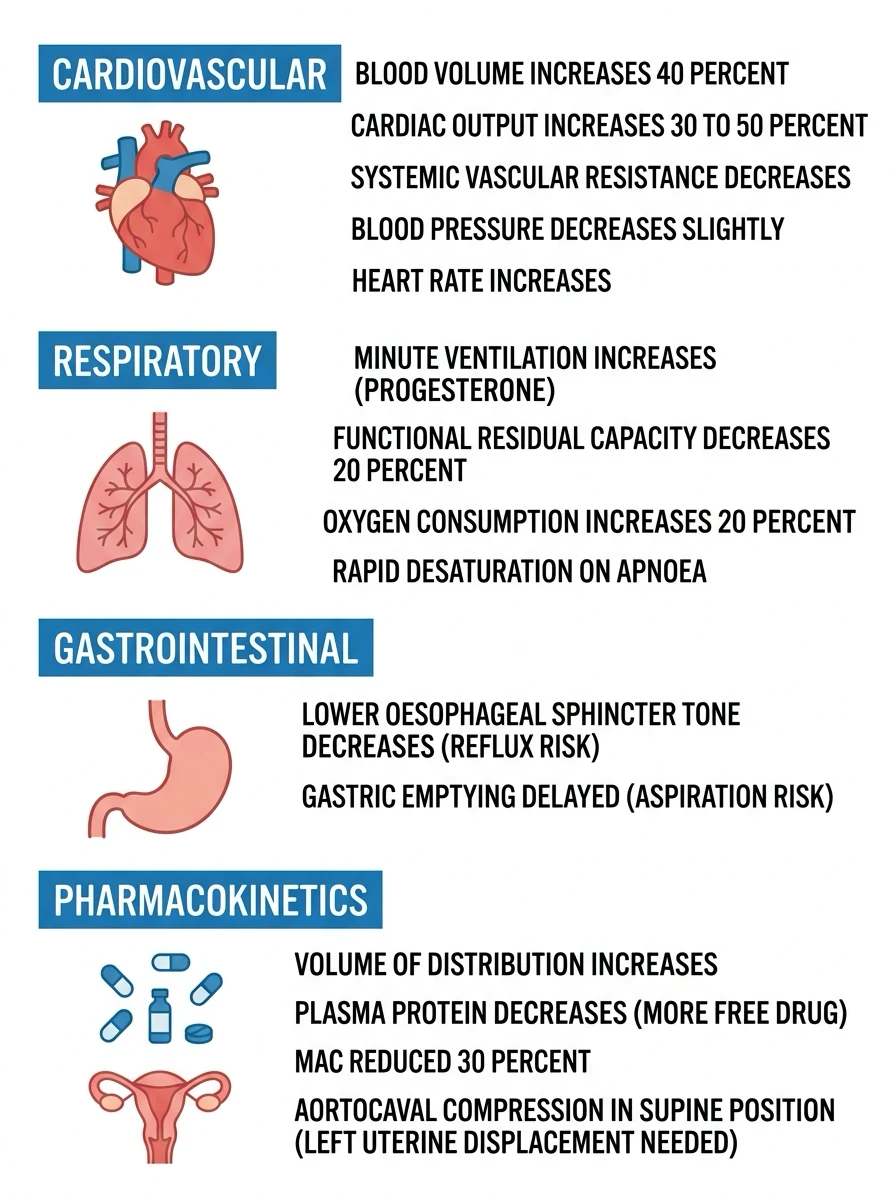
Pregnancy transforms every organ system, and the anaesthetist must know the changes to manage the obstetric patient safely. The framework rests on five exam-critical ideas: blood volume rises about 40 percent and cardiac output about 30 to 50 percent, while systemic vascular resistance falls (the placental circulation is a low-resistance shunt), producing a hyperdynamic, vasodilated circulation; the respiratory system increases minute ventilation (progesterone-driven) but the functional residual capacity falls about 20 percent and oxygen consumption rises about 20 percent, so the pregnant patient desaturates within seconds of apnoea; the gastrointestinal system has reduced lower oesophageal sphincter tone and delayed gastric emptying, making aspiration risk real and mandatory the rapid-sequence induction; the gravid uterus compresses the inferior vena cava in the supine position (aortocaval compression), reducing venous return and cardiac output — the patient is tilted left (15 degrees) or a lumbar wedge is placed; and the minimum alveolar concentration (MAC) of volatile agents falls about 30 percent in pregnancy, and the dose requirement for local anaesthetics is reduced, so less drug is needed. Built on the obstetric cardiac-arrest review (Astete 2026), the phenylephrine-spinal-hypotension study (Yu 2026), the caesarean-spinal-haemodynamics study (Zagrodnik 2026), the lumbar-wedge study (Kim 2025), the TCI-pharmacokinetics-for-caesarean study (Keresztes 2026), and the propofol-pharmacodynamics-in-pregnancy study (Lacassie 2026).
On this page & tools
Your progress
Saved locally on this device.
8 MCQs with explanations
Target exams
Red flags
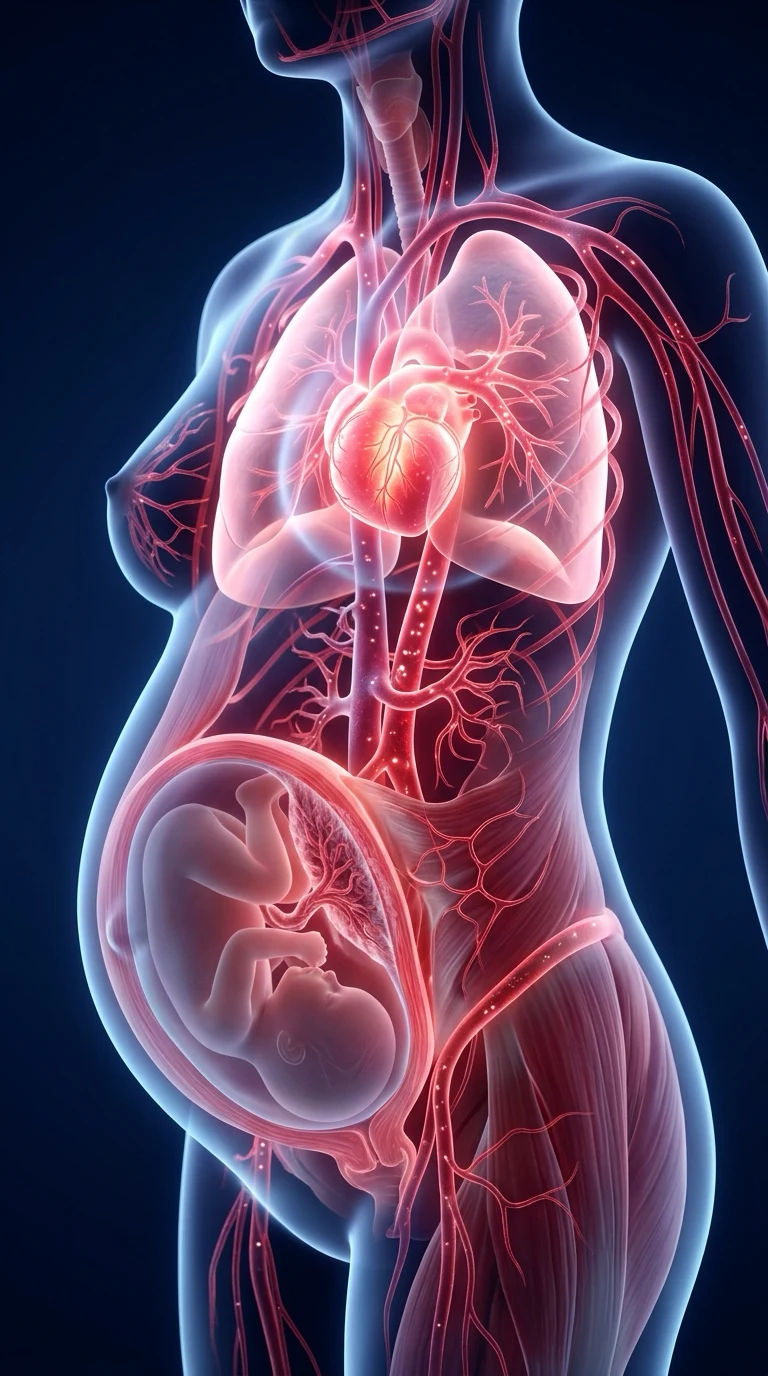
Why this matters to the anaesthetist
From the second trimester, the parturient is a different physiological organism: higher oxygen consumption, lower FRC, aortocaval compression, full-stomach kinetics, hypercoagulability, and reduced MAC. Every RSI, spinal for caesarean, and haemorrhage resuscitation is applied maternal physiology. Primary candidates must quantify the major system changes and the anaesthetic consequences. [1]
Cardiovascular changes
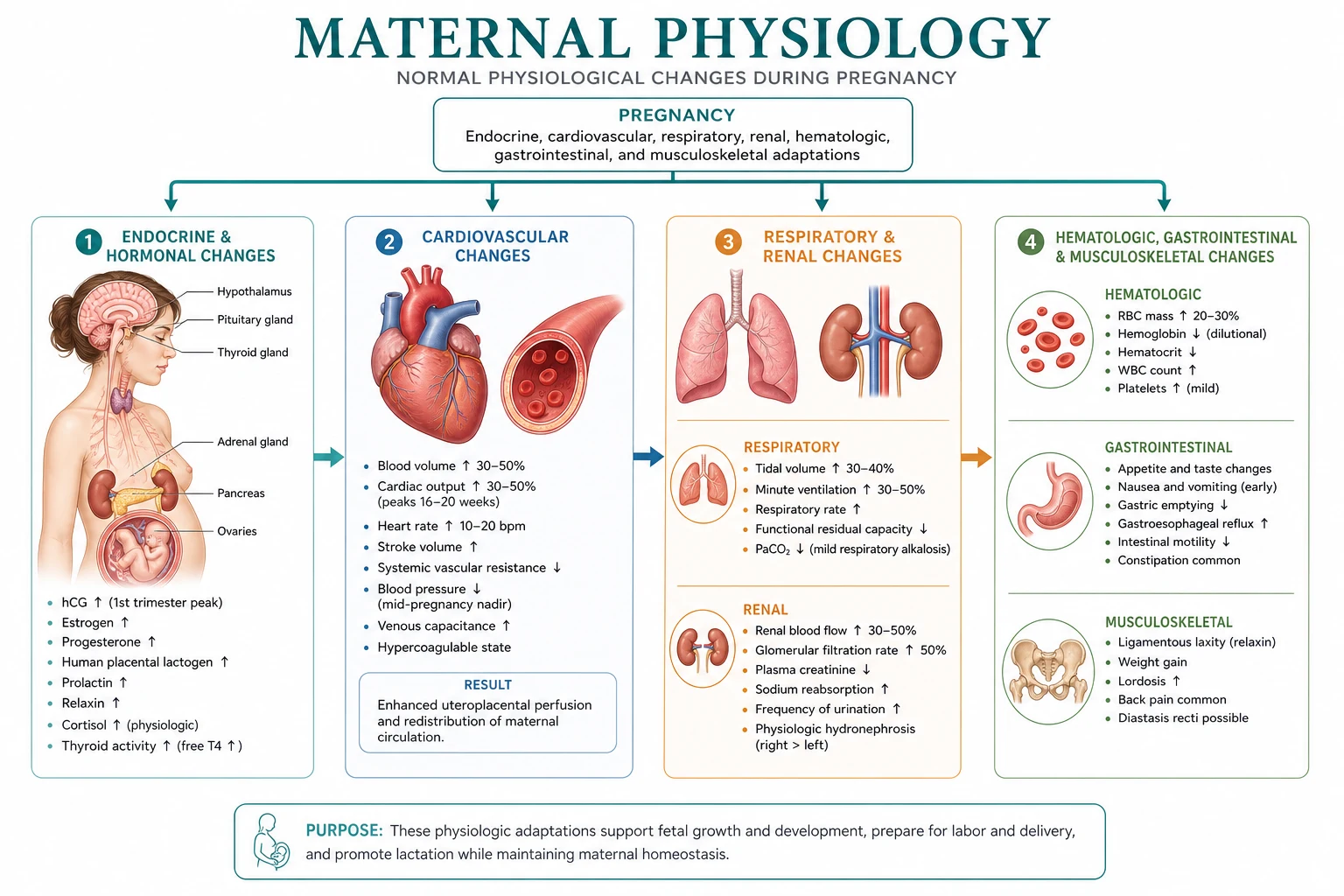
Plasma volume rises 45–50% by term; red-cell mass rises less (20–30%) → dilutional anaemia (physiological). Cardiac output rises 30–50% (early rise, peaks in labour with each contraction). Stroke volume and heart rate both contribute; SVR falls (20%) with a gestational fall in MAP mid-pregnancy then partial rise toward term. Uterine blood flow at term ~700 mL/min (~10% of CO) — non-autoregulated in the same way as brain; depends on perfusion pressure and uterine tone. [1]
Aortocaval compression from ~20 weeks supine: IVC compression reduces VR; aortic compression may reduce uterine perfusion. Left lateral tilt 15° or uterine displacement is mandatory for resuscitation and often for caesarean under regional anaesthesia. [1]
Respiratory changes
Oxygen consumption ↑ ~20%. Minute ventilation ↑ ~40–50% (progesterone; tidal volume mainly) → PaCO2 falls to ~30 mmHg, HCO3− falls compensatorily to ~18–22 mmol/L — normal pregnant ABG is compensated respiratory alkalosis. FRC falls ~20% (uterus elevates diaphragm), closing capacity encroaches, especially supine. Result: rapid desaturation during apnoea — preoxygenation and efficient airway strategy essential from mid-pregnancy. Upper airway mucosal engorgement increases difficult airway and bleeding risk with instrumentation. [1]
Airway and aspiration risk
Mallampati scores worsen in labour; oedema and breast/positioning complicate laryngoscopy. Progesterone relaxes LOS; mechanical stomach displacement; labour delays gastric emptying (especially with opioids) → aspiration risk — RSI with antacid strategies as per local obstetric airway doctrine from ~16–20 weeks for GA. [1]
Haematology and coagulation
Hb often 105–120 g/L at term is expected. Platelets may fall mildly (gestational thrombocytopenia). Coagulation factors (I, VII, VIII, X, vWF) rise; protein S falls; fibrinolysis modulated → hypercoagulable state, VTE risk ~4–5×. At delivery, clotting activation prepares for haemostasis but PPH can still exhaust factors — fibrinogen becomes critical in obstetric haemorrhage. [1]
Renal and fluid
RBF and GFR ↑ ~50% → lower creatinine is normal; "normal" non-pregnant creatinine may indicate injury. Glycosuria may occur with normal plasma glucose. Mild hydronephrosis from ureteric compression common. [1]
Gastrointestinal and hepatic
LOS tone ↓; gastric pressure ↑; gall bladder sluggish. Cholestasis of pregnancy is a disease state, not normal. Pseudocholinesterase activity falls mildly — rarely clinically prolongs suxamethonium markedly. [1]
CNS and anaesthetic pharmacology
MAC decreases ~25–40% by term (progesterone, endorphins). Local anaesthetic dose requirements fall for neuraxial block (engorged epidural veins reduce CSF volume, enhanced spread). Sensitivity to volatiles and induction agents rises — dose reduce. Pain threshold and opioid sensitivity change in labour. [1]
Uteroplacental physiology
Uterine flow pressure-dependent; avoid prolonged severe hypotension under spinal — phenylephrine infusion common to defend MAP without as much nausea as ephedrine in modern practice. Placental exchange: passive diffusion of O2/CO2; Bohr/Haldane and HbF facilitate fetal O2 uptake. Many drugs cross placenta (highly lipid soluble, low ionisation, low protein binding favour transfer). [1]
Labour haemodynamics
Each contraction autotransfuse ~300–500 mL blood from uterus → transient CO rise. Pain and catecholamines add tachycardia and hypertension in labour; effective analgesia (epidural) blunts peaks. Second stage and delivery produce further CO peaks; immediate postpartum high CO risk for women with cardiac disease (fluid shifts). [1]
Pharmacokinetic changes
↑ Vd for many drugs; ↑ renal clearance; altered hepatic metabolism variable; ↓ albumin → higher free fraction of some drugs; neuraxial local anaesthetic spread increased. Induction agent doses often reduced; maintenance MAC reduced. [1]
Airway/respiratory risk
- ↓FRC + ↑VO2 → fast desaturation
- Mucosal engorgement
- Aspiration risk
- Preoxygenate + RSI readiness
Cardiovascular risk
- Aortocaval compression
- High CO / low SVR baseline
- PPH can be catastrophic
- Cardiac disease tolerates poorly
Postpartum reversal
Most respiratory and cardiovascular changes reverse over days to weeks; CO falls after initial postpartum autotransfusion peak. VTE risk remains elevated for ~6 weeks. Neuraxial anatomy returns toward baseline as epidural engorgement recedes. [1]
Haemorrhage physiology note
Parturients tolerate blood loss better initially because of expanded volume, then decompensate suddenly. Fibrinogen <2 g/L in PPH is a critical threshold in many protocols — hypercoagulable baseline does not protect against dilutional/consumptive hypofibrinogenaemia. [1]
Viva traps
- Physiological anaemia is dilutional — not automatically iron deficiency (though iron deficiency is common).
- MAC falls — do not use non-pregnant MAC tables uncritically.
- PaCO2 40 under GA is relative hypercapnia for mother/fetus.
- Left tilt even during CPR modifications in pregnancy.
- Suxamethonium still used for RSI; mild BuChE fall rarely dominates. [1]
SAQ: why does the parturient desaturate so quickly?
"Functional residual capacity falls because the gravid uterus elevates the diaphragm, while oxygen consumption rises. The oxygen store in the lungs is therefore smaller and is consumed faster. Airway closure is more likely, and the upper airway is more oedematous. During apnoea the arterial oxygen tension therefore falls more rapidly than in the non-pregnant adult. Preoxygenation with a tight seal, head-up positioning if feasible, and readiness for difficult airway and aspiration prophylaxis are mandatory." [1]
Spinal anaesthesia for caesarean — applied maternal physio
Engorged epidural venous plexus reduces CSF volume → greater LA spread. Sympathetic block on a low-SVR high-flow circulation → hypotension common. Aortocaval compression multiplies VR fall if supine. Phenylephrine infusion supports SVR; left tilt; co-load fluid. Block height to T4 for caesarean — watch for high block bradycardia and respiratory compromise. [1]
Cardiac disease in pregnancy (physiology link)
The CO peak at delivery and autotransfusion after placental delivery stress stenotic lesions (MS, AS) and pulmonary hypertension. Regional vs general decisions rest on SVR and filling goals — avoid sudden SVR collapse in fixed-output lesions. [1]
Peripartum haemorrhage numbers
Blood volume ~100 mL/kg at term (teaching approx). Loss of 1000 mL may be compensated initially. Fibrinogen falls first among coagulation factors in PPH; target replacement early. TXA benefit in WOMAN trial era — mention as clinical application of fibrinolytic balance, not pure physiology. [1]
Primary exam expansion
Timeline of major changes
Weeks 4–8: CO begins rising. First trimester: SVR falls, BP dips. Second trimester: aortocaval risk appears with growing uterus; FRC declines. Third trimester: maximal respiratory and cardiac adaptation; difficult airway risk peaks in labour. Labour: intermittent autotransfusion. Delivery: CO peaks. Puerperium: diuresis, involution, VTE risk persists ~6 weeks. [1]
Haematologic numbers board
Blood volume +40–50%. RBC mass +20–30%. Hb often 105–120 g/L. WBC rises, especially in labour. Platelets mild fall. Fibrinogen often 4–6 g/L at term (higher than non-pregnant). Protein S falls. D-dimer rises — limited diagnostic utility in pregnancy alone. [1]
Respiratory numbers board
VE +40–50%. VT increases more than rate. PaCO2 ~30 mmHg. PaO2 slightly high or normal. HCO3− ~18–22. FRC −20%. VO2 +20%. Closing capacity approaches FRC earlier when supine. [1]
Cardiovascular numbers board
CO +30–50%. HR +15–25%. SV up. SVR −20%. PVR falls. CVP roughly unchanged. Uterine blood flow ~700 mL/min at term. [1]
Gastrointestinal and endocrine
LOS pressure falls; gastrin and progesterone effects; delayed gastric emptying in labour especially with opioids. Insulin resistance of pregnancy (hPL); risk of ketosis when fasting. Thyroid binding globulin rises — total T4 up, free hormones roughly normal. [1]
Neuraxial anatomy changes
Epidural vein engorgement; reduced CSF volume; exaggerated LA spread; softer ligaments sometimes; higher risk of venous puncture. Dose reduction for spinal/epidural LA is applied anatomy-physiology. [1]
Resuscitation modifications in pregnancy
Left uterine displacement, hand position slightly higher on sternum possibly, early advanced airway readiness, perimortem caesarean consideration at 4 minutes of stalled maternal CPR after 20 weeks — all rest on aortocaval and oxygen-store physiology. [1]
Fetal considerations in maternal physio answers
Maternal alkalosis left-shifts maternal ODC and constricts umbilical vessels if extreme; maternal hypotension cuts uteroplacental flow; drugs cross placenta by physicochemical properties. Always close maternal physiology answers with fetal implications when relevant. [1]
Extended viva dialogue
Examiner: Summarise cardiovascular changes of pregnancy. [1]
Candidate: Blood volume rises about forty to fifty percent, red-cell mass less so, producing dilutional anaemia. Cardiac output rises thirty to fifty percent, systemic vascular resistance falls, and uterine blood flow reaches about 700 mL per minute at term. From twenty weeks aortocaval compression in the supine position reduces venous return and uteroplacental perfusion — left lateral tilt or uterine displacement is mandatory. [1]
Examiner: Why does the parturient desaturate so quickly when apnoeic? [1]
Candidate: Functional residual capacity falls about twenty percent while oxygen consumption rises about twenty percent. The oxygen store is smaller and is consumed faster, and airway closure is more likely. Preoxygenation, optimal positioning and a clear airway plan are therefore non-negotiable from mid-pregnancy for general anaesthesia. [1]
Examiner: What happens to ventilation and blood gases? [1]
Candidate: Minute ventilation rises about forty to fifty percent driven by progesterone, mainly by tidal volume. PaCO2 falls to about 30 mmHg with compensatory fall in bicarbonate. Under anaesthesia, ventilating to a non-pregnant PaCO2 of 40 mmHg is relative hypercapnia for mother and fetus. [1]
Examiner: Haematology and thrombosis risk? [1]
Candidate: Haemoglobin around 105 g/L may be physiological. Coagulation factors rise and protein S falls, creating a hypercoagulable state with several-fold increased VTE risk into the puerperium. In postpartum haemorrhage fibrinogen is consumed early and must be replaced aggressively despite the baseline hypercoagulable label. [1]
Examiner: Anaesthetic pharmacology implications? [1]
Candidate: MAC falls about thirty percent. Neuraxial local anaesthetic spread increases because of reduced CSF volume from epidural venous engorgement. Induction doses are often reduced. Aspiration risk and difficult airway risk rise — RSI and failed-intubation drills are part of the physiology story, not separate folklore. [1]
Clinical synthesis: Two clocks: oxygen and venous return. Wind both before you induce or block. [1]
Worked SAQ model answers
SAQ: Outline the major physiological changes of pregnancy relevant to anaesthesia (10 marks)
Pregnancy produces multi-system adaptations that peak in the third trimester and labour. [1]
Cardiovascular: blood volume rises 40–50% and red-cell mass less so, causing dilutional anaemia. Cardiac output rises 30–50% with reduced systemic vascular resistance. Uterine blood flow is about 700 mL/min at term and is pressure-dependent. From 20 weeks the gravid uterus compresses the inferior vena cava and aorta when supine, reducing venous return and uteroplacental perfusion; left lateral tilt or manual displacement is essential. [1]
Respiratory: minute ventilation rises 40–50% under progesterone drive, lowering PaCO2 to about 30 mmHg with compensatory bicarbonate reduction. Oxygen consumption rises and functional residual capacity falls, so apnoeic desaturation is rapid. Upper airway engorgement increases difficult airway risk. [1]
Gastrointestinal: lower oesophageal sphincter tone falls and gastric anatomy changes, increasing aspiration risk; rapid sequence induction strategies are used for general anaesthesia from mid-pregnancy. [1]
Haematology: hypercoagulability from increased clotting factors and reduced protein S raises VTE risk several-fold into the puerperium. Fibrinogen is high at term but falls early in postpartum haemorrhage and must be replaced. [1]
Pharmacology: MAC falls about 30%; neuraxial local anaesthetic spread increases because of reduced CSF volume from epidural venous engorgement. [1]
SAQ: Why is spinal anaesthesia for caesarean associated with hypotension? (5 marks)
Sympathetic block reduces SVR and venous tone on a circulation that already has low SVR and is vulnerable to aortocaval compression. Venous return and cardiac output fall; high block may cause bradycardia. Prevention and treatment use left uterine displacement, appropriate fluid co-loading, and vasopressor infusions such as phenylephrine to support vascular tone while monitoring fetal and maternal responses. [1]
Clinical scenario walkthroughs
Scenario 1 — Category-1 caesarean under GA
Preoxygenate meticulously; left tilt; RSI with difficult-airway plan; expect rapid desaturation if intubation is delayed; ventilate to PaCO2 near 30 mmHg; prepare for haemorrhage and neonatal resuscitation. Physiology dictates every step of the drill. [1]
Scenario 2 — Spinal for elective caesarean
Anticipate hypotension from sympathectomy plus aortocaval risk. Phenylephrine infusion, co-load, left tilt, and block-height monitoring. Nausea often means hypotension — treat pressure, not only antiemetics. [1]
Scenario 3 — Massive PPH
Expanded blood volume delays decompensation then sudden collapse. Replace red cells, fibrinogen early, TXA as indicated, correct calcium, maintain uterine tone pharmacologically and surgically. Hypercoagulable baseline does not prevent consumptive coagulopathy. [1]
Scenario 4 — Cardiac disease in labour
Autotransfusion with contractions and immediate postpartum volume shifts can precipitate pulmonary oedema in mitral stenosis or failure in cardiomyopathy. Analgesia blunts catecholamine peaks; carefully chosen regional techniques manage SVR goals; ICU-level monitoring may be required. [1]
Additional exam numerical anchors
Numerical anchors for rapid recall: [1]
- CO +30–50%; SVR −20%; blood volume +40–50%; RBC mass +20–30%.
- VE +40–50%; PaCO2 ~30 mmHg; HCO3− ~18–22 mmol/L; VO2 +20%; FRC −20%.
- Uterine blood flow ~700 mL/min (~10% CO) at term.
- Aortocaval compression significant from ~20 weeks; left tilt ~15 degrees.
- MAC −25–40% by term.
- Hb often 105–120 g/L; fibrinogen often 4–6 g/L at term.
- VTE risk ~4–5× higher; remains elevated ~6 weeks postpartum.
- Preoxygenation is mandatory; expect desaturation in well under a minute if apnoeic without reserve in late pregnancy, especially obese parturients.
- Epidural veins engorged — higher risk of intravascular catheter placement and greater LA spread.
- Postpartum autotransfusion and CO peak can decompensate cardiac disease within hours of delivery — observe high-risk women accordingly. [1]
Closing synthesis for the Primary
Maternal physiology is not a list of percentages; it is a coherent adaptation that supports fetal gas exchange and growth while creating a predictable anaesthetic risk profile. Cardiovascular volume expansion and high cardiac output meet aortocaval compression. Respiratory alkalosis and reduced FRC meet higher oxygen consumption. Hypercoagulability meets haemorrhage risk at delivery. Reduced MAC and enhanced neuraxial spread meet aspiration and airway difficulty. If you organise every obstetric anaesthesia answer around these adaptations — and state the key numbers for CO, VE, PaCO2, FRC, MAC and left tilt — you will sound systematic under pressure. The parturient desaturates faster and obstructs venous return easier than her non-pregnant counterpart; plan oxygen and displacement before you plan anything else. [1]
Red flags
- Rapid desaturation — preoxygenation and RSI mindset from mid-pregnancy.
- Aortocaval compression from 20 weeks — left tilt/displacement.
- MAC and LA dose requirements fall.
- Hb ~105 g/L can be normal; volume expansion is real.
- Hypercoagulable — VTE risk raised; fibrinogen critical in PPH. [1]
References
- [1]Astete M, et al. Perioperative cardiac arrest in obstetric patients Rev Esp Anestesiol Reanim (Engl Ed), 2026.PMID 41850587
- [2]Yu XQ, et al. The Median Effective Dose of Phenylephrine Infusion for Prevention of Spinal-Induced Hypotension During Cesarean Delivery in the 15° Left-Tilt vs. Supine Positions: A Randomised Control Study Drug Des Devel Ther, 2026.PMID 42137121
- [3]Zagrodnik E, et al. Hemodynamic Changes During Cesarean Section Under Spinal Anesthesia in Normotensive and Hypertensive Pregnant Women-A Narrative Review J Clin Med, 2026.PMID 41899085
- [4]Kim JN, et al. Effectiveness of lumbar wedge in preventing intraoperative hypotension during cesarean delivery in multiple gestation: a retrospective analysis BMC Pregnancy Childbirth, 2025.PMID 41350653
- [5]Keresztes M, et al. Target-Controlled Infusion for Caesarean Delivery Under General Anesthesia: From Conventional Pharmacokinetic Models to Physiologically Based Pharmacokinetic Modeling Life (Basel), 2026.PMID 42195295
- [6]Lacassie HJ, et al. Propofol pharmacodynamics in a pregnant patient with portal hypertension: a case report Int J Obstet Anesth, 2026.PMID 42035514