Anaes · Applied cardiovascular & respiratory physiology
Pharmacodynamics: receptors and the dose-response relationship
Also known as Pharmacodynamics · Receptor theory · Dose-response curve · Agonist and antagonist · Affinity efficacy potency · Biased agonism
Pharmacodynamics is what the drug does to the body — the study of the molecular events, almost always at a receptor, that produce a clinical effect, and how that effect scales with dose. The framework rests on seven exam-critical ideas. First, drugs act chiefly through four receptor superfamilies: ligand-gated ion channels (millisecond signalling, e.g. the muscle nicotinic acetylcholine receptor and the GABA-A chloride channel), G-protein-coupled receptors or GPCRs (seconds, the largest family, e.g. opioid, adrenergic, muscarinic), kinase-linked receptors (minutes, e.g. insulin, growth factors), and intracellular nuclear receptors (hours, e.g. steroid and thyroid receptors that alter gene transcription). Second, a drug's action is described by affinity (how tightly it binds), efficacy (how big a response it can generate once bound) and potency (the concentration at which it is effective, summarised by the EC50). Third, the dose-response curve is sigmoidal on a semi-log plot: it has a threshold, a steep linear portion, and a ceiling (Emax). Fourth, agonists generate a response, antagonists block it, partial agonists generate a submaximal response (intrinsic activity less than 1) and can therefore act as antagonists in the presence of a full agonist, and inverse agonists reduce constitutive (baseline) receptor activity. Fifth, competitive antagonism is surmountable (the dose-response curve shifts rightward in parallel, raising the apparent EC50 without lowering Emax), whereas irreversible or non-competitive antagonism lowers Emax. Sixth, modern receptor pharmacology recognises biased agonism (functional selectivity): a single agonist can preferentially activate one downstream pathway over another at the same receptor, exemplified by the G-protein-biased mu-opioid agonists and the beta-blocker carvedilol. Seventh, receptors are dynamic: they desensitise, internalise, down-regulate or up-regulate, which explains tachyphylaxis and the withdrawal phenomena seen in anaesthetic practice. Built on the propofol-diazepam GABA-A competition study (Pence 2022), the darigabat subtype-selective GABA-A modulator review (Iannone 2026), the adult muscle nicotinic receptor positive allosteric modulator study (Webster 2026), the G-protein-biased mu-opioid agonist autonomic study (Zhang 2026), the translatable GPCR-bias biosensor review (Ji 2026), the carvedilol biased-signalling study (Hamed 2024), the aripiprazole D2/D3 partial-agonist study (Edelstein 2026), and the protease-activated receptor PAR1 signalling-bias review (Sinha 2026).
On this page & tools
Your progress
Saved locally on this device.
8 MCQs with explanations
Target exams
Red flags
Why this matters to the anaesthetist
Every anaesthetic drug you give works through a receptor, and the dose-response relationship is what lets you titrate depth, reverse a block, or rescue a falling blood pressure. Pharmacokinetics tells you what the body does to the drug (absorption, distribution, metabolism, excretion); pharmacodynamics tells you what the drug does to the body — the receptor it binds, the signal it generates, and how the clinical effect scales with concentration. Understanding receptor subtypes, affinity versus efficacy, competitive versus irreversible antagonism, and biased agonism is the difference between a controlled anaesthetic and a series of surprises [1][5].
Core terms: agonists, antagonists, partial and inverse agonists
- Agonist. A drug that binds a receptor and activates it, producing a response. A full agonist can produce the maximal response the tissue is capable of (Emax).
- Antagonist. A drug that binds but does not activate the receptor, and by occupying the binding site prevents an agonist from acting. Antagonists have affinity but zero efficacy.
- Partial agonist. A drug that activates the receptor but with submaximal effect — its intrinsic activity is less than 1, so even at full receptor occupancy it cannot reach the Emax of a full agonist [7].
- Inverse agonist. A drug that reduces the constitutive (baseline) activity of a receptor that is spontaneously active in the absence of any ligand. Many clinically useful antagonists at constitutively active receptors are actually inverse agonists (e.g. carvedilol and many beta-blockers at the beta-adrenergic receptor) [6].
- Allosteric modulator. A drug that binds a site distinct from the agonist (orthosteric) site and changes the receptor's response to the agonist — either enhancing it (positive allosteric modulator, PAM) or reducing it (negative allosteric modulator, NAM) [2][3].
Affinity, efficacy and potency
These three are constantly confused and constantly examined: [1]
- Affinity is how tightly a drug binds its receptor (quantified by the dissociation constant Kd, or for antagonists by the affinity constant pA2). It is a property of the drug-receptor binding interaction.
- Efficacy (intrinsic activity) is the maximum response a drug can produce once bound — a measure of the drug, not the concentration. Full agonists have high efficacy; partial agonists lower efficacy; antagonists none.
- Potency is the concentration or dose at which a drug produces a defined effect, summarised by the EC50 (the concentration producing 50 percent of Emax). A potent drug has a low EC50. [1]
A drug can be highly potent (low EC50) but have low efficacy (a partial agonist), or highly efficacious but not especially potent. Potency matters for dosing convenience; efficacy determines whether the drug can achieve the desired clinical effect at all. [1]
The dose-response curve
When drug concentration (on a logarithmic x-axis) is plotted against effect (linear y-axis), the relationship is sigmoidal. The curve has a threshold (no effect below a minimum concentration), a steep linear portion in the middle, and a ceiling (Emax) where increasing the dose produces no further effect. The EC50 is the concentration producing 50 percent of Emax and is the standard index of potency. [1]
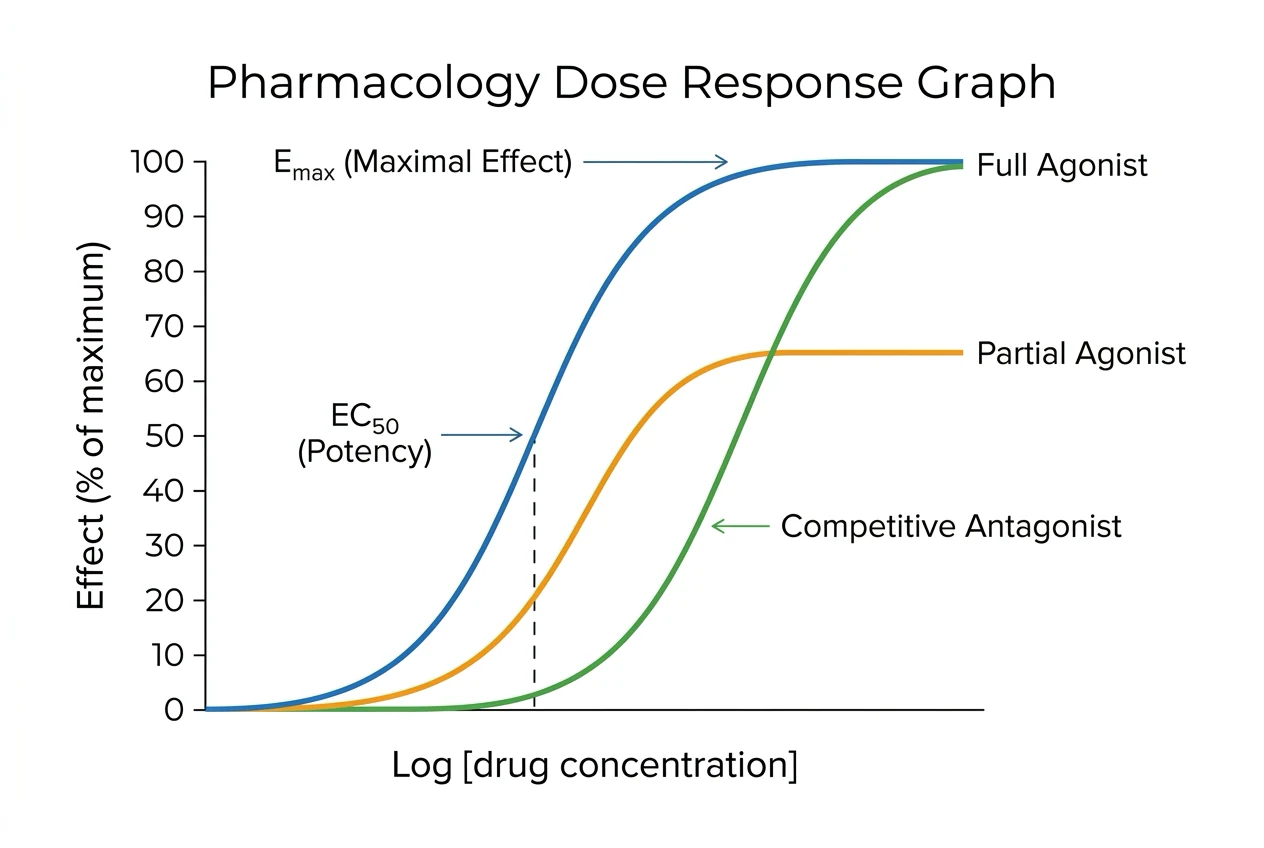
Two flavours of dose-response curve are distinguished. A graded (individual) curve plots the magnitude of effect in a single tissue against concentration (the sigmoid above). A quantal (population) curve plots the proportion of a population that achieves a defined effect (or a toxic effect) against dose, and is used to derive the ED50 (effective dose in 50 percent) and the LD50 (lethal dose in 50 percent). The ratio of LD50 to ED50 is the therapeutic index — a crude measure of a drug's margin of safety. [1]
The four receptor superfamilies
Drugs act chiefly through four receptor families, classified by structure, coupling and speed of response: [1]
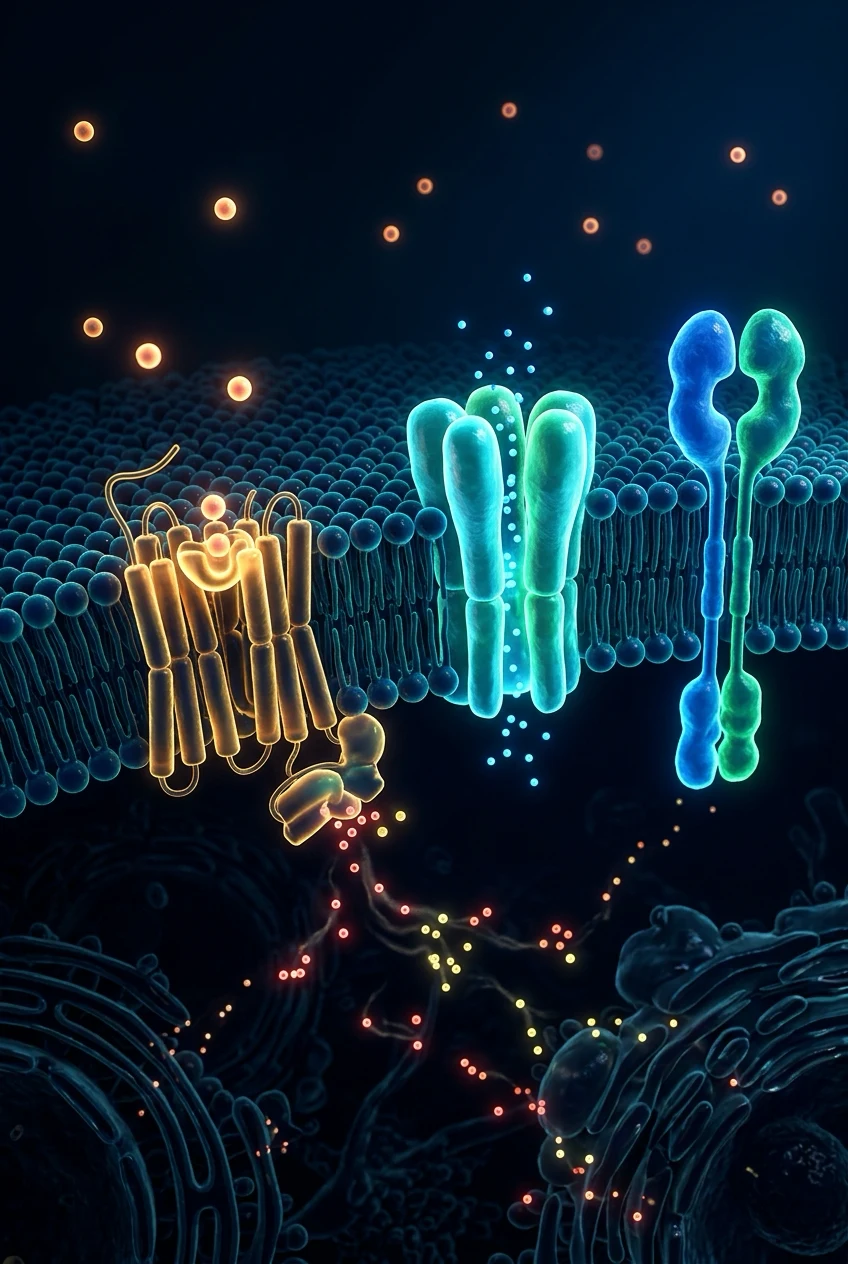
- Ligand-gated ion channels (ionotropic receptors). Directly gated ion pores; response in milliseconds. Examples: the muscle nicotinic acetylcholine receptor (the target of neuromuscular blocking agents) and the GABA-A receptor (the target of propofol, benzodiazepines and etomidate) [1][3].
- G-protein-coupled receptors (GPCRs, metabotropic). Seven transmembrane helices coupled to intracellular G-proteins; response in seconds. The largest family and the commonest anaesthetic drug target: opioid (mu, kappa, delta), adrenergic (alpha, beta), muscarinic, dopamine and cannabinoid receptors [5][8].
- Kinase-linked receptors. A single transmembrane helix linked to an intracellular tyrosine kinase; response in minutes. Examples: insulin, cytokine and growth-factor receptors.
- Intracellular (nuclear) receptors. Lipid-soluble drugs that cross the membrane and alter gene transcription; response in hours. Examples: steroid, thyroid and vitamin D receptors.
The speed of onset is a direct consequence of the mechanism: ion channels are fastest (no second messenger), GPCRs intermediate (one amplification step), kinase-linked slower (protein phosphorylation cascades), and nuclear slowest (new protein synthesis). [1]
Signal transduction and second messengers
When an agonist binds a GPCR, the receptor activates an intracellular G-protein, which in turn modulates an effector enzyme that generates a second messenger. The classic second messengers are cyclic AMP (produced by adenylyl cyclase, downstream of Gs-coupled receptors such as the beta-1 receptor, and broken down by phosphodiesterase), inositol trisphosphate (IP3) and diacylglycerol (DAG) (produced by phospholipase C, downstream of Gq-coupled receptors such as the alpha-1 receptor), and intracellular calcium. The second messenger amplifies the signal — one activated receptor can generate many second-messenger molecules, each of which may activate many downstream effectors — which is why GPCR agonists are potent and why receptor spareness exists [5].
Spare receptors
A receptor is described as spare when a maximal tissue response can be achieved while only a fraction of the receptors are occupied. This happens because the signal-amplification cascade is so efficient that occupying, say, 1 to 5 percent of beta-adrenergic receptors is enough to generate a full response. The practical consequence: an irreversible antagonist (which permanently disables receptors) may not reduce Emax until a large fraction of receptors has been inactivated — there is a receptor reserve to burn through first. This is why, for example, a partial irreversible cholinesterase or receptor antagonist has a delayed or blunted clinical effect. [1]
Competitive versus irreversible antagonism
- Competitive (surmountable) antagonism. The antagonist competes with the agonist for the same orthosteric site. The block can be overcome by increasing the agonist concentration, so the dose-response curve is shifted rightward and parallel — Emax is preserved, but the apparent EC50 rises. The affinity of a competitive antagonist is expressed as the pA2 (the negative log of the antagonist concentration that requires a doubling of agonist concentration to restore the same effect) [1].
- Irreversible (non-competitive, insurmountable) antagonism. The antagonist binds covalently or at an allosteric site that cannot be displaced. The block cannot be overcome by more agonist, so Emax falls. The curve is depressed rather than shifted.
The distinction is clinically decisive. Propofol and benzodiazepines both act at the GABA-A receptor but at distinct, non-competitive (allosteric) sites — propofol at a transmembrane site and the benzodiazepine at an interface between subunits — so their interaction is additive rather than mutually displacing [1][2]. Competitive versus irreversible also explains why neostigmine (a competitive, reversible anticholinesterase) can be overcome by excess acetylcholine but an organophosphate (irreversible) cannot.
Partial agonists and intrinsic activity
A partial agonist has affinity for the receptor but an intrinsic activity less than 1, so its dose-response curve plateaus below the Emax of a full agonist. The defining clinical behaviour follows: in the presence of a full agonist, a partial agonist behaves as a competitive antagonist — it occupies receptors but generates less effect per receptor, so the net response falls [7]. The classic examples are buprenorphine at the mu-opioid receptor (which is why it can precipitate withdrawal if given to a patient already on a full opioid agonist) and aripiprazole at the D2 dopamine receptor, which acts as an agonist when endogenous dopamine is low but as an antagonist when it is high — a "stabilising" property [7].
Allosteric modulators
An allosteric modulator binds a site distinct from the orthosteric (agonist) site and alters the receptor's response to the agonist without activating it directly. A positive allosteric modulator (PAM) enhances the agonist response (increases apparent affinity or efficacy); a negative allosteric modulator (NAM) reduces it. The benzodiazepines are the archetypal PAMs: they bind a site on the GABA-A receptor and increase the frequency of chloride-channel opening in response to GABA, potentiating inhibition without opening the channel themselves [2]. A PAM selective for the adult muscle-type nicotinic acetylcholine receptor can potentiate neuromuscular transmission, a strategy being explored for congenital myasthenic syndromes [3]. Because allosteric modulators have a ceiling effect (they only work when the endogenous agonist is present), they tend to have a wider therapeutic margin than full agonists.
Biased agonism (functional selectivity)
The classical model assumed one receptor signals through one pathway. It is now clear that a single receptor can couple to multiple downstream pathways, and different agonists can preferentially activate one over another — biased agonism or functional selectivity [5][8]. The anaesthetically important example is the mu-opioid receptor: classical opioids activate both the G-protein pathway (analgesia) and the beta-arrestin pathway (respiratory depression, constipation). G-protein-biased mu-opioid agonists were designed to favour analgesia and shed the beta-arrestin-mediated adverse effects [4]. Similarly, the beta-blocker carvedilol is biased towards beta-arrestin-mediated signalling while blocking G-protein coupling, giving it properties beyond simple beta-blockade [6]. The clinical separation has proved smaller than the theory promised, but the concept is now central to modern drug design.
Receptor regulation: desensitisation and tachyphylaxis
Receptors are dynamic and adjust their number and sensitivity to the prevailing agonist concentration: [1]
- Desensitisation / tachyphylaxis. Repeated or continued agonist exposure makes the receptor less responsive, within minutes (through receptor phosphorylation and uncoupling, often beta-arrestin mediated) or hours (through receptor internalisation and down-regulation). This is why repeated boluses of ephedrine become progressively less effective — the alpha and beta receptors desensitise and noradrenaline stores deplete [5].
- Down-regulation. Chronic agonist exposure reduces receptor number, producing tolerance (e.g. chronic opioid therapy).
- Up-regulation. Chronic antagonist exposure increases receptor number, so abrupt withdrawal produces rebound over-activity. The classic anaesthetic example is clonidine withdrawal (rebound hypertension) after chronic alpha-2 agonist therapy — the up-regulated adrenergic receptors are suddenly exposed to unopposed catecholamines.
Therapeutic index and margin of safety
The therapeutic index (TI = LD50 / ED50) is a population-derived measure of how far apart the effective and toxic doses lie. Drugs with a narrow TI — digoxin, lithium, warfarin, the aminoglycosides, and many anaesthetic agents — require careful monitoring because the effective and toxic doses overlap. The more clinically useful margin of safety compares the dose toxic in a defined fraction of the population (TD1) with the effective dose (ED99), which better reflects the real risk at the doses actually used. [1]
Clinical
- Standard approach
- Evidence-based
Alternative
- Modified technique
- Risk-benefit
Red flags
[1]References
- [1]Pence A, et al. Competitive Interactions Between Propofol and Diazepam: Studies in GABA(A) Receptors and Zebrafish J Pharmacol Exp Ther, 2022.PMID 36167415
- [2]Iannone LF, et al. Darigabat and subtype-selective GABA-A modulation: pharmacology, clinical development, and translational challenges Expert Opin Investig Drugs, 2026.PMID 42252536
- [3]Webster RG, et al. Positive allosteric modulator selective for adult muscle nicotinic acetylcholine receptor Proc Natl Acad Sci U S A, 2026.PMID 42228531
- [4]Zhang Y, et al. Autonomic nervous system modulation by G protein-biased mu-opioid receptor agonists: A translational scoping review protocol PLoS One, 2026.PMID 42139241
- [5]Ji RL, et al. Biosensors for translatable GPCR bias Trends Pharmacol Sci, 2026.PMID 42285785
- [6]Hamed O, et al. The β-Blocker Carvedilol and Related Aryloxypropanolamines Promote ERK1/2 Phosphorylation in HEK293 Cells with K (A) Values Distinct From Their Equilibrium Dissociation Constants as β (2)-Adrenoceptor Antagonists: Evidence for Functional Affinity J Pharmacol Exp Ther, 2024.PMID 38129128
- [7]Edelstein GA, et al. Dopamine antagonist effects of the D2/D3 receptor partial agonist aripiprazole on effort-based choice tasks in male and female rats Cogn Affect Behav Neurosci, 2026.PMID 40993487
- [8]Sinha S, et al. Orchestrating the signaling-bias at the protease-activated receptor, PAR1 Trends Cell Biol, 2026.PMID 42342503