Anaes · Applied cardiovascular & respiratory physiology
Pharmacogenetics and variability in drug response
Also known as Pharmacogenetics · Pharmacogenomics · Drug response variability · CYP2D6 polymorphism · Pseudocholinesterase deficiency · Malignant hyperthermia genetics
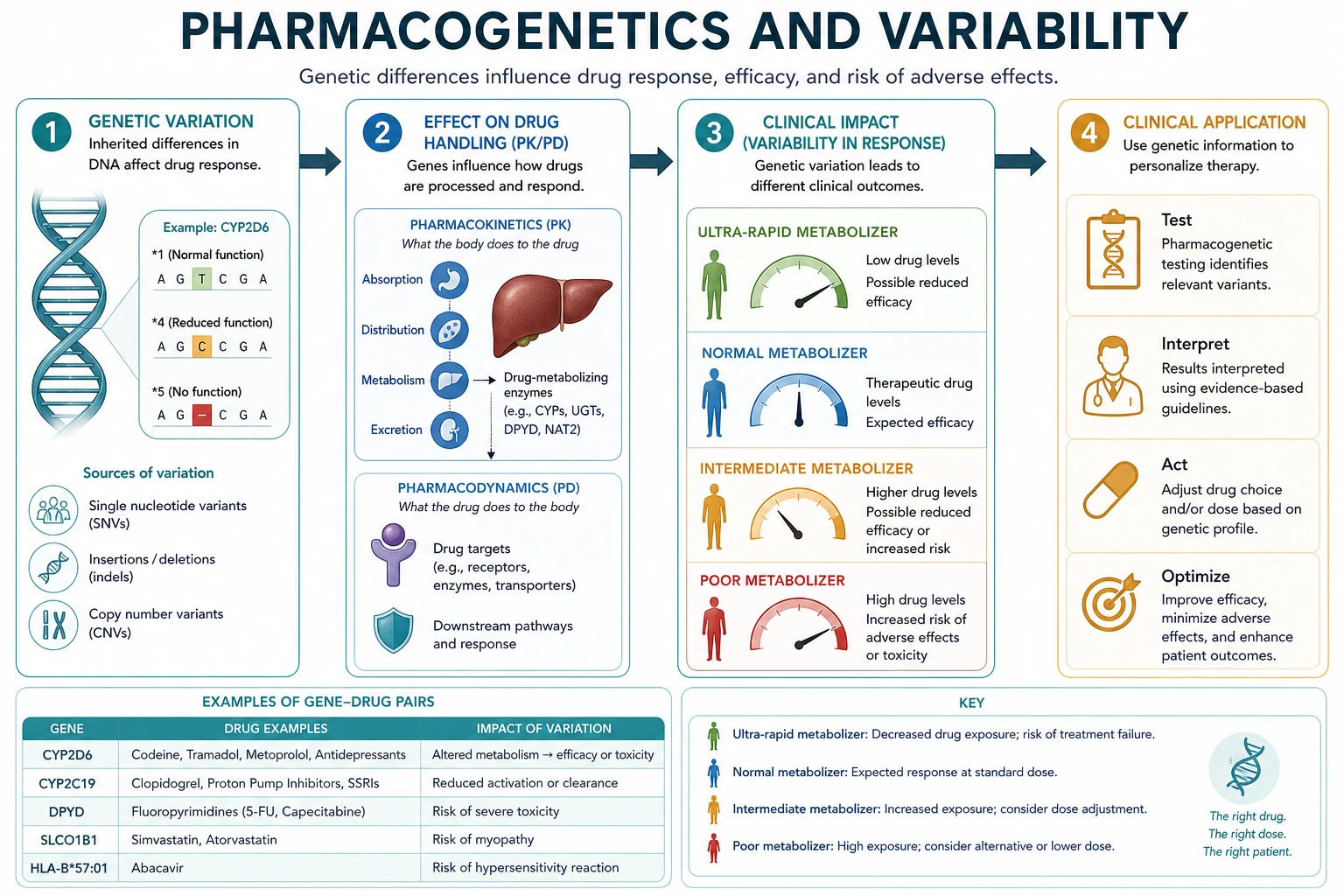
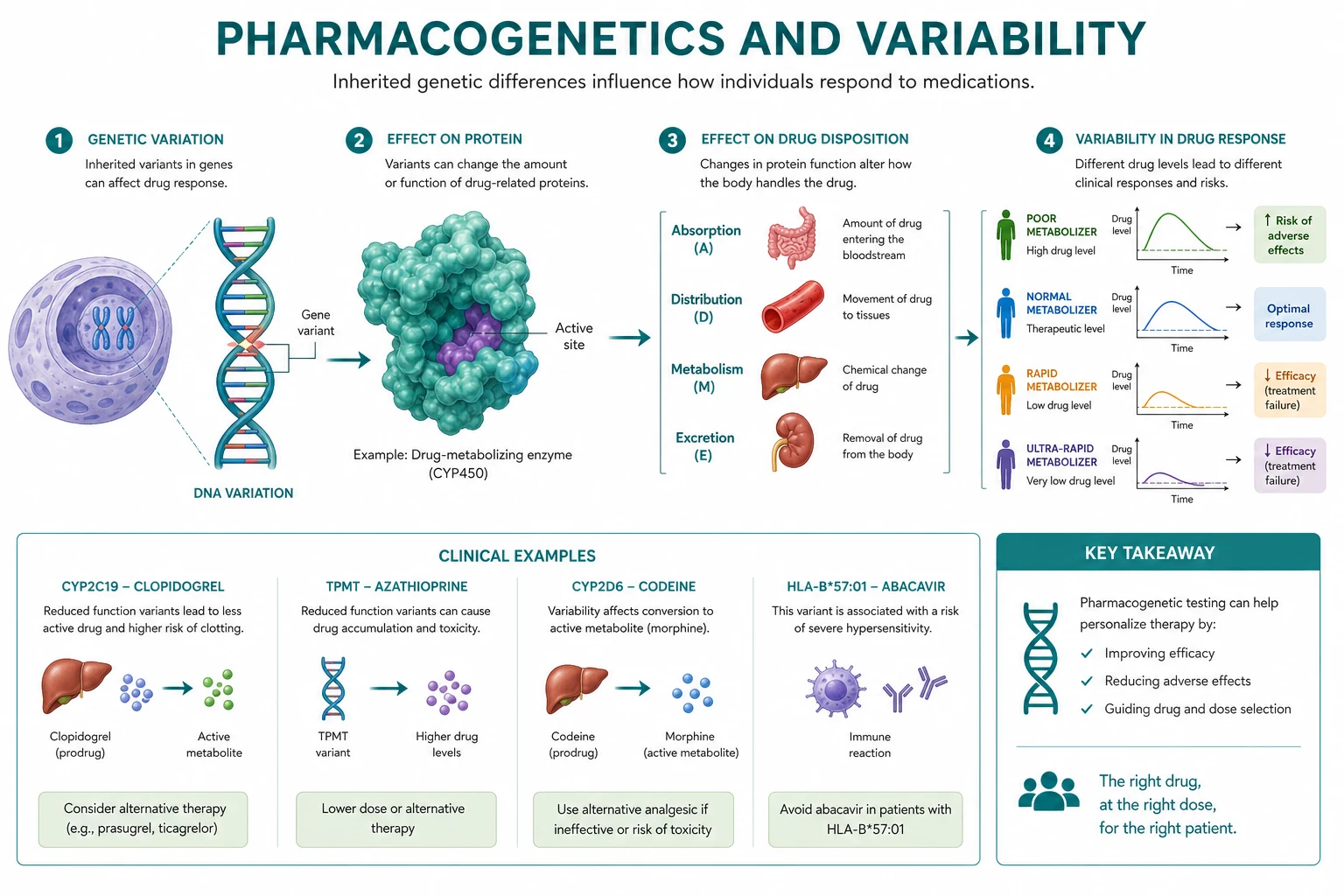
Patients vary enormously in their response to the same dose of a drug, and a major, inherited component of that variability is pharmacogenetics — the influence of genetic differences on drug absorption, distribution, metabolism, excretion and effect. The framework rests on six exam-critical ideas. First, variability is multifactorial: genetic (the largest single factor for many drugs), age (the neonate and the elderly at the extremes), sex and body habitus, organ function (hepatic and renal), and drug interactions all contribute, but genetics explains a large fraction of the inter-individual difference in drug handling. Second, the cytochrome P450 enzymes are highly polymorphic and are classified into metaboliser phenotypes — poor, intermediate, extensive (normal) and ultra-rapid — by the activity of the enzyme variant a person inherits; about 5 to 10 percent of Caucasians are CYP2D6 poor metabolisers, while CYP2D6 ultra-rapid metabolisers are common in North African and Middle Eastern populations. Third, the clinical consequences are dramatic for prodrugs and drugs with a narrow therapeutic index: a CYP2D6 poor metaboliser given codeine converts almost none of it to morphine and gets no analgesia, while an ultra-rapid metaboliser can generate lethal morphine concentrations from a normal codeine dose — which is why codeine is now contraindicated in children and breastfeeding mothers. Fourth, several anaesthesia-critical enzymes are genetically determined: butyrylcholinesterase (pseudocholinesterase) deficiency causes prolonged paralysis after suxamethonium or mivacurium; thiopurine methyltransferase (TPMT) and NUDT15 deficiency predict catastrophic myelosuppression from azathioprine and 6-mercaptopurine; and the ryanodine receptor (RYR1) variants underlie susceptibility to malignant hyperthermia. Fifth, pharmacogenetics also guides dosing of common drugs: warfarin dose depends on CYP2C9 (metabolism) and VKORC1 (sensitivity) genotype, and clopidogrel efficacy depends on CYP2C19 status (poor metabolisers cannot activate the prodrug and have a higher risk of stent thrombosis). Sixth, pharmacogenetic variation interacts with the other sources of variability — the neonate is both genetically and developmentally a slow metaboliser — so safe prescribing integrates all of them. Built on the cytochrome P450 metaboliser-status distribution study (Thamilselvan 2026), the pre-emptive pharmacogenetic-testing study (Baye 2026), the butyrylcholinesterase-and-mivacurium study (Kempff-Andersen 2026), the genotype-guided warfarin-dosing study (Fahmi 2026), the thiopurine-induced myelosuppression report (Fry 2026), the glucose-6-phosphate-dehydrogenase-deficiency anaesthetic-management report (Khaliq 2026), the RYR1 malignant-hyperthermia-susceptibility study (Gulen 2026), and the point-of-care CYP2C19 genotyping study (Schubert 2026).
On this page & tools
Your progress
Saved locally on this device.
8 MCQs with explanations
Target exams
Red flags
Why this matters to the anaesthetist
Primary expects sources of PK/PD variability and classic pharmacogenetic syndromes (BuChE, MH, CYP2D6, G6PD, NAT2, malignant hyperthermia genetics, porphyria). Final applies to unexpected prolonged block, codeine in paediatrics, and family history taking.[1]
One-liner: Variability = genetics + age + size + disease + interactions + environment; pharmacogenetics is germline DNA changing enzymes/receptors — know the named anaesthesia examples cold. [1]
Map of variability
| Domain | Examples |
|---|---|
| PK – absorption | Gut oedema, first-pass genetics (CYP3A, transporters) |
| PK – distribution | Body composition, protein binding, cardiac output |
| PK – metabolism | CYP2D6, CYP2C9/19, CYP3A4/5, BuChE, NAT2 |
| PK – excretion | GFR genetics minor vs disease dominant |
| PD – receptor | Opioid receptor variants, MH RYR1, channelopathies |
| Immune | HLA-linked severe cutaneous reactions (selected drugs) |
Butyrylcholinesterase (pseudocholinesterase) deficiency
- Hydrolyses suxamethonium and mivacurium (and ester LAs partially).
- Genetic variants (e.g. atypical, silent, fluoride-resistant) → prolonged neuromuscular block after sux.
- Acquired low activity: liver disease, pregnancy, malnutrition, burns, drugs.
- Dibucaine number: inhibits normal BuChE more than atypical — lab phenotype classic exam.
- Manage prolonged block: sedate/ventilate until recovery; do not reverse sux with anticholinesterase early in classical teaching; consider blood products as enzyme source rarely. [1]
Malignant hyperthermia genetics
- RYR1 most common; CACNA1S less common — defective excitation–contraction Ca release control.
- AD inheritance with incomplete penetrance — family history matters but negative history does not exclude.
- Triggers: volatiles + sux. Safe: TIVA, N2O, locals, non-depolarising NMBAs (protocolised).
- Diagnosis: clinical, genetics, caffeine-halothane contracture testing historically. [1]
CYP2D6 and opioids
- Codeine/tramadol need CYP2D6 activation to morphine/active metabolites.
- Ultra-rapid metabolisers: higher active metabolite → toxicity risk (esp. children post-tonsillectomy — regulatory warnings).
- Poor metabolisers: little analgesia from codeine.
- Exam line: codeine is a poor choice when genetics or age make response unpredictable. [1]
Other CYP stories
- CYP2C9: warfarin/S-warfarin sensitivity variants.
- CYP2C19: clopidogrel activation; some PPI interactions.
- CYP3A4/5: vast substrate list (midazolam, fentanyl, many); 3A5 expressors alter tacrolimus etc.
- Induction/inhibition overshadow genetics day-to-day — still know both. [1]
NAT2 acetylator status
- Isoniazid, hydralazine, some sulphonamides.
- Slow acetylators: higher drug levels/toxicity risk (neuropathy with INH without pyridoxine context). [1]
G6PD deficiency
- X-linked; reduced NADPH in RBCs → vulnerable to oxidative haemolysis.
- Triggers: primaquine, dapsone, sulphonamides, nitrofurantoin, infections, fava beans; methylene blue problematic in G6PD (MetHb treatment dilemma). [1]
Acute porphyrias
- Induced hepatic ALA synthase by enzyme-inducing drugs (barbiturates classic) → neurovisceral crisis.
- Safe drug lists exist — avoid barbiturates, avoid some enzyme inducers; use regional/volatile/TIVA choices per guidance. [1]
MH vs NMS vs thyroid storm vs sepsis (variability of phenotype)
Genetic MH is one hypermetabolic crisis — differential diagnosis is clinical. Genetics explains susceptibility, not every fever under anaesthesia. [1]
Non-genetic variability anaesthetists see daily
- Age extremes (neonate/elderly leaves).
- Obesity dosing scalars.
- Pregnancy (↑Vd, ↑GFR, ↓albumin, MAC↓).
- Hypothermia slows metabolism.
- Interactions (CYP, protein binding).
- Tolerance/tachyphylaxis (opioids, nitrates). [1]
Numbers / classic lab
- Dibucaine number high (~80) normal; low (~20) atypical homozygous teaching figures.
- MH incidence rare but deadly without dantrolene.
- CYP2D6 PM ~5–10% European teaching order; UM rarer population-dependent. [1]
PK genetic
- BuChE deficiency
- CYP2D6 codeine
- NAT2 slow
- Alters concentration
PD genetic
- MH RYR1
- Channelopathies
- Receptor variants
- Alters response curve
Viva scripts
List genetic causes of prolonged suxamethonium block. [1]
Explain dibucaine number. [1]
CYP2D6 poor vs ultra-rapid with codeine. [1]
MH inheritance pattern and triggers. [1]
Extended viva dialogue
Examiner: A patient fails to breathe for 4 hours after suxamethonium — differential? [1]
Candidate: Inherited BuChE variants, acquired BuChE deficiency, overdose, phase II block with repeated dosing, residual inhalational, electrolyte/temperature, and misdiagnosis of other weakness. Manage airway first; investigate BuChE activity and dibucaine number later. [1]
Examiner: How does pharmacogenetics differ from an immunological allergy? [1]
Candidate: Pharmacogenetics alters dose–concentration or concentration–effect via DNA-encoded proteins. Allergy is adaptive immune recognition. Both can be “unexpected,” but testing and future avoidance strategies differ. [1]
Clinical synthesis: Variability is the rule; pharmacogenetics is the named subset you must recite with enzyme or receptor attached. [1]
Personalised anaesthesia currently practical
- Family history MH / sux apnoea.
- Avoid codeine in children/known UM risk contexts.
- Check interaction table for CYP culprits.
- Titrate always — genetics rarely available preop. [1]
Dibucaine number worked interpretation
Normal homozygote: high dibucaine number (~70–80%), short sux. Heterozygote intermediate. Atypical homozygote low number (~20%), multi-hour block risk after sux. [1]
Worked SAQ
SAQ: Discuss genetic causes of abnormal response to suxamethonium (7 marks)
Suxamethonium is hydrolysed by plasma butyrylcholinesterase. Inherited qualitative variants (atypical enzyme) or quantitative deficiency prolong neuromuscular block, diagnosed by enzyme activity and dibucaine number. Acquired reductions occur in liver disease, pregnancy and malnutrition. Malignant hyperthermia is a separate genetic PD crisis of calcium release, not a cholinesterase problem, but is also a pharmacogenetic anaesthetic emergency. [1]
Primary exam expansion — dense examiner pack
Variability taxonomy (say this structure first)
| Source | Examples under anaesthesia | Exam label |
|---|---|---|
| Pharmacokinetic | CL, Vd, protein binding, absorption F | Gets to the receptor differently |
| Pharmacodynamic | Receptor density, coupling, tolerance | Same concentration, different effect |
| Genetic | CYP2D6, BuChE, RYR1/CACNA1S | Pharmacogenetics |
| Physiological | Age, pregnancy, obesity, CO, organ failure | Covariates |
| Pathological | Sepsis, burns, hypoalbuminaemia | Altered kinetics/dynamics |
| Drug–drug | CYP inhibition/induction, PD synergy | Interactions |
| Environmental / error | Wrong weight scalar, pump errors | System factors |
Pharmacogenetics is the inherited DNA-encoded slice — not the whole of variability. [1]
Classic anaesthetic genetic stories (must-pass table)
| Trait | Gene / protein | Anaesthetic drug | Phenotype |
|---|---|---|---|
| Butyrylcholinesterase variants | BCHE | Suxamethonium, mivacurium | Prolonged block; dibucaine number |
| Malignant hyperthermia susceptibility | RYR1, CACNA1S | Volatiles, suxamethonium | Hypermetabolic crisis |
| CYP2D6 poor / ultra-rapid metaboliser | CYP2D6 | Codeine → morphine; tramadol | Failed analgesia (PM) or toxicity (UM) |
| Acquired BuChE deficiency | Not genetic | Pregnancy, liver disease, malnutrition | Prolonged sux |
| G6PD deficiency | G6PD | Oxidant drugs | Haemolysis risk |
| Acute porphyrias | Heme pathway enzymes | Barbiturates (classic avoid list) | Crisis trigger risk |
Dibucaine number — mechanism
Dibucaine inhibits normal plasma cholinesterase more than atypical enzyme. Percent inhibition equals dibucaine number. Normal approximately 70–80 percent; heterozygote intermediate; atypical homozygote low (around 20 percent). Fluoride number and genotype panels refine classification. Clinical management of prolonged apnoea is neuromuscular monitoring plus supportive ventilation until recovery. [1]
CYP system for the anaesthetist
- CYP3A4/5: midazolam, fentanyl, many others — strong inhibitors raise levels; inducers lower levels.
- CYP2D6: codeine, tramadol, some beta-blockers — highly polymorphic.
- CYP2C19: some PPIs; clopidogrel activation (stent context).
- CYP2E1: fraction of volatile metabolism; paracetamol NAPQI pathway. [1]
Induction is protein-synthesis timescale (days); inhibition can be immediate competitive. [1]
Codeine and tramadol safety rules
Codeine is a prodrug; analgesia depends on CYP2D6-generated morphine. Ultra-rapid metabolisers risk respiratory depression (historically catastrophic in some paediatric post-tonsillectomy contexts). Poor metabolisers get little analgesia. Many jurisdictions restrict codeine in children and breastfeeding — state the principle even if local formulary varies. [1]
Malignant hyperthermia genetics versus clinical test
Family history and known pathogenic RYR1/CACNA1S variants raise prior probability. Crisis is clinical diagnosis plus dantrolene — do not wait for genetics. In vitro contracture testing and genetic pathways are post-event counselling territory. Safe anaesthesia: avoid triggers; TIVA with non-triggering agents; prepare dantrolene logistics. [1]
Non-genetic PK variability checklist
- Hepatic blood flow (shock, volatiles, laparoscopy). 2. Intrinsic clearance (cirrhosis, enzyme induction). 3. Protein binding (AAG rises in acute phase). 4. Renal function (M6G, norpethidine). 5. Body composition (Vd in obesity). 6. Cardiac output (induction onset speed). 7. Age extremes. 8. Temperature (enzyme rates, regional flows). [1]
PD variability
Tolerance (chronic opioids), concurrent PD drugs (benzodiazepine plus opioid synergy), electrolyte effects on NMJ, acid–base effects on local anaesthetic ionisation (LAST context). [1]
SAQ: pharmacogenetic variability in anaesthesia (8–10 marks)
Define pharmacogenetics → table of four classic drug–gene–phenotype pairs → one detailed mechanism (BuChE or CYP2D6) → clinical actions (history, avoid codeine scenarios, MH precautions) → caveat that titration and monitoring still dominate because most variability is not genotyped preoperatively. [1]
Extended viva script
Q: Differentiate pharmacogenetic abnormal response from anaphylaxis. A: Genetic enzyme or receptor variants alter dose–response or duration without mast-cell IgE. Anaphylaxis is acute multi-system mast-cell degranulation — different mechanism and treatment. Q: Why does a normal dose still poison some patients? A: Population dose is for the average; outliers in CL, Vd, PD sensitivity, organ failure or interactions shift the curve. Q: First practical step when sux block is prolonged? A: Ventilate and sedate; exclude other weakness causes; train-of-four; consider BuChE pathway later — never reverse residual sux with neostigmine early in phase I. [1]
Anchors board
| Item | Teaching value |
|---|---|
| Dibucaine number normal | ~70–80% |
| MH triggers | All potent volatiles + sux |
| CYP2D6 | Codeine bioactivation |
| AAG | Acute-phase binder of basic drugs |
| Rule | Genotype rare preop; history + titration always |
High-yield viva battery and numbers lock-in
Minimum memorised genetics–drug pairs (six)
- BCHE — suxamethonium/mivacurium prolonged block. 2. RYR1/CACNA1S — malignant hyperthermia. 3. CYP2D6 — codeine/tramadol activation. 4. CYP3A4/5 inhibition-induction — midazolam/fentanyl levels. 5. G6PD — oxidant haemolysis risk. 6. Acute intermittent porphyria enzyme defects — barbiturate trigger lists (classic teaching). [1]
Suxamethonium apnoea differential (structured)
Inherited atypical BuChE; inherited quantitative deficiency; acquired low BuChE (pregnancy, liver disease, malnutrition, burns, contraceptives teaching); overdose; phase II block after large/repeated doses; drug interactions (anticholinesterases, metoclopramide teaching); underdosing of residual monitoring error; myasthenic syndromes. Management: maintain anaesthesia/sedation and ventilation; monitor TOF; do not early-reverse phase I with neostigmine; investigate later (dibucaine number, genotype, family). [1]
Variability without a gene result — how you answer
"Most of the variability I see day to day is age, organ function, cardiac output, body composition, interactions and pharmacodynamic sensitivity. Pharmacogenetic traits are high-impact when present but rarely genotyped preoperatively, so I take a targeted history for MH, sux apnoea, porphyria and codeine reactions, then titrate and monitor." [1]
Full viva dialogue (additional)
Examiner: What is the dibucaine number? [1]
Candidate: The percentage inhibition of plasma cholinesterase activity by dibucaine under standardised assay conditions. Normal enzyme is inhibited about 70–80 percent; atypical enzyme is inhibited much less, giving a low number and correlating with prolonged suxamethonium action in homozygotes. [1]
Examiner: How would CYP3A4 inhibition change a midazolam infusion? [1]
Candidate: Midazolam clearance falls, context-sensitive accumulation increases, sedation prolongs, and the same infusion rate produces higher concentrations — I reduce dose and rely on clinical and EEG titration rather than fixed rates. [1]
Exam traps
- Calling all abnormal drug responses "allergy".
- Reversing prolonged sux early with neostigmine.
- Assuming codeine is "weak therefore safe" in children.
- Ignoring family history of MH because genotype unknown.
- Treating pharmacogenetic tables as complete — titration still rules. [1]
References
- [1]Thamilselvan M, et al. Distribution of Cytochrome P450 Metabolizer Status and Allelic Variants in Individuals with Mental Health Disorders in Ontario, Canada: Répartition du statut métabolique du cytochrome P450 et des variantes alléliques chez les personnes atteintes de problèmes de santé mentale en Ontario, au Canada Can J Psychiatry, 2026.PMID 42240275
- [2]Baye JF, et al. Genotype influences antidepressant discontinuation in a pre-emptive pharmacogenetic testing population Pharmacogenomics J, 2026.PMID 42168153
- [3]Kempff-Andersen S, et al. Butyrylcholinesterase activity and prolonged duration of action of mivacurium in elderly patients (≥80 years): A secondary analysis of a clinical trial Eur J Anaesthesiol, 2026.PMID 42298973
- [4]Fahmi AM, et al. Derivation and Validation of a Genotype- Guided Warfarin Dosing Model in a Mixed Arab Population Clin Appl Thromb Hemost, 2026.PMID 42262158
- [5]Fry J, et al. Severe Thiopurine-Induced Myelosuppression in a Pediatric Acute Lymphoblastic Leukemia Patient With the NUDT15 *1/*6 Genotype: A Brief Report Clin Transl Sci, 2026.PMID 42286409
- [6]Khaliq A, et al. Anesthetic Management of a Pediatric Patient With Glucose-6-Phosphate Dehydrogenase Deficiency Undergoing Emergency Rigid Esophagoscopy: A Case Report Cureus, 2026.PMID 42281694
- [7]Gulen A, et al. Residual risk after familial RYR1 testing: interpreting malignant hyperthermia susceptibility in the context of regional testing strategies Eur J Hum Genet, 2026.PMID 42321436
- [8]Schubert AJ, et al. CRISPR-Based Assay for Point-of-Care Pharmacogenetic CYP2C19 Genotyping ACS Sens, 2026.PMID 42345496