Anaes · Applied cardiovascular & respiratory physiology
Plasma protein binding and drug interactions
Also known as Plasma protein binding · Protein binding · Free fraction · Drug displacement · Drug-drug interaction · Enzyme induction and inhibition
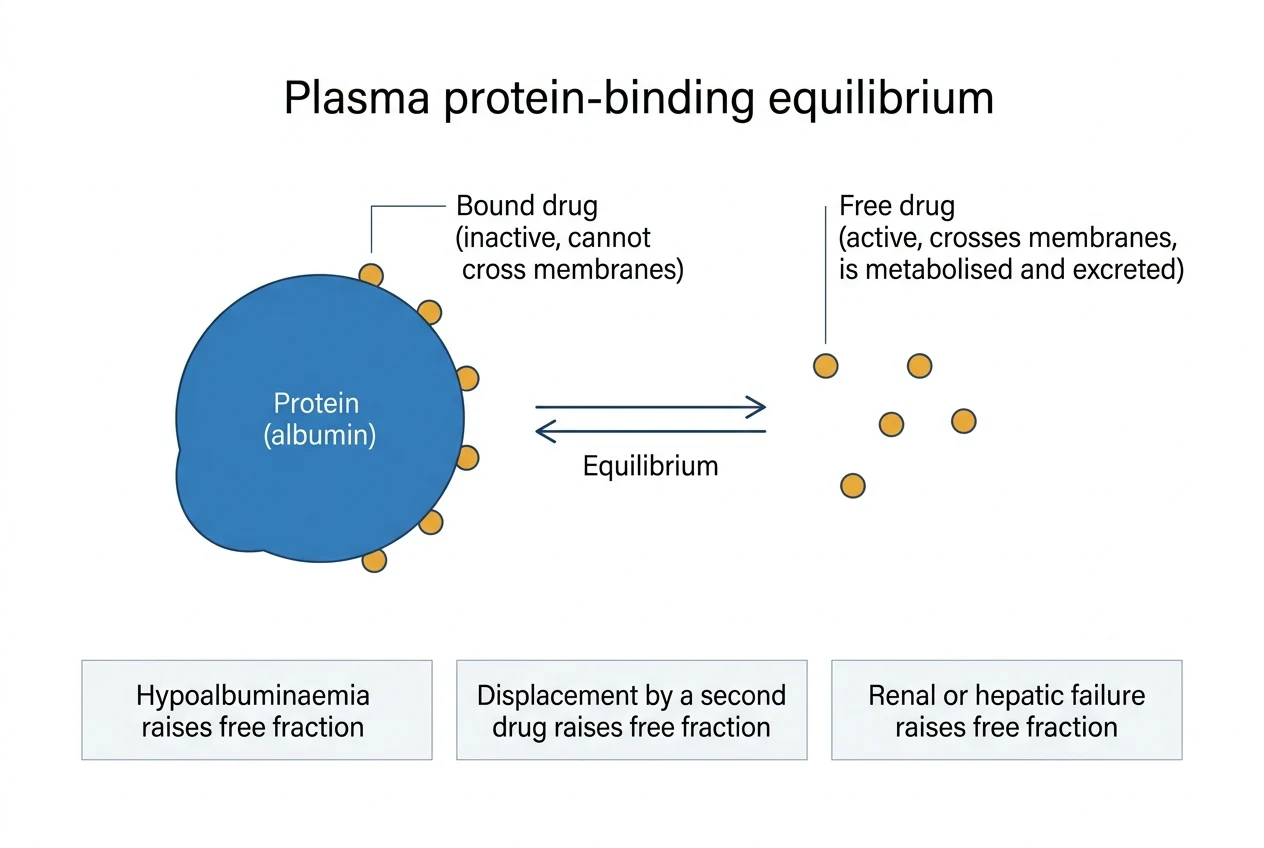
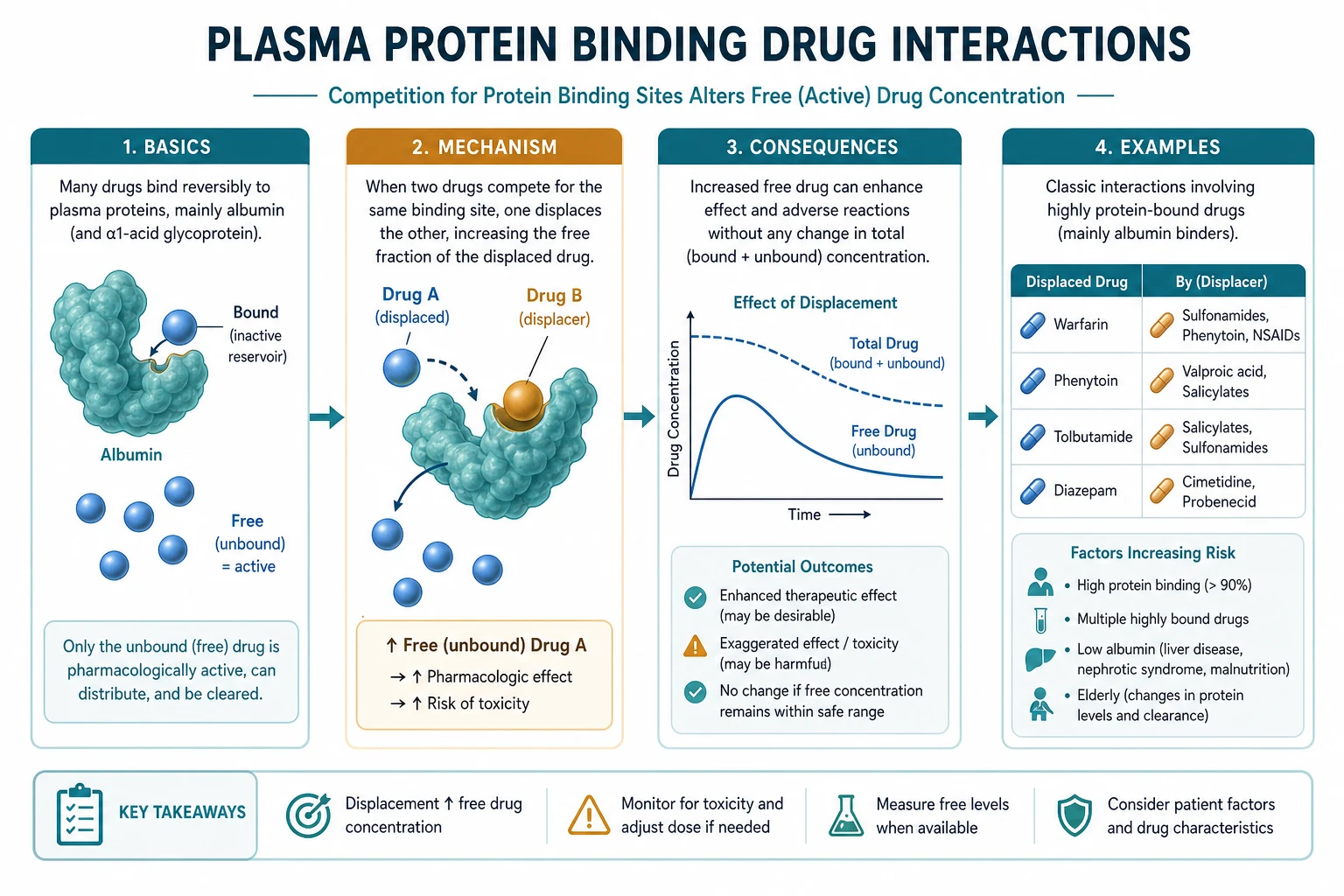
Most drugs circulate partly bound to plasma proteins and partly free, and only the free (unbound) fraction is pharmacologically active, available for distribution, metabolism and excretion. The bound fraction is a reservoir that buffers the free concentration. Understanding plasma protein binding and drug-drug interactions is essential for safe perioperative prescribing. The framework rests on six exam-critical ideas. First, only the FREE drug is active: it crosses membranes, binds receptors, is metabolised and excreted; the protein-bound drug is pharmacologically inert and acts as a slow-release reservoir. Second, different proteins bind different drugs: albumin (the major protein, concentration about 35 to 50 g per L) binds acidic and neutral drugs (warfarin, phenytoin, diazepam, thiopental), while alpha-1-acid glycoprotein (an acute-phase reactant, concentration about 0.5 to 1.2 g per L) binds basic drugs (lidocaine, bupivacaine, propranolol, opioids). Third, the free fraction matters most for drugs that are highly bound (more than 90 percent): a small change in the bound fraction produces a large change in the free concentration, so displacement or hypoalbuminaemia can double or treble the active concentration of a drug like warfarin or phenytoin. Fourth, protein binding is altered by hypoalbuminaemia (liver disease, nephrotic syndrome, critical illness, burns, the elderly and neonates), by raised alpha-1-acid glycoprotein (an acute-phase response raises it, lowering the free fraction of basic drugs in inflammation), by renal and hepatic failure (uraemic toxins and bilirubin compete for binding sites), and by displacement by a second drug. Fifth, drug-drug interactions are classified as pharmaceutical (incompatibility in the same infusion), pharmacokinetic (one drug alters the absorption, distribution, metabolism or excretion of another — chiefly through plasma protein displacement or through CYP450 enzyme induction or inhibition), and pharmacodynamic (two drugs act on the same receptor, pathway or physiological system to give additive, synergistic or antagonistic effects). Sixth, the most clinically important pharmacokinetic interactions are enzyme INHIBITION (rapid onset, raises the affected drug's concentration — ketoconazole, erythromycin, clarithromycin, fluoxetine, amiodarone and grapefruit juice inhibit CYP3A4) and enzyme INDUCTION (slow onset and slow offset over weeks, lowers the affected drug's concentration — rifampicin, phenytoin, carbamazepine, barbiturates, chronic alcohol and St John's wort induce CYP3A4 and 2C9 via the pregnane X receptor). The most dangerous pharmacodynamic interaction in anaesthesia is the serotonergic interaction culminating in serotonin syndrome. Built on the plasma-protein-binding framework study (Enlo-Scott 2026), the biomimetic-binding-to-Vd study (Valko 2026), the in vitro CYP-inhibition DDI assay study (Sensenhauser 2026), the antiseizure CYP2C9 and P-glycoprotein induction study (Cohen 2026), the pregnane-X-receptor induction study (Chen 2026), the grapefruit-juice CYP-inhibition study (Aurinsalo 2026), the serotonin-syndrome DDI detection study (Xu 2026), and the postoperative serotonin syndrome report (Aboe Aboe 2026).
On this page & tools
Your progress
Saved locally on this device.
8 MCQs with explanations
Target exams
Red flags
Why this matters to the anaesthetist
Primary PK: bound vs free drug, albumin vs α1-acid glycoprotein, factors changing binding, and interaction mechanisms (binding, CYP, PD synergy). Examiners probe whether you naïvely blame every problem on displacement.[1]
One-liner: Free fraction fu = unbound/total; free drug drives effect; albumin binds acidic/neutral drugs, AAG binds many basics; displacement raises fu transiently but steady-state free levels often re-equilibrate via clearance — know when it still matters. [1]
Bound vs free
- Most plasma drug may be protein-bound, but equilibrium free ⇌ bound.
- Free concentration interacts with receptors (usually).
- Assays often report total concentration — interpret free when binding abnormal (phenytoin in hypoalbuminaemia). [1]
fu = fraction unbound. Highly bound drugs (fu < 0.1) are theoretically more sensitive to binding changes — but clinical importance needs PK context. [1]
Major binding proteins
| Protein | Binds preferentially | Levels fall | Levels rise |
|---|---|---|---|
| Albumin | Acidic & many neutral (warfarin, phenytoin, NSAIDs, benzos partly) | Liver failure, nephrotic, malnutrition, pregnancy, acute illness | Dehydration (relative) |
| AAG (α1-acid glycoprotein) | Basic lipophilic (local anaesthetics, bupivacaine, lidocaine, propranolol, opioids partly) | Hepatic synthetic failure | Acute phase (surgery, MI, trauma) — ↑AAG can ↓fu of basics |
Determinants of binding
- Protein concentration.
- Affinity and number of sites.
- Competition (other drugs, bilirubin, uraemic toxins, free fatty acids).
- pH (affects ionisation and binding).
- Temperature (less clinical day-to-day). [1]
Volume, clearance and binding — the advanced bit
For restrictively cleared drugs (low extraction), only free drug is metabolised/filtered: [1]
- ↑fu can ↑CL and ↑Vd → total concentration falls but free may return near original at steady state if dosing unchanged.
- Therefore chronic displacement alone rarely causes sustained toxicity for many drugs — exam nuance. [1]
For non-restrictive high extraction IV drugs, clearance depends more on blood flow; free fraction effects differ. [1]
Loading dose relates to Vd (which rises if fu rises and drug distributes more). Maintenance relates to CL. [1]
When binding changes still bite clinically
- Interpretation of total levels (phenytoin, valproate with low albumin — use corrected level formulae carefully).
- Rapid IV displacement before re-equilibration (theoretical peaks).
- Combined with CYP inhibition (free rises and clearance falls) — double hit.
- Highly bound narrow TI drugs with complex kinetics (warfarin — but CYP and vitamin K status dominate day-to-day).
- Neonates: low albumin + bilirubin competition → free bilirubin ↑ risk kernicterus with some sulphonamides historical. [1]
Drug interaction taxonomy (broader than binding)
| Type | Mechanism | Anaesthetic examples |
|---|---|---|
| Pharmaceutical | In vitro incompatibility | Precipitates in same line (thiopental-acid drugs) |
| PK absorption | Chelation, pH, motility | Antacids + some drugs |
| PK binding | Displacement | Rare solo star; warfarin–NSAIDs multifactorial |
| PK metabolism | CYP/UGT induction/inhibition | Erythromycin + midazolam; rifampicin induction |
| PK excretion | Competition renal transporters | Probenecid + penicillins |
| PD synergistic | Same endpoint | Opioid + propofol apnoea; benzo + alcohol |
| PD antagonistic | Oppose | Naloxone–opioid; flumazenil–benzo |
Most dangerous everyday anaesthetic interactions are PD synergy and CYP inhibition, not textbook albumin displacement. [1]
Local anaesthetics and AAG
- Bupivacaine highly protein bound; duration partly related to binding/tissue affinity.
- Post-op ↑AAG may alter free fraction of basics.
- Hypoalbuminaemia more relevant to acidic drugs; still consider free LA in pregnancy (↓protein, ↑CO) as part of LAST risk package — multifactorial. [1]
Warfarin teaching case (multifactorial)
NSAIDs increase bleeding by PD antiplatelet effect + GI injury ± displacement + CYP interactions depending on agent — do not attribute solely to protein binding. [1]
Numbers board
- Albumin normal ~35–50 g/L
- Phenytoin ~90% bound teaching
- Warfarin >99% bound teaching
- Bupivacaine highly bound (~95%) [1]
Albumin binders
- Acidic drugs
- Warfarin, phenytoin
- ↓ in liver failure
- Total level pitfalls
AAG binders
- Basic drugs
- Many LAs
- ↑ acute phase
- fu may fall after surgery
Viva scripts
Define fu and name two binding proteins with drug classes. [1]
Explain why displacement may not change steady-state free concentration. [1]
Classify interaction mechanisms with examples. [1]
Why measure free phenytoin in hypoalbuminaemia? [1]
Extended viva dialogue
Examiner: Does hypoalbuminaemia mean you should always halve highly bound drug doses? [1]
Candidate: Not automatically. Free fraction rises and volume/clearance may change so that free concentrations at steady state are less altered than total concentrations suggest. Titrate to effect and interpret levels as free when possible; consider the whole PK picture and concurrent liver/renal disease. [1]
Examiner: Which interactions matter most under anaesthesia? [1]
Candidate: Pharmacodynamic synergies on respiration and blood pressure, and metabolic inhibitors that raise midazolam or opioid levels. Pure protein-binding displacement is a classic textbook trap that is less often the sole cause of clinical harm. [1]
Clinical synthesis: Speak free vs bound fluently, then rank interaction mechanisms by real-world impact — examiners reward that maturity. [1]
Free phenytoin correction (teaching formula)
Corrected phenytoin ≈ measured / ((0.2 × albumin g/dL) + 0.1) in hypoalbuminaemia (US unit form; know principle not worship formula). Free level preferred when available. [1]
Acid–base and binding
Alkalosis may increase binding of some weak acids; acidosis can increase free fraction — contributes to LAST spiral with acidosis. [1]
Worked SAQ
SAQ: Explain plasma protein binding and its clinical importance (8 marks)
Many drugs bind albumin or α1-acid glycoprotein; only the unbound fraction is free to cross membranes, bind receptors and, for restrictively cleared drugs, be eliminated. Albumin primarily binds acidic drugs; AAG binds many basic drugs and rises in the acute phase. Hypoalbuminaemia increases free fraction and complicates interpretation of total plasma levels. Displacement interactions transiently raise free drug, but steady-state free concentrations often re-equilibrate unless clearance is also reduced. Pharmacodynamic synergy and CYP interactions usually matter more under anaesthesia than binding displacement alone. [1]
Primary exam expansion — dense examiner pack
Free fraction fundamentals
Total concentration C_total = C_free + C_bound. Unbound fraction fu = C_free / C_total. Only free drug crosses membranes, binds receptors, is filtered at glomerulus, and is often the substrate for hepatic enzymes (with transporter nuances). Clinical assays often report total concentration — interpret with albumin and AAG in mind for highly bound drugs. [1]
Major binding proteins
| Protein | Prefers | Examples | Changes in disease |
|---|---|---|---|
| Albumin | Acidic / neutral drugs | Warfarin, phenytoin, NSAIDs, many benzos | ↓ in liver failure, nephrosis, burns, pregnancy, critical illness |
| α1-acid glycoprotein (AAG) | Basic drugs | Local anaesthetics, fentanyl, propranolol, lidocaine | ↑ acute phase (trauma, MI, surgery) |
| Globulins / lipoproteins | Some hormones, vitamins | Variable | Variable |
When binding changes matter clinically
Displacement interactions that transiently raise fu rarely matter for most IV anaesthetics because clearance and distribution of free drug adjust — steady-state free levels often return toward previous if intrinsic clearance allows. Exceptions examiners love: [1]
- Low extraction, capacity-limited, highly bound drugs with narrow therapeutic index (phenytoin, warfarin) — total levels mislead when albumin low; free levels or corrected totals needed.
- Rapid IV bolus of highly bound drug into hypoalbuminaemic patient — higher free peak transiently (LAST risk framing with acidosis and hypercarbia raising free LA).
- Measurement interpretation: total phenytoin low-looking in hypoalbuminaemia may still be therapeutic free. [1]
Teaching correction (know principle): corrected phenytoin rises as albumin falls — use local formula carefully with unit systems. [1]
Hepatic clearance link (well-stirred model)
CL_H = Q × (fu × CLint) / (Q + fu × CLint). For low extraction drugs, CL ≈ fu × CLint — changing fu changes clearance of total drug, free concentration may be stable at steady state after dose adjustment nuance. For high extraction drugs, CL ≈ Q — fu changes affect free fraction and free exposure differently. This is the intellectual core linking binding to PK interactions. [1]
Interaction taxonomy ranked by anaesthetic importance
| Rank | Mechanism | Example | Why it matters |
|---|---|---|---|
| 1 | PD synergy | Midazolam + opioid → apnoea | Common, lethal |
| 2 | CYP inhibition | Azole + midazolam/fentanyl | Raised levels |
| 3 | CYP induction | Rifampicin + many | Failure of effect |
| 4 | Absorption | Antacids/chelators | Less relevant IV theatre |
| 5 | Binding displacement | Warfarin + NSAID (also PD bleeding) | Often mixed mechanisms |
| 6 | Renal transporter | Less classic primary | Advanced |
Acid–base and binding
Acidosis can increase free fraction of some local anaesthetics and worsen ion trapping in myocardium — one reason LAST spirals with hypoxia/acidosis. Alkalinisation of LA solutions alters onset via ionisation, separate from plasma protein binding. [1]
AAG rise after surgery
Basic drugs more bound → lower fu → total levels may rise for given free effect — complicated titration; always titrate LA and opioids to effect in inflammatory states rather than relying on total level thinking. [1]
SAQ: plasma protein binding importance (8 marks)
Define fu and binding proteins (2). Only free drug active (1). Disease changes albumin/AAG (2). Link to clearance/extraction (2). Clinical example phenytoin or LAST free fraction (1). [1]
Viva
Q: Should you always halve highly bound drug doses in hypoalbuminaemia? A: Not automatically — free concentration at steady state depends on free clearance; measure free levels when critical; titrate anaesthetics to effect. Q: Which interactions matter most in theatre? A: PD respiratory depression stacks and CYP-mediated sedative/opioid elevations. Q: Why is AAG mentioned with lidocaine? A: Basic drug binding rises in acute phase, altering total concentration interpretation. [1]
High-yield viva battery and numbers lock-in
Free drug rules of thumb
- Free drug is active. 2. Highly bound means fu is small so small absolute changes in binding can double free fraction. 3. Steady-state free levels for many low-E drugs re-equilibrate via clearance. 4. Acute IV boluses and narrow therapeutic index drugs are when binding drama matters most. 5. Always titrate anaesthetics to effect rather than to theoretical total concentration. [1]
Interaction examples that score marks
- Midazolam + opioid / volatile: PD respiratory depression.
- Erythromycin/azole + midazolam: CYP3A inhibition.
- Rifampicin + many CYP substrates: induction, awareness/failure risk if sedation under-dosed chronically then...
- NSAID + warfarin: PD bleeding ± binding.
- LA + acidosis/hypercarbia: free fraction and ion trapping worsen LAST.
- AAG rise post-op: basic drug total levels interpretation. [1]
Full viva dialogue (additional)
Examiner: A hypoalbuminaemic patient has a 'low' total phenytoin level. Interpret. [1]
Candidate: Total levels under-read free phenytoin when albumin is low. I would calculate a correction or measure free phenytoin and judge clinically for seizures rather than automatically increasing the dose based on total concentration alone. [1]
Examiner: Why are displacement interactions often overstated for IV anaesthetics? [1]
Candidate: Because free drug is rapidly redistributed and cleared; a transient rise in fu rarely sustains toxicity compared with simple overdose, organ failure or PD synergy. The exceptions are highly bound narrow-index drugs and measurement misinterpretation. [1]
Exam traps
- Always cutting dose 50% for low albumin without thought.
- Ranking binding displacement above PD synergy for theatre crises.
- Forgetting AAG as the basic-drug binder.
- Ignoring assay total-versus-free issues. [1]
References
- [1]Enlo-Scott Z, et al. A framework for plasma protein binding: Comparing methods for diverse small molecules and adapting for novel modalities J Pharm Sci, 2026.PMID 42309206
- [2]Valko K, et al. Linking biomimetic binding measurements to pharmacokinetic models of volume of distribution and hepatic clearance ADMET DMPK, 2026.PMID 42100636
- [3]Sensenhauser C, et al. In vitro reversible enzyme inhibition assays to predict drug-drug interactions: Current state and industry perspective from the IQ Consortium Enzyme Inhibition Working Group Drug Metab Dispos, 2026.PMID 42275929
- [4]Cohen H, et al. Induction of cytochrome P450 2C9 and P-glycoprotein activity by antiseizure medications: A systematic review and network meta-analysis Epileptic Disord, 2026.PMID 41948839
- [5]Chen S, et al. Role of pregnane X receptor in the upregulation of human aldehyde oxidase gene expression Biochem Pharmacol, 2026.PMID 42178049
- [6]Aurinsalo L, et al. Repeated Intake of Grapefruit Juice Inhibits CYP2B6, CYP2C9, CYP2C19, and CYP3A4 while Lingonberry Powder Does Not Induce Major CYP Enzymes in Humans Clin Pharmacol Ther, 2026.PMID 41390976
- [7]Xu S, et al. Detection of clinically significant drug-drug interactions in serotonin syndrome: a multisource real-world data and pharmacovigilance study Ther Adv Drug Saf, 2026.PMID 42317468
- [8]Aboe Aboe MN, et al. [Postoperative serotonin syndrome in a patient with attention-deficit/hyperactivity disorder and treatment-resistant depression] Praxis (Bern 1994), 2026.PMID 42346977