Anaes · Applied cardiovascular & respiratory physiology
Splanchnic & GI physiology
Also known as Splanchnic circulation · Gut blood flow · Gut barrier · Portal circulation · Gastric acid secretion · Gut microbiome
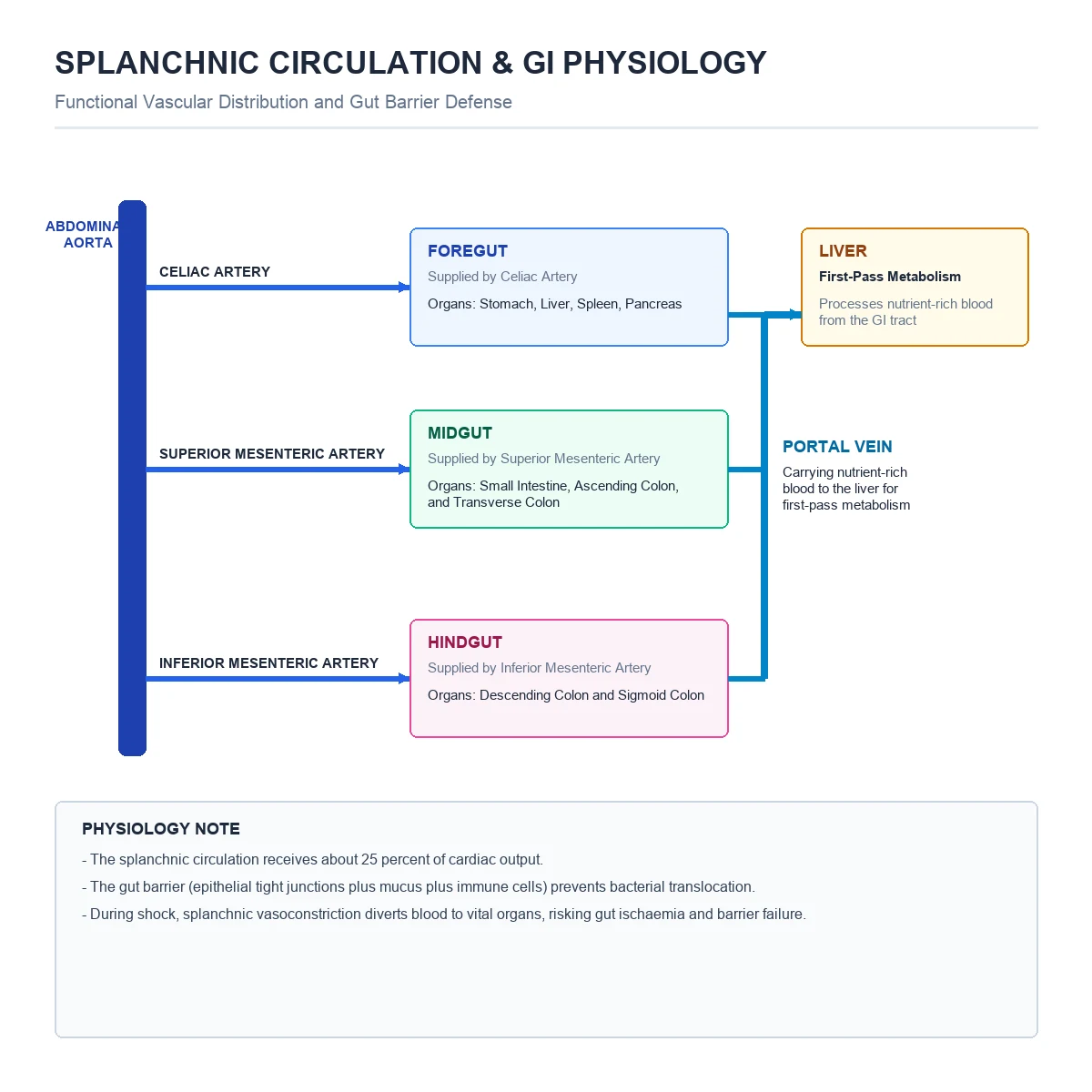
The splanchnic circulation receives about 25 percent of the cardiac output, serves the dual function of nutrient absorption and first-pass drug metabolism (the portal vein to the liver), and houses the gut barrier and the largest immune system in the body. The framework rests on five exam-critical ideas: the splanchnic circulation is supplied by three arteries (the celiac artery to the foregut, the superior mesenteric artery to the midgut, the inferior mesenteric artery to the hindgut) and drained by the portal vein to the liver; the gut barrier (epithelial tight junctions, mucus layer, immune cells) prevents bacterial translocation, and it fails in shock (splanchnic vasoconstriction causes gut ischaemia); the liver receives the portal blood first (first-pass metabolism, covered in the hepatic physiology topic); gastric acid secretion is driven by the parietal cell proton-potassium ATPase, stimulated by acetylcholine, gastrin and histamine (the targets of pharmacological blockade); and the gut microbiome influences systemic inflammation, the stress response and even postoperative cognitive function via the gut-brain axis. Built on the gut blood flow ultrasound study (Narita 2026), the GLP-2 SMA blood flow study (Galsgaard 2025), the lactate gastric mucosal injury study (Yang 2026), the splanchnic vein thrombosis study (Bandi 2026), the gut-brain axis POCD review (Abdullah 2025), and the sodium butyrate delirium study (Xu 2024).
On this page & tools
Your progress
Saved locally on this device.
12 MCQs with explanations
Target exams
Red flags
Why this matters to the anaesthetist
Splanchnic physiology explains induction hypotension (venodilation of a huge reservoir), portal hypertension consequences, enteral nutrition vs ileus, aspiration risk (gastric emptying), and drug first-pass via portal flow. Primary wants flow share, regulation, and gut barrier basics.[1]
One-liner: Splanchnic organs take ~25% of resting CO; SNS constricts this reservoir to defend central volume; portal vein supplies most hepatic inflow; gut motility and sphincter tone set aspiration and ileus risk. [1]
Splanchnic circulation map
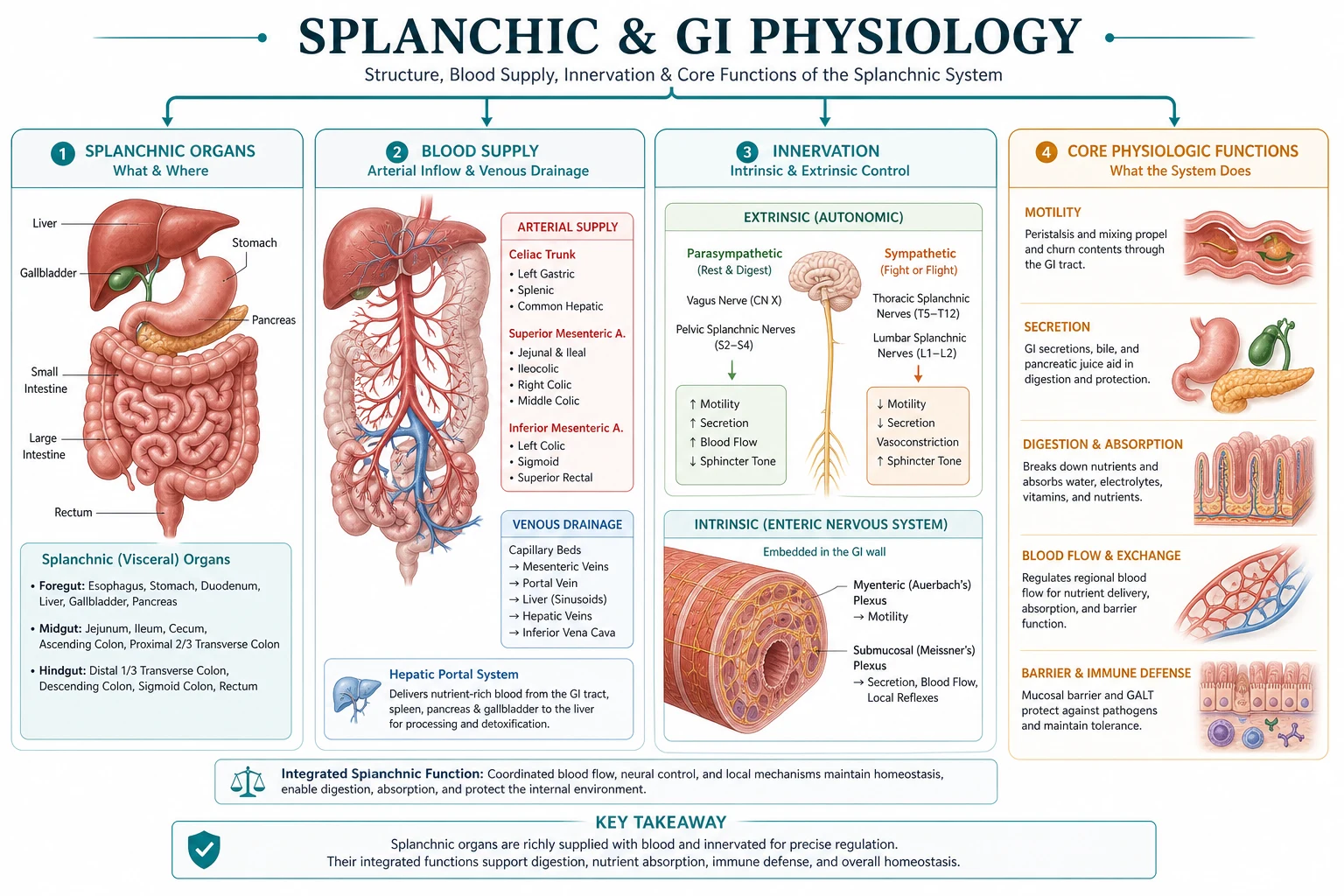
- Coeliac, SMA, IMA supply gut, spleen, pancreas, liver (arterial).
- Portal vein drains gut/spleen/pancreas → liver (~75% of hepatic blood flow).
- Resting splanchnic share ~20–30% of CO; can hold a large fraction of blood volume.
- After a meal: postprandial hyperaemia (local metabolites, hormones). [1]
Regulation of splanchnic flow
- SNS α-constriction potent — haemorrhage/exercise redistributes blood to heart/brain.
- Metabolic hyperaemia after feeding.
- Hormonal: angiotensin II, vasopressin constrict; others modulate.
- Surgical handling, laparoscopy, vasopressors, hypocapnia can reduce gut flow.
- Critical illness: splanchnic ischaemia → barrier failure, translocation theories, lactate generation. [1]
Gut motility and gastric emptying
- Enteric nervous system + ANS: parasympathetic stimulates motility/secretion; SNS inhibits.
- Gastric emptying slowed by: opioids, anticholinergics, pain, labour, diabetes autonomicopathy, obstruction, high fat, pregnancy (progesterone), critical illness.
- Accelerated by: metoclopramide, erythromycin (motilin), some situations of empty liquids. [1]
Aspiration physiology: volume + acidity + particulates of residual gastric content; LOS tone vs intragastric pressure (pregnancy, obesity, laparoscopy). [1]
Secretion and absorption (high level)
- Stomach: acid (parietal H+/K+-ATPase), intrinsic factor, pepsin.
- Pancreas: bicarbonate + enzymes (CCK/secretin control).
- Small bowel: vast surface (villi) for nutrient/electrolyte/water absorption.
- Colon: water/electrolyte salvage, microbiome.
- Ileus: dysmotility after surgery/opioids/inflammation — ERAS early feeding counters. [1]
Hepatic portal links
- First-pass metabolism depends on portal delivery of oral drugs.
- Portal hypertension: ascites, varices, splenomegaly/thrombocytopenia, encephalopathy (ammonia bypass).
- Portosystemic shunts reduce effective hepatic clearance of some substances. [1]
Barrier function
Tight junctions + mucus + IgA + microbiome. Ischaemia–reperfusion, inflammation, and malnutrition impair barrier — relevant to sepsis discussions without overclaiming translocation dogma. [1]
Anaesthetic implications board
| Theme | Actionable physiology |
|---|---|
| Hypovolaemia | Splanchnic venoconstriction already defending volume — induction venodilation unmasks deficit |
| Vasopressors | Can reduce gut mucosal flow — titrate to whole-patient endpoints |
| Laparoscopy | ↑IAP reduces venous return and gut perfusion; hypercarbia from CO2 |
| Nutrition | Enteral feed uses gut and may protect barrier when appropriate |
| Antiemetics/ prokinetics | Target receptors on vomiting pathway and motility |
| Liver disease | Portal HTN changes volume distribution and drug handling |
Numbers board
- Splanchnic ~25% CO
- Portal ~75% hepatic flow
- Resting hepatic flow ~1.5 L/min
- Gastric residual and LOS drive aspiration risk [1]
SNS on splanchnic bed
- Venoconstriction
- Mobilises reservoir
- ↓gut flow if extreme
- Haemorrhage defence
Postprandial state
- Local hyperaemia
- ↑splanchnic share
- First-pass active
- Not for full stomach surgery
Viva scripts
Draw coeliac/SMA/IMA and portal vein. [1]
Explain postprandial hyperaemia. [1]
List factors delaying gastric emptying. [1]
Extended viva dialogue
Examiner: Why might a dry patient crash harder at induction? [1]
Candidate: Compensatory splanchnic and other venoconstriction maintained venous return. Anaesthetics and histamine-releasing drugs dilate that reservoir, mean systemic filling pressure falls, venous return and CO collapse. [1]
Examiner: How does portal hypertension affect anaesthesia? [1]
Candidate: Ascites and varices change volumes and bleeding risk; portosystemic shunting alters first-pass and encephalopathy risk; thrombocytopenia from splenomegaly complicates procedures. [1]
Clinical synthesis: Splanchnic physiology is reservoir + portal + motility. Name which of the three is deranged. [1]
Gut hormones rapid board
| Hormone | Stimulus | Action |
|---|---|---|
| Gastrin | Amino acids, vagal | Acid, mucosal growth |
| CCK | Fat/protein duodenum | Bile, pancreatic enzymes, satiety |
| Secretin | Acid duodenum | Pancreatic HCO3 |
| GIP/GLP-1 | Nutrients | Incretin insulin |
| Motilin | Interdigestive | MMC migrating complex |
Aspiration risk physiology stack
Full stomach volume × acidity × particulates × LOS competence × airway reflexes. Pregnancy, obesity, opioids, pain, diabetes each hit different parts of the stack. [1]
Worked SAQ
SAQ: Outline the splanchnic circulation and its role in hypovolaemia (7 marks)
The splanchnic bed receives about a quarter of cardiac output via coeliac and mesenteric arteries and drains via the portal vein to the liver. It is a major venous reservoir under sympathetic control. In hypovolaemia, sympathetic venoconstriction mobilises blood centrally. Anaesthetic-induced venodilation reverses this compensation, dropping venous return and cardiac output — explaining profound induction hypotension in dry patients. [1]
Portal hypertension pathophysiology chain
Increased intrahepatic resistance + increased splanchnic inflow → portal pressure rise → portosystemic collaterals (varices) → shunting of ammonia and drugs → encephalopathy risk; splenomegaly sequesters platelets; ascites from Starling forces in splanchnic capillaries plus hypoalbuminaemia and secondary hyperaldosteronism. [1]
Ileus mechanisms
Sympathetic inhibition of motility, opioid µ-receptor gut effects, inflammation-driven neuromuscular dysfunction, electrolyte disturbance (K, Mg), and oedema. Epidural analgesia, opioid-sparing, early feeding and electrolyte correction are physiology-based countermeasures. [1]
Liver blood supply under anaesthesia
Surgical packing, retractors, laparoscopy (↑IAP), hypocapnia, and high-dose vasopressors can all cut splanchnic/hepatic flow. Pringle manoeuvre is the extreme intentional inflow occlusion — ischaemia–reperfusion physiology applies. [1]
Extended viva add-on
Examiner: Why is the splanchnic bed important at induction? [1]
Candidate: It holds a large venous reservoir under sympathetic tone. Induction agents reduce SNS outflow and dilate veins, dropping mean systemic filling pressure and venous return. Patients who were compensating for hypovolaemia with splanchnic venoconstriction decompensate abruptly. [1]
Primary exam expansion — dense examiner pack
Anatomy of supply and drainage (draw this)
| Vessel / region | Supply | Notes |
|---|---|---|
| Coeliac trunk | Liver (hepatic artery), stomach, spleen, pancreas | Foregut |
| SMA | Small bowel, right/mid colon | Midgut; embolus classic |
| IMA | Distal colon, rectum contributions | Hindgut |
| Portal vein | Superior mesenteric + splenic veins | Nutrient-rich, deoxygenated |
| Hepatic artery | ~25% liver blood flow, ~50% O2 delivery teaching | High pressure arterial |
| Hepatic veins | To IVC | Outflow obstruction = Budd-Chiari |
Splanchnic bed receives roughly 25% of cardiac output at rest and is a major venous capacitance reservoir under sympathetic control. [1]
Dual hepatic blood supply physiology
Liver blood flow ≈ 25% of CO: portal vein ~75% of volume flow, hepatic artery ~25%. Oxygen delivery roughly split because arterial O2 content is higher. Hepatic arterial buffer response: if portal flow falls, hepatic artery dilates (adenosine washout hypothesis teaching) to defend total hepatic O2 delivery — incomplete protection under anaesthesia and shock. [1]
Autoregulation and control
Metabolic hyperaemia in gut after meals; sympathetic vasoconstriction (α1) in hypovolaemia redistributes blood to vital organs — gut is sacrificed early. Humoral: angiotensin II, vasopressin potent splanchnic vasoconstrictors. Enteric nervous system and vagal influences on motility more than total flow. [1]
Anaesthesia and surgery effects on splanchnic flow
| Factor | Effect |
|---|---|
| Volatile agents | Dose-dependent vasodilation and CO changes |
| IPPV / PEEP | ↓ venous return, may ↓ CO and portal flow |
| Hypocapnia | Splanchnic vasoconstriction tendency |
| Laparoscopy (↑IAP) | ↓ venous return; may impair splanchnic perfusion |
| Retractors / packing | Mechanical flow reduction |
| Vasopressin / high-dose noradrenaline | Splanchnic vasoconstriction risk |
| Epidural local anaesthetic | Sympathectomy may increase splanchnic capacitance |
Shock, lactate and the gut
Splanchnic hypoperfusion → anaerobic gut metabolism → lactate; bacterial translocation theories in multi-organ failure teaching. Gastric tonometry historical interest; modern practice uses lactate trends, ScvO2, urine output, liver enzymes as global surrogates — none perfect for regional gut flow. [1]
GI motility, ileus and aspiration risk
Fasting guidelines balance residual volume versus dehydration. Ileus drivers: opioids (µ), sympathetic stress, inflammation, hypokalaemia, anticholinergics, retroperitoneal irritation. Prokinetics limited role. Full stomach: pregnancy, obesity, pain, opioids, autonomic neuropathy, bowel obstruction — RSI decisions. [1]
Portal hypertension chain
↑ hepatic resistance (cirrhosis) + splanchnic vasodilation/inflow → portal hypertension → varices, splenomegaly, ascites, portosystemic shunting (encephalopathy, altered first-pass drug metabolism). Anaesthetic implications: coagulopathy, ascites respiratory effects, variceal bleed risk, altered PK, cardiomyopathy of cirrhosis, hepatorenal syndrome risk. [1]
Carcinoid / neuroendocrine gut note (exam favourite)
Serotonin and vasoactive mediators → bronchospasm, flushing, right heart valvular lesions; octreotide perioperatively; avoid histamine liberators; invasive monitoring if cardiac involvement. [1]
SAQ: splanchnic circulation in hypovolaemia (7–8 marks)
Define splanchnic bed and fraction of CO → arterial supply named → portal drainage → sympathetic capacitance role → hepatic dual supply and buffer response → anaesthesia/surgery factors reducing flow → clinical consequences (lactate, anastomotic risk, ileus, drug metabolism). [1]
Viva lines
Q: Why is the gut a blood bank in shock? A: Large venous capacitance under SNS tone; constriction mobilises volume to central circulation. Q: Why worry about anastomosis under high-dose vasopressors? A: Splanchnic vasoconstriction may threaten anastomotic perfusion. Q: Portal vs hepatic arterial O2? A: Portal supplies most volume; artery supplies disproportionate O2 per millilitre. [1]
High-yield viva battery and numbers lock-in
Numbers lock-in
- Splanchnic share of CO at rest ≈ 25%
- Portal fraction of hepatic blood flow ≈ 75% by volume
- Hepatic artery ≈ 25% by volume, higher O2 content per mL
- Gut venous capacitance: major blood reservoir under SNS control
- Filtration/absorption GI fluid daily: litres processed — diarrhoea/ileus fluid loss clinically huge [1]
Induction hypotension and the splanchnic reservoir
Induction agents and volatiles reduce sympathetic tone; venodilation of splanchnic capacitance beds reduces venous return; cardiac output falls; if the patient is dry or on ACEI/ARB, MAP crashes. Mitigation: fluid optimisation when appropriate, careful dosing, vasopressors, reduce induction dose in elderly/shock. [1]
Laparoscopy physiology chain
Insufflation ↑IAP → ↓venous return, ↑SVR sometimes, cephalad diaphragm → ↓FRC, hypercarbia from CO2 absorption → ↑PaCO2 if ventilation not adjusted, possible splanchnic hypoperfusion at high pressures. Shoulder tip pain: phrenic referred (C3–5). [1]
Full viva dialogue (additional)
Examiner: Draw the blood supply of the liver and explain oxygen delivery. [1]
Candidate: The liver receives portal venous blood from the gut and spleen rich in nutrients but lower in oxygen, and hepatic arterial blood higher in oxygen. Although the portal vein supplies most of the flow, oxygen delivery is more evenly shared. If portal flow falls, the hepatic arterial buffer response dilates the hepatic artery to defend oxygen delivery, but this compensation is limited under anaesthesia and shock. [1]
Examiner: Why might high-dose vasopressin threaten a bowel anastomosis? [1]
Candidate: Vasopressin is a potent splanchnic vasoconstrictor; while it supports systemic MAP, it may reduce gut mucosal perfusion and anastomotic blood flow, so I use the lowest effective dose and watch lactate, urine output and surgical concerns. [1]
Exam traps
- Saying portal blood is fully oxygenated.
- Claiming TAP blocks cover visceral pain via splanchnic nerves (wrong pathway teaching).
- Ignoring IAP effects in laparoscopic cases.
- Forgetting ileus contributors beyond opioids alone. [1]
Examiner synthesis paragraph
Splanchnic physiology for the Primary is a three-layer answer: name the coeliac and mesenteric arterial supply and portal drainage; quantify the roughly quarter-CO capacitance role under sympathetic control; then link anaesthesia and critical care manoeuvres — induction venodilation, positive pressure ventilation, pneumoperitoneum, hypocapnia and high-dose vasopressin — to reduced gut and hepatic perfusion. Add the hepatic dual supply and arterial buffer response when asked about liver blood flow, and finish with a clinical consequence such as anastomotic risk, lactate rise, ileus or altered first-pass drug metabolism in portal hypertension. That structure scores higher than a pure anatomical dump. [1]
References
- [1]Narita T, et al. Surrogate measure of gut blood flow via superior mesenteric circulation on ultrasound in adults who underwent esophagectomy: A descriptive cohort study JPEN J Parenter Enteral Nutr, 2026.PMID 41620832
- [2]Galsgaard KD, et al. GLP-2 and GIP acutely increase superior mesenteric artery blood flow in male rats, and the effect is independent of nitric oxide and vasoactive intestinal peptide Physiol Rep, 2025.PMID 41388842
- [3]Yang Y, et al. [Lactate induces gastric mucosal injury by promoting M1 polarization of macrophages via the cardio-gastric axis] Nan Fang Yi Ke Da Xue Xue Bao, 2026.PMID 42343836
- [4]Bandi AS, et al. Impact of Splanchnic Vein Thrombosis on Outcomes of Interventions in Patients With Pancreatic Fluid Collections Following Acute Pancreatitis-A Prospective Observational Study Pancreas, 2026.PMID 41428621
- [5]Abdullah IA, et al. Gut-Brain Axis and Perioperative Gut Microbiome in Postoperative Cognitive Dysfunction: Implications for Neurosurgical Patients Med Sci (Basel), 2025.PMID 41133518
- [6]Xu F, et al. Sodium Butyrate Ameliorates Postoperative Delirium by Regulating Gut Microbiota Dysbiosis to Inhibit Astrocyte Activation in Aged Mice Neurochem Res, 2024.PMID 39340594