Anaes · Applied physiology
The stress response to surgery
Also known as Surgical stress response · Neuroendocrine response · Metabolic response to surgery · Catabolic response · ERAS rationale
Exam-pass surgical stress response: neuroendocrine and inflammatory cascade, metabolic effects, how anaesthesia and ERAS attenuate it, and viva/SAQ framing for ANZCA Primary and Final.
On this page & tools
Your progress
Saved locally on this device.
8 MCQs with explanations
Target exams
Red flags
Why this matters to the anaesthetist
The stress response is the physiological rationale that ties together regional anaesthesia, opioid-sparing technique, laparoscopic surgery, glucose control, fluid strategy and ERAS. Primary expects the hormone list, metabolic consequences, and which interventions actually blunt afferent traffic. Final expects you to design an anaesthetic that reduces catabolism without magical thinking that you can abolish major injury.[1] />[1] />
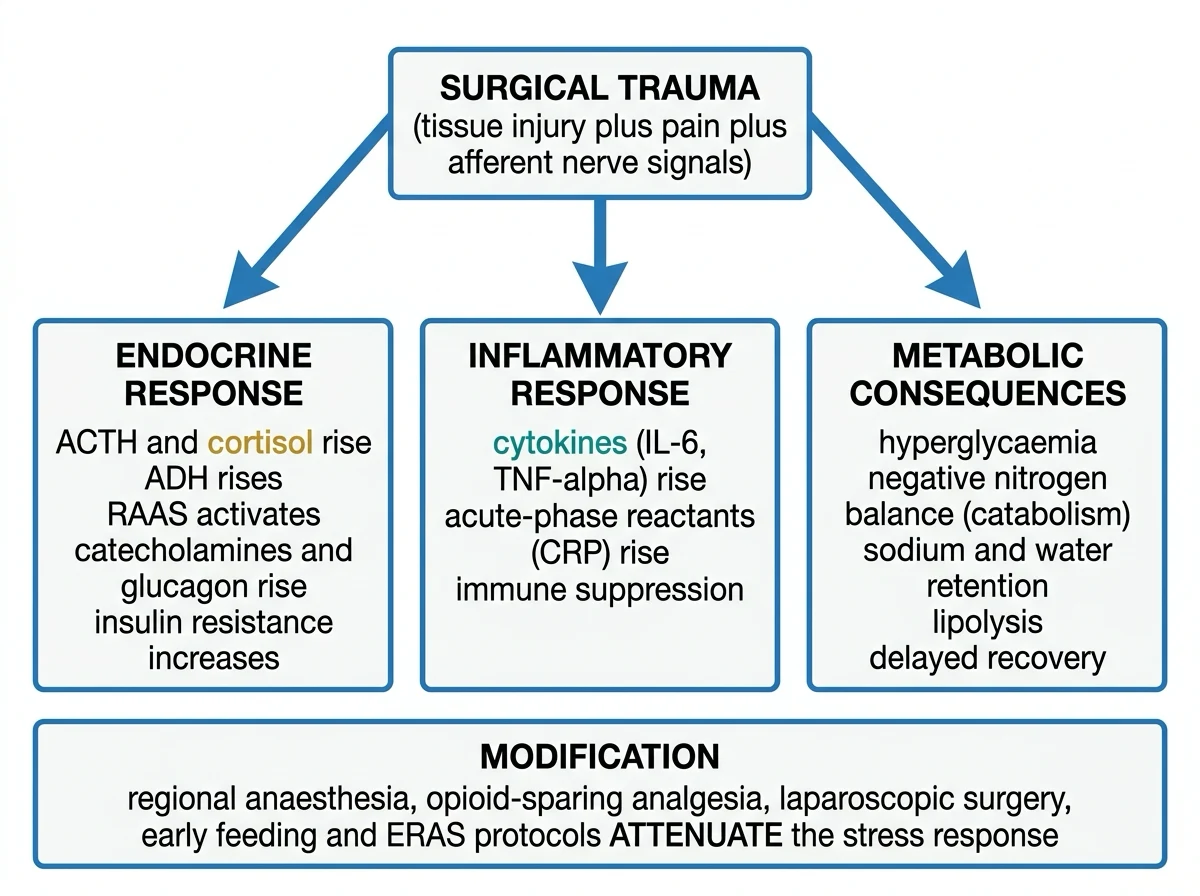
One-liner: Tissue injury and pain drive HPA + SNS activation and cytokines → cortisol/catecholamines/ADH/RAAS/glucagon up, insulin effect down → hyperglycaemia, catabolism, Na/water retention; neuraxial block and ERAS attenuate the afferent and inflammatory load. [1]
Afferent limb — how the signal starts
- Somatic and visceral nociceptors → spinal cord → brainstem and hypothalamus.
- Local tissue factors and cytokines (IL-6, TNF-α, IL-1) enter the circulation and amplify the response.
- Psychological stress, hypovolaemia, hypothermia and hypoxia add parallel inputs. [1]
Block the nerves (neuraxial / regional), reduce tissue injury (MIS), and reduce inflammatory amplifiers (technique, infection control) and the cascade is smaller.[1] />
Endocrine cascade — the list examiners want
| Axis | Up or down | Net effect |
|---|---|---|
| CRH → ACTH → cortisol | ↑↑ | Gluconeogenesis, anti-insulin, permissive for catecholamines |
| SNS → adrenaline / noradrenaline | ↑↑ | Tachycardia, vasoconstriction, glycogenolysis |
| ADH | ↑ | Free water retention, concentrated urine |
| RAAS | ↑ | Na retention, K loss, vasoconstriction |
| Glucagon | ↑ | Hyperglycaemia |
| Growth hormone | ↑ | Anti-insulin, lipolysis |
| Insulin | Relative resistance / inadequate | Hyperglycaemia |
| Thyroid (sick euthyroid patterns later) | Variable | Not the primary acute driver |
Cortisol timeline: rises within minutes–hours, peaks around the first day after major surgery, and can remain elevated for days proportional to insult. Dexamethasone used as antiemetic also suppresses the measured cortisol response — dual antiemetic and HPA-modifying effect.[1][2]
Inflammatory limb
- IL-6 is the flagship surgical cytokine — peaks ~24 h, scales with surgical magnitude (open major > laparoscopic).
- Acute-phase pattern: CRP↑, fibrinogen↑, albumin↓.
- Cellular immunity can be transiently suppressed → infection risk if response is massive and prolonged.
- SIRS physiology is the extreme of the same continuum when infection/inflammation dominates. [1]
Metabolic consequences — what the patient looks like
- Hyperglycaemia — hepatic glucose output ↑ + peripheral insulin resistance. Harms: impaired neutrophil function, wound problems, osmotic diuresis.
- Protein catabolism — negative nitrogen balance, muscle wasting, delayed mobilisation.
- Lipolysis — free fatty acids as fuel.
- Sodium and water retention — ADH + aldosterone; hyponatraemia if free water given liberally while ADH is high.
- Increased oxygen consumption and CO2 production — relevant to weaning and cardiac demand.
- Hypercoagulability — acute-phase prothrombotic shift (VTE risk context). [1]
Time course: catecholamines minutes → cortisol/IL-6 hours to 1–2 days → recovery over days to a week+ after major open surgery. Magnitude ∝ tissue injury × incomplete afferent block × complications. [1]
Modifiers — regional anaesthesia
Thoracic epidural / spinal for major abdominal/thoracic surgery can blunt the endocrine stress response by interrupting afferent traffic below the block level (and reducing sympathetic outflow in blocked segments). This is not pure magic for cytokine release from the wound itself, but it is one of the strongest anaesthetic tools for the neuroendocrine limb and for dynamic pain that otherwise sustains the cascade.[1]
Peripheral blocks improve analgesia and mobilisation; systemic endocrine blunting is generally less than solid neuraxial cover of the surgical field. [1]
Modifiers — ERAS package (unifying purpose)
ERAS is not a checklist of random niceties — it is stress-response engineering: [1]
- Minimally invasive surgery when appropriate.
- Multimodal opioid-sparing analgesia (regional, paracetamol, NSAID if safe, ketamine/α2 as indicated).
- Avoidance of prolonged starvation; early feeding.
- Euvolemia / goal-directed fluid rather than liberal salt water.
- Early mobilisation, nausea control, normothermia, glycaemic control.
- Avoid unnecessary drains/tubes that impair recovery. [1]
Outcome language for exams: less ileus, fewer complications, shorter stay — mechanism language: less catabolism and less ileus drivers.[1] />
Glucose as the bedside stress meter
Perioperative hyperglycaemia is expected. Targets vary by guideline and patient, but the physiology is fixed: stress hyperglycaemia ≠ automatic new diabetes, yet it still needs management in major surgery and ICU. Insulin is both metabolic therapy and, in stressed states, a tool against glycosuria and osmotic fluid shifts. [1]
What an unmodified response costs
Uncontrolled pain + large open injury + starvation + immobilisation → more hyperglycaemia, more infection risk, more muscle loss, more oedema from Na/water retention, delayed gut function, prolonged hospitalisation. That is the harm model ERAS argues against.[1] />[1] />
Anaesthetic plan that shows you understand the physiology
- Choose technique that blocks afferents for major cavity surgery when risk–benefit allows.
- Multimodal analgesia so movement does not re-ignite the cascade.
- Normothermia — shivering multiplies VO2.
- Glucose management for major cases / diabetics.
- Fluid discipline — ADH is high; do not drown with hypotonic free water.
- ERAS alignment with surgeons — shared target. [1]
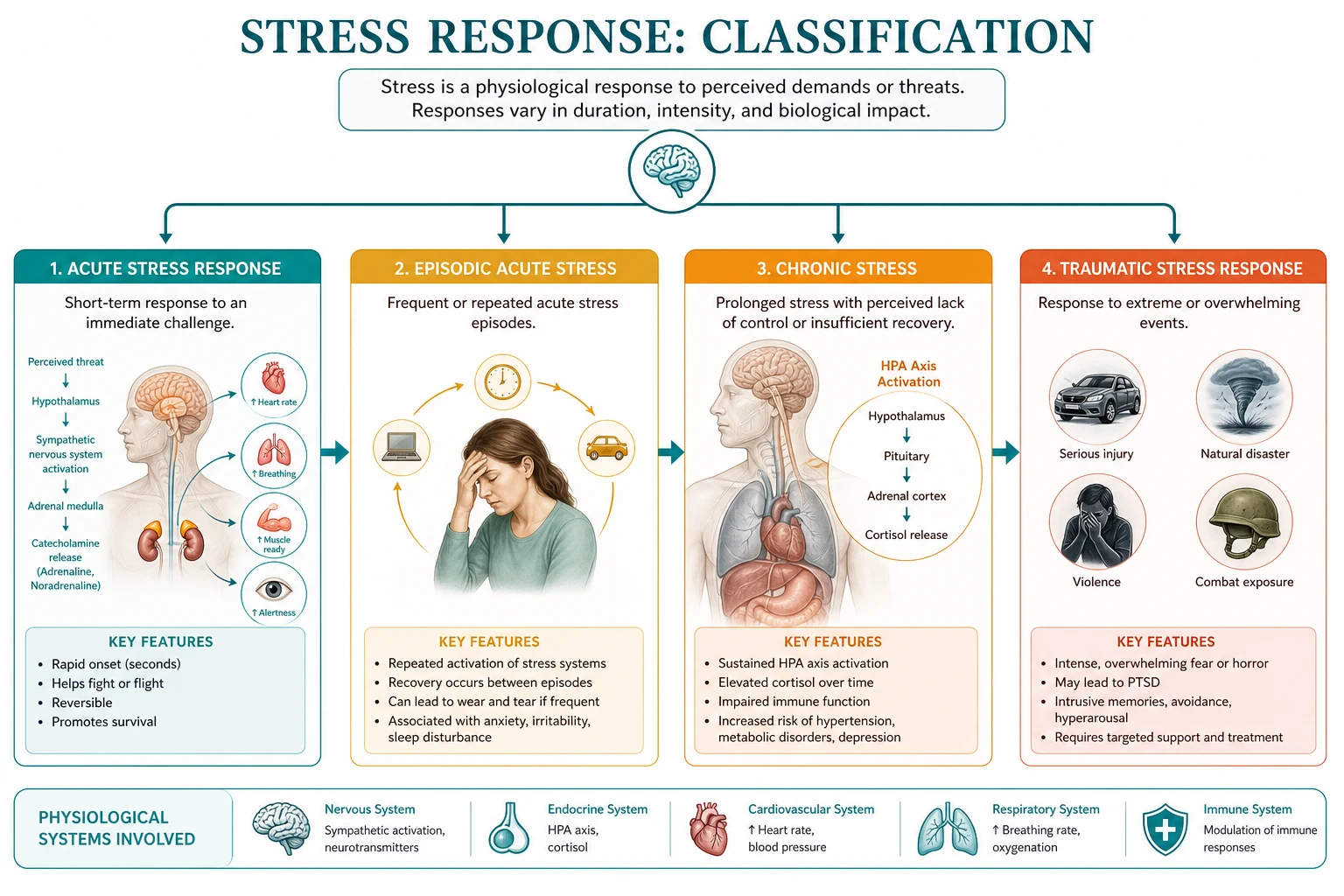
Neuroendocrine limb
- ACTH/cortisol, SNS, ADH, RAAS
- Hyperglycaemia, Na/water retain
- Blunted by neuraxial block
- Minutes to days
Inflammatory limb
- IL-6, TNF, CRP
- Scales with tissue injury
- MIS reduces load
- Immunomodulation risk if extreme
SAQ / viva scripts
List the hormonal changes of the surgical stress response (table form scores). [1]
Explain how thoracic epidural modifies the response. [1]
Why is laparoscopic colectomy associated with less stress than open? — less tissue injury, less pain, faster feeding/mobilisation. [1]
Mechanism of stress hyperglycaemia — counter-regulatory hormones + insulin resistance. [1]
Extended viva dialogue
Examiner: What happens to insulin and glucagon after major surgery? [1]
Candidate: Glucagon, catecholamines, cortisol and growth hormone rise and oppose insulin. Insulin secretion may not match need and tissues become resistant, so hyperglycaemia is the rule after major injury even in non-diabetics. [1]
Examiner: How does this link to ERAS? [1]
Candidate: ERAS reduces the magnitude and duration of the response by smaller incisions, better afferent blockade, less opioids, early feeding and mobilisation, and disciplined fluids — so less catabolism, ileus and hyperglycaemia-driven complications. [1]
Clinical synthesis: If your plan does not address afferents, glucose, temperature and mobilisation, you are managing anaesthesia but not the stress response. [1]
Hormone list you must recite under pressure
Increase: CRH/ACTH/cortisol, adrenaline/noradrenaline, ADH, renin–angiotensin–aldosterone, glucagon, growth hormone, IL-6/TNF, CRP/fibrinogen. [1]
Decrease or impaired: anabolic insulin effect (resistance), albumin (negative acute phase), sometimes thyroid T3 (sick euthyroid later). [1]
Regional anaesthesia — what is actually blocked
- Afferent nociceptive traffic from the surgical field if the block covers the metameres.
- Preganglionic sympathetic outflow in blocked segments → less catecholamine surge, vasodilation in blocked territory.
- Does not remove cytokine release from wounded tissue entirely.
- Thoracic epidural for upper abdominal surgery is the classic “stress-modifying” example in vivas; evidence for outcome benefit is context-specific — physiology still scores. [1]
Worked SAQ
SAQ: Describe the metabolic consequences of the surgical stress response (8 marks)
Counter-regulatory hormones and cytokines increase hepatic glucose output and create peripheral insulin resistance, producing hyperglycaemia. Protein catabolism causes negative nitrogen balance and muscle wasting. Lipolysis releases free fatty acids. ADH and aldosterone retain water and sodium, risking oedema and hyponatraemia if free water is administered. Oxygen consumption and CO2 production rise. The magnitude and duration scale with tissue injury and inadequately treated pain; ERAS measures exist to attenuate these consequences and speed recovery. [1]
Cortisol physiology detail for the Primary
Cortisol is a glucocorticoid synthesised from cholesterol in the zona fasciculata under ACTH (cAMP/PKA, StAR protein rate steps in steroidogenesis teaching). It is largely protein-bound (CBG); free fraction rises in acute stress when CBG falls. Genomic effects via glucocorticoid receptor take hours; some rapid non-genomic vascular effects exist. Cortisol is permissive for catecholamine-mediated vasoconstriction and cardiac inotropy — why adrenal crisis presents as vasopressor-refractory shock. [1]
Circadian rhythm: peak morning, trough midnight — surgical timing and exogenous steroids interact with this axis. [1]
Inflammatory mediators beyond IL-6
TNF-α and IL-1 initiate much of the early cytokine cascade; IL-6 is the best surgical magnitude correlate and main driver of hepatic acute-phase protein switching (CRP up, albumin down). Prostaglandins and leukotrienes contribute to pain and fever. Complement fragments amplify inflammation after major tissue injury or bypass. [1]
Autonomic + endocrine cross-talk
Baroreceptor unloading and pain afferents both drive SNS and HPA. Angiotensin II stimulates ACTH/CRH pathways — RAAS and stress axes are not siloed. This is why hypovolaemic, painful patients look “stressed” metabolically even before incision length is considered. [1]
Practical ERAS mapping table
| ERAS element | Stress physiology target |
|---|---|
| Carbohydrate drink / avoid long starve | Reduce insulin resistance |
| Regional / multimodal analgesia | Cut afferent drive |
| Minimally invasive surgery | Less cytokine load |
| Euvolemia | Avoid oedema and gut hypoperfusion |
| Early feeding | Enteral signal blunts catabolism |
| Early mobilisation | Oppose muscle wasting |
| PONV control | Reduce ADH/nausea non-osmotic signals |
| Normothermia | Avoid VO2 spike from shivering |
Extended viva add-on
Examiner: Why might postoperative hyponatraemia occur after an uncomplicated major case? [1]
Candidate: ADH is elevated by stress, pain and nausea, so free water is reabsorbed. If hypotonic fluids are given, plasma sodium falls. Women and the elderly are more susceptible to neurological complications; prevention is isotonic fluid discipline and treating pain/nausea. [1]
References
- [1]Gustafsson UO et al. Guidelines for perioperative care in elective colorectal surgery: Enhanced Recovery After Surgery (ERAS) Society recommendations 2025 Surgery, 2025.PMID 40783294
- [2]Apfel CC et al. A simplified risk score for predicting postoperative nausea and vomiting: conclusions from cross-validations between two centers Anesthesiology, 1999.PMID 10485781