Anaes · Applied cardiovascular & respiratory physiology
Drug toxicity and adverse drug reactions
Also known as Adverse drug reaction · ADR · Drug toxicity · Type A and Type B reactions · LAST · Pharmacovigilance
An adverse drug reaction is any noxious, unintended response to a drug given at standard doses; toxicity is harm from excessive exposure. Together they are among the commonest causes of iatrogenic injury and a major focus of perioperative safety. The framework rests on six exam-critical ideas. First, adverse drug reactions are classified by predictability into Type A (Augmented) reactions, which are dose-dependent, predictable from the drug's pharmacology and common (e.g. bleeding with warfarin, bradycardia with a beta-blocker, respiratory depression with an opioid), and Type B (Bizarre) reactions, which are dose-independent, unpredictable, uncommon and often immune-mediated or idiosyncratic (e.g. anaphylaxis, malignant hyperthermia, idiosyncratic drug-induced liver injury); Type A accounts for about 80 percent of all reactions. Second, the four mechanistic classes of toxicity are on-target (an exaggerated but expected pharmacological effect), off-target (an effect at a different receptor), immune (hypersensitivity — IgE, immune complex, T-cell) and idiosyncratic (a genetically determined, unpredictable reaction, often reactive-metabolite mediated). Third, organ-specific toxicity has recognisable signatures: hepatotoxicity (paracetamol via the reactive metabolite NAPQI depleting glutathione; halothane; idiosyncratic DILI), nephrotoxicity (NSAIDs, aminoglycosides, radiocontrast), cardiotoxicity (the local anaesthetics, causing local-anaesthetic systemic toxicity LAST; the anthracyclines), and neurotoxicity. Fourth, several toxicity syndromes are high-stakes in anaesthesia: local-anaesthetic systemic toxicity (seizures and cardiovascular collapse from bupivacaine, rescued by intravenous lipid emulsion), perioperative anaphylaxis (most often a neuromuscular blocker, treated with intravenous adrenaline), drug-induced long-QT and torsades de pointes (prolonged repolarisation from a wide range of agents), serotonin syndrome, neuroleptic malignant syndrome, malignant hyperthermia and propofol infusion syndrome. Fifth, drug toxicity can be delayed and remote from the dose: teratogenicity (harm to the fetus — thalidomide, valproate, retinoids, mycophenolate), carcinogenicity and mutagenicity. Sixth, management is to stop the drug, provide supportive care, and use specific antidotes where they exist (N-acetylcysteine for paracetamol, flumazenil for benzodiazepines, naloxone for opioids, lipid emulsion for LAST, dantrolene for malignant hyperthermia), and to report the reaction for pharmacovigilance. Built on the adverse-drug-reaction reporting study (Dubrall 2026), the acetaminophen-liver-injury redox study (Guo 2026), the long-acting local-anaesthetic safety review (Pham 2026), the perioperative immediate-hypersensitivity guidelines (Michel 2026), the remimazolam-anaphylaxis report (Jo 2026), the drug-induced QT-prolongation report (Sapkota 2026), the sodium-valproate teratogenicity review (McLaughlin 2026), and the drug-induced-liver-injury incidence study (Pocurull 2026).
On this page & tools
Your progress
Saved locally on this device.
8 MCQs with explanations
Target exams
Red flags
Why this matters to the anaesthetist
Primary pharmacology requires a classification of ADRs, mechanisms of toxicity vs allergy, and classic anaesthetic poisons (LAST, MH, anaphylaxis, opioid OD, volatile hepatitis historical, methaemoglobinaemia). This leaf is the framework; crisis leaves hold algorithms.[1]
One-liner: Type A augmented (dose-related predictable) vs Type B bizarre (unpredictable allergy/idiosyncrasy); treat by stopping drug, supporting physiology, and using specific antidotes when they exist. [1]
Classification of adverse drug reactions
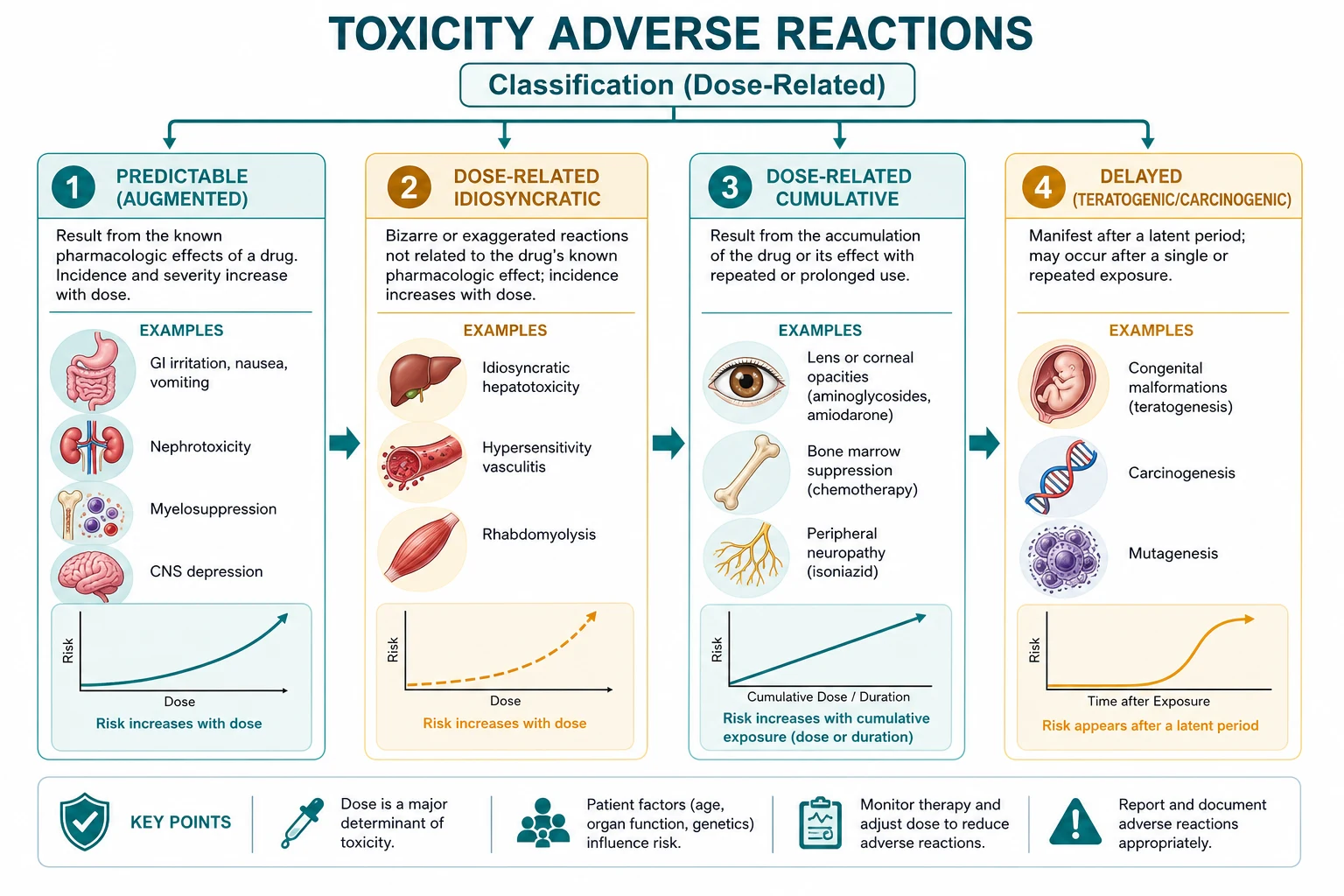
| Type | Feature | Examples in anaesthesia |
|---|---|---|
| A – Augmented | Common, dose-related, predictable from pharmacology | Opioid respiratory depression, propofol hypotension, residual NMBA |
| B – Bizarre | Uncommon, not dose-simple, host factors | Anaphylaxis, MH, idiosyncratic hepatitis, aplastic anaemia |
| C – Chronic | Time-related | Steroid side effects, opioid dependence |
| D – Delayed | Latency | Carcinogenesis, some dysmorphogenesis |
| E – End of use | Withdrawal | Clonidine rebound, opioid withdrawal, benzo withdrawal |
| F – Failure | Inadequate effect | Resistance, interaction, non-compliance, wrong route |
(Letter schemes vary slightly by textbook — know Type A vs B solidly.) [1]
Dose-dependent toxicity (Type A) mechanisms
- On-target excess: same receptor/path, too much (opioid µ → apnoea).
- Off-target: other receptors/channels at high concentration (LA → cardiac Na channels).
- Metabolite toxicity: paracetamol NAPQI; halothane intermediates (historical).
- Physiological cascade: histamine release (atracurium/mivacurium/morphine) causing flushing/hypotension without true allergy. [1]
Therapeutic index = TD50/ED50 concept — narrow TI drugs need monitoring (local anaesthetics, aminoglycosides, digoxin, lithium). [1]
Immunological reactions (Type B subset)
Gell–Coombs (see immunology leaf): [1]
- I: anaphylaxis (IgE) — NMBAs, antibiotics, latex, chlorhexidine.
- II: cytolytic (haemolysis, cytopenias).
- III: immune complex.
- IV: delayed rash, contact dermatitis; severe cutaneous adverse reactions. [1]
Anaphylactoid non-IgE mast-cell activation presents like anaphylaxis — same acute treatment. [1]
Idiosyncratic pharmacogenetic toxicity
- MH: RYR1/CACNA1S — volatile/sux trigger → uncontrolled SR Ca release (crisis leaf).
- Pseudocholinesterase deficiency: prolonged sux/mivacurium.
- G6PD: oxidant drug haemolysis; caution methylene blue in some contexts.
- Porphyria: barbiturates etc. induce ALA synthase — crisis risk.
- Slow acetylators / CYP variants: toxicity or failure (pharmacogenetics leaf). [1]
Local anaesthetic systemic toxicity (LAST) — physiology sketch
Excess free LA → CNS excitation then depression; cardiac Na/Ca/K channel block → arrhythmia, contractile failure. Risk↑ with: high dose, intravenous injection, high vascularity sites, low protein binding states, hypoxia/acidosis (ion trapping). [1]
Treatment pillars: stop injectate, airway/O2, benzodiazepine for seizures, lipid emulsion, ACLS with modified dosing (low adrenaline per guidelines), avoid vasopressin/Ca-channel blockers per LAST guidance. [1]
Malignant hyperthermia — mechanism sketch
Defective SR Ca release channel → sustained myoplasmic Ca → rigid hypermetabolism, CO2 surge, heat, rhabdomyolysis, hyperkalaemia. Dantrolene inhibits SR Ca release. Not an allergy. [1]
Opioid toxicity
µ-receptor: miosis, respiratory depression, coma. Reverse with naloxone (care re-narcotisation if short naloxone vs long opioid; pulmonary oedema rare). [1]
Methaemoglobinaemia
Oxidised Fe3+ Hb — cannot carry O2; left shift of remaining sites; chocolate blood; SpO2 ~85% plateau. Triggers: prilocaine, benzocaine, dapsone, nitrites. Treat methylene blue (care G6PD). [1]
Carbon monoxide / cyanide (context)
CO: content↓ + left shift; co-oximetry. Cyanide: histotoxic hypoxia (nitroprusside high dose teaching). Different mechanisms — do not conflate. [1]
Hepatotoxicity patterns
- Dose-related intrinsic: paracetamol.
- Idiosyncratic: rare immune or metabolic (halothane hepatitis classic exam story — IgG against TFA-protein adducts).
- Cholestatic vs hepatocellular LFTs. [1]
Prevention systems
- Two-person check, labelled syringes, lipid available, MH trolley, allergy history, max LA dose calculation, ETCO2 monitoring (MH early), depth/NM monitoring. [1]
Numbers / antidote board
| Toxin / problem | Antidote / specific |
|---|---|
| Opioid | Naloxone |
| Benzodiazepine | Flumazenil (selectively; seizure risk) |
| LAST | 20% lipid emulsion |
| MH | Dantrolene |
| Paracetamol | N-acetylcysteine |
| MetHb | Methylene blue |
| Malignant anticholinergic | Physostigmine (selected) |
| Organophosphate | Atropine + pralidoxime |
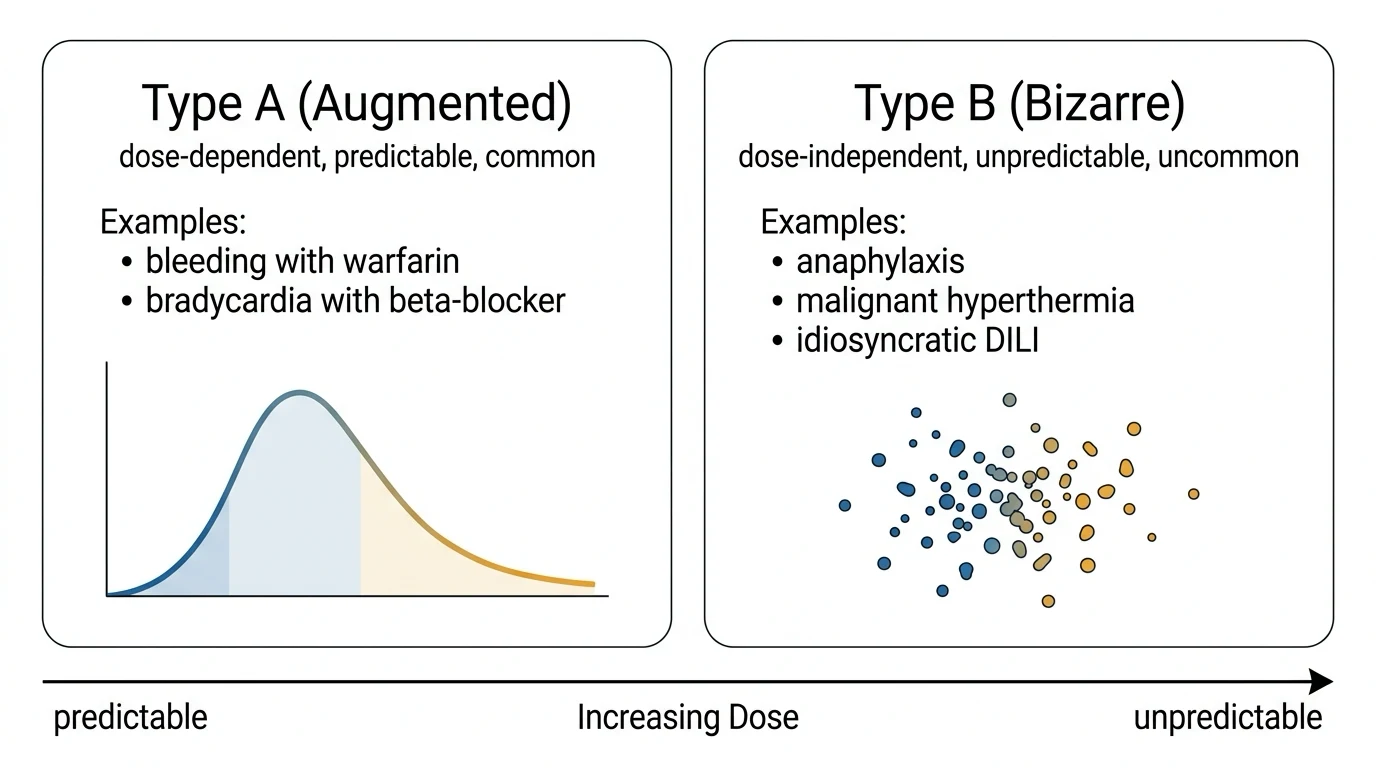
Type A
- Predictable
- Dose-related
- Common
- Reduce dose / support
Type B
- Unpredictable
- Host factors
- Allergy/idiosyncrasy
- Avoid re-exposure
Viva scripts
Classify ADRs with anaesthetic examples. [1]
LAST mechanism and lipid rationale (lipid sink / cardiometabolic theories — state sink as primary exam line). [1]
Distinguish anaphylaxis from MH. [1]
Extended viva dialogue
Examiner: Is atracurium flushing an allergy? [1]
Candidate: Often non-immunological histamine release — Type A pharmacologic effect — dose and rate related. True IgE anaphylaxis is Type B, can occur on re-exposure, and causes multi-system crisis; tryptase and allergy testing help afterwards. [1]
Examiner: Why give lipid in LAST? [1]
Candidate: Lipid emulsion creates an intravascular sink binding lipophilic local anaesthetic and may support cardiac metabolism; it is given with good ALS and seizure control, not instead of airway management. [1]
Clinical synthesis: Name the ADR type, the mechanism, and the specific antidote in that order — examiners listen for the structure. [1]
Naranjo-style causality thinking (light)
Timing, dechallenge, rechallenge, alternative causes — exam language for “was it the drug?” after events. [1]
Safe max dose concept for LA
mg/kg ceilings are starting safety rails; site vascularity, epinephrine, patient frailty, and free fraction matter more than a single number. Still state common teaching maxima then qualify. [1]
Worked SAQ
SAQ: Classify adverse drug reactions and illustrate with anaesthetic examples (8 marks)
Type A reactions are common, dose-related and predictable from pharmacology — opioid respiratory depression or propofol hypotension. Type B reactions are bizarre and host-dependent — IgE anaphylaxis to neuromuscular blockers or malignant hyperthermia. Other useful categories include chronic use effects, delayed effects, withdrawal phenomena and therapeutic failure from interactions. Management stops the drug, supports ABC, and uses specific antidotes when available (naloxone, lipid emulsion, dantrolene, adrenaline). [1]
Primary exam expansion — dense examiner pack
Full ADR classification with anaesthetic examples
| Type | Mechanism | Example under anaesthesia | Predictable? |
|---|---|---|---|
| A (Augmented) | Dose-related pharmacology | Opioid apnoea; propofol hypotension; residual NMB | Yes |
| B (Bizarre) | Idiosyncratic / immune | Anaphylaxis to NMBAs, antibiotics, chlorhexidine | No |
| C (Chronic) | Dose/time related | Steroid side effects; opioid dependence | Often |
| D (Delayed) | Latency | Carcinogenesis teaching; fetal toxicity classes | Variable |
| E (End of use) | Withdrawal | Clonidine/dex rebound; opioid withdrawal | Yes if anticipated |
| F (Failure) | Inadequate effect | Resistance, wrong route, interaction | Investigable |
Primary examiners love Type A versus Type B contrast with one example each. [1]
Anaphylaxis under anaesthesia — structured response
Triggers (frequency teaching): neuromuscular blockers, antibiotics (especially penicillins/teicoplanin patterns by region), chlorhexidine, latex, patent blue, colloids. Presentation may be pure cardiovascular collapse without rash under anaesthesia. Management skeleton: call for help, 100% oxygen, discontinue triggers, epinephrine IV per local anaphylaxis dosing, fluids, airway, start infusion if recurrent, tryptase timing (immediate, 1–2 h, baseline later), referral to allergy clinic. Differentiate from: latex-free pathway already failing, venous air, PE, MH, scombroid, non-IgE histamine release. [1]
LAST — local anaesthetic systemic toxicity
Mechanism: Na channel block in CNS then heart; lipophilicity and free fraction matter. Prodrome: tinnitus, metallic taste, circumoral numbness, agitation → seizures → coma. Cardiac: arrhythmias, conduction block, contractile failure (bupivacaine classically severe). Prevention: aspiration, incremental injection, ultrasound, dose limits, epinephrine markers, avoid injection into inflamed vascular beds. Treatment: stop injection, ABC, benzodiazepine for seizures (avoid large propofol as sole therapy in unstable patient), lipid emulsion 20% per local protocol (e.g. bolus then infusion teaching), ACLS modifications (avoid lignocaine as antiarrhythmic if LAST from amide; small epinephrine doses often taught), cardiopulmonary bypass as last resort in refractory cases. [1]
Malignant hyperthermia as Type B-ish pharmacogenetic crisis
Trigger volatiles/sux → uncontrolled SR Ca release → hypermetabolism, rising EtCO2, rigidity, hyperthermia, hyperkalaemia, rhabdomyolysis, DIC risk. Treatment: call for help, discontinue triggers, 100% O2 high flow, dantrolene, cool, treat hyperK, check ABG/CK/coags, ICU. Safe technique thereafter: trigger-free machine protocol or TIVA. [1]
Methaemoglobinaemia and CO as toxicology ADRs
Methaemoglobinaemia: oxidant LA (prilocaine, benzocaine), dapsone, nitrites — chocolate blood, SpO2 ~85% plateau, PaO2 normal, co-oximetry diagnosis, methylene blue (care in G6PD). CO: smoke, methylene chloride — content and left shift, co-oximetry, 100% O2. [1]
Opioid and sedative Type A stack
Respiratory depression is the dominant lethal Type A. Risk multiplies with: other sedatives, OSA, elderly, residual NMB, neuraxial opioid, renal failure (M6G). Monitoring: rate, depth, sedation score, SpO2 (late), EtCO2 when available. Naloxone: titrate to ventilation not full pain; observe renarcotisation (naloxone shorter than many agonists). [1]
NMB-related ADRs
Anaphylaxis; residual paralysis (PORC) → aspiration/hypoxia; sux: hyperK (burns, denervation, MH, myopathies), bradycardia, MH, prolonged block (BuChE); atracurium/mivacurium histamine; sugammadex: rare hypersensitivity, binds oral contraceptives teaching, TOF indication. [1]
Causality and documentation
Timing, dechallenge, alternative causes, tryptase, serum IgE where relevant, yellow-card/pharmacovigilance, allergy referral, medicolegal documentation of lot numbers for suspected product reactions. [1]
SAQ: classify ADRs with anaesthetic examples (8 marks)
Define ADR → Type A vs B with two examples each → expand one emergency (anaphylaxis or LAST) including immediate management → prevention strategies (dose limits, test doses, allergy history, checklists). [1]
Viva rapid fire
Q: Is atracurium flushing allergy? A: Often non-immune histamine release — Type A, rate/dose related. Q: Why lipid in LAST? A: Intravascular lipid sink for lipophilic LA plus possible metabolic cardiac support. Q: First drug in perioperative anaphylaxis? A: Epinephrine — not antihistamine first. [1]
High-yield viva battery and numbers lock-in
Emergency ADR algorithms — one-liners you must lead with
- Anaphylaxis: adrenaline first-line, not antihistamine.
- LAST: stop injection, ABC, benzos for seizures, lipid emulsion, modified ACLS.
- MH: trigger off, dantrolene, cool, treat hyperK, ICU.
- Opioid apnoea: ventilate, then titrated naloxone.
- Residual NMB: assess TOF, reverse appropriately, never extubate weak. [1]
Dose-related Type A examples bank
Propofol hypotension/apnoea; volatile myocardial depression; opioid rigidity/apnoea; local anaesthetic when excessive dose; neostigmine bradycardia/secretions; atropine tachycardia; vasopressor hypertension; residual volatile ileus/sedation. State mechanism (receptor or channel) in half a sentence each. [1]
Tryptase timing
Take samples at reaction, about 1–2 hours later, and baseline at >24 h. Elevated peak supports mast-cell activation; normal tryptase does not completely exclude anaphylaxis. Refer all suspected perioperative anaphylaxis to specialist allergy services for skin testing and future planning. [1]
Full viva dialogue (additional)
Examiner: Distinguish Type A and Type B with one anaesthetic example each. [1]
Candidate: Type A is augmented, dose-related, predictable pharmacology — for example opioid respiratory depression. Type B is bizarre/idiosyncratic, not predictable from the primary pharmacology dose–response — for example IgE-mediated anaphylaxis to a neuromuscular blocker. [1]
Examiner: Outline lipid emulsion dosing philosophy in LAST without inventing a single universal number if unsure. [1]
Candidate: I would follow the current association checklist immediately available on the machine or in the emergency folder — typically a bolus of 20 percent lipid followed by an infusion, with a ceiling dose — and simultaneously manage airway, seizures and circulation, preparing for prolonged CPR and cardiopulmonary bypass if refractory cardiac arrest. [1]
Exam traps
- Steroids/antihistamines as first drugs in anaphylaxis.
- Large propofol boluses as sole LAST therapy in collapsed patient.
- Assuming rash must be present for anaphylaxis under anaesthesia.
- Ignoring renarcotisation after single naloxone dose. [1]
References
- [1]Dubrall D, et al. Patterns of Spontaneous Adverse Drug Reaction Reporting in Germany From 2012 to 2021 Pharmacol Res Perspect, 2026.PMID 42281142
- [2]Guo C, et al. Malic Enzyme 1 Limits Acetaminophen-Induced Liver Injury by Sustaining Redox and Bioenergetic Homeostasis Metabolites, 2026.PMID 42346403
- [3]Pham DT, et al. New long-acting local anesthetics: recent formulations and safety Curr Opin Anaesthesiol, 2026.PMID 42228505
- [4]Michel MP, et al. Guidelines: Diagnosis and management of perioperative immediate hypersensitivity reactions 2025 Anaesth Crit Care Pain Med, 2026.PMID 42335666
- [5]Jo Y, et al. Remimazolam-Induced Anaphylaxis After Spinal Anesthesia: A Case Report and Literature Review J Clin Med, 2026.PMID 42278971
- [6]Sapkota S, et al. When Rhythm Control Backfires: A Case of Severe QT Prolongation and Polymorphic Ventricular Tachycardia Following Dual Antiarrhythmic Therapy Cureus, 2026.PMID 42255834
- [7]McLaughlin D, et al. Sodium valproate: balancing benefits and risks especially in people of childbearing potential Aust Prescr, 2026.PMID 42312305
- [8]Pocurull A, et al. Incidence of Drug-Induced Liver Injury in the Urban Primary Care Setting Clin Gastroenterol Hepatol, 2026.PMID 42314789