Anaes · Acute pain & multimodal analgesia
Acute pain & multimodal analgesia
Also known as Acute pain service · Multimodal analgesia · Opioid-sparing · PCA · Fascial plane blocks · Postoperative pain
Exam-exhaustive acute pain: WHO-style ladder adapted to acute surgical pain, multimodal components with doses, PCA principles, regional integration, and brief opioid-tolerant patient strategy.
On this page & tools
Your progress
Saved locally on this device.
Target exams
Red flags
Why this is examined / one-line answer
Acute pain management is daily consultant practice and a frequent SAQ/viva. Examiners want a structured ladder adapted to surgery, exact-ish doses, PCA safety rules, regional integration, and a sensible opioid-tolerant plan. One-liner: I start with regular paracetamol and NSAID/COX-2 if safe, add regional or local wherever it changes outcomes, use the lowest effective opioid via oral or PCA routes, monitor sedation and ventilation, and I escalate through the acute pain service when the trajectory is wrong. [1]
Goals of acute postoperative analgesia
- Comfort sufficient for rest.
- Function — cough, deep breathe, mobilise, sleep.
- Minimise side effects — nausea, sedation, ileus, respiratory depression, delirium.
- Reduce chronic postsurgical pain (CPSP) risk by preventing severe uncontrolled acute pain.
- Enable ERAS — oral intake, physiotherapy, discharge. [2]
Score pain (NRS 0–10) but treat function: a patient who can cough and walk with NRS 4 is often better managed than one asleep with NRS 0 on high opioid. [3]
WHO-style ladder adapted to acute surgical pain
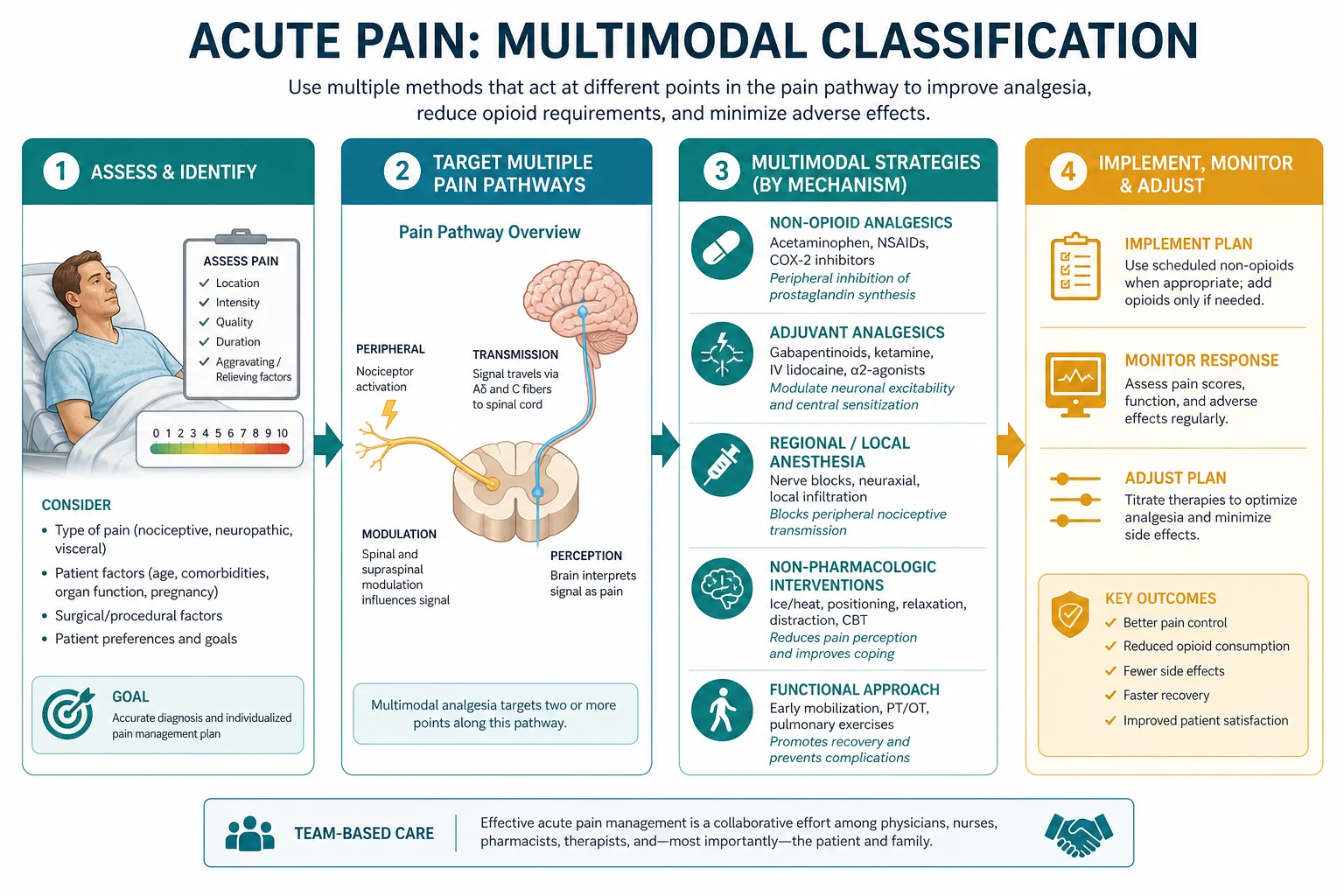
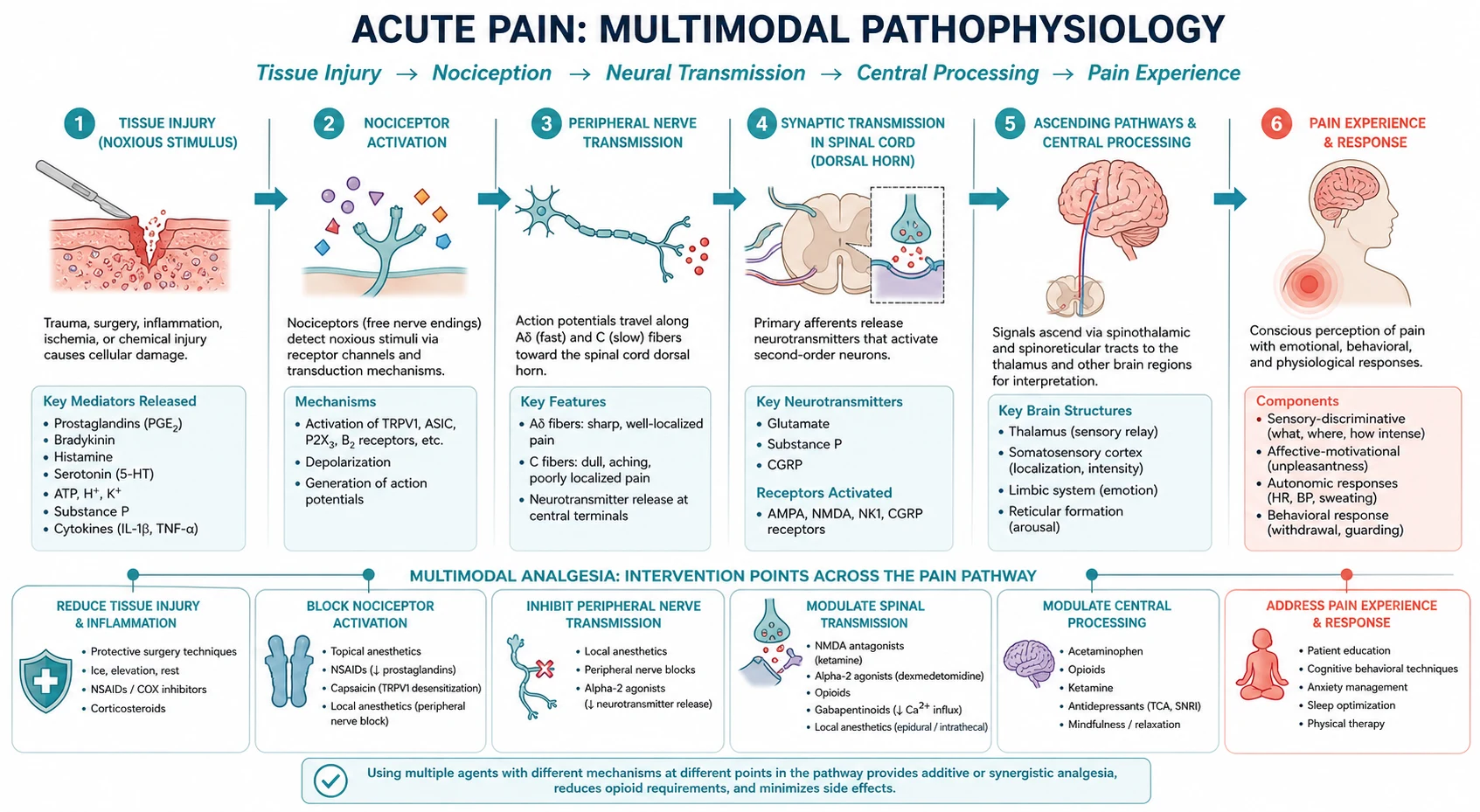
The classic WHO cancer ladder (non-opioid → weak opioid → strong opioid) is re-ordered for surgery: regional and non-opioids are foundations; strong opioids are tools, not the peak of virtue. [1]
| Step (surgical adaptation) | Components |
|---|---|
| Foundation | Regular paracetamol + NSAID or COX-2 (if not contraindicated) |
| Procedure-specific regional | Neuraxial, plexus/peripheral, fascial plane, wound catheters, infiltration |
| Adjuncts | Ketamine, α2-agonists, lidocaine infusion, gabapentinoids (selective) |
| Opioid rescue | Oral immediate-release or IV PCA / nurse-controlled |
| Escalation | APS review, adjust regional, treat complications, consider other diagnoses (compartment, ischaemia, anastomotic leak) |
Not “morphine first, then maybe some paracetamol.” [3]
Multimodal components — doses examiners expect
Non-opioids
| Drug | Adult teaching dose | Notes |
|---|---|---|
| Paracetamol | 1 g QID PO/IV (max 4 g/day; reduce in low weight/liver disease) | Foundation; regular not PRN |
| Ibuprofen | 400 mg TDS PO | NSAID risks |
| Diclofenac | 50 mg TDS PO or PR | Avoid in high renal/bleed risk |
| Celecoxib | 100–200 mg BD PO | COX-2; less platelet effect |
| Parecoxib | 40 mg IV (unit protocols) | Perioperative COX-2 |
| NSAID cautions: AKI risk (hypovolaemia, ACEI/ARB, elderly), peptic ulcer, bleeding, some asthma (sensitivity), anastomotic concerns in some colorectal practices (unit variation). [1] |
Opioids (minimal effective)
| Drug | Notes |
|---|---|
| Morphine | PCA gold standard in many units; active metabolite in renal failure — caution |
| Oxycodone | Common oral step-down |
| Fentanyl | PCA alternative; less renally cleared active metabolite |
| Tramadol / codeine | Weak; CYP2D6 variability; serotonin risk with tramadol |
| Tapentadol | µ-agonist + NRI — selected use |
Adjuncts
| Drug | Teaching regimen | Role |
|---|---|---|
| Ketamine | Bolus 0.1–0.5 mg/kg then 0.1–0.2 mg/kg/h (unit range) | Anti-hyperalgesia; opioid-tolerant; major surgery |
| Lidocaine IV | 1–1.5 mg/kg bolus then 1–2 mg/kg/h (avoid in unstable heart block/severe cardiac disease) | Abdominal ERAS adjunct in some protocols |
| Dexmedetomidine | Low-dose infusion | Opioid-sparing; bradycardia/hypotension |
| Gabapentinoids | Not routine for all — sedation/dizzy risk; selected CPSP-risk or chronic pain | |
| Magnesium | Intraoperative adjunct in some protocols | Modest opioid-sparing |
Regional / local (integrate early)
- Epidural — open thoracic/upper abdominal major surgery (anticoagulation timing critical).[2]
- Intrathecal opioid — single-shot (pruritus, delayed respiratory depression monitoring).
- Upper/lower limb blocks — amputation, arthroplasty, fractures.
- Fascial planes: TAP, rectus sheath, QL, ESP — wall analgesia, variable visceral cover.
- Wound infiltration / catheters — simple and high-yield.
- Always respect LA maxima and LAST preparedness.[1]
Opioid-sparing regional also reduces PONV risk (Apfel postoperative opioid factor).[3]
PCA principles
Patient-controlled analgesia — small IV boluses on demand with lockout. [2]
| Parameter | Typical adult morphine example (unit-variable) |
|---|---|
| Bolus | 1 mg (0.5–2 mg) |
| Lockout | 5 minutes |
| Background infusion | Usually 0 mg/h in opioid-naïve |
| 1- or 4-hour limit | Per pump protocol |
| Monitoring | Sedation score, RR, SpO2, pain, nausea |
Rules that score marks:
- Only the patient presses the button (not relatives) — except authorised nurse-controlled in children/ICU.
- No background in naïve patients — respiratory depression risk.
- Concurrent sedatives increase risk.
- Step down to oral when absorbing and pain trajectory allows.
- Treat side effects (ondansetron, laxatives, antihistamine for itch) — do not abandon analgesia.
- Failure of PCA → assess regional options, adjuncts, surgical complications — not endless bolus increases alone. [1]
Acute pain service (APS)
- Daily review of epidurals, PCA, complex pain, opioid-tolerant, failed oral regimens.
- Protocols, education, audit (pain scores at rest/movement, side effects, function).
- Bridge from theatre plan to ward safety.
- Escalation pathway for neurological red flags after neuraxial. [2]
Opioid-tolerant / OUD notes (brief but solid)
- Continue baseline methadone / buprenorphine / chronic opioid where possible (liaise addiction/pain services — do not stop abruptly without plan).
- Expect higher opioid requirements for acute pain — calculate carefully; avoid pure “PRN only” under-treatment.
- Maximise non-opioid + regional + ketamine.
- Avoid mixed agonist-antagonists that may precipitate withdrawal.
- Discharge planning: short acute course, clear follow-up, no unstructured mega-scripts.
- Buprenorphine: often continued; acute pain needs multimodal + higher-affinity pure agonists carefully supervised. [3]
Special populations
- Elderly: start low; delirium risk; prefer regional; reduce opioid.
- Renal impairment: avoid morphine accumulation; fentanyl/oxycodone caution with advice; NSAID avoid.
- Day-case: oral multimodal + local/regional; avoid long-acting neuraxial opioids that delay discharge.
- Paediatrics: weight-based; FACES/FLACC; nurse-controlled analgesia protocols.
- Obese/OSA: opioid-sparing mandatory; monitoring; CPAP. [1]
When pain is “out of proportion”
Consider ischaemia, compartment syndrome, compartment abdominal, anastomotic leak, compartment after cast, neuropathic transition, missed fracture, psychological distress — examine the patient. [2]
SAQ scaffold
- Adapted multimodal ladder for laparotomy (4)
- PCA parameters and safety (3)
- Two fascial plane blocks with coverage (3)
- Opioid-tolerant plan (3)
- Red flags after epidural (2) [3]
Viva stems
“Design analgesia for open colectomy.” — epidural or alternative regional + paracetamol/NSAID + opioid rescue + APS.
“PCA not working.” — check pump, IV, education, surgical cause, add adjunct/regional.
“Patient on 100 mg morphine equivalent daily.” — continue baseline, ketamine, regional, APS.
“Why multimodal?” — synergy, less SE, better function.
“NSAID after nephrectomy?” — often avoid — renal risk. [1]
Common traps
- PRN paracetamol only.
- Three different opioids without non-opioids.
- Background PCA in naïve elderly.
- Ignoring constipation.
- Missing compartment syndrome while escalating morphine.
- Removing epidural without anticoagulation check. [2]
PAIN plan
Opioid-naïve major surgery
- Regional first-line
- PCA no background
- Regular non-opioids
- APS backup
Opioid-tolerant
- Continue baseline
- Higher acute needs
- Ketamine + regional
- Specialist liaison
Day-case
- Oral multimodal
- Local/regional
- Minimise long opioids
- PONV co-plan
Integrated exam drill sheet
Sixty-second version
Say the definition, the critical number or sequence, the main clinical use, and the top red flag. Stop. If you cannot do this without notes, the topic is not yet learnable.
Three-minute version
Add mechanism, a comparison table spoken aloud, one special population, and one crisis stem with first actions. This is the standard viva unit.
Ten-minute mastery version
Add equipment detail or procedural steps, evidence limits, second-line options, and a teach-the-junior summary. This is Final long-case depth.
Written SAQ timing
For a 10-minute SAQ, spend one minute planning headings, seven minutes writing, two minutes checking hard stops and units. Headings should mirror examiner dimensions: definition, mechanism or anatomy, clinical application, complications, special situations.
Common mark-losing behaviours
- Lists without mechanisms
- Mechanisms without clinical action
- Doses without route or monitoring
- Landmarks without injury consequences
- Device talk without re-enable or backup plans
- Absolute claims where practice is protocol-dependent
Positive mark-gaining behaviours
- Numbers with units and approximate ranges
- Explicit assumptions for equations
- Side-by-side comparisons
- Named hard contraindications
- Monitoring endpoints
- Clear escalation
Cross-specialty board alignment
ANZCA Primary and Final, FRCA Primary and Final, ABA, EDAIC and FCAI all test these leaves repeatedly because they are portable across subspecialties. A candidate who owns flow physics, electrical safety, neck and neuraxial anatomy, vaporiser principles and core adjunct pharmacology can survive stems in ICU transfer, obstetric haemorrhage, thoracic lists and outpatient dental anaesthesia alike.
Personal rehearsal script
Read the AnswerCard twice. Cover it and rewrite it from memory. Speak the red flags. Draw one table from memory. Answer one hostile interruption. Then move on. Spaced repetition beats marathon re-reading.
Safety culture close
Every technical topic ends in patient safety: do not expand closed gas spaces, do not dilate arteries, do not leave ICD therapies off, do not apply Poiseuille in turbulence, do not ignore conus level, do not tip a full vaporiser back into service without protocol, and do not stack serotonergic weak opioids casually. Knowledge is only exam-pass when it prevents harm.
Red flags
References
- [1]Neal JM et al. The Third American Society of Regional Anesthesia and Pain Medicine Practice Advisory on Local Anesthetic Systemic Toxicity: Executive Summary 2017 Reg Anesth Pain Med, 2018.PMID 29356773
- [2]Horlocker TT et al. Regional Anesthesia in the Patient Receiving Antithrombotic or Thrombolytic Therapy: American Society of Regional Anesthesia and Pain Medicine Evidence-Based Guidelines (Fourth Edition) Reg Anesth Pain Med, 2018.PMID 29561531
- [3]Gan TJ, et al. Fourth Consensus Guidelines for the Management of Postoperative Nausea and Vomiting Anesth Analg, 2020.PMID 32467512