Anaes · Neuraxial anaesthesia
Caudal epidural anaesthesia
Also known as Caudal anaesthesia · Caudal block · Caudal epidural · Sacral epidural · Caudal analgesia · Single-shot caudal
Caudal epidural anaesthesia injects local anaesthetic into the epidural space through the sacral hiatus — the most caudal access to the neuraxis. It is the commonest regional block in children, providing sacral and lumbar anaesthesia for lower-abdominal, perineal and lower-limb surgery, and it is used in adults for chronic-pain caudal epidural steroids. Its safe practice rests on the sacral-hiatus anatomy, the needle angle and the aspiration test, and its place is now compared against the newer erector spinae plane blocks.
On this page & tools
Your progress
Saved locally on this device.
8 MCQs with explanations
Target exams
Red flags

Overview
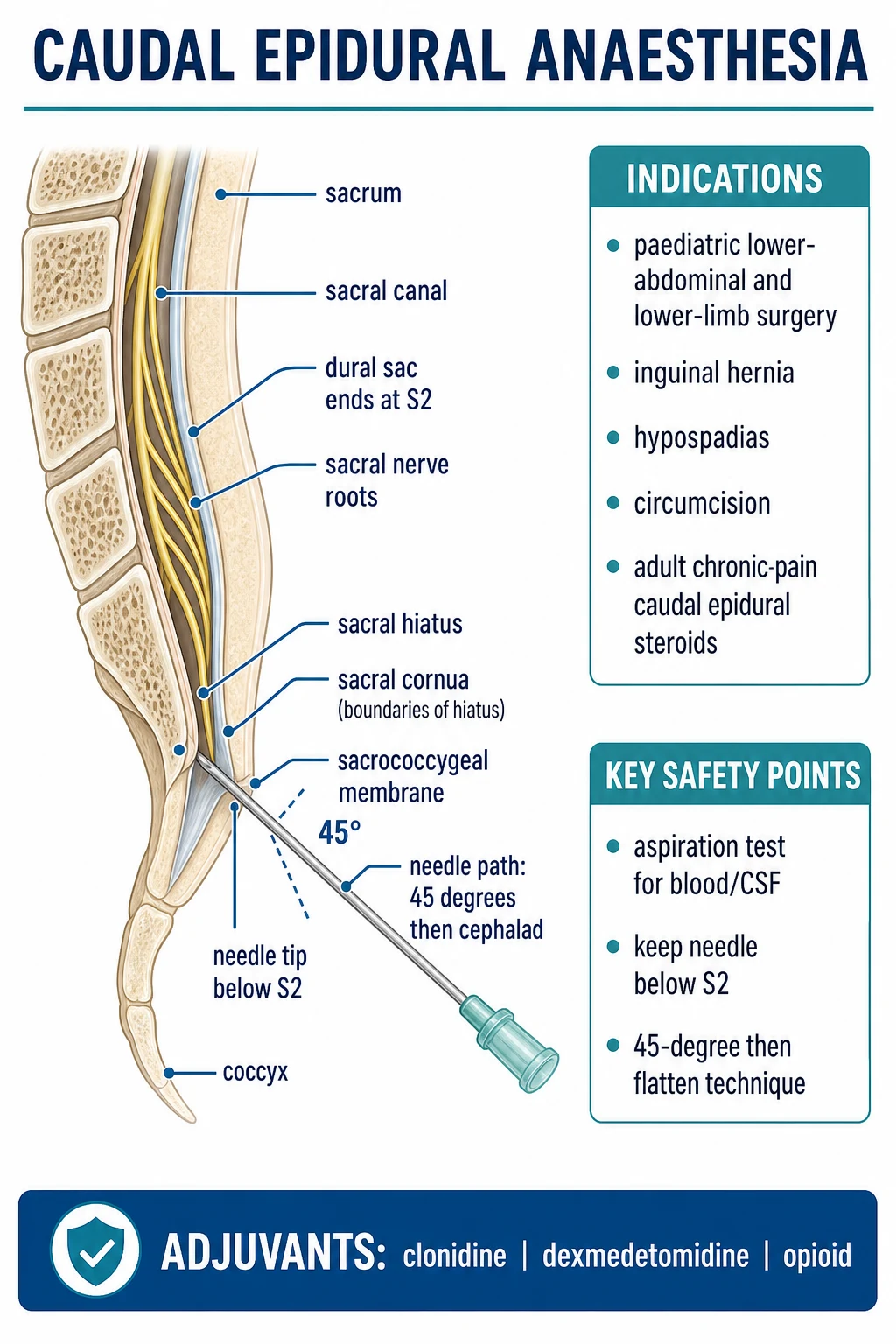
Caudal epidural anaesthesia approaches the epidural space through the sacral hiatus, the opening at the caudal end of the sacral canal where the dura ends and the epidural space is most accessible[1]. It is the commonest regional block performed in children, providing reliable sacral and lumbar anaesthesia for the lower-body operations of childhood — inguinal hernia, hypospadias and circumcision, lower-limb orthopaedics — and it has an adult role in chronic-pain caudal epidural steroid injection[1]. Its discipline rests on the sacral-hiatus anatomy, the needle angle that keeps the tip below the dural sac, the aspiration test, and the contemporary comparison with the newer erector spinae plane blocks[5].
Indications
The caudal block is indicated in children for surgery of the lower abdomen, perineum and lower limbs: inguinal and umbilical hernia repair, orchidopexy and hydrocele, hypospadias and circumcision, and lower-limb orthopaedics[4][5]. In adults it is used for chronic-pain caudal epidural steroid injection in lumbar radicular pain and spinal stenosis, where a comprehensive review confirms its continued utility[1]. The contraindications are the neuraxial ones (coagulopathy, local or systemic sepsis — pilonidal disease at the site is a particular concern — and patient refusal), together with sacral anatomical abnormality that prevents access to the hiatus[1].
Anatomy of the sacral hiatus
The sacral canal is the caudal continuation of the vertebral canal, and it opens inferiorly at the sacral hiatus, bounded by the two sacral cornua and closed by the sacrococcygeal membrane[1]. The dural sac terminates at the second sacral vertebra (S2) in the adult and at a lower level in the infant, so the epidural space below S2 is safe to enter; the sacral nerve roots and the filum terminale lie in the canal with fat and a rich venous plexus. The two sacral cornua are palpable on the midline at the upper end of the natal cleft and are the landmark for the hiatus between them[1].
The technique
With the patient (commonly an anaesthetised child) in the lateral position with knees drawn up, the sacral cornua are palpated and the skin over the hiatus between them is prepared. A short bevelled or blunt needle (or a cannula-over-needle) is inserted through the sacrococcygeal membrane at an angle of about forty-five degrees to the skin until a distinct 'pop' is felt as the membrane is pierced; the needle is then flattened to lie almost parallel to the skin and advanced a short distance into the sacral canal, well below the S2 level[1]. Before injection, aspiration confirms the absence of blood (intravascular) or cerebrospinal fluid (intrathecal), and the local anaesthetic is injected incrementally, free of resistance and without the swelling of a subcutaneous injection.
Local anaesthetic dosing and adjuvants
The dose is determined by the volume (which sets the height of spread) and the weight-based dose of the agent — typically levobupivacaine or ropivacaine 0.125 to 0.25 percent at up to two milligrams per kilogram, with a volume of half to one millilitre per kilogram for a sacral-to-lumbar block[2][4]. Adjuvants extend and enhance the block: clonidine and dexmedetomidine prolong the analgesia, and a comparative study of the two as adjuvants to levobupivacaine informs the choice between them, while opioids and ketamine are further options, each balanced against their side-effects in the child[2].
The aspiration test
Because the sacral canal is vascular and close to the dural sac, a misplaced injection can be intravascular or intrathecal. Aspiration before injection, and careful observation for blood or CSF in the hub, is the safeguard; an intravascular injection of the relatively large caudal dose can cause local-anaesthetic systemic toxicity, and an intrathecal injection can cause a total spinal[1]. The use of a needle or cannula that allows aspiration, incremental injection, and watchfulness for the early signs of toxicity (in the awake patient) are the routine precautions; some operators add adrenaline to the solution and watch for a heart-rate rise as a sign of intravascular placement.
Ultrasound guidance
Ultrasound improves the success and the safety of the caudal block by visualising the sacral hiatus, the sacrococcygeal membrane and the needle, and by confirming the cephalad spread of the local anaesthetic within the canal after injection[4]. It is particularly useful where the anatomy is difficult — obesity, sacral anomaly, or the re-block — and it reduces the reliance on the 'pop' and the blind feel of the needle. Ultrasound also underlies the newer alternatives to the caudal block, such as the ultrasound-guided pudendal nerve block and the sacral erector spinae plane block, which are compared with the caudal for specific indications[4].
Onset, duration and block height
The onset of a caudal block is slower than that of a spinal — typically ten to twenty minutes — because the local anaesthetic must spread through the tissues of the epidural space rather than bathing the roots in CSF[4]. The height of the block is determined mainly by the volume injected, and the duration by the agent and any adjuvant; a plain levobupivacaine caudal lasts four to six hours, prolonged to eight or more with clonidine or dexmedetomidine[2]. The block is assessed by a loss of sensation to cold or pinprick, and in the anaesthetised child it is inferred from the spread of the legs and the haemodynamic stability.
The continuous caudal technique
A catheter can be threaded through the caudal needle for continuous caudal epidural anaesthesia, extending the duration for prolonged surgery or postoperative analgesia, and the technique is compared with general anaesthesia for its effect on outcome[3]. The continuous caudal is an alternative to a lumbar epidural in the small child, where lumbar access may be harder, and it shares the epidural's titratability through the catheter; the catheter is secured carefully against the skin of the natal cleft and the site monitored for infection or dislodgement[3].
Adult caudal epidural steroids
In adult chronic-pain practice, the caudal route is used for epidural steroid injection in lumbar radicular pain and spinal stenosis, where it is technically simpler than the lumbar interlaminar or transforaminal routes and avoids the thecal sac[1]. A comprehensive review of its utility confirms its place in the chronic-pain armamentarium, with the injection of steroid and local anaesthetic into the caudal epidural space aimed at the inflamed nerve root; the technique, the dosing and the complications are the same in principle as the paediatric surgical block[1].
Comparison with the erector spinae plane blocks
The contemporary place of the caudal block is now measured against the newer fascial-plane blocks. Comparisons of the erector spinae plane block and the sacral erector spinae plane block with the caudal block find the fascial-plane blocks provide comparable analgesia with a possibly lower risk profile, and they are increasingly chosen where a pure analgesic (rather than a surgical anaesthetic) block is wanted[5][6]. The caudal block retains the advantage of a denser block suited to surgical anaesthesia and the option of an intrathecal-style spread, and the choice between them is made per indication[5][6].
Clinical
- Standard approach
- Evidence-based
Alternative
- Modified technique
- Risk-benefit
Red flags
References
- [1]Hasoon J, et al. The Utility of Caudal Epidural Steroid Injections: A Comprehensive Review Orthop Rev (Pavia), 2026.PMID 42299144
- [2]Agarwal S, et al. A comparative study of clonidine and dexmedetomidine as an adjuvant to levobupivacaine for caudal analgesia in children undergoing below umbilical surgeries: A randomized double-blind controlled trial Agri, 2026.PMID 41609323
- [3]Samaan PME, et al. Comparative Study of the Effect of Continuous Caudal Epidural With General Anesthesia Versus General Anesthesia on Intraoperative and Postoperative Analgesic Requirements for Lumbar Fixation Anesthesiol Res Pract, 2026.PMID 42147357
- [4]Bagri V, et al. Analgesic efficacy of ultrasound-guided pudendal nerve block versus caudal block for penile surgeries in children J Anaesthesiol Clin Pharmacol, 2026.PMID 42088184
- [5]Masiero BB, et al. Response to Letter to the Editor: Erector spinae plane block versus caudal block in children: similar analgesia, different stories beneath the surface Braz J Anesthesiol, 2026.PMID 42331224
- [6]Kankal S, et al. Comparison of sacral erector spinae plane block and caudal epidural block for postoperative analgesia in pediatric hypospadias surgery: a prospective observational study Perioper Med (Lond), 2026.PMID 42265792