Anaes · Regional anaesthesia
Combined spinal-epidural (CSE) anaesthesia
Also known as Combined spinal-epidural · CSE · Needle-through-needle technique · Dural puncture epidural · DPE
Exam-exhaustive CSE: needle-through-needle technique, single vs double space, labour and caesarean indications, DPE variant, hypotension anticipation, catheter migration/total spinal risk, PDPH, and failed-block rescue for ANZCA Final and equivalents.
On this page & tools
Your progress
Saved locally on this device.
8 MCQs with explanations
Target exams
Red flags
Why this is examined / one-line answer
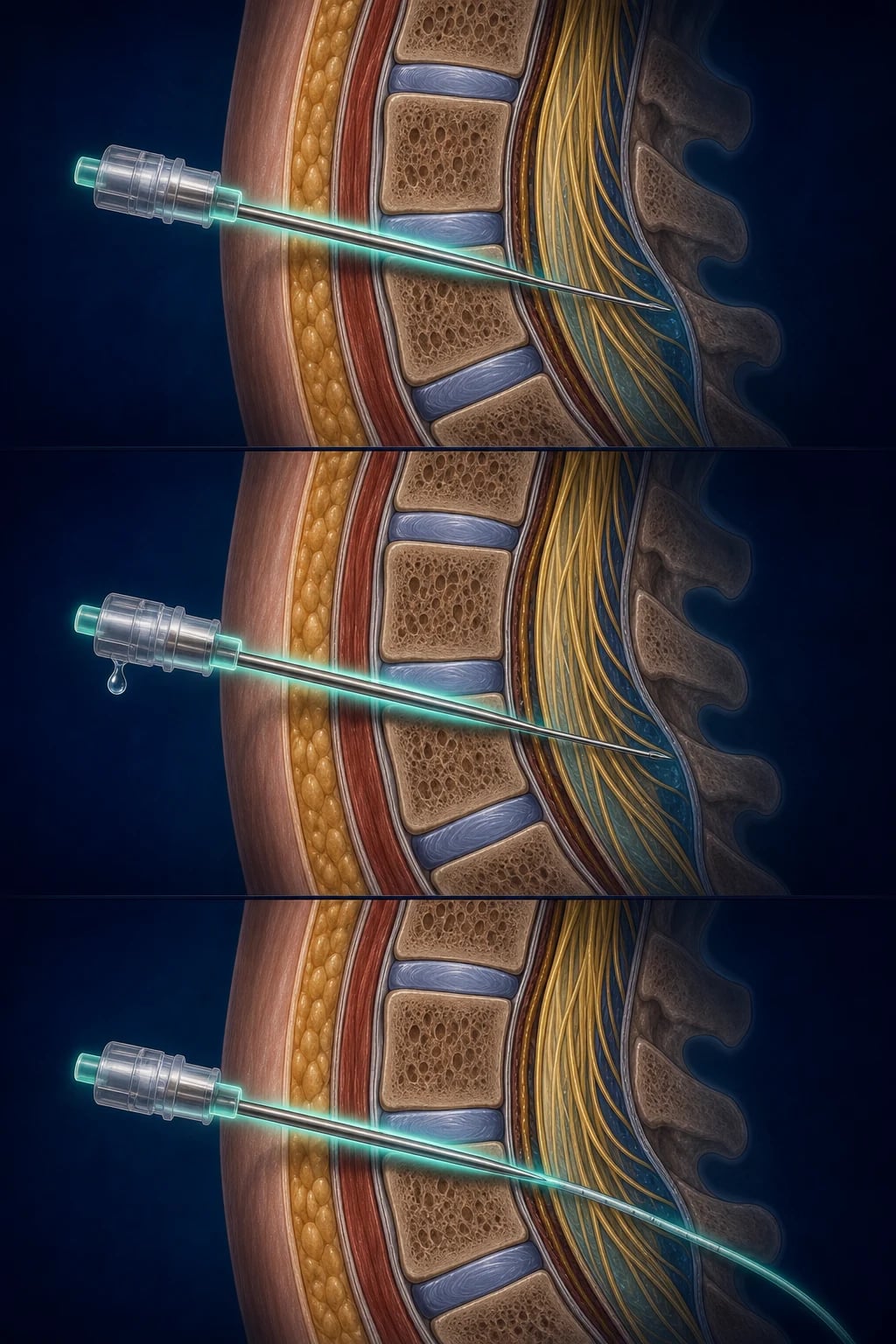
CSE is the flexible neuraxial tool for labour, caesarean and long lower-body surgery. Examiners want technique steps, why CSE beats plain spinal or plain epidural in named settings, DPE distinction, and migration / PDPH / hypotension safety talk — not kit brand names.[1]
One-liner: I use needle-through-needle CSE when I need rapid dense block now and a catheter for later; I confirm CSF, dose carefully, prepare vasopressors, and fractionate every catheter dose because the dura has a hole. [1]
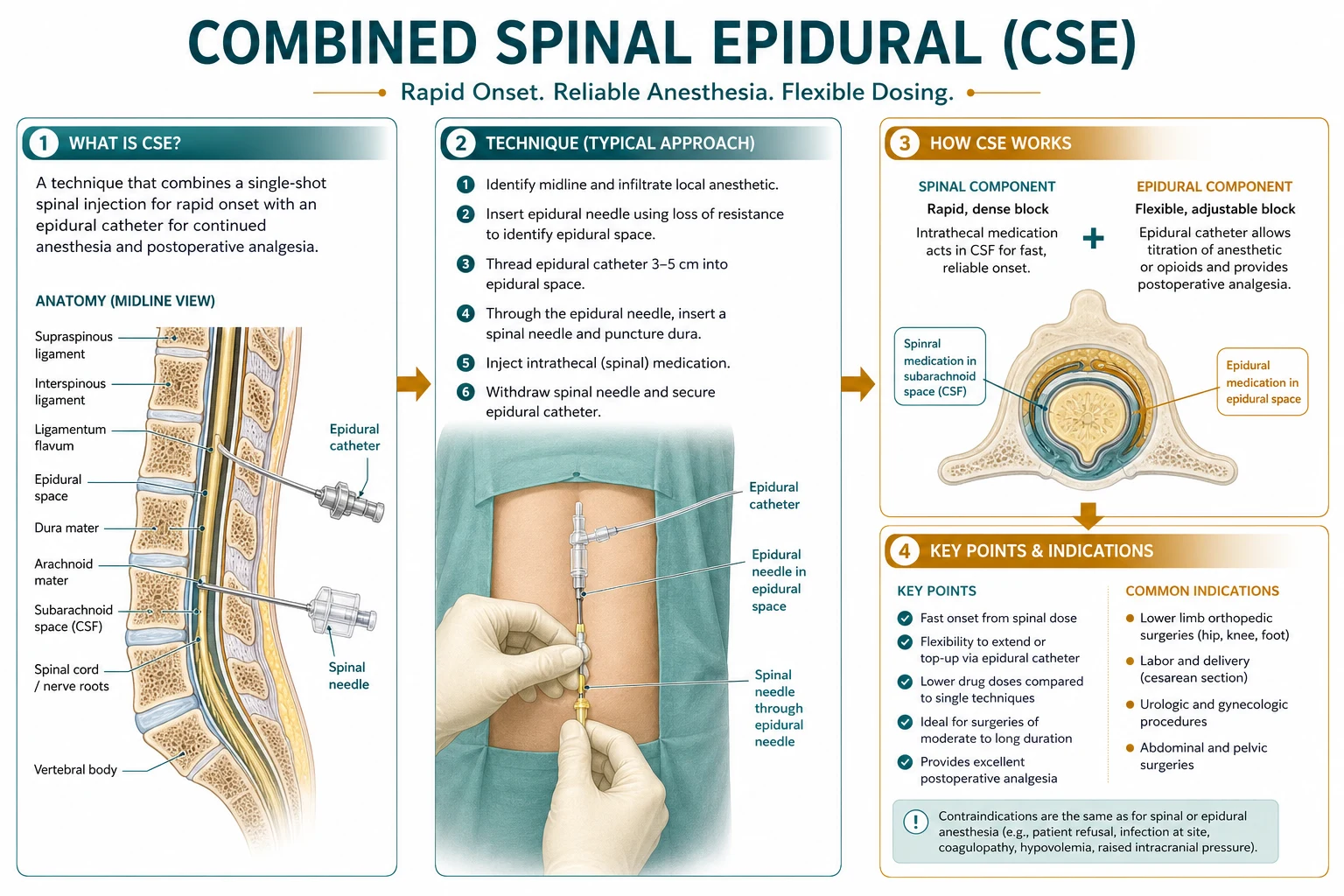
What CSE is
Spinal component: rapid, dense, reliable sacral/lower thoracic block.
Epidural component: titratable top-ups, prolonged surgery, postoperative / labour analgesia, conversion of labour analgesia to surgical anaesthesia. [2]
Compared with plain spinal: longer and adjustable. Compared with plain epidural: faster, denser onset (especially sacral segments / labour breakthrough).[1]
Indications and contraindications
Indications
- Labour analgesia (fast relief + catheter)
- Caesarean section (surgical spinal + backup catheter / postop epidural)
- Conversion potential when labour may become operative
- Prolonged orthopaedic / lower abdominal surgery [3]
Contraindications — same as any neuraxial: refusal, uncorrected coagulopathy, infection at site, untreated sepsis with high bacteraemia risk, raised ICP with herniation risk, severe hypovolaemia until resuscitated, some progressive neurological diseases (individualise). [4]
Needle-through-needle technique (say the sequence)
- Consent, monitoring, IV access, vasopressor drawn up.
- Asepsis; position sitting or lateral.
- Tuohy needle to epidural space (loss of resistance saline or air).
- Pass long fine pencil-point spinal needle through Tuohy until CSF returns.
- Inject planned intrathecal local anaesthetic ± opioid.
- Withdraw spinal needle; thread epidural catheter 3–5 cm into space; remove Tuohy; secure.
- Position patient for block height; watch BP continuously.
- Test / use catheter only after assessing spinal block — and always as if it might be intrathecal.[1]
If no CSF: do not force length indefinitely. Options — advance Tuohy slightly if still shallow, resite, or convert to plain epidural. Failed CSF = failed spinal component risk.[4]

Single-space vs double-space
| Single-space (needle-through-needle) | Double-space | |
|---|---|---|
| How | One interspace; spinal through Tuohy then catheter | Epidural at one level, separate spinal at adjacent level |
| Pros | Faster, one puncture, common default | Independent confirmation of each component |
| Cons | Catheter unproven at moment of siting; technical kit issues | Two punctures, slower, more discomfort |
| Evidence flavour | Preferred for speed/comfort in most practice | Both can work; comparative work supports single-space practicality[3] |
Dural puncture epidural (DPE) — not the same as CSE
DPE: intentional fine dural puncture with spinal needle, no intrathecal drug, then epidural dosing via catheter. Theoretical benefit: better bilateral epidural spread through micro-hole. Onset intermediate between plain epidural and full CSE. PDPH risk relates to needle gauge/design, as with any dural puncture.[2]
Exam phrase: CSE injects drug into CSF; DPE only punctures then uses epidural dosing. [1]
Dosing principles (order-of-magnitude teaching)
- Labour CSE spinal: low-dose mix (e.g. small bupivacaine + short-acting opioid) for analgesia without dense motor block — local protocol numbers.
- Surgical CSE (e.g. CS): intrathecal hyperbaric bupivacaine surgical dose ± opioid (fentanyl/diamorphine/morphine per region); catheter for extension or postop.
- First catheter dose after CSE: treat as possible total spinal — aspirate, small test/fractionated aliquots, continuous verbal/BP monitoring.
- Never “fill the catheter with a full surgical epidural bolus” blindly after a fresh dural hole. [2]
Advantages and disadvantages
Advantages: speed of spinal + flexibility of epidural; sacral sparing less than pure epidural labour blocks; backup if surgery outlasts spinal; labour-to-theatre conversion pathway.[1]
Disadvantages / complications
- PDPH from spinal needle (and accidental wet tap with Tuohy)[2]
- Rapid spinal hypotension / high block
- Catheter migration intrathecal or intravascular
- Failed spinal (no CSF / dose not intrathecal) or failed epidural later
- Slightly more complex equipment and failure modes than single technique alone
- Theoretical metal-on-metal needle issues / rare breakage — know your kit
Failure modes and rescue
| Failure | Recognition | Action |
|---|---|---|
| No CSF | Dry spinal needle | Resite / plain epidural / alternative anaesthesia |
| Inadequate spinal | Patchy/low block early | Do not assume catheter will fix instantly; careful top-up vs resite vs GA |
| Catheter failure later | No bilateral block to top-ups | Resite epidural; do not keep bolusing into void |
| Unrecognised intrathecal catheter | Sudden high block after “epidural” dose | Treat as high/total spinal — ABC, support until regression |
| Unintended dural puncture with Tuohy | Free CSF flow via Tuohy | Options: thread intrathecal catheter (local policy), resite, or carefully convert — PDPH counselling |
Operator experience, anatomy (obesity, scoliosis), and equipment all influence failure/UDP rates.[4]
Hypotension and block height
Anticipate faster haemodynamic change than plain epidural labour start. Phenylephrine (or local first-line vasopressor) ready before spinal dose; co-load/preload per obstetric protocol; left lateral tilt in pregnancy; monitor block to T4–ish for CS, lower for labour analgesia. [4]
PDPH after CSE
Risk driven by spinal needle gauge and tip (and by accidental Tuohy wet tap). Finest pencil-point needle that still gives reliable CSF is the usual compromise. Manage PDPH as for any dural puncture: posture, fluids, simple analgesia, caffeine options, epidural blood patch if disabling/persistent (see neuraxial complications topic).[2]
SAQ answer scaffold
Primip in labour requests CSE. Outline technique, benefits, and complications. [1]
- Indication / consent (2) including PDPH and high block.
- Technique steps (4) needle-through-needle sequence.[1]
- Dosing philosophy (2) low-dose spinal + epidural maintenance.
- Complications (3) hypotension, PDPH, migration/total spinal, failure.[2][4]
- Monitoring / top-up safety (2)
Viva stem bank and model phrases
Stem 1: “Why CSE not plain epidural for labour?”
Faster onset and denser early block with a catheter for duration — useful when pain is severe or theatre conversion likely. [2]
Stem 2: “Why not plain spinal for long case?”
Single-shot duration may be insufficient; catheter extends and provides postop analgesia. [3]
Stem 3: “CSF not flowing.”
I do not force. I reassess depth/position, resite, or convert to epidural rather than invent an intrathecal dose. [4]
Stem 4: “First top-up 90 minutes later — patient apnoeic.”
Treat as total spinal from intrathecal catheter migration: airway, 100% O₂, support BP, stop further doses. [1]
Stem 5: “CSE versus DPE?”
CSE gives intrathecal drug; DPE only punctures then doses epidurally — intermediate onset profile. [2]
Stem 6: “Single or double space?”
I default to single-space needle-through-needle for speed; double-space if kit/anatomy makes sequential separate components wiser. [3]
Common traps
- Bolusing a full epidural surgical volume into a post-CSE catheter without fractionation
- No vasopressor ready
- Calling DPE a CSE
- Ignoring dry-tap and injecting “anyway”
- Forgetting PDPH counselling
- Using CSE when coagulopathy forbids any neuraxial [4]
CSE safety — CSF-SAFE
Examiner mental map
- Definition / indications.
- Needle-through-needle steps.
- Single vs double space.
- DPE distinction.
- Dosing + first top-up rule.
- Hypotension.
- PDPH.
- Failure and total spinal rescue.
- Obstetric use cases. [1]
That is a complete CSE viva. [2]
Integrated exam drill sheet
Sixty-second version
Say the definition, the critical number or sequence, the main clinical use, and the top red flag. Stop. If you cannot do this without notes, the topic is not yet learnable.
Three-minute version
Add mechanism, a comparison table spoken aloud, one special population, and one crisis stem with first actions. This is the standard viva unit.
Ten-minute mastery version
Add equipment detail or procedural steps, evidence limits, second-line options, and a teach-the-junior summary. This is Final long-case depth.
Written SAQ timing
For a 10-minute SAQ, spend one minute planning headings, seven minutes writing, two minutes checking hard stops and units. Headings should mirror examiner dimensions: definition, mechanism or anatomy, clinical application, complications, special situations.
Common mark-losing behaviours
- Lists without mechanisms
- Mechanisms without clinical action
- Doses without route or monitoring
- Landmarks without injury consequences
- Device talk without re-enable or backup plans
- Absolute claims where practice is protocol-dependent
Positive mark-gaining behaviours
- Numbers with units and approximate ranges
- Explicit assumptions for equations
- Side-by-side comparisons
- Named hard contraindications
- Monitoring endpoints
- Clear escalation
Cross-specialty board alignment
ANZCA Primary and Final, FRCA Primary and Final, ABA, EDAIC and FCAI all test these leaves repeatedly because they are portable across subspecialties. A candidate who owns flow physics, electrical safety, neck and neuraxial anatomy, vaporiser principles and core adjunct pharmacology can survive stems in ICU transfer, obstetric haemorrhage, thoracic lists and outpatient dental anaesthesia alike.
Personal rehearsal script
Read the AnswerCard twice. Cover it and rewrite it from memory. Speak the red flags. Draw one table from memory. Answer one hostile interruption. Then move on. Spaced repetition beats marathon re-reading.
Safety culture close
Every technical topic ends in patient safety: do not expand closed gas spaces, do not dilate arteries, do not leave ICD therapies off, do not apply Poiseuille in turbulence, do not ignore conus level, do not tip a full vaporiser back into service without protocol, and do not stack serotonergic weak opioids casually. Knowledge is only exam-pass when it prevents harm.
References
- [1]Roofthooft E, et al. Current status of the combined spinal-epidural technique in obstetrics and surgery Best Pract Res Clin Anaesthesiol, 2023.PMID 37321766
- [2]Chino K, et al. Post-dural Puncture Headache in Dural Puncture Epidural and Combined Spinal-Epidural Using 24- and 25-Gauge Needles Versus Conventional Epidural Labor Analgesia: A Systematic Review and Meta-analysis Anesth Analg, 2026.PMID 42155003
- [3]Basheer P, et al. A Clinical Comparison between Single-Space Technique and Double-Space Technique for Combined Spinal and Epidural Anesthesia Anesth Essays Res, 2022.PMID 36249131
- [4]Vallejo MC, et al. Factors Associated With Unintended Dural Puncture and Failed Neuraxial Anesthesia in Obstetric Anesthesia Cureus, 2026.PMID 42199590