Anaes · Neuraxial anaesthesia
Epidural anaesthesia and analgesia
Also known as Epidural · Thoracic epidural · Lumbar epidural · Loss of resistance · Epidural test dose · High block · Epidural top-up
Exam-exhaustive epidural anaesthesia: thoracic vs lumbar, loss of resistance, test dose, top-up and failure modes, absolute/relative contraindications, ASRA anticoagulation timing principles, and high/total spinal recognition.
On this page & tools
Your progress
Saved locally on this device.
Target exams
Red flags
Why this is examined / one-line answer
Epidurals are high-stakes: labour analgesia, major open abdominal/thoracic analgesia, and surgical anaesthesia. Examiners want thoracic vs lumbar differences, test dose logic, failure modes, absolute vs relative contraindications, ASRA anticoagulation principles, and a crisp high-block algorithm. One-liner: I place a catheter with LOR, exclude intravascular and intrathecal placement with aspiration and a test dose, titrate to dermatomes, and I never ignore anticoagulation timing or a progressive neurological deficit. [1]
Anatomy and physiology of block
Epidural space: from foramen magnum to sacral hiatus, outside dura, containing fat, veins, lymphatics, nerve roots. LA spreads segmentally along roots; height depends mainly on mass and volume, injection site, age, pregnancy (engorged veins shrink effective volume), and catheter position — not baricity (spinal concept). [1]
Order of fibre sensitivity (teaching): sympathetic → sensory → motor (concentration-dependent). Low-concentration infusions aim for analgesia with motor sparing; surgical anaesthesia needs higher concentration/mass. [1]
Thoracic vs lumbar epidural
| Thoracic | Lumbar | |
|---|---|---|
| Typical levels | T5–T8 (upper abdo/thoracic), T8–T10 (mid abdo) | L2–L4 labour / lower abdo / lower limb |
| Indications | Thoracotomy, major open upper GI, AAA, rib trauma analgesia | Labour, CS top-up, lower abdominal, pelvic, lower limb |
| Technical | Steeper angle, narrower spaces, higher skill | More familiar landmarks |
| Haemodynamics | Can spare lower limbs if segmental; still sympathetic block → hypotension | Dense lower limb motor block common with surgical doses |
| Special risks | Dural puncture, spinal cord injury (cord ends ~L1–L2 in adults — thoracic is cord level) | Nerve root trauma, less cord risk below conus |
| Analgesia profile | Excellent for dynamic pain of laparotomy/thoracotomy | Gold standard labour analgesia |
CSE combines rapid spinal onset with epidural titration (separate topic). [1]
Indications
- Labour analgesia; conversion to CS anaesthesia with top-up
- Postoperative analgesia: open major abdominal, thoracic, some vascular
- Surgical anaesthesia when titratable lower-density block preferred
- Selected trauma (rib fractures) — risk–benefit with anticoagulation [1]
Absolute and relative contraindications
Absolute (classic teaching):
- Patient refusal
- Local infection at insertion site
- Raised intracranial pressure with herniation risk
- True allergy to LA (rare)
- Uncorrected frank coagulopathy / therapeutic anticoagulation outside safe windows
- Inadequate monitoring / no resuscitation facilities [1]
Relative:
- Systemic sepsis (risk of epidural abscess)
- Fixed cardiac output states (severe AS) — sympathectomy poorly tolerated
- Progressive neurological disease (document carefully)
- Severe hypovolaemia (correct first)
- Anatomical difficulty / previous spinal surgery
- Thrombocytopenia — many units use platelet thresholds (e.g. ≥70–80 × 10⁹/L for insertion, higher caution in rapidly falling counts — follow local + ASRA spirit) [1]
Technique essentials
- Consent: benefits, failure, PDPH, hypotension, rare nerve injury/haematoma/abscess, motor block.
- Monitoring, IV access, resuscitation drugs.
- Position: sitting or lateral; asepsis.
- Tuohy needle via midline or paramedian.
- Loss of resistance to saline (or air — saline preferred by many to avoid pneumocephalus/patchy air).
- Thread catheter 3–5 cm in space (more → knot/migration risk; less → dislodge).
- Aspirate (blood/CSF).
- Test dose then incremental therapeutic dosing.
- Secure, label epidural line, dedicated pump, no IV injection ports without anti-error system. [1]
Test dose
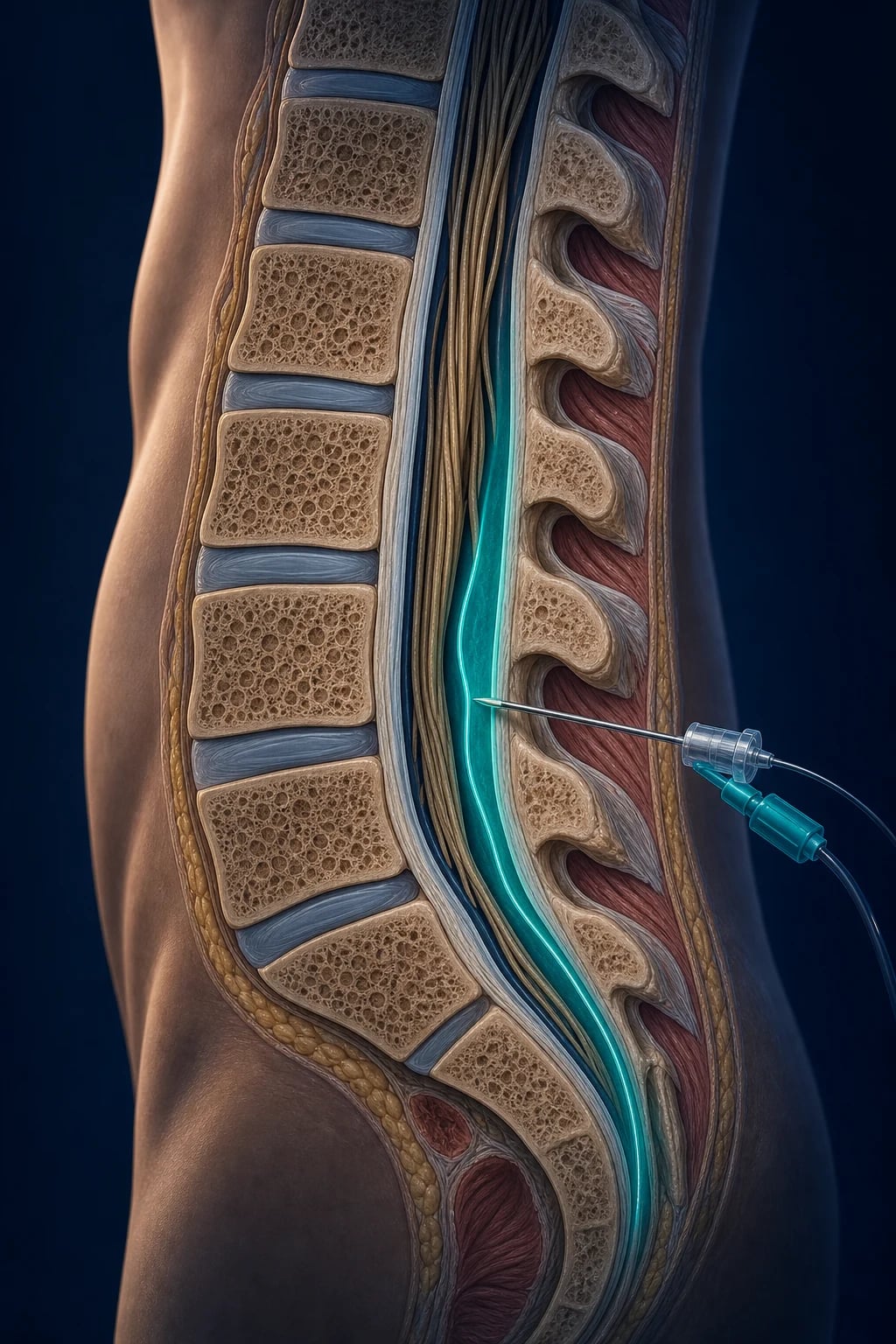
Purpose: detect intrathecal or intravascular catheter before large dose. [1]
Classic adult test dose teaching: lidocaine 45–60 mg (e.g. 3 mL of 1.5–2%) ± adrenaline 15 microg (1:200,000). [1]
| Misplacement | Positive signs |
|---|---|
| Intrathecal | Rapid dense sensory ± motor block within minutes; may progress to high spinal |
| Intravascular | HR rise ≥20 bpm within ~1 min if adrenaline used; tinnitus, metallic taste, circumoral tingling (LA) |
Limitations: beta-blockers blunt HR response; labouring women have HR variability; negative test ≠ guaranteed safe forever — always fractionate large top-ups. Aspiration is mandatory but imperfect.[2]
Top-up and dosing principles
- Mass (mg) = concentration × volume drives density and spread.
- Labour analgesia: low-concentration LA + opioid (e.g. bupivacaine/levobupivacaine/ropivacaine 0.0625–0.1% with fentanyl) via infusion/PCEA/programmed intermittent boluses.
- Surgical top-up: higher concentration (e.g. lidocaine 2% ± adrenaline, or ropivacaine/bupivacaine surgical strengths) in divided doses to T4 for CS.
- Postoperative: dilute LA ± opioid infusion; motor and BP checks.
- Warm solutions may speed onset slightly — minor point.
- Max LA dose ceilings still apply across all sites; watch for LAST.[2]
Failure modes
| Problem | Clues | Action |
|---|---|---|
| Never worked | No block after adequate dose | Resite; consider CSE/spinal/GA |
| Unilateral | Catheter lateral / inadequate volume | Withdraw 1 cm, reposition patient, bolus, resite |
| Patchy / missed segment | Septations, catheter issues | Bolus, adjust, resite |
| Primary failure after wet tap | Hole in dura | Follow PDPH pathway; consider different interspace |
| Migration out | Lost block over hours | Inspect site; resite if needed |
| Migration in | High/dense block | Treat as intrathecal |
| Pump/line error | Wrong rate/drug | Protocolised epidural safety |
High block / total spinal
Presentation: rapid ascending numbness, arm weakness, dyspnoea, whisper voice, bradycardia, profound hypotension, apnoea, unconsciousness, cardiac arrest. [1]
Management:
- Call for help; stop further LA.
- 100% oxygen, support ventilation, intubate if needed (DAS mindset if difficult).[3]
- Left tilt if pregnant.
- Vasopressors (phenylephrine/metaraminol/adrenaline as severity demands); fluids.
- Atropine/glycopyrrolate for bradycardia.
- CPR if no output — treat as perioperative arrest.
- Reassure: dense block usually recedes over hours if ventilation/circulation supported.
- After recovery: review catheter, document, follow neurology.
Anticoagulation timing — ASRA principles (not a full table dump)
You must show you know principles; quote exact hours from current ASRA/local app in clinical practice.[1]
Principles:
- Epidural haematoma is rare but catastrophic — prevention is timing.
- Consider drug, dose (prophylactic vs therapeutic), renal function, and combination therapy.
- Insertion and catheter removal are both high-risk moments — same discipline.
- After traumatic tap, delay anticoagulation restart.
- LMWH: classic teaching gaps between dose and neuraxial procedure (prophylactic vs therapeutic differ; twice-daily regimens more restrictive).
- Unfractionated heparin IV: stop infusion, check aPTT normalised before neuraxial.
- DOACs: longer holds, renal adjustment — do not guess.
- Antiplatelet: aspirin alone often acceptable; dual therapy and potent P2Y12 agents are problematic.
- Neurological observation protocol after removal.
- If haematoma suspected → immediate MRI and surgical decompression — hours matter for recovery. [1]
Complications (structured)
Common: inadequate block, hypotension, pruritus (opioids), urinary retention, motor block, shivering.
PDPH: after wet tap — postural headache; conservative then epidural blood patch.
LAST: intravascular injection — lipid ready for large top-ups.[2]
Haematoma/abscess: back pain, bilaterally progressive motor/sensory loss, bowel/bladder — emergency.
Nerve injury: rare; document baseline deficits.
Epidural-related maternal fever: inflammatory; distinguish from chorioamnionitis clinically.
Wrong-route injection: systems design (NRFit, labelling).
Monitoring after epidural
- BP, HR, sensory level, motor score (Bromage), sedation if opioid, respiratory rate.
- Labour: CTG collaboration with midwifery/obstetrics.
- Post-op: APS review; anticoagulation plan written before catheter out. [1]
SAQ scaffold
- Thoracic vs lumbar indications (3)
- Test dose composition and interpretation (3)
- Absolute contraindications (3)
- High spinal management (4)
- ASRA anticoagulation principles (3)
- Haematoma red flags (2) [1]
Viva stems
“Top-up for CS — patient says she cannot breathe.” — high block algorithm.
“When can I remove the epidural on enoxaparin?” — ASRA timing principles + local chart.
“Unilateral labour epidural.” — failure mode actions.
“Wet tap — next?” — resite, counsel PDPH, follow-up.
“Why thoracic for laparotomy?” — segmental analgesia, less lower limb block, better dynamic pain control. [1]
Common traps
- Large single-shot top-up without fractionation.
- Ignoring anticoagulation for catheter removal.
- Calling every fever chorioamnionitis without thought — and the reverse.
- Missing LAST while chasing high spinal (or vice versa).
- Documenting “working epidural” with patient still in severe pain. [1]
EPIDURAL safe
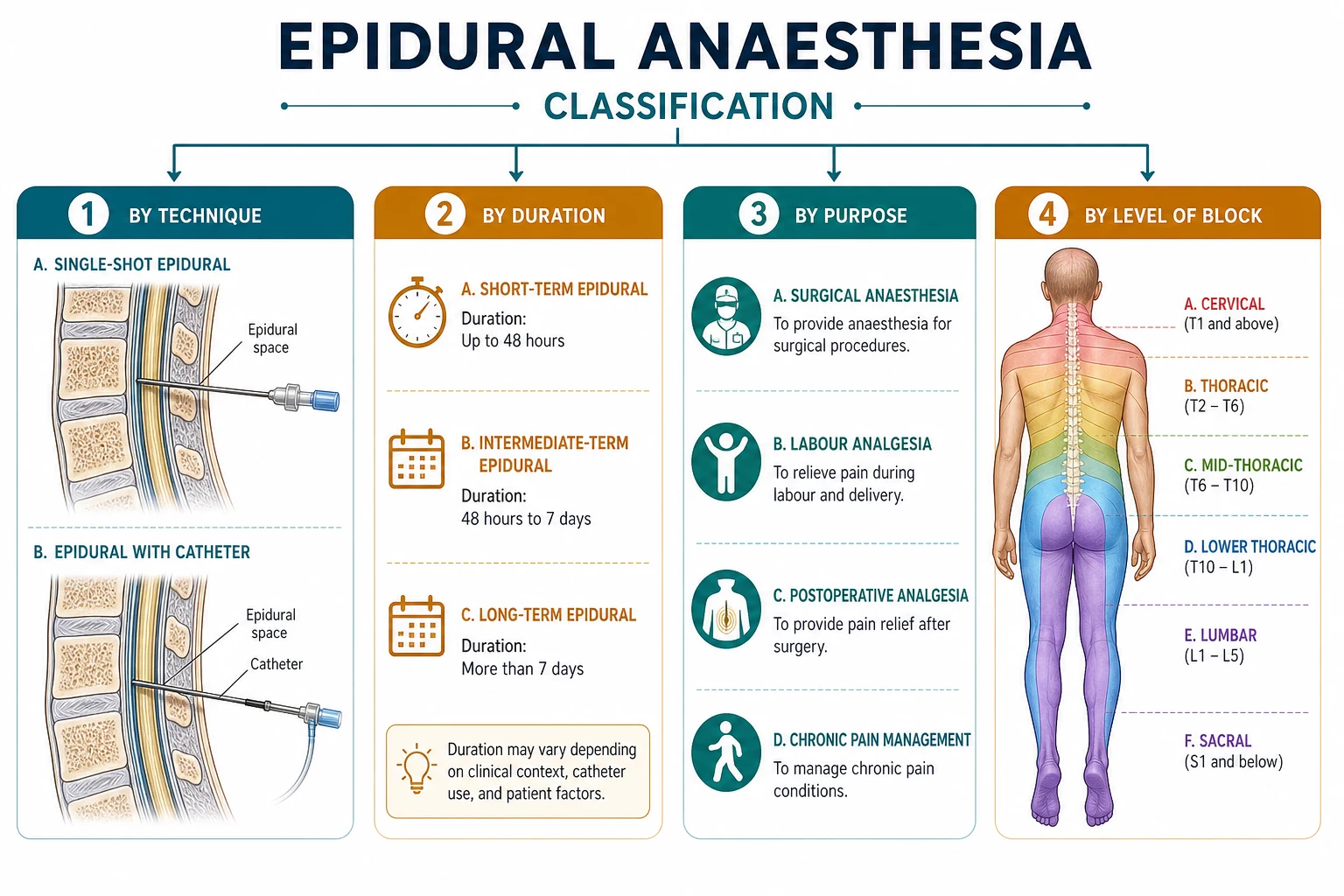
Spinal
- Single shot
- Rapid dense
- Baricity matters
- Fixed duration
Epidural
- Catheter titration
- Slower onset
- Volume/mass spread
- Labour & APS workhorse
Danger
- Intrathecal migration
- Haematoma
- LAST
- Wrong-route injection
Red flags
[1] [1] [1] [1]References
- [1]Horlocker TT et al. Regional Anesthesia in the Patient Receiving Antithrombotic or Thrombolytic Therapy: American Society of Regional Anesthesia and Pain Medicine Evidence-Based Guidelines (Fourth Edition) Reg Anesth Pain Med, 2018.PMID 29561531
- [2]Neal JM et al. The Third American Society of Regional Anesthesia and Pain Medicine Practice Advisory on Local Anesthetic Systemic Toxicity: Executive Summary 2017 Reg Anesth Pain Med, 2018.PMID 29356773
- [3]Frerk C, Mitchell VS, McNarry AF, et al. Difficult Airway Society 2015 guidelines for management of unanticipated difficult intubation in adults Br J Anaesth, 2015.PMID 26556848