Anaes · Regional anaesthesia
Fascial plane blocks: TAP, ESP, and QL
Also known as TAP block · Erector spinae plane block · Quadratus lumborum block · Abdominal wall blocks ERAS
Exam-pass fascial plane blocks: TAP, ESP, and QL indications, ultrasound landmarks, typical volumes, LAST risk, ERAS role, and failure/rescue strategy for ANZCA Final and equivalents.
On this page & tools
Your progress
Saved locally on this device.
Target exams
Red flags
Why this is examined / the one-line answer
Fascial plane blocks dominate modern acute pain and ERAS vivas because they are common, high-volume, LAST-relevant, and often oversold as “epidural replacements.” Examiners want indications, coverage limits, volumes, LAST readiness, and a Plan B when the wall is numb but the patient still hurts.[3][4]
One-liner: I match TAP/QL/ESP to the surgical incision, inject dilute local anaesthetic under ultrasound within maximum dose, warn that visceral pain remains, and combine with systemic multimodal analgesia. [1]
Anatomy that changes the plan
TAP (transversus abdominis plane)
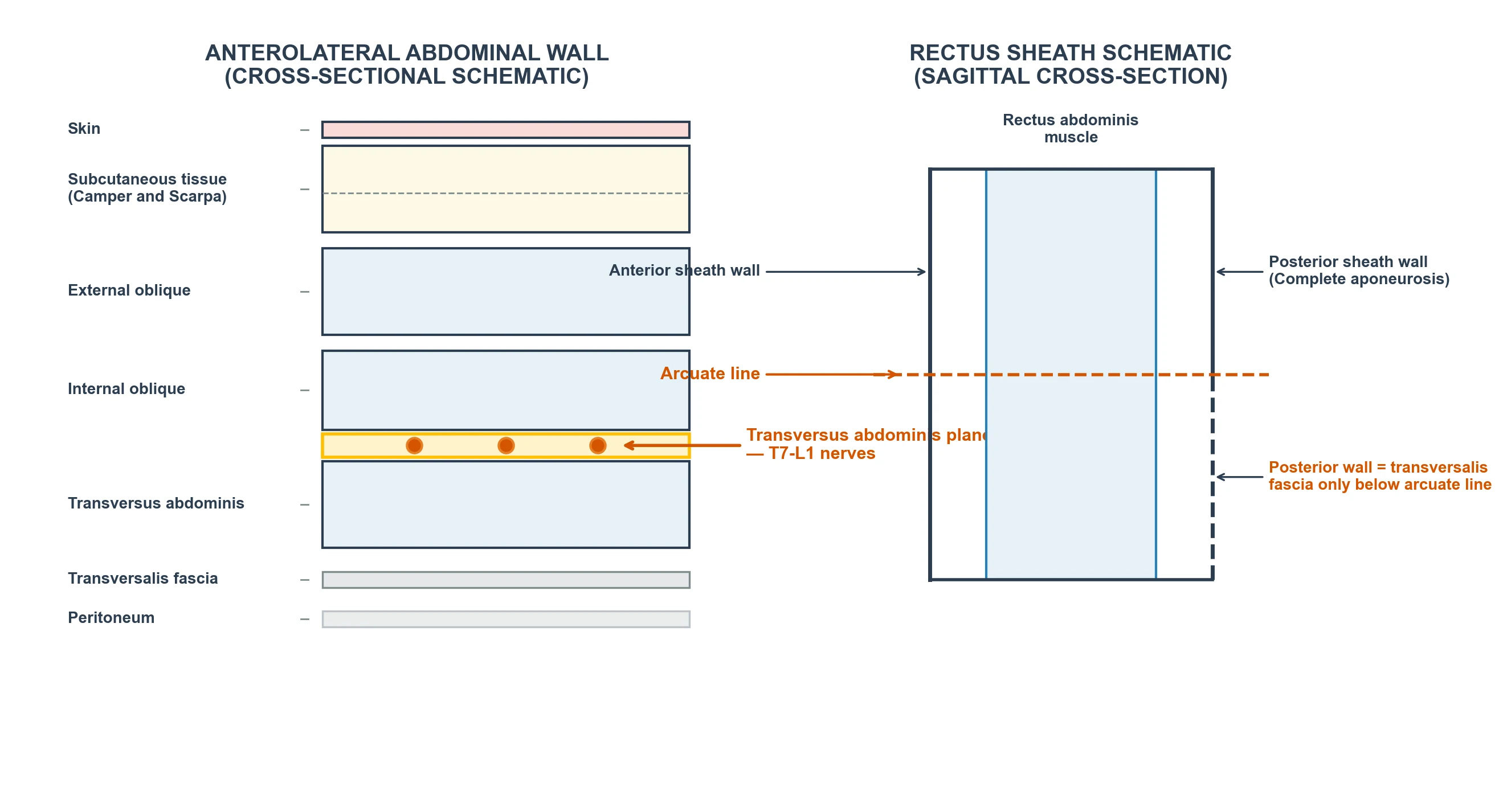
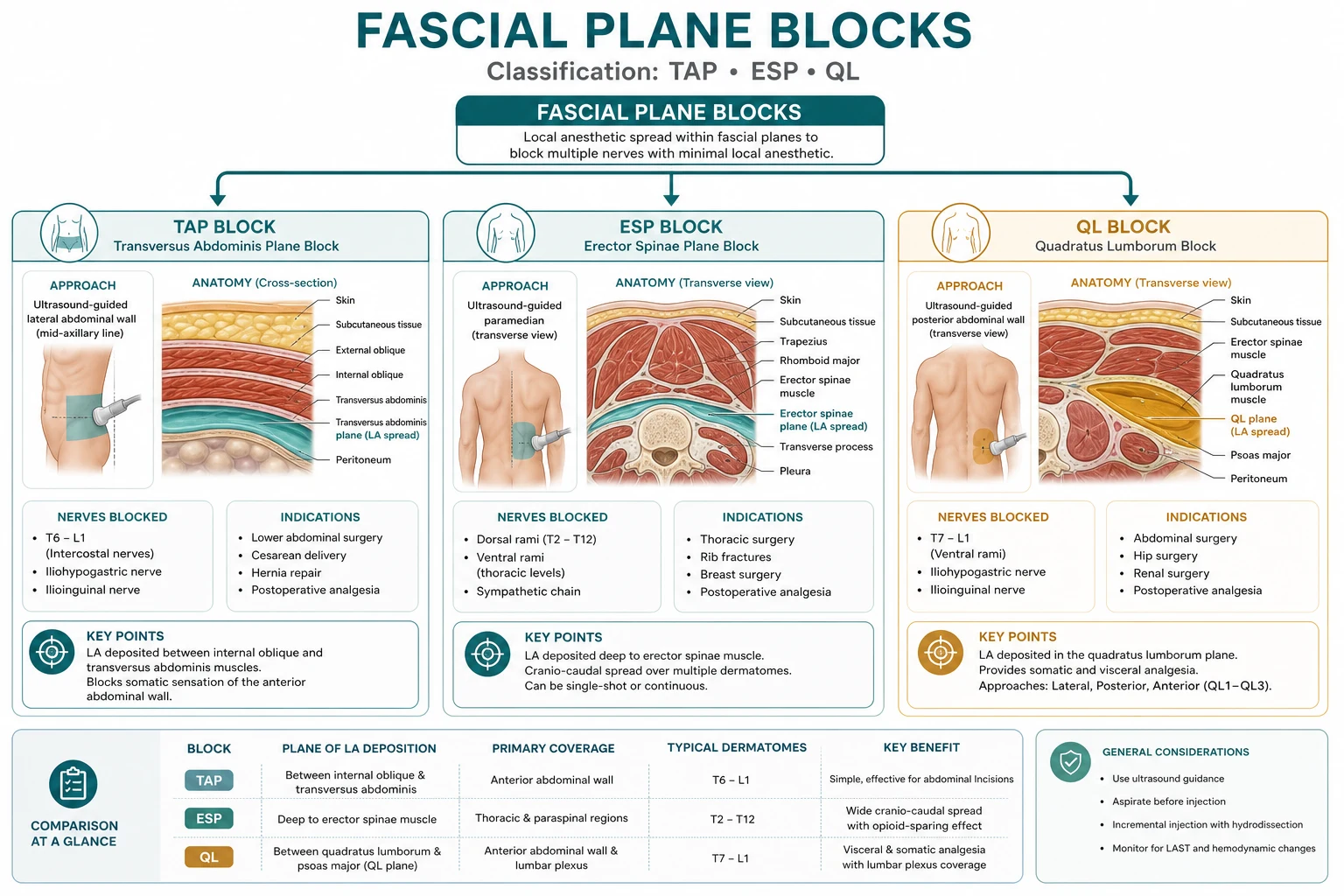
LA deposited between internal oblique and transversus abdominis. Targets thoracolumbar nerves supplying the abdominal wall. Landmark/US subcostal, lateral, and posterior approaches change cranial coverage. Classic evidence supports reduced opioid use after abdominal surgery when appropriately applied.[4]
Good for: lower abdominal wall (Pfannenstiel, open appendicectomy, some midline lower).
Limits: poor visceral cover; upper abdominal may need subcostal TAP or other techniques. [1]
QL (quadratus lumborum)
LA around quadratus lumborum (lateral/posterior/anterior approaches — exam: know that approach variants exist and may spread differently). Potential for wider coverage including some lateral cutaneous and possibly more paravertebral-like spread depending on approach — also deeper, with denser anticoagulation concern than superficial TAP. [1]
ESP (erector spinae plane)
LA deep to erector spinae muscle, superficial to transverse processes — described for thoracic neuropathic pain and widely used for rib fractures, thoracic and abdominal surgery as part of multimodal care.[1][3]
Mechanism viva: proposed craniocaudal fascial spread and possible paravertebral/epidural seepage — exact mechanism debated; clinical effect is real but variable. [1]
Indications matrix
| Surgery / problem | Often useful plane | Caveat |
|---|---|---|
| Lower open abdomen / Pfannenstiel | Bilateral TAP | Visceral pain remains |
| Midline laparotomy | TAP ± QL / ESP adjuncts | Not epidural equivalent |
| Laparoscopic cholecystectomy ports | Subcostal TAP / local infiltration | Modest effect sizes |
| Rib fractures / VATS / thoracotomy adjunct | ESP | Pneumothorax rare; LAST volumes |
| Breast / chest wall | ESP / PECS family (related) | Match to incision |
| Iliac crest graft / hip | QL variants | Deep block rules |
| ERAS colorectal | Plane blocks + multimodal | Epidural still considered in some open pathways |
Volumes, concentration, LAST maths
- Fascial planes are volume-dependent (often 15–30 mL per side of dilute long-acting LA such as ropivacaine 0.2–0.375% or equivalent, within maximum dose).
- Bilateral doubles the dose — recalculate mg/kg before drawing up.
- Count surgeon’s infiltration in the same daily maximum.
- Lower concentration, adequate volume is the plane-block philosophy; toxicity is still dose × absorption. [1]
LAST: large fascial volumes are a classic modern LAST setting. Know early CNS signs, cardiovascular collapse, and ASRA lipid emulsion pathway (20% lipid, airway, benzodiazepines for seizures, modified ACLS).[2]
[1]Anaesthetic goals
- Match plane to incision.
- Ultrasound visualisation of plane and spread.
- Stay within maximum LA dose.
- Realistic expectations (somatic > visceral).
- Multimodal systemic cover.
- Document drug, volume, laterality, time. [1]
Technique decision points
- In-plane US preferred for tip control.
- Hydrodissection confirms plane — watch for intraperitoneal or intramuscular pattern.
- Anticoagulation: apply ASRA-style timing — deeper QL/ESP catheters are not “risk free” because they are not neuraxial.
- Catheters: continuous infusions need LAST maths per hour and secure fixation. [1]
Monitoring and equipment
Ultrasound with appropriate probe; block needle; calibrated LA syringes; full monitoring; lipid emulsion accessible; resuscitation equipment; consent including failure and LAST. [1]
Intraoperative / PACU management
Assess block with cold/pinprick in expected dermatomes. If wall numb but pain severe → visceral pain, referred pain, or failed segment — add systemic multimodal/ketamine/PCA, do not only “top up” past toxic dose. Mobilise within ERAS if motor sparing (usually is). [1]
Crisis pivots
LAST suspected
Stop injection, call for help, ABC, 100% oxygen, benzodiazepine for seizures, lipid emulsion per ASRA checklist, prolonged CPR if arrest.[2]
Incomplete analgesia
Rescue multimodal; consider second technique only within dose limits; exclude surgical complication. [1]
Peritoneal / intravascular injection concern
Stop, reassess, observe for LAST, do not chase remaining volume if landmarks lost. [1]
Hypotension after large volume
Usually not epidural-like sympathectomy (variable with ESP/QL); consider absorption/sedation, bleeding, or anaphylaxis differentials. [1]
Postoperative / ERAS role
Plane blocks reduce opioid need and support mobilisation when combined with paracetamol/NSAID/early feeding pathways. They do not replace good surgical technique, PONV prophylaxis, or fluid discipline. Audit block success and LAST near-misses. [1]
Special populations
- Pregnancy: TAP for caesarean adjunct — dose carefully, aortocaval awareness when positioning.
- Obesity: deeper images, longer needles, dose on lean/IBW caution for LA mg/kg.
- Coagulopathy: prefer superficial techniques or avoid deep planes.
- Paediatrics: weight-based volumes strictly. [1]
SAQ answer scaffold
Outline the role of bilateral TAP blocks after open hysterectomy. [1]
- Anatomy/indication (3): abdominal wall somatic cover; limited visceral.[4]
- Technique (3): US plane, volume/concentration, max dose.
- LAST (3): calculate dose, lipid ready.[2]
- Multimodal (2): systemic analgesics for visceral pain.
- Failure plan (2): PCA/APS, not endless LA.
Viva stem bank and model phrases
Stem 1: “TAP vs epidural for open colectomy?”
Model: “TAP helps wall pain and opioid sparing but does not match epidural visceral and thoracic coverage; I individualise within ERAS multimodal care.” [1]
Stem 2: “What is ESP?”
Model: “Local anaesthetic deep to erector spinae over transverse processes — used for thoracic and trunk analgesia with ultrasound; mechanism of spread is debated.”[1]
Stem 3: “Bilateral 25 mL of 0.375% ropivacaine — concern?”
Model: “Large total dose — I calculate mg/kg including any infiltration and keep lipid available.” [1]
Stem 4: “Patient still writhing with numb skin.”
Model: “Visceral pain or incomplete cover — treat systemically; plane blocks are not complete anaesthesia of the abdomen.” [1]
Stem 5: “QL on therapeutic anticoagulation?”
Model: “Deeper plane — I apply ASRA-style risk stratification; often avoid or delay.” [1]
Stem 6: “Why dilute large volumes?”
Model: “Planes need volume for spread; concentration trades density against mass dose and toxicity.” [1]
Stem 7: “Chest wall blocks literature?”
Model: “Fascial plane chest wall techniques are established adjuncts; I match block to incision and respect dose.”[3]
Common traps
- Overselling as epidural replacement
- Bilateral max-dose ignorance
- No lipid in room
- Expecting visceral silence
- Deep plane on full anticoagulation
- Not counting surgical infiltrate
- Injecting without seeing spread [1]
Plane block safety — PLANE
Ultrasound landmarks — exam sequences
Lateral TAP: probe mid-axillary between costal margin and iliac crest; identify external oblique, internal oblique, transversus abdominis; needle in-plane to IO–TA plane; hydrodissect lens-shaped spread. [1]
Subcostal TAP: probe parallel to costal margin for upper abdominal wall coverage. [1]
QL: identify QL adjacent to transverse process/psoas/erector; approach-specific targets (lateral/posterior/anterior) — state your local preferred approach and risks (deeper, organ proximity). [1]
ESP: probe parasagittal paramedian; identify transverse processes and erector spinae; needle onto TP plane; craniocaudal hydrodissection.[1]
Worked dose example
80 kg patient, bilateral lateral TAP for lower midline: ropivacaine 0.25% 20 mL each side = 100 mg total (1.25 mg/kg) — within common max ranges if no other LA. If surgeon adds 20 mL 0.5% bupivacaine infiltration, you may exceed safe mass — coordinate before drawing up.[2]
Catheters and continuous infusions
Continuous TAP/ESP catheters can extend opioid-sparing into day 2–3 for laparotomy or rib fractures. Problems: dislodgement, leak, patchy coverage, cumulative LAST from infusion plus boluses, and infection. Label pumps clearly; use dilute concentrations; set hourly limits; review daily with APS. [1]
Examiner mental map
- Match block to surgery.
- Anatomy of each plane.
- Volume/dose/LAST.
- Coverage limits (visceral).
- Anticoagulation depth risk.
- Failure rescue within multimodal ERAS. [1]
Realistic plane-block talk scores higher than miracle claims. [1]
References
- [1]Forero M, Adhikary SD, Lopez H, Tsui C, Chin KJ. The Erector Spinae Plane Block: A Novel Analgesic Technique in Thoracic Neuropathic Pain Reg Anesth Pain Med, 2016.PMID 27501016
- [2]Neal JM, Barrington MJ, Fettiplace MR, et al. The Third American Society of Regional Anesthesia and Pain Medicine Practice Advisory on Local Anesthetic Systemic Toxicity: Executive Summary 2017 Reg Anesth Pain Med, 2018.PMID 29356773
- [3]Chin KJ, Versyck B, Pawa A. American Society of Regional Anesthesia and Pain Medicine Local Anesthetic Systemic Toxicity checklist: 2020 version Reg Anesth Pain Med, 2021.PMID 33148630
- [4]McDonnell JG, O'Donnell B, Curley G, et al. Ultrasound guidance in regional anaesthesia Br J Anaesth, 2005.PMID 15277302