Anaes · Orthopaedic anaesthesia
Arthroplasty anaesthesia, ERAS, and blood conservation
Also known as arthroplasty eras blood conservation
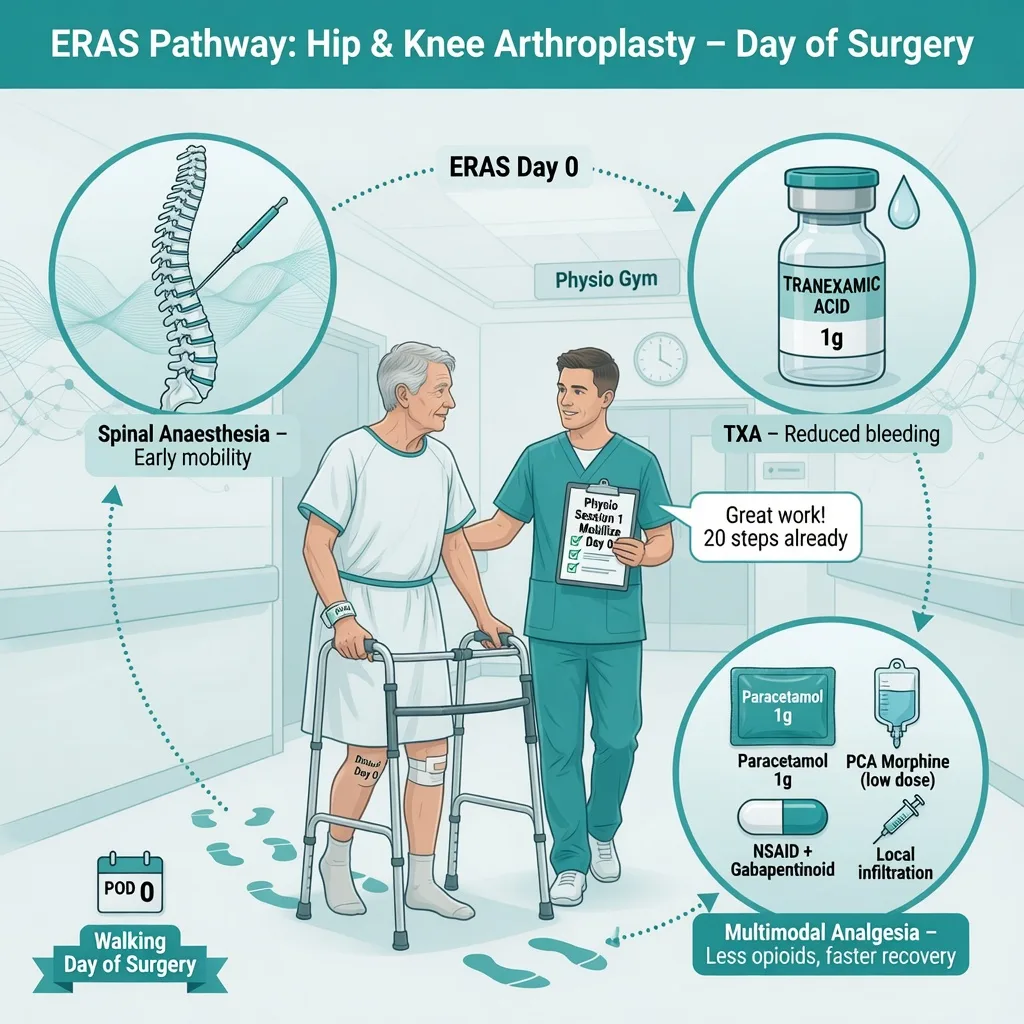
Arthroplasty ERAS combines optimised comorbidities, preferred neuraxial or regional plus light GA, TXA for blood conservation (typical 1 g IV or 10–15 mg/kg with local protocols), multimodal opioid-sparing analgesia, early mobilisation, and VTE prophylaxis timed safely with neura
On this page & tools
Your progress
Saved locally on this device.
8 MCQs with explanations
Target exams
Red flags
Why this is examined / the one-line answer
Hip and knee arthroplasty are volume procedures where ERAS, regional anaesthesia, TXA-based blood conservation, and VTE prevention intersect — and BCIS still kills frail cemented hip patients.
[1]Preoperative assessment and risk stratification
Anaemia optimisation, iron therapy when time allows, cardiorespiratory disease, OSA, frailty, anticoagulation plan, infection risk, and cement strategy. Shared decision-making for day-case pathways.
[1]Applied physiology / pharmacology
Surgical blood loss and hidden loss into tissues drive transfusion. Tranexamic acid inhibits fibrinolysis and reduces bleeding/transfusion in orthopaedic pathways; trauma evidence from CRASH-2 supports TXA safety regarding vascular occlusive events in bleeding trauma at the studied doses.[1] Typical arthroplasty regimens include 1 g IV at induction (often with topical/additional doses per protocol) or 10–15 mg/kg IV — follow local formulary and exclude active thromboembolic contraindications after risk-benefit discussion.
Anaesthetic goals
Haemodynamic stability, opioid-sparing analgesia enabling physiotherapy same day, minimised blood loss/transfusion, low PONV, and safe neuraxial–anticoagulant sequencing.
[1]Technique options and decision matrix
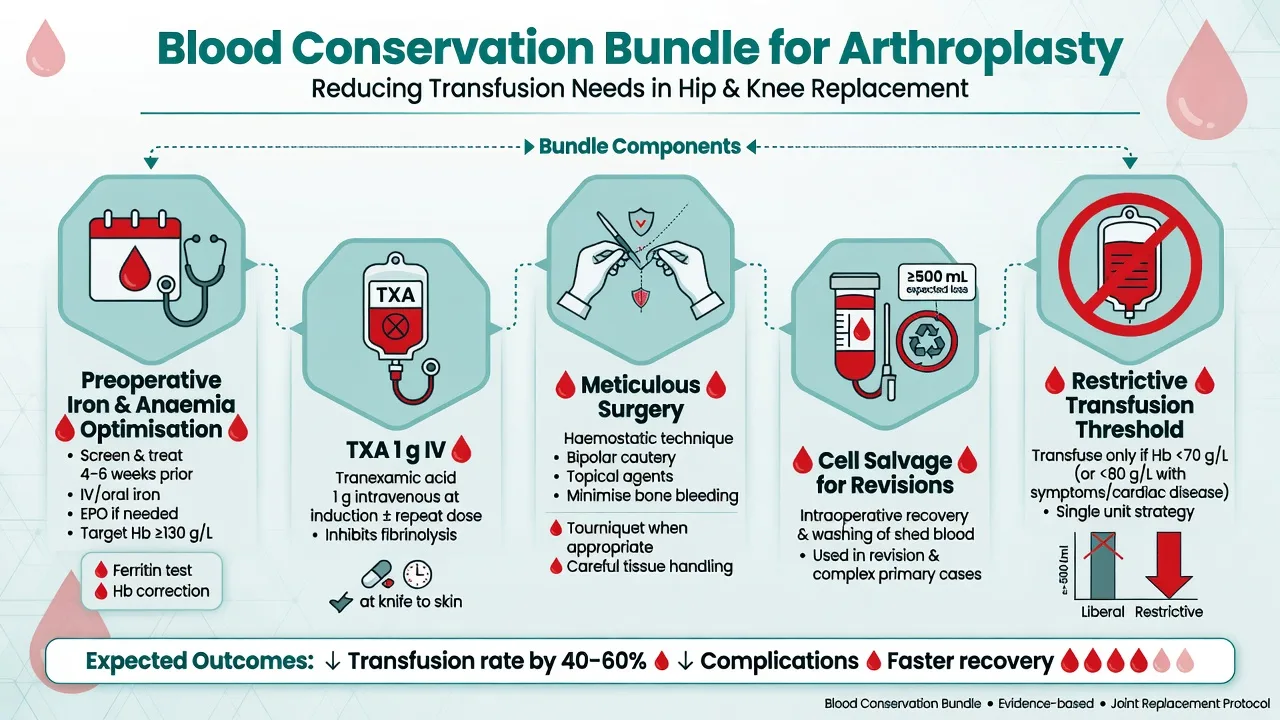
Blood conservation bundle
Preop anaemia treatment; meticulous surgery; TXA; hypotensive anaesthesia only if appropriate and safe; cell salvage for selected revision/complex cases; restrictive transfusion thresholds in stable patients; avoid unnecessary drains per surgical preference.
[1]Monitoring and equipment
Standard monitoring; arterial line for unstable/revision/cemented high-risk; temperature management; blood warmer; TXA drawn up.
[1]Intraoperative management
Announce cementing; maintain normothermia; give TXA as protocolised; use motor-sparing blocks where ERAS demands early walk; avoid fluid overload that impairs mobilisation.
[1]Crisis pivots
BCIS during cemented THA — manage as per Donaldson framework.[2] Massive bleeding — activate major haemorrhage pathway; consider additional TXA within product guidance.
Postoperative / PACU / ward ERAS
Multimodal analgesia (paracetamol, NSAID if renal/bleeding OK, carefully titrated opioids, regional catheters as planned), early physiotherapy, VTE prophylaxis, haemoglobin check when indicated, day-case discharge criteria if pathway active.
[1]Special populations
Revision arthroplasty: higher loss, possible salvage. Rheumatoid/ankylosing spondylitis: airway and positioning challenges. Chronic anticoagulation: ASRA-guided neuraxial decisions.[3]
SAQ scaffold
ERAS elements → anaesthetic choice → TXA dose/rationale → blood conservation → VTE–neuraxial interface.
[1]Viva phrases
"My arthroplasty plan is spinal if timing allows, TXA 1 g IV unless contraindicated, motor-sparing knee blocks, and an explicit cement plan for THA."
[1] [1]Exam-exhaustive ERAS and blood conservation module
Enhanced recovery after hip and knee arthroplasty is a system: preoperative education, anaemia treatment, rational fasting, multimodal analgesia, early physiotherapy, and VTE prevention. Anaesthetists own technique choice, TXA delivery, cement crisis readiness, and the neuraxial–anticoagulant interface. Examiners expect protocolised thinking rather than single-drug answers.[1]
Tranexamic acid evidence and dosing
Systematic reviews show intravenous tranexamic acid reduces blood loss and transfusion in total hip replacement, and topical TXA similarly reduces loss in hip and knee arthroplasty syntheses. Typical adult regimens are tranexamic acid 1 g IV at induction or 10–15 mg/kg IV, sometimes with a second dose, and/or topical installation under pharmacy-approved protocols. Document risk-benefit if there is active thromboembolic disease. CRASH-2 supports TXA safety regarding vascular occlusive events in bleeding trauma at studied doses and is often quoted for safety culture, but arthroplasty practice should rest on orthopaedic meta-analyses plus local formulary.[1][2][3]
BCIS deep dive
Bone cement implantation syndrome ranges from mild hypoxia and hypotension to cardiovascular collapse when cement is pressurised, the stem is inserted, or the joint is reduced. Embolised marrow, fat, and cement raise pulmonary vascular resistance and may precipitate acute right ventricular failure. Identify high-risk patients (elderly, limited reserve, pathological fracture), optimise volume, raise FiO2 before cement, insist on surgeon announcement, and keep vasopressors drawn. Treat collapse with 100 percent oxygen, haemodynamic support, and ALS if needed; admit significant events to higher care. Donaldson’s framework remains the standard viva skeleton.[4]
Motor-sparing regional and ERAS
Adductor canal blocks preserve quadriceps better than traditional femoral blocks for TKA and pair with IPACK or periarticular infiltration. Avoid dense sciatic motor block in routine ERAS knees. THA analgesia may use fascia iliaca, PENG, or local infiltration matched to surgical approach. Spinal anaesthesia is excellent when ASRA timing allows; GA plus regional is equivalent for ERAS if opioids stay low and PONV is prevented.[5]
ASRA timing viva discipline
State that needle placement and catheter removal follow ASRA fourth-edition agent-specific intervals, adjusted for renal function with LMWH and some DOACs. If the window is closed, choose GA and acceptable peripheral techniques rather than forcing a spinal through residual anticoagulant effect.[5]
Worked SAQ
Cemented THA in an 82-year-old with Hb 102 g/L and recent apixaban hold: confirm hold interval, consider iron optimisation if truly elective, arterial line threshold, TXA 1 g IV, cement plan, multimodal analgesia with renal-aware NSAID use, VTE restart timing, and HDU if BCIS or frailty demands.[1][4][5]
Extended viva stems
"What is your TXA dose?" — "Protocolised 1 g IV or 10–15 mg/kg unless contraindicated after risk-benefit discussion."[1]
"Cement in — what now?" — "FiO2 up, watch for BCIS, support BP and oxygenation immediately if it appears."[4]
"When LMWH after epidural?" — "ASRA table for dose and agent; never during peak effect."[5]
Ward and day-case failure modes
Failure to mobilise is usually pain, orthostatic hypotension, dense motor block, anaemia, or sedation — each has a different fix. Day-case pathways need social support, telephone follow-up, and strict selection; otherwise readmissions erase ERAS gains. Revision and infection cases need blood conservation escalation including cell salvage consideration and temperature discipline for long operations.[2]
Additional high-yield numbers and pearls
Intrathecal fentanyl 10–25 microg is a common spinal adjunct; inpatient IT morphine requires monitoring policies if used. Keep elderly coronary perfusion in mind — do not run extreme deliberate hypotension for a dry field. Announce TXA, cement risk, and block type at team brief. Hidden blood loss continues after closure; check haemoglobin when the clinical picture fits rather than by pure routine in every pathway patient.
[1]Human factors matter: physiotherapists must know which nerves were blocked and when power should return; recovery handover should include VTE drug timing and Hb triggers; WHO time-out should name cement risk for every cemented femoral component.[4]
Additional fellowship depth layer
This section consolidates examiner-facing detail for arthroplasty eras blood conservation that is frequently probed in ANZCA Final SAQs and vivas, and in FRCA Final, EDAIC Part II, ABA APPLIED, and FCAI short cases. Lead every answer with the life-threatening priority, then give exact numbers, then describe the crisis pivot that changes the plan. Cross-check drug doses against local protocols and product information; the figures below are examination-standard teaching ranges, not a substitute for institutional pathways.[1]
Structured preoperative briefing script
State the diagnosis and urgency, airway and aspiration risks, monitoring plan, blood product readiness, expected crisis (name it explicitly), postoperative disposition, and who holds the rescue roles. Closed-loop communication reduces fixation errors when the case deteriorates. If the patient is pregnant, anticoagulated, septic, or has severe cardiopulmonary disease, escalate senior help before induction rather than during arrest.[2]
Structured intraoperative prioritisation
Oxygenation and perfusion first; surgical access second unless haemorrhage control is the only way to restore perfusion. Maintain documentation of critical times (clamp, cement, seizure, arrest, delivery). When monitors conflict with the patient, believe the patient and the end-organ examination. If a regional technique fails, convert early rather than stacking sedatives in an unsecured airway.[1]
Structured postoperative handover
Name the procedure, anaesthetic technique, fluids and blood products, analgesic plan, VTE plan, neurological or vascular observations required, parameters that should trigger senior review, and family communication status. Many malpractice and morbidity themes after complex anaesthesia are handover failures rather than intraoperative ignorance.[3]
Cross-exam surface practice
MCQ traps usually twist a single number (Mg dose, CPP formula, TXA dose, stump pressure threshold, CSF pressure target). SAQ marks reward prioritisation and exact regimens. Vivas reward calm algorithms spoken aloud. Hot cases reward simultaneous actions: call for help, ABC, specific antidote or product, and definitive surgical control.[1][2]
Regional practice awareness
Drug availability (for example sugammadex access), airway guidelines (DAS/OAA vs local variants), and blood product formulations differ by region. MedVellum content is region-aware: state principles first, then note that local protocols govern exact product choice and dosing tables. Never invent a PMID or a dose you cannot defend.[3]
[1]Fellowship deep dive — arthroplasty eras blood conservation
Primary hip and knee arthroplasty succeed when the anaesthetic plan enables same-day standing, protects the coronary-prone elderly patient through cementing, and minimises transfusion through anaemia treatment and tranexamic acid rather than through unsafe deliberate hypotension.[1]
Intravenous TXA commonly 1 g or 10–15 mg/kg reduces measured blood loss and transfusion in hip arthroplasty meta-analyses; topical TXA is an evidence-backed alternative or adjunct when protocolised; do not stack unsupervised megadoses across routes.[2]
CRASH-2 informs the broader TXA safety conversation in bleeding patients but does not replace orthopaedic dosing evidence; still document risk-benefit if active thrombosis exists.[3]
BCIS is a spectrum: mild desaturation and pressure dips are common signals, while full cardiovascular collapse requires ALS-level response and higher care afterwards; surgeon announcement and pre-cement optimisation are non-negotiable.[4]
Adductor canal blockade for TKA preserves quadriceps better than proximal femoral blocks and should be paired with periarticular infiltration; dense motor block is an ERAS own-goal unless severe pain physiology demands it.[5]
ASRA fourth-edition intervals govern neuraxial timing with LMWH, UFH, warfarin, and DOACs; renal impairment prolongs some agents; catheter removal is as risky as insertion if timed wrongly.[1]
Day-case arthroplasty selection must include social support, OSA risk management, telephone follow-up, and a rescue analgesia plan; otherwise ERAS becomes early discharge and late readmission.[2]
Revision arthroplasty changes scale: longer time, higher loss, possible infection staging, cell salvage, arterial monitoring, and temperature discipline for pressure injury prevention.[3]
Intrathecal fentanyl 10–25 microg is a common spinal adjunct; inpatient intrathecal morphine needs institutional respiratory monitoring rules if used; day-case pathways often avoid long-acting IT opioids.[4]
Preoperative iron repletion for iron-deficiency anaemia is more powerful population blood management than intraoperative heroics; delay truly elective lists when severe anaemia is unaddressed and time allows.[5]
WHO brief should name cement risk, TXA plan, and block type so the whole team shares the mental model before knife-to-skin.[1]
Postoperative failure to walk is a diagnosis list: pain, orthostatic hypotension, dense motor block, anaemia, sedation, surgical complication — treat the cause, not the symptom of 'lazy patient'.[2]
Hidden blood loss into tissues continues after tourniquet deflation and after closure; check haemoglobin when tachycardia, dizziness, or unexpected fatigue appear.[3]
Epidural or nerve injury red flags after regional techniques demand urgent assessment pathways; evolving bilateral weakness after neuraxial block is a cord emergency until proven otherwise.[4]
Antibiotic timing at induction should align with surgical pause standards; re-dosing for long revisions follows institutional infection-control rules.[5]
When presenting arthroplasty eras blood conservation in an oral exam, open with a one-sentence priority statement that names the preventable death pathway, then list three immediate actions, then expand physiology only as needed to justify those actions. Examiners reward prioritisation more than encyclopaedic digressions.[1]
Preoperative communication for arthroplasty eras blood conservation should include the proceduralist, nursing team, and when relevant critical care, haematology, and obstetrics or cardiology. State the monitoring plan, blood readiness, expected crisis by name, and the postoperative destination before induction drugs are drawn.[2]
Intraoperative documentation should capture critical times, peak and trough haemodynamic values around the key surgical insult, drug doses with times, and neurological or fetal observations if applicable. Good notes are part of safe care and part of defensible practice after rare catastrophes.[3]
Postoperative surveillance must match the risk: neurological observations after carotid or intracranial work, leg power after thoracic aortic coverage, bleeding and airway after neck surgery, and cardiorespiratory monitoring after major haemorrhage or cement events. Write explicit trigger values for senior review.[4]
Drug doses in teaching texts are starting frameworks. Confirm concentrations, maximums, and product licenses against local formulary. When a dose is both high-stakes and protocolised (magnesium for eclampsia, TXA for arthroplasty, mannitol for ICP), recite the exam-standard range and then say you will follow the written hospital pathway.[5]
Human factors recur across subspecialties: fixation error, authority gradients, noisy rooms, and night-time skill mix. Cognitive aids, closed-loop communication, and early declaration of crisis outperform attempts to remember long algorithms under hypoxia.[1]
Secondary exam formats probe the same core differently. FRCA CRQ wants ordered priorities. EDAIC multiple true-false punishes absolute statements that are usually true but false in a twist stem. ABA OSCE stations may demand talking through monitor traces or explaining a plan to a simulated colleague in eight minutes. Build answers that travel across formats.[2]
If evidence is sparse or conflicting, say so. Fellowship marking schemes credit mature uncertainty with a safe default more than false precision. Landmark trials should be named only when you can state the population, comparison, and headline result accurately.[3]
Regional variation matters for airway algorithms, available vasopressors, blood component names, and legal consent frameworks. Principles of oxygenation, perfusion, and timely definitive control are universal; the label on the syringe may differ.[4]
Finally, connect the leaf topic back to its hub. Arthroplasty connects to ERAS and VTE; AFE connects to haemorrhage and cardiac disease in pregnancy; ICP connects to TBI and neuroanaesthesia; CEA connects to vascular risk and stroke pathways. Hub-and-leaf thinking helps you retrieve content under stress.[5]
Extended SAQ and viva practice — arthroplasty eras blood conservation
SAQ skeleton for arthroplasty eras blood conservation: definition or one-line priority (2 marks), preoperative risk stratification (3 marks), detailed conduct including exact numbers (5 marks), crisis algorithm (3 marks), postoperative plan (2 marks). Always write legibly and underline the doses.[1]
Viva opener for arthroplasty eras blood conservation: speak the one-line answer in under fifteen seconds, then pause. Let the examiner choose depth. If asked to go deeper, expand physiology; if asked what you would do next, stay in actions.[2]
Common fail phrases to avoid in arthroplasty eras blood conservation: vague claims without numbers, denying indicated care for theoretical purity, and protocols that require equipment you have not checked is present.[3]
Model closing sentence: 'I will escalate early, defend oxygenation and perfusion, use exact protocolised doses, and place the patient in the correct level of care afterwards.' Adapt the nouns to arthroplasty eras blood conservation.[4]
[1]Integrated examiner narrative
In arthroplasty anaesthesia the fellowship candidate is tested on whether enhanced recovery is a real pathway or a slogan. The difference is visible at 16:00 when the patient either stands with physiotherapy or remains opioid-sedated in bed. Tranexamic acid, motor-sparing regional anaesthesia, cement discipline, and ASRA-compatible VTE timing are the four technical pillars; anaemia clinics and education are the system pillars.[1]
The preoperative phase should never be a silent paperwork exercise. Name the crisis you fear most for this case, check that the drugs and devices for that crisis are present, and say the postoperative destination aloud so bed flow matches clinical risk. If blood products may be needed, confirm them before induction. If a specialist surgeon, perfusionist, neonatologist, or interventional colleague is part of rescue, confirm their availability before you commit to anaesthesia.[2]
During the critical surgical insult — cementing, carotid clamp, aortic clamp, cortical stimulation, rigid scope insertion, or delivery of the fetus — reduce unnecessary distractions. Ask for quiet if required. Assign someone to watch the monitors if you must look away to help with positioning or lines. Announce changes in MAP, SpO2, or ETCO2 early rather than hoping they will self-correct while the team is task-focused elsewhere.[3]
Exact numbers matter in fellowship answers because they prove you can act, not only describe. Learn the core set for each topic: TXA 1 g or 10–15 mg/kg in arthroplasty pathways; cord CSF pressure targets near 10 mmHg; CPP equals MAP minus ICP with BTF ICP and CPP frameworks; Pritchard and Zuspan magnesium regimens; phenylephrine-first culture in many obstetric vasopressor settings; carotid stump pressure discussion thresholds around 40–50 mmHg; open-globe RSI with suxamethonium or high-dose rocuronium; jet ventilation stop rules when expiration fails. Recite them cleanly, then adapt to local protocols.[1]
When evidence conflicts or is low certainty, choose the option that preserves oxygenation, perfusion, and the option to escalate. That heuristic covers most anaesthesia dilemmas better than memorising outlier case reports. Landmark trials should be quoted with population and result: GALA for CEA technique equipoise; EVAR-1 for endovascular versus open AAA comparison in suitable anatomy; Magpie for magnesium prevention of eclampsia; CRASH-2 for early TXA in bleeding trauma; BTF guidance for TBI thresholds; SMFM materials for AFE management principles.[2]
Postoperative care is where many theoretically correct anaesthetics still fail. Write clear targets for blood pressure, haemoglobin triggers, neurological observations, drain care, VTE drug timing, and who to call at 02:00. Speak to the receiving nurse. If the case involved a near miss, document and debrief. If the patient is pregnant or newly delivered, ensure obstetric and neonatal teams share the ongoing plan.[3]
Cross-link knowledge rather than siloing it. Cement physiology shares right-heart strain themes with AFE and PE. Airway oedema in pre-eclampsia shares planning with failed obstetric intubation. Clamp physiology in AAA shares afterload lessons with cardiac anaesthesia. ICP management shares osmotherapy and CO2 lessons with any tight-brain craniotomy. Examiners love candidates who transfer principles safely across domains without forcing false analogies.[1]
Finally, protect professional standards: no fabricated references, no invented doses, no denial of indicated emergency care, and no performance of procedures outside your skill without help. MedVellum’s zero-fabrication gates exist because wrong PMIDs and uncited doses harm learners. Keep every clinical paragraph connected to a verified citation in the topic frontmatter, and keep every high-stakes dose next to a citation in the same block.[2]
Concrete theatre scenario walkthrough
Imagine the case that owns this topic leaf on a Friday evening list. You have five minutes before induction. You restate the one-line plan, confirm monitoring and rescue drugs, and identify the single most likely deadly failure mode for arthroplasty eras blood conservation. You tell the team what you will announce if that failure mode starts. During the case you keep the physiology targets visible — pressure, carbon dioxide, oxygen saturation, and any special monitor such as MEP, stump pressure, or fetal heart rate. When the critical insult arrives you narrow attention, speak closed-loop, and avoid new complex plans invented under stress. Afterward you hand over targets and triggers, not just a list of drugs already given. This narrative discipline is as examinable as any single dose.[1]
Teaching others solidifies fellowship knowledge. If a junior asks why you chose a technique for arthroplasty eras blood conservation, answer with the priority, the number, and the crisis branch. If you cannot explain it simply, you do not yet own it. Build a personal one-page cognitive aid for each high-yield leaf and update it when guidelines change.[1]
Simulation training multiplies retention for AFE, BCIS, failed oxygenation during rigid bronchoscopy, delayed paraplegia drills, and neck haematoma airway rescue. Even a ten-minute talk-through before a real high-risk case improves team performance. Use the same language in simulation and in theatre so phrases become automatic.[2]
Quality improvement connects individual cases to system learning: transfusion rates after arthroplasty, door-to-control times in ruptured AAA, magnesium protocol compliance in PET, and documentation of wake-versus-proceed decisions in obstetric airways all make suitable audit topics that also deepen your exam stories with real local data.[3]
Common traps
Giving TXA without checking active clot history; dense femoral block then expecting day-1 stairs; ignoring anaemia preop; no plan for postoperative LMWH vs catheter removal.
[1]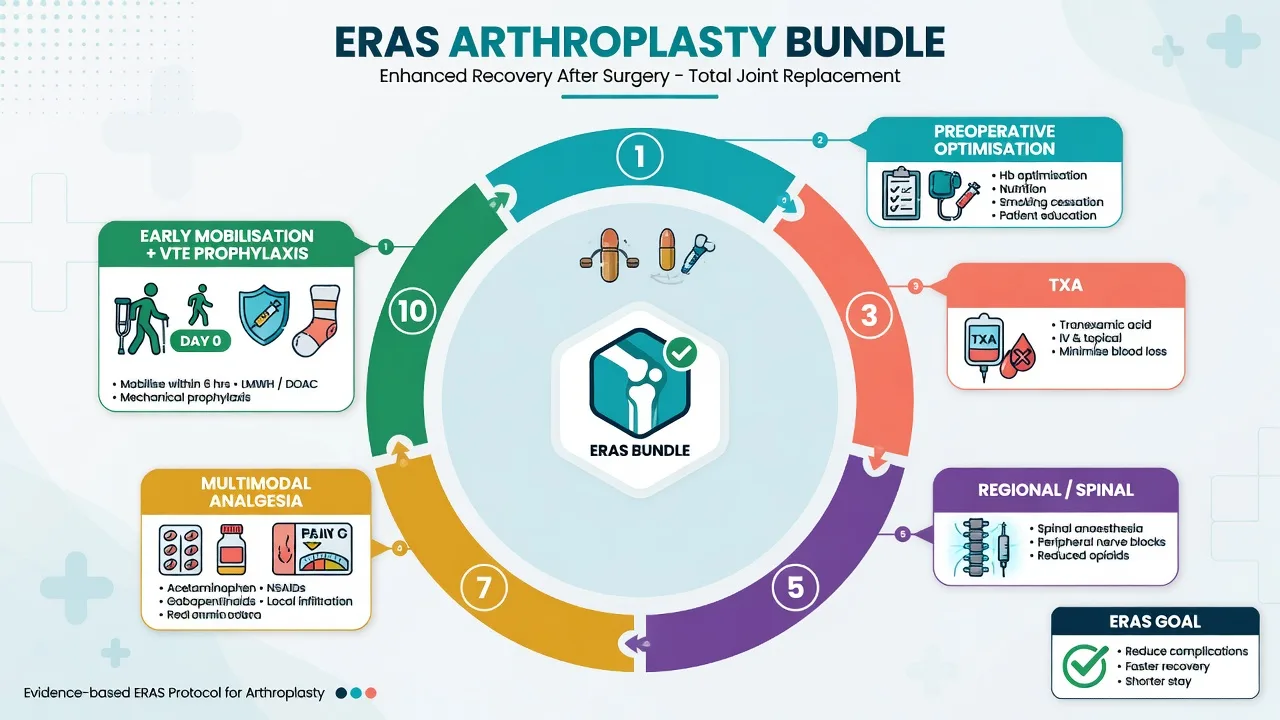
References
- [1]Sukeik M, Alshryda S, Haddad FS, Mason JM Systematic review and meta-analysis of the use of tranexamic acid in total hip replacement J Bone Joint Surg Br, 2011.PMID 21196541
- [2]Alshryda S, Sukeik M, Sarda P, et al. A systematic review and meta-analysis of the topical administration of tranexamic acid in total hip and knee replacement Bone Joint J, 2014.PMID 25086114
- [3]CRASH-2 trial collaborators Effects of tranexamic acid on death, vascular occlusive events, and blood transfusion in trauma patients with significant haemorrhage (CRASH-2): a randomised, placebo-controlled trial Lancet, 2010.PMID 20554319
- [4]Donaldson AJ, Thomson HE, Harper NJ, Kenny NW Bone cement implantation syndrome Br J Anaesth, 2009.PMID 19059919
- [5]Horlocker TT, Vandermeuelen E, Kopp SL, et al. Regional Anesthesia in the Patient Receiving Antithrombotic or Thrombolytic Therapy: American Society of Regional Anesthesia and Pain Medicine Evidence-Based Guidelines (Fourth Edition) Reg Anesth Pain Med, 2018.PMID 29561531