Anaes · Cardiac anaesthesia
CABG anaesthesia: on-pump and off-pump
Also known as CABG anaesthesia: on-pump and off-pump · OPCAB anaesthesia · On-pump coronary bypass
Exam-exhaustive anaesthesia for CABG including on-pump CPB goals, heparin and ACT targets, OPCAB haemodynamics with stabilisers, conversion readiness, grafting sequence, TOE-guided optimisation, and TRICS III transfusion context.
On this page & tools
Your progress
Saved locally on this device.
10 MCQs with explanations
Target exams
Red flags
Why this is examined / the one-line answer
CABG is the commonest adult cardiac operation in many viva banks. Discriminators are on-pump versus OPCAB physiology, exact heparin/ACT practice, haemodynamic rescue during heart displacement, TOE use, and knowing when to convert.
[1]One-line answer: On-pump CABG uses full heparinisation to ACT at least 400 seconds (often 480), cardiopulmonary bypass, and cardioplegic arrest; OPCAB avoids the bypass circuit but demands management of beating-heart displacement, regional ischaemia, and an always-ready conversion plan.
[2]Preoperative assessment and risk stratification
Define coronary anatomy (left main, proximal LAD, three-vessel disease, chronic total occlusions), LV and RV function, mitral regurgitation, pulmonary hypertension, aortic calcification (cannulation and cross-clamp risk), prior sternotomy, conduits planned (LIMA, RIMA, radial, saphenous vein), antiplatelet timing (aspirin often continued; P2Y12 usually held per local cardiac protocol), diabetes, renal function, carotid disease, and EuroSCORE/STS risk.
[1]Airway and TOE contraindications (oesophageal disease, severe dysphagia). Plan arterial monitoring (often pre-induction arterial line in high-risk), large-bore venous access, central venous catheter, external defibrillator pads, pulmonary artery catheter in selected high-risk patients, and comprehensive TOE unless contraindicated.[2]
Applied physiology — on-pump versus beating heart
On-pump CABG physiology
CPB replaces heart and lung function temporarily: non-pulsatile or attenuated pulsatile flow, contact activation of inflammation and coagulation, haemodilution, hypothermia options, and ischaemia-reperfusion after cross-clamp. Myocardial protection with cardioplegia is mandatory during aortic cross-clamping (see companion cardioplegia topic). Weaning requires restored rhythm, ventilation, temperature, electrolytes, and contractility.
[2]OPCAB physiology
The heart continues to beat. Stabilisers and pericardial slings expose coronary targets. Verticalisation and compression, especially for posterior and lateral walls, impair RV filling, reduce preload, and can cause severe hypotension and mitral regurgitation geometry changes. Regional ischaemia occurs during target vessel snaring or shunting. The benefit sought is avoidance of CPB-related inflammatory and embolic risks; the cost is haemodynamic instability and sometimes incomplete revascularisation if conversion thresholds are poorly managed.
[2]Anaesthetic goals
Maintain coronary perfusion pressure; avoid tachycardia and extreme anaemia; blunt response to laryngoscopy and sternotomy; plan myocardial protection strategy (cardioplegia on-pump; ischaemic preconditioning and volatile agents as programme practice for OPCAB); facilitate surgical exposure without catastrophic hypotension; prepare for bleeding and transfusion with TRICS III-informed restrictive thresholds when appropriate; plan fast-track extubation when physiology allows.[1]
Technique options and decision matrix
On-pump CABG sequence
- Induction and line placement / baseline TOE.
- Sternotomy and conduit harvest.
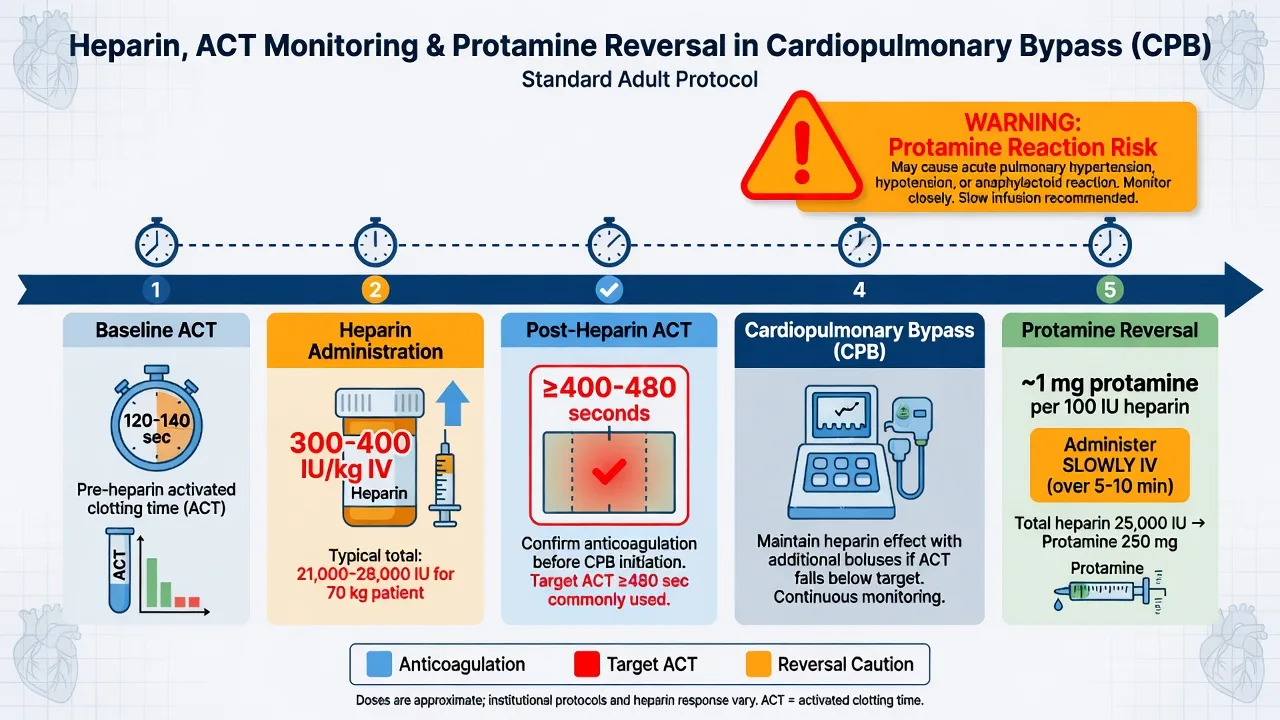
- Heparin 300–400 IU/kg IV.
- Confirm ACT at least 400 s (often target ≥480 s) before CPB.
- Arterial and venous cannulation → CPB.
- Aortic cross-clamp and cardioplegia → distal ± proximal grafts (unit sequence varies).
- De-air, rewarm, wean from CPB with inotropic support as needed.
- Protamine about 1 mg per 100 IU of heparin (titrate to ACT and bleeding; watch for reactions).[3]
- Haemostasis, pacing wires, drains, close.
Indexed CPB flows commonly about 2.2–2.5 L/min/m²; MAP often 50–80 mmHg unless higher targets indicated (known carotid disease, severe chronic hypertension, malperfusion concerns).
[3]OPCAB sequence and rescue
Heparinisation per unit protocol (often intermediate dose with ACT targets below full CPB but still anticoagulated — know local numbers). Position and stabilise targets, usually grafting sequence prioritising collaterals and critical vessels per surgeon. Anaesthetic rescue during displacement:
[2]- Communicate early with surgeon; temporary return of the heart toward neutral position if collapse.
- Volume (Trendelenburg, fluids) to restore preload.
- Vasopressors (noradrenaline, phenylephrine) for SVR support.
- Inotropes if contractility fails.
- Pacing for bradyarrhythmia.
- Intraluminal shunts as surgical ischaemia strategy.
- Convert to CPB if instability is refractory — perfusionist and circuit readiness are mandatory before verticalisation.
Monitoring and equipment
Arterial line, CVP ± PAC in selected high-risk patients, five-lead ECG with ST monitoring, TOE (comprehensive exam standards), cerebral near-infrared spectroscopy in some units, ACT, ABG, glucose, electrolytes (especially potassium), temperature, urine output, defibrillator pads, cell salvage, antifibrinolytics (tranexamic acid per protocol). TOE guides preload, RWMA, MR, aortic disease, and de-airing.[2]
Transfusion: TRICS III supports a restrictive red-cell transfusion strategy in cardiac surgery (threshold 75 g/L in the trial's restrictive arm context) as non-inferior to liberal strategies for the primary outcome in the studied population — apply with clinical judgement for active bleeding and active ischaemia.[1]
Intraoperative management
Induction: opioid-based or balanced technique with careful haemodynamics in severe left main or poor LV; have vasopressors drawn. Avoid extremes of hypotension and tachycardia.
[2]Maintenance: volatile agents have ischaemic preconditioning narratives; TIVA also acceptable. Glucose control per unit protocol. Antibiotics timed.
[2]On CPB: confirm ACT before going on; communicate flows and pressures with perfusion; watch for aortic dissection on cannulation (TOE), malperfusion, and inadequate venous drainage. Cardioplegia delivery coordinated with surgeon.
[2]Weaning: ventilation on, electrolytes corrected, rate and rhythm optimised, gradual flow reduction, TOE assessment, inotropes/vasopressors as indicated, IABP or other MCS if needed.
[2]Protamine: give slowly via peripheral or carefully managed route per unit practice; watch for systemic hypotension, pulmonary hypertension, and anaphylactoid reactions; support and pause if severe.[3]
OPCAB-specific: continuous dialogue during each anastomosis; treat hypotension aggressively early; do not pride-protect against conversion.
[2]Crisis pivots — what changes the plan
OPCAB collapse: restore position if needed, fluids, vasopressors, open communication for conversion to CPB, defibrillation readiness, consider ischaemia on ECG/TOE.
[2]On-pump ischaemia after wean: TOE regional wall motion, graft flow assessment/revision, support, return to CPB if needed.
[2]Protamine reaction: stop protamine, support RV and systemic pressure, pulmonary vasodilators in selected severe pulmonary hypertensive reactions, reheparinise and return to CPB if catastrophic.
[3]Massive bleeding after CPB: surgical haemostasis, products guided by ACT/viscoelastic tests, calcium, consider incomplete heparin reversal versus surgical bleeding.
[2]Stroke concern / severe aortic atheroma: higher MAP targets, careful cannulation strategy, epiaortic scanning in some units.
[2]Postoperative / ICU / PACU plan
ICU haemodynamics with clear MAP and cardiac output goals; graft ischaemia surveillance (ECG, enzymes, TOE if instability); bleeding and tamponade watch; pacing thresholds; glucose control; fast-track extubation if warm, not bleeding, neurologically appropriate, and gas exchange adequate; analgesia and physiotherapy.
[1]Special populations and comorbidities
Poor LV / recent MI: higher inotrope and MCS readiness; cautious OPCAB selection.
[2]Renal impairment: higher risk on CPB; haemodynamic and transfusion discipline.
[1]Re-do sternotomy: bleeding, longer time to safe cannulation, external defibrillator pads essential.
[2]Combined valve and CABG: dual pathology planning beyond pure CABG.
[2]SAQ answer scaffold
On versus off table; exact heparin and ACT; CPB flow and MAP; OPCAB haemodynamic rescue steps; conversion triggers; protamine dosing and reactions; TOE uses; TRICS III transfusion context; postoperative ischaemia detection.
[1]Viva stem bank and model phrases
- "I state conversion criteria out loud before the heart is verticalised."
- "ACT at least four hundred seconds before full CPB — often we target four-eighty."
- "OPCAB hypotension is preload and position until proven otherwise, then convert early."
- "Protamine about one milligram per hundred units of heparin, given carefully."
- "Restrictive transfusion thresholds are evidence-based in cardiac surgery when bleeding is controlled."
Fellowship depth notes — numbers drill and conversion CRM
Heparin/ACT/protamine card
On-pump heparin 300–400 IU/kg; ACT ≥400 s before CPB (many target ≥480 s); redose heparin as ACT falls; protamine ≈ 1 mg per 100 IU heparin given, slowly, with reaction vigilance.[3]
CPB targets card
Flow ≈ 2.2–2.5 L/min/m²; MAP often 50–80 mmHg with individualisation; temperature per surgical plan; glucose control; haemoglobin management with TRICS III restrictive evidence when not actively bleeding.[1]
OPCAB rescue ladder (order)
Communicate → restore position if needed → Trendelenburg/volume → vasopressors → inotropes → pace → surgical shunt/strategy change → convert to CPB. State conversion criteria before verticalisation.
[2]TOE moments that score marks
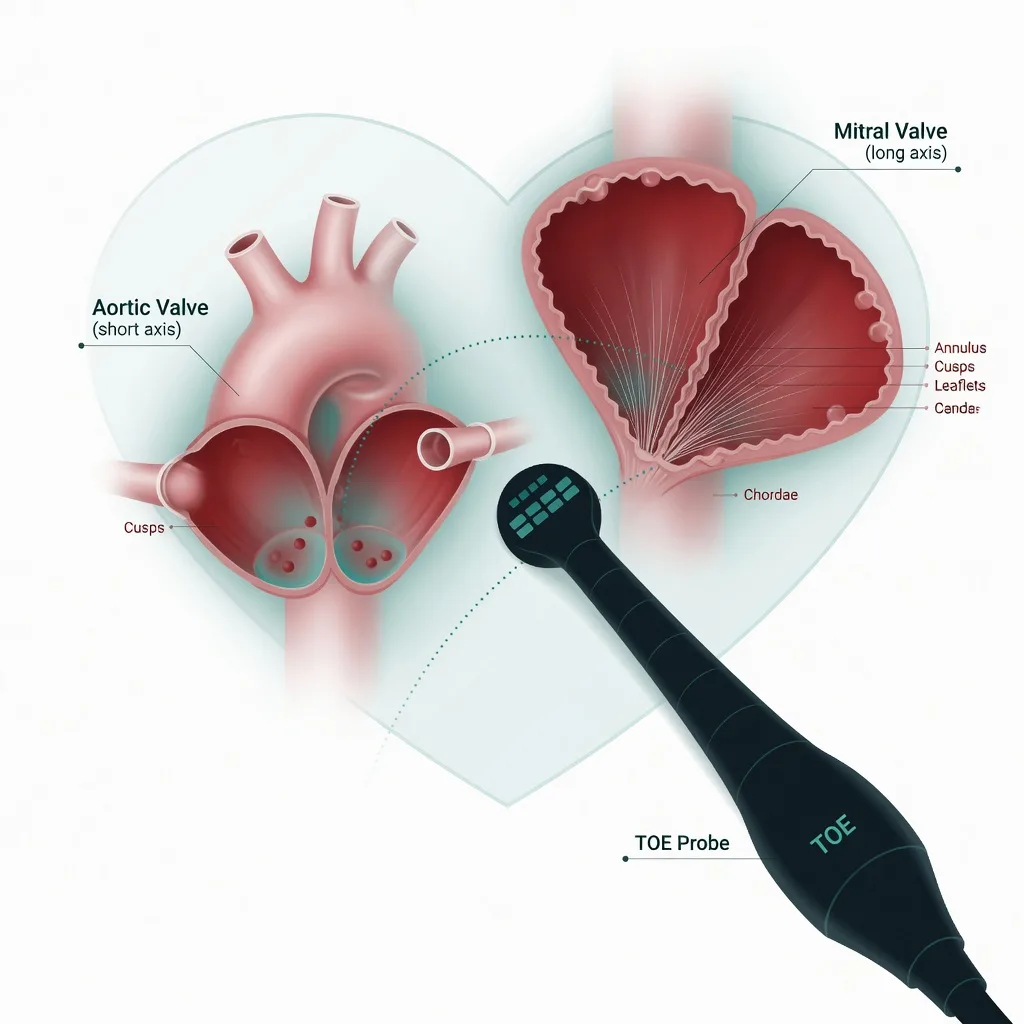
Pre-CPB baseline RWMA and aortic assessment; on cannulation for dissection; weaning for function and air; post-graft for new RWMA suggesting technical issues.[2]
Fast-track criteria theme
Warm, not bleeding, stable haemodynamics without extreme support, adequate gas exchange, neurologically appropriate — then early extubation pathways.
[2]Combined pathology notes
Left main disease needs especially careful induction; poor LV needs MCS readiness; re-do sternotomy needs external defibrillator pads and blood available early.
[2]Extended viva stems
"Compare on-pump and OPCAB for the anaesthetist." "What ACT do you need?" "How do you manage hypotension during lateral wall grafting off-pump?" "How do you give protamine?" "What did TRICS III show?"
[1]Common traps
Treating OPCAB as low risk without conversion preparation; forgetting full CPB ACT targets; delayed conversion while stacking pressors; rapid protamine boluses; ignoring TOE RWMA after weaning; liberal transfusion without indication or restrictive zeal during active haemorrhage.
[1]Model SAQ answers (fellowship length)
SAQ: Compare anaesthetic management of on-pump versus off-pump CABG.
On-pump CABG requires full heparinisation to ACT at least 400 seconds, CPB at flows about 2.2–2.5 L/min/m², cardioplegic arrest, and protamine reversal after weaning. OPCAB avoids CPB but causes haemodynamic instability from heart displacement and regional ischaemia; I use volume, position changes, vasopressors, pacing, and early conversion to CPB if needed. Both need TOE-capable care and transfusion discipline informed by TRICS III.
[1]SAQ: Hypotension during OPCAB lateral wall grafting.
I communicate with the surgeon, consider temporary repositioning, give Trendelenburg and volume for preload, support SVR with vasopressors, add inotrope if contractility is poor, pace if bradycardic, and convert to CPB if instability persists. I do not delay conversion for pride.
[2]SAQ: Heparin, ACT, and protamine numbers.
Heparin 300–400 IU/kg for full CPB; ACT ≥400 s (often ≥480 s) before bypass; protamine about 1 mg per 100 IU heparin, given carefully watching for reactions.
[3]Extended viva scripts
Examiner: TRICS III? Candidate: Restrictive red-cell transfusion in cardiac surgery was non-inferior to liberal strategies for the primary outcome in the studied population — apply with judgement during active bleeding or ischaemia.
[1]Examiner: Conversion criteria example? Candidate: Refractory hypotension or ischaemia despite repositioning, volume, and drugs — convert early with perfusion ready.
[2]Continuous clinical narrative — on-pump CABG day and OPCAB crisis
For on-pump three-vessel CABG the morning begins with arterial line placement in the awake high-risk patient when appropriate, large venous access, and careful induction preserving coronary perfusion pressure. TOE establishes baseline regional wall motion and screens the aorta. After sternotomy and conduit harvest, heparin 300 to 400 IU per kilogram is given and ACT confirmed at least 400 seconds before cannulation. Cardiopulmonary bypass runs at indexed flows near 2.2 to 2.5 litres per minute per square metre with MAP typically 50 to 80 mmHg unless higher targets are chosen for cerebrovascular disease. Cardioplegia arrests and protects the heart while distal and proximal anastomoses proceed. Weaning requires ventilation, rhythm, temperature, electrolytes, and contractility; TOE checks air and function. Protamine is given slowly at about one milligram per hundred units of heparin with vigilance for pulmonary hypertensive and hypotensive reactions. Transfusion follows a restrictive philosophy when bleeding is controlled, consistent with TRICS III evidence, while active haemorrhage is treated with products without ideological delay.
[1]For OPCAB the same morning preparation occurs, but the critical moment is verticalisation for a lateral or posterior target. Preload falls, the right heart is compressed, and blood pressure collapses. The anaesthetist announces numbers, asks for a slight positional relief if needed, uses Trendelenburg and volume, supports SVR, and watches ST segments. If the situation does not correct quickly, conversion to CPB is requested without negotiation theatre politics. A perfusionist who is scrubbed only in theory is not a conversion plan; the circuit must be ready before the heart is lifted. That sentence is the viva.
[2]Board alignment and key numbers card
Cardiac anaesthesia numbers for CABG: heparin 300–400 IU/kg; ACT ≥400 s (often ≥480 s) before CPB; flows about 2.2–2.5 L/min/m²; MAP often 50–80 mmHg; protamine about 1 mg per 100 IU heparin.[3] OPCAB needs conversion readiness before verticalisation. TOE guides baseline, weaning, and ischaemia assessment.[2] TRICS III supports restrictive transfusion thresholds in cardiac surgery when appropriate.[1] On-pump costs CPB inflammation; OPCAB costs haemodynamic instability — manage each failure mode. Fast-track extubation when warm, stable, and not bleeding. These are core SS_CS marks across ANZCA and FRCA.
Additional examiner stems and expanded cardiac prose
Candidates should recite heparin three hundred to four hundred international units per kilogram, ACT at least four hundred seconds and often four hundred eighty before CPB, flows near two point two to two point five litres per minute per square metre, and protamine about one milligram per hundred units of heparin. On-pump management is the CPB sequence with cardioplegia and TOE-guided wean. OPCAB management is displacement physiology with a conversion ladder: communicate, position, volume, pressors, inotropes, pace, convert. TRICS III informs restrictive transfusion when bleeding is controlled. Protamine reactions require pause, support, and sometimes return to bypass. Postoperative care watches graft ischaemia, bleeding, tamponade, and fast-track criteria. The viva discriminator is not whether the candidate has heard of OPCAB, but whether conversion is planned before verticalisation and whether ACT targets are exact.
[1]Handover to cardiac ICU and early complications
Handover after CABG must include grafts performed, on-pump or OPCAB course, conversion if any, difficult weaning details, inotropes and vasopressors, pacing wires and thresholds, bleeding and product totals, ACT and protamine events, TOE findings, glucose, and targets for MAP and haemoglobin. Early complications to watch are graft ischaemia, tamponade, bleeding, vasoplegia, RV failure, stroke, and acute kidney injury. Fast-track candidates are warm, cooperative, not bleeding, and gas-exchanging well. Reopening thresholds should be unit-standard and spoken at handover. This postoperative arc completes the intraoperative story and is frequently examined as a separate stem after a technical CABG discussion.
[1]For the one-line viva close: on-pump means full heparinisation, ACT targets, CPB flows, cardioplegia, and careful protamine; OPCAB means displacement physiology with a conversion plan stated before verticalisation. Quote heparin three hundred to four hundred IU per kilogram, ACT at least four hundred seconds, and protamine about one milligram per hundred units. Use TOE. Transfuse with TRICS III-informed restraint when bleeding is controlled.
[1]Rapid revision box
Rehearse aloud: core definition, three exact numbers or doses, one crisis algorithm, and one common trap. If you can deliver those four items in under ninety seconds, the rest of the topic becomes supporting detail rather than a scramble. Fellowship exams reward automatic structures under time pressure.
[2]Close by restating conversion readiness for OPCAB and exact heparin-ACT-protamine numbers for on-pump care, with TOE as the integrating monitor across both techniques.
[2]Final mark-scheme reminder
Deliver definition, exact numbers, crisis algorithm, and common traps in that order. Support each claim with the physiology that makes it true. Examiners award structure as highly as content density.
[2] [2]These high-yield lines should be automatic under viva pressure.
[2]State the conversion plan before verticalisation every time.
[2] [2]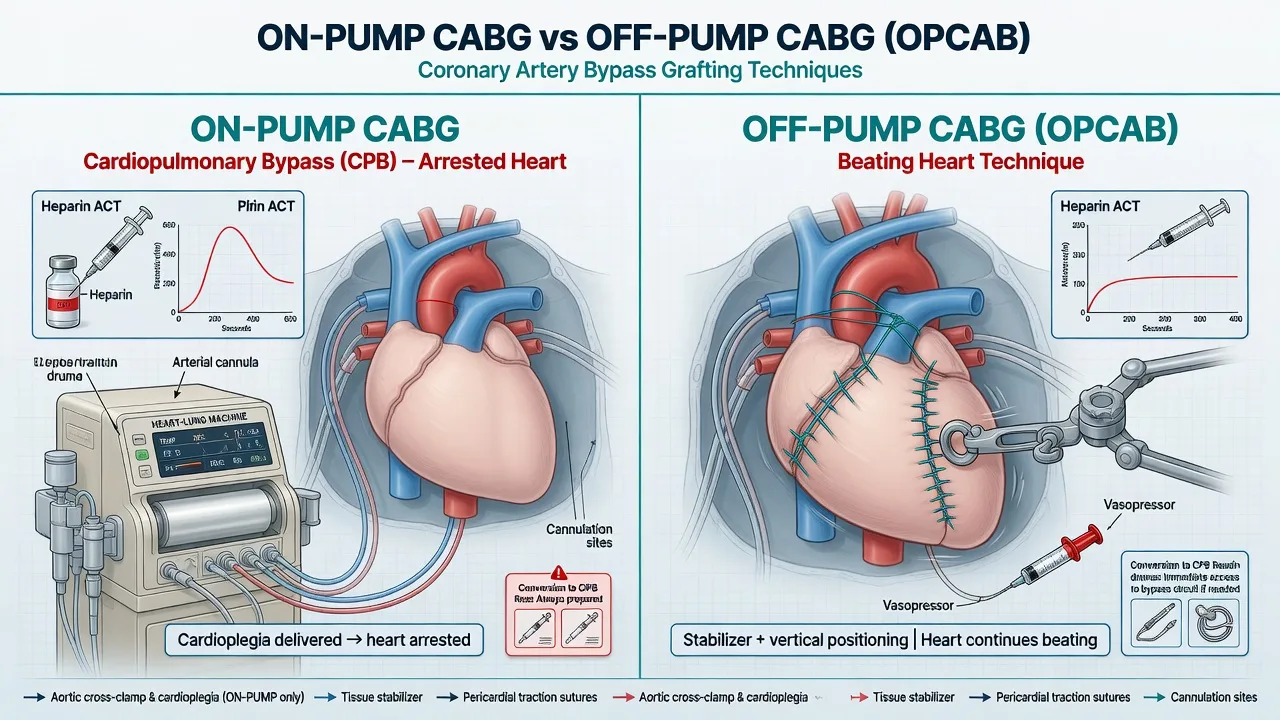
References
- [1]Mazer CD, Whitlock RP, Fergusson DA, et al. Restrictive or Liberal Red-Cell Transfusion for Cardiac Surgery N Engl J Med, 2017.PMID 29130845
- [2]Hahn RT, Abraham T, Adams MS, et al. Guidelines for performing a comprehensive transesophageal echocardiographic examination: recommendations from the American Society of Echocardiography and the Society of Cardiovascular Anesthesiologists J Am Soc Echocardiogr, 2013.PMID 23998692
- [3]Levy JH, et al. What's fishy about protamine? Clinical use, adverse reactions, and potential alternatives J Thromb Haemost, 2023.PMID 37062523