Anaes · Cardiac anaesthesia & cardiopulmonary bypass
Cardiac anaesthesia and cardiopulmonary bypass
Also known as Cardiac anaesthesia · Cardiopulmonary bypass · CPB · TOE cardiac surgery · SS_CS specialised study unit
Exam-pass cardiac anaesthesia hub (SS_CS): CPB circuit order, heparin/ACT, cardioplegia, TOE-guided weaning (RRAC), protamine reactions, TRICS III restrictive transfusion, valves/CABG leaf links, and mechanical support escalation.
On this page & tools
Your progress
Saved locally on this device.
Target exams
Red flags
Why this is examined
SS_CS (cardiac surgery and interventional cardiology) contributes 28 FEx outcomes with high equipment and formula load. Classic viva material includes circuit components in order, ACT targets, cardioplegia strategies, TOE views, weaning failure, and protamine reactions. Cross-exam boards (FRCA, ABA with TEE emphasis, EDAIC, FCAI) share this core. ANZCA PS46 and ASE/SCA standards set the echocardiography training expectation; TOE remains the intraoperative haemodynamic and structural truth serum.[3]
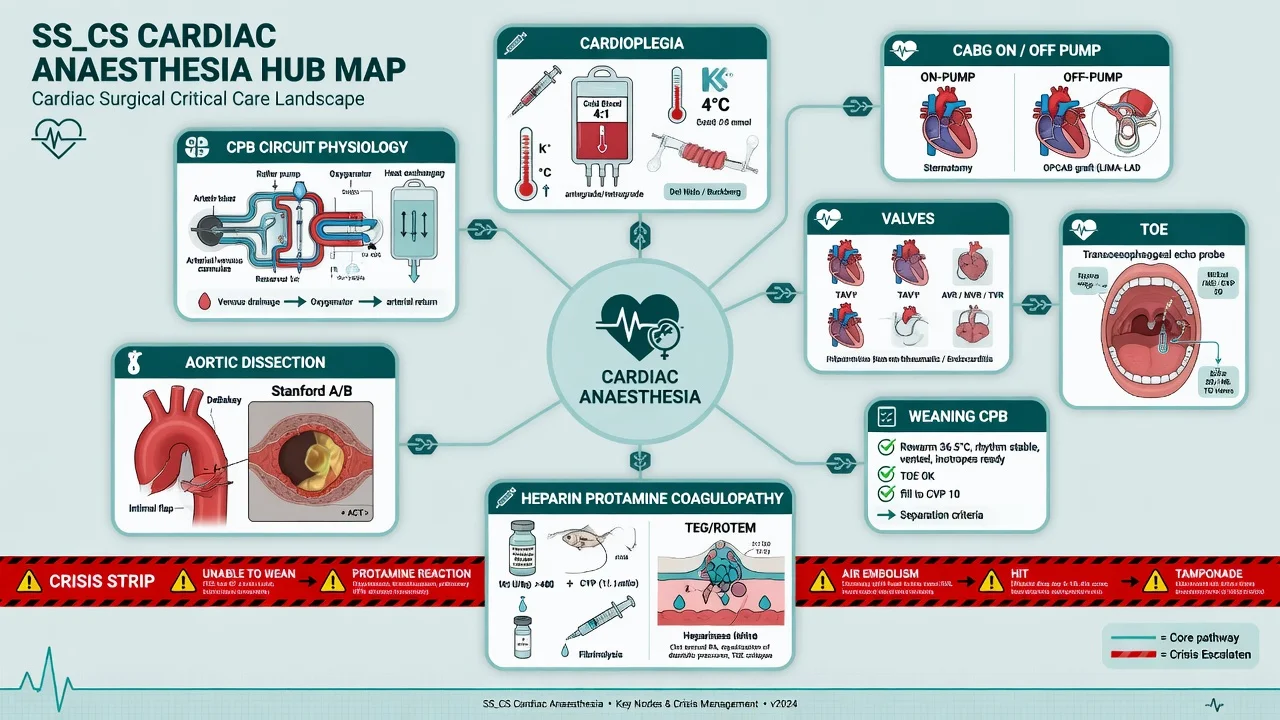
SSU framework and hub map
| Leaf topic | Depth owned |
|---|---|
cpb-circuit-physiology | Circuit order, flows, prime, hypothermia, α-stat vs pH-stat |
| Myocardial protection / cardioplegia (planned/leaf) | Blood vs crystalloid, antegrade/retrograde, del Nido/HTK |
| CABG on/off pump | Haemodynamics, graft strategy |
| Valve surgery | AS/MR pathophysiology, TOE for repair assessment |
| TOE for anaesthetists | 11 basic views, haemodynamic puzzles |
| Weaning from bypass | RRAC + mechanical support |
| Protamine / heparin / coagulopathy | Reactions, HIT, TEG/ROTEM |
| Aortic dissection / major aortic | Malperfusion, DHCA basics |
| Congenital basics / LVAD | Special populations |
CPB circuit (order you must recite)
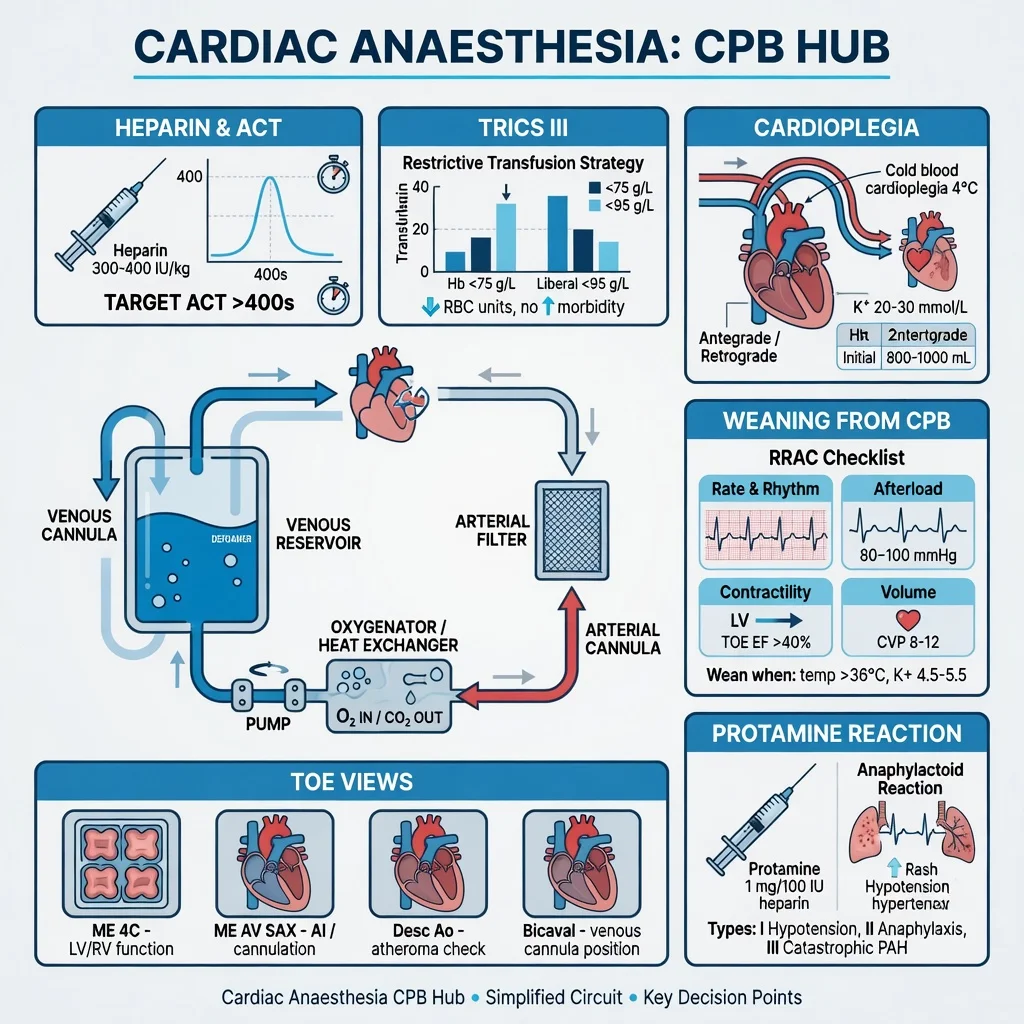
Venous cannula (RA/bicaval) → venous reservoir → pump (roller or centrifugal) → oxygenator with heat exchanger → arterial filter → arterial cannula (usually ascending aorta). Accessories: cardiotomy suction, cell saver, LV vent, cardioplegia delivery, sampling manifold. Full leaf: cpb-circuit-physiology. [1]
Flows and targets (typical adult): indexed flow ~2.2–2.5 L/min/m²; MAP often 50–80 mmHg on bypass (individualise for carotid disease/age); hypothermia per surgical plan; α-stat common in adults, pH-stat sometimes in deep hypothermic paediatric/arch strategies. [1]
Anticoagulation and protamine
Heparin 300–400 IU/kg to achieve ACT ≥400 s (many units target ≥480 s) before aortic cannulation and bypass. Recheck ACT periodically on bypass; additional heparin as needed. Protamine ~1 mg per 100 IU heparin (≈1:1 mg:mg of heparin dose, institutional ratio varies) given slowly via peripheral line when surgical haemostasis allows.[2]
Protamine reactions: systemic hypotension from histamine/vasodilation; catastrophic pulmonary hypertension with RV failure (immune/anaphylactoid); heparin rebound later. Management: stop protamine, 100% O2, support SVR and RV (inotropes, pulmonary vasodilators, return to bypass if needed). [1]
HIT: if suspected, avoid heparin; discuss bivalirudin or institutional alternative with haematology and perfusion. [1]
Myocardial protection
Cardioplegia achieves diastolic arrest and reduces CMR. Axes examiners test: blood vs crystalloid; cold vs warm; antegrade (aortic root/coronaries) vs retrograde (coronary sinus); additives (potassium, magnesium, lidocaine — del Nido; HTK/Custodiol). Cross-clamp time and incomplete protection → difficulty weaning and rising lactate. [1]
Anaesthetic technique and monitoring
Induction tailored to ventricular function (opioid-based, careful propofol/etomidate strategies — institutional). Maintenance: volatile and/or TIVA per unit protocol. Standard monitors plus arterial line (pre-induction if critical AS), central venous access, TOE (unless contraindicated), temperature (nasopharyngeal/bladder), ACT, urine output, point-of-care ABG/electrolytes/Hb, cerebral oximetry in selected cases. Defibrillator pads on before prep for re-do and unstable patients. [1]
TOE roles: pre-bypass baseline (valves, ventricles, aorta for cannulation), during weaning (volume, RWMA, air, SAM, prosthesis function), post-bypass complications (tamponade later in ICU more than immediate TOE, but intra-op collection possible).[3]
Weaning from CPB — the RRAC framework
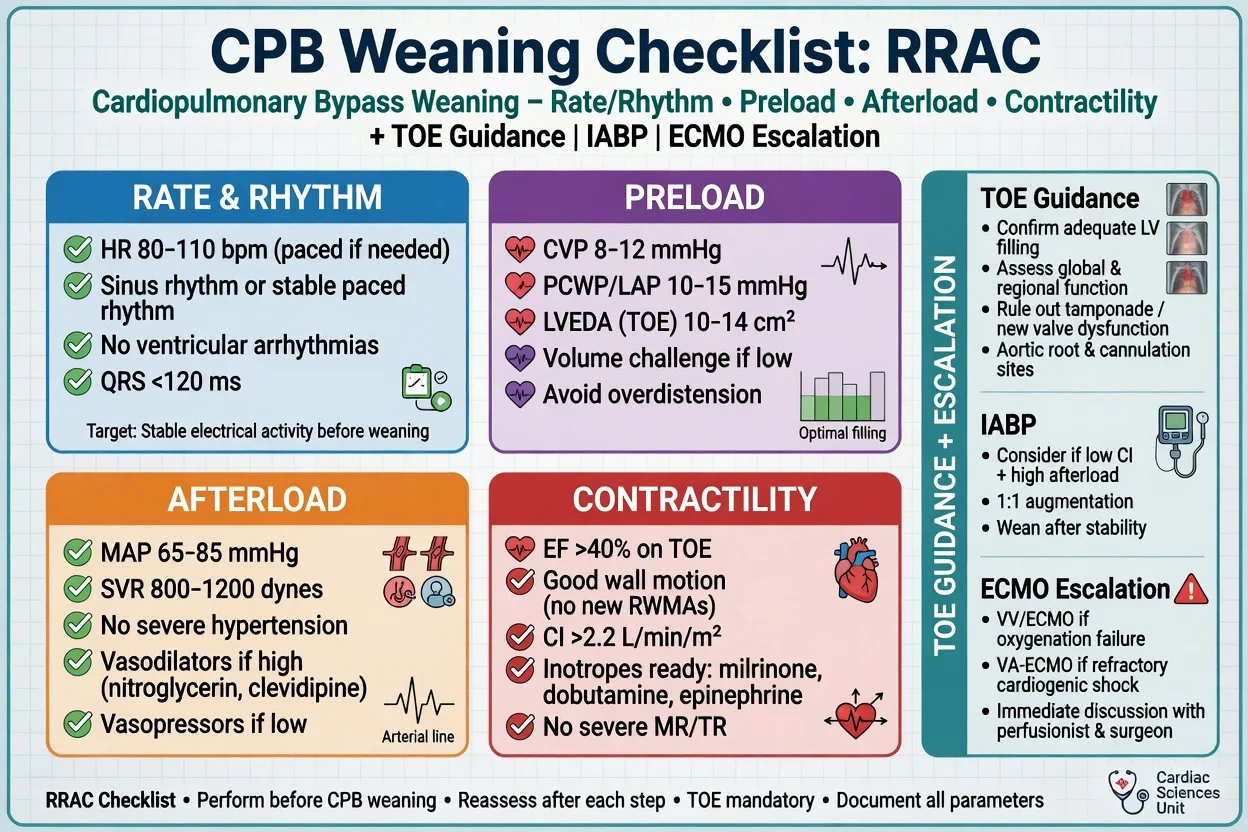
Wean only when: temperature adequate, electrolytes/acid-base acceptable, rhythm preferably sinus or paced, lungs de-aired and ventilating, surgical haemostasis reasonable, inotropes prepared. [1]
RRAC — unable to wean
Escalation: IABP for LV afterload reduction and diastolic augmentation; temporary VAD; VA-ECMO for refractory cardiogenic shock; inhaled pulmonary vasodilators for RV failure with high PVR. LVAD/temporary support populations need dedicated planning.[4]
Coagulation after CPB
Bypass causes platelet dysfunction, factor dilution/consumption, residual heparin, hyperfibrinolysis, and hypothermia effects. Use viscoelastic testing (ROTEM/TEG) plus ACT and standard labs. Antifibrinolytics (tranexamic acid) are routine in many units. Cell salvage reduces allogeneic red-cell need. TRICS III (Mazer et al., NEJM 2017) found a restrictive red-cell transfusion strategy non-inferior to a liberal strategy for the composite outcome in moderate-to-high-risk cardiac surgery — quote institutional Hb triggers but name the trial.[1]
Off-pump CABG and hybrid/interventional
OPCAB avoids CPB but challenges haemodynamics during heart positioning — deep pericardial sutures, stabilisers, vasopressors, trendelenburg, communication with surgeon. Interventional suite: TAVI (pacing, hypotension on deployment, vascular access complications), MitraClip, EP labs — different crisis set (tamponade, stroke, access bleeding). [1]
Crisis bank
- Unable to wean from CPB — RRAC + TOE + mechanical support.
- Protamine reaction — stop drug, support RV/SVR, consider return to bypass.
- Massive air embolism — Trendelenburg, stop pump per protocol, de-air, hyperoxia, consider arrest/cooling protocols with perfusion.
- Aortic dissection on cannulation — emergency surgical management, cerebral protection strategy.
- HIT needing urgent CPB — alternative anticoagulant pathway.
- Postoperative tamponade — equalisation of pressures, shock, emergency resternotomy.
- Vasoplegia post-CPB — noradrenaline, vasopressin, methylene blue in refractory cases.
- Malignant hyperthermia / hyperkalaemic arrest in field (rare but examined). [1]
Landmark trials and standards
| Item | Takeaway |
|---|---|
| TRICS III | Restrictive transfusion non-inferior in cardiac surgery.[1] |
| ASE/SCA TOE guidelines | Standard views and comprehensive exam |
| ANZCA PS46 | Perioperative echo training/accreditation |
| STS/SCA risk models | Risk communication |
| POISE / DECREASE context | Beta-blockade lessons (more non-cardiac, but viva crossover) |
| Protamine reviews | Reaction patterns and alternatives |
Regional practice deltas
ANZ. ANZCA PS46 shapes TOE credentialing language in viva. Metaraminol and noradrenaline both common; milrinone widely used for RV/LV support. State your unit ACT target and protamine ratio.
SAQ answer scaffold
Stem: "Coming off bypass after CABG, MAP 50, RV distended on TOE. Outline management." [1]
- Call out the problem; 100% O2; communicate with surgeon/perfusion.
- Rhythm/rate — pace A-V sequentially if needed.
- RV failure package — reduce PVR (avoid hypoxia/hypercarbia/acidosis), pulmonary vasodilators, inotrope with inodilation (milrinone), noradrenaline for SVR, consider opening chest wider / check grafts.
- Preload — not overloaded; TOE-guided volume.
- Escalate — return to full bypass, IABP if LV also fails, VA-ECMO if refractory.
- Exclude — air, ischaemia, tamponade physiology, technical surgical issues. [1]
Viva stem bank
- "List the CPB circuit in order from venous to arterial cannula."
- "Heparin dose and ACT target before bypass."
- "How does cardioplegia work and what are the delivery routes?"
- "Unable to wean — structured approach."
- "Types of protamine reaction and immediate management."
- "Basic TOE views you would obtain for MR repair assessment."
- "TRICS III — what did it show?" [1]
Common traps
- Going on bypass with inadequate ACT.
- Pushing protamine fast "because the surgeon is waiting."
- Weaning without temperature/electrolytes corrected.
- Treating CVP as true preload without TOE.
- Ignoring RV when LV looks fine on pressors alone.
- Liberal transfusion without viscoelastic guidance or trial-aware thresholds. [1]
On-pump CABG
- Still field
- Cardioplegia needed
- CPB inflammatory hit
- TOE for weaning
Off-pump CABG
- No CPB
- Positioning instability
- Stabilisers
- Pressor-ready
Crisis path
- RRAC wean failure
- Protamine reaction
- Air embolism
- ECMO escalate
Preoperative cardiac assessment (hub level)
For the elective cardiac surgical patient the anaesthetist integrates coronary anatomy, ventricular function, valve lesions, pulmonary pressures, renal function, neurological status, and frailty. Continue beta-blockers and statins in most pathways; manage antiplatelets with the surgical bleeding plan (aspirin often continued, P2Y12 timing institutional). For non-cardiac surgery in the cardiac patient, RCRI and functional capacity remain cross-links — but this hub focuses on the CPB operating theatre. [1]
Critical aortic stenosis for non-cardiac surgery is a related viva: fixed cardiac output, avoid tachycardia and sudden afterload collapse, arterial line, careful induction — see comorbid/elderly and vascular hubs for depth. [1]
Deep hypothermic circulatory arrest (awareness level)
Arch and some congenital repairs use DHCA or selective antegrade cerebral perfusion. Anaesthetic implications: cooling strategy, glycaemic control, haematocrit management, alpha-stat vs pH-stat debates in deep hypothermia, cerebral protection packages, and slow rewarming. Exact protocols are unit-specific; the exam wants recognition that the brain is at ischaemic risk and that communication with perfusion and surgeon is continuous. [1]
TOE decision examples (viva currency)
- Coming off bypass with low MAP and empty LV on TOE → give volume, not only pressors.
- SAM after mitral repair → volume, stop inotropes that empty the LV, increase afterload carefully, surgical review.
- New RWMA after CABG → tell surgeon, consider graft revision, support coronary perfusion pressure.
- Severe RV dilation and underfilled LV → RV failure package, not pure volume overload. [1]
Red flags
[1] [1] [1] [1] [1]References
- [1]Mazer CD, Whitlock RP, Fergusson DA, et al. Restrictive or Liberal Red-Cell Transfusion for Cardiac Surgery N Engl J Med, 2017.PMID 29130845
- [2]Levy JH, Ghadimi K, Kizhakkedathu JN, Iba T What's fishy about protamine? Clinical use, adverse reactions, and potential alternatives J Thromb Haemost, 2023.PMID 37062523
- [3]Fraile-Gutiérrez V, et al. Transesophageal echocardiography: A comprehensive assessment of the critically ill patient Med Intensiva (Engl Ed), 2026.PMID 42020231
- [4]Bottiroli M, et al. Perioperative Management of Patients With Durable and Temporary Left Ventricular Assist Devices Undergoing Non-Cardiac Surgery: A Comprehensive Review J Cardiothorac Vasc Anesth, 2026.PMID 42350177