Anaes · Anaesthesia for the elderly and the co-morbid patient
Anaesthesia for the elderly and the co-morbid patient
Also known as Geriatric anaesthesia · Frailty · Polypharmacy · Postoperative delirium · Postoperative cognitive dysfunction · Pharmacokinetics of ageing · Comprehensive geriatric assessment · CPET in the elderly · Elderly emergency laparotomy
The elderly and the co-morbid patient is the largest and the highest-risk group in the modern operating theatre. The framework rests on the physiological changes of ageing (the loss of the homeostatic reserve in every organ system), the altered pharmacokinetics and the pharmacodynamics (the increased sensitivity and the reduced clearance), the frailty and the sarcopenia (the strongest predictor of the outcome), the polypharmacy, the preoperative assessment (the CPET and the comprehensive geriatric assessment), the individualised choice of the technique, the high-mortality elderly emergency laparotomy, and the postoperative neurocognitive disorders (the delirium and the postoperative cognitive dysfunction).
On this page & tools
Your progress
Saved locally on this device.
Target exams
Red flags
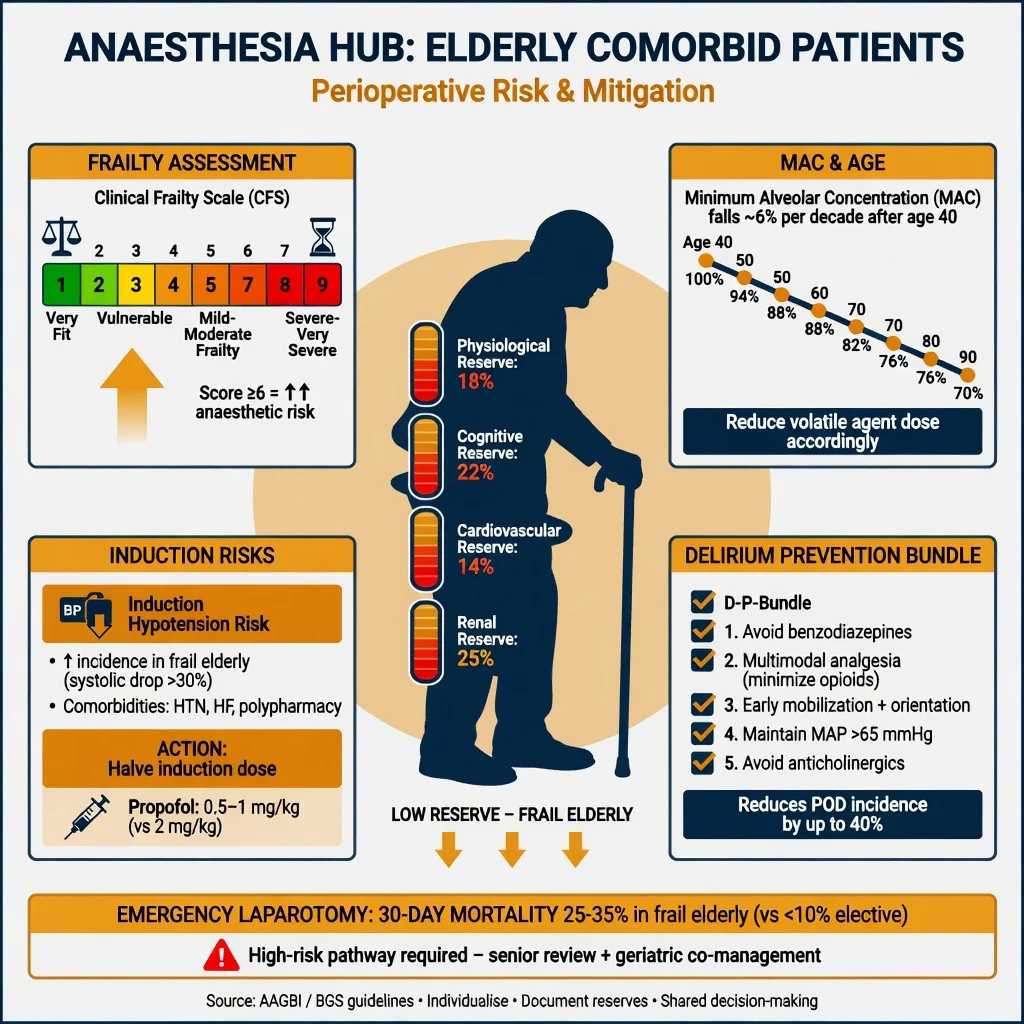
Overview and the scale of the problem
Anaesthesia for the elderly and the co-morbid patient is the care of the patient with the reduced physiological reserve, the accumulated chronic disease, and the polypharmacy. The elderly — conventionally those over 65, with the very old (over 85) the fastest-growing group — now account for more than half of all surgical activity and a disproportionate share of perioperative mortality. The mastery of geriatric anaesthesia rests on three premises. First, that ageing erodes the homeostatic reserve of every organ system long before disease declares itself, so that a "fit" eighty-year-old has nothing like the reserve of a fit thirty-year-old once a stressor is applied. Second, that frailty — a distinct syndrome of cumulative decline — predicts the postoperative outcome more powerfully than the chronological age, the ASA grade, or the cardiac risk index. Third, that the cognitive and the functional endpoints (delirium, cognitive decline, loss of independence, new institutionalisation) matter to the elderly patient at least as much as survival, and that they are partly preventable.[1][13]
The mortality figures concentrate the mind. The elective perioperative mortality in the over-eighties is several-fold that of the general surgical population, but it is the emergency surgery — above all the elderly emergency laparotomy — that is the killer. The National Emergency Laparotomy Audit (NELA) in the United Kingdom repeatedly shows a thirty-day mortality in the over-eighties of around fifteen to twenty per cent, and frailty amplifies this several-fold; longer-term survival is dominated by the frailty status rather than the operative details.[11] The anaesthetist's task is therefore not merely to deliver a safe anaesthetic but to act as the perioperative physician: to assess the reserve, to quantify the frailty, to optimise the co-morbidities, to individualise the technique, to prevent the delirium, and to preserve the independence — and, where the operation cannot achieve a meaningful goal, to say so.
The physiological changes of ageing — the loss of the reserve
Ageing reduces the functional reserve of every organ system even in the absence of disease. The resting function is often preserved; it is the ability to respond to a stressor that is lost. The anaesthetic relevance is that induction hypotension, postoperative pneumonia, acute kidney injury, and delayed drug clearance are all far more likely, and far less well tolerated, in the older patient.[1]
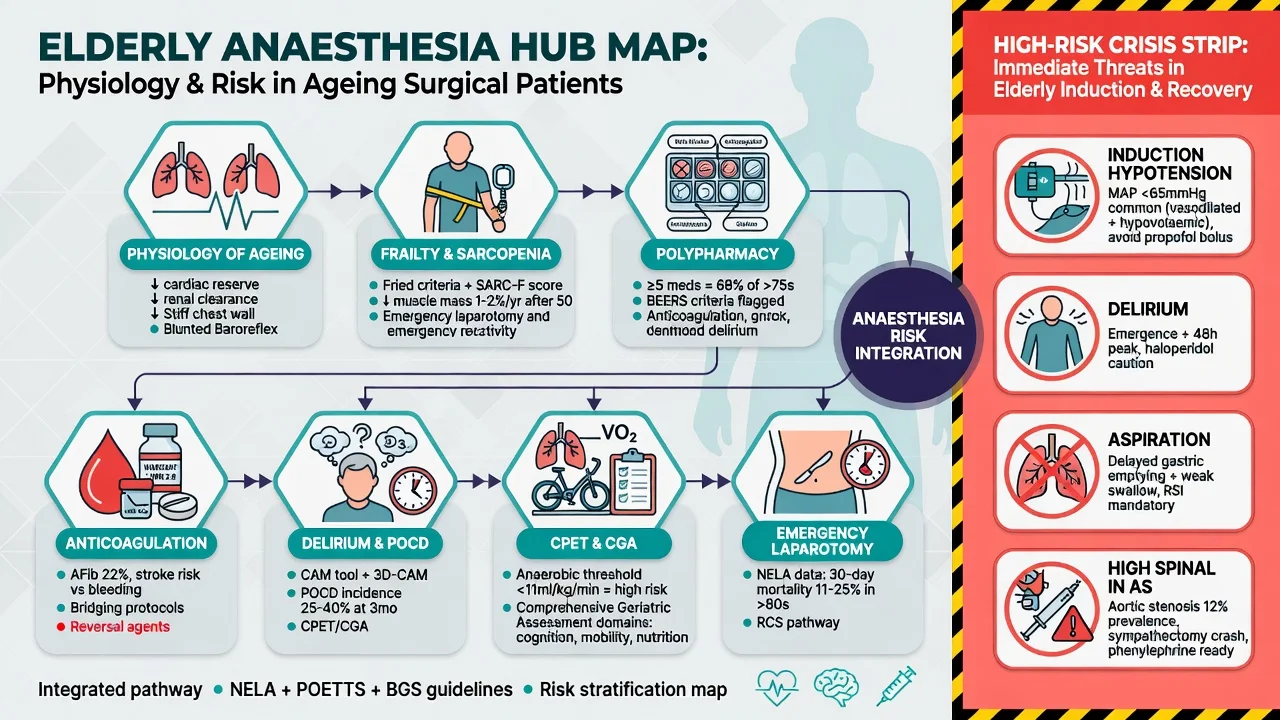
The cardiovascular system
The cardiovascular changes of ageing are the most examined in the fellowship and the most relevant to induction hypotension. [1]
- The stiff large arteries. The elastin of the aorta and the large conductance vessels degrades and is replaced by collagen, so the aorta becomes stiff. The stiff aorta cannot expand to accommodate the stroke volume, so the systolic pressure rises (the windkessel effect is lost) and the diastolic pressure falls (no elastic recoil to sustain it). The pulse pressure widens, and the systolic hypertension of the elderly is largely a mechanical phenomenon of the stiff aorta, not a disease of the microcirculation. The isolated systolic hypertension with a wide pulse pressure is the classic haemodynamic signature of the aged vasculature.
- The left ventricular hypertrophy and the diastolic dysfunction. The stiff aorta raises the afterload, and the left ventricle hypertrophies concentrically and stiffens. The stiff ventricle is slow to relax in diastole, so the early filling is impaired and the atrial contribution to the filling (the "atrial kick") rises from about fifteen to over thirty per cent of the stroke volume. The ventricle becomes preload-dependent and rate-dependent — the atrial fibrillation, the loss of the atrial kick, and the tachycardia that shortens the diastolic filling time all precipitate the heart failure. The implication for the anaesthetist is that the elderly ventricle tolerates the volume overload (it floods) and the volume depletion (it collapses) equally poorly, and the atrial fibrillation is a much greater haemodynamic insult than in the young.
- The blunted beta-adrenergic response. The beta-receptor density and the post-receptor signalling decline, so the chronotropic and the inotropic response to the endogenous catecholamines (and to the exogenous isoprenaline or dobutamine) is blunted. The maximum heart rate falls by about one beat per minute per year (the age-predicted maximum is 220 minus the age). The implication is that the elderly patient cannot mount the tachycardic response to the hypovolaemia or the vasodilatation, so the induction hypotension is not rescued by a reflex tachycardia and may deepen catastrophically.
- The conduction system fibrosis. The sick sinus syndrome, the atrioventricular block, the bundle branch blocks, and the atrial fibrillation all become common, and the resting heart rate falls. A pre-existing pacemaker or the implantable defibrillator must be checked and magnet-managed.
- The autonomic baroreflex. The baroreceptor reflex blunts, so the postural and the post-induction hypotension is more pronounced and less well corrected. [1]
The net is that the resting cardiac output is preserved (it is maintained by the stroke volume, helped by the mild hypertension), but the response to the stress — the tachycardia, the inotropy, the vasoconstriction — is diminished. The induction hypotension is the single most common haemodynamic crisis in the elderly, and it is the precipitant of the myocardial injury, the fall, the delirium, and the stroke. [1]
The respiratory system
- The closing capacity encroaches on the functional residual capacity. The most important single change. The FRC falls slightly and the closing capacity (the lung volume at which the small airways begin to close) rises, so the closing capacity exceeds the FRC in the supine elderly patient (it crosses the FRC at about 45 years supine, 65 years erect). The dependent airways therefore close during the normal tidal breathing, the dependent lung collapses into the shunt, and the elderly desaturate rapidly during the apnoea of induction. The preoxygenation must be meticulous and prolonged, and the apnoeic oxygenation (the transnasal humidified rapid-insufflation ventilatory exchange, THRIVE) extends the safe apnoea time.
- The chest wall stiffens, the lungs become more compliant. The rib-cage calcifies and the intercostal muscles weaken (the barrel chest), so the chest wall compliance falls, while the alveolar compliance rises (the loss of the elastic recoil). The diaphragm therefore does more of the work, the functional residual capacity and the residual volume rise slightly, and the vital capacity and the expiratory reserve volume fall. The weak respiratory muscles and the weak cough (the sarcopenia) raise the postoperative pneumonia risk.
- The hypoxic and the hypercapnic ventilatory response falls. The hypoxic ventilatory drive falls by about fifty per cent and the hypercapnic response also declines. The elderly do not hyperventilate in response to the hypoxia as vigorously as the young, so the postoperative opioid-induced respiratory depression is more dangerous and less heralded.
- The upper-airway obstruction. The reduced pharyngeal tone raises the risk of the obstructive sleep apnoea and the post-extubation airway obstruction. [1]
The central nervous system
- The cerebral atrophy. The brain mass falls (about ten per cent by the age of eighty), the cortical sulci widen, and the ventricles enlarge. The cognitive reserve falls, so the same insult (the inflammation, the hypoperfusion, the drug) causes a larger cognitive deficit. The dementia (often undiagnosed) is the strongest risk factor for the postoperative delirium.
- The minimum alveolar concentration (MAC) falls. The MAC of every volatile agent falls by about six per cent per decade after the age of forty (a halving of the rate per year). An eighty-year-old requires about seventy per cent of the MAC of a forty-year-old; a ninety-year-old about sixty per cent. The opioid and the benzodiazepine sensitivity also rise. The implication is the dose reduction of every anaesthetic agent and the role of the processed EEG (the bispectral index, the patient-state index, the spectrogram) to avoid the over-sedation.
- The autonomic dysregulation. The thermoregulation blunts (see below), and the postoperative shivering and the hypothermia are more pronounced. [1]
The renal system
- The glomerular filtration rate falls by about one millilitre per minute per year after the age of forty (the loss of the cortical nephrons). The concentrating ability falls (the nocturia of the elderly) and the diluting ability falls, so the elderly tolerate the volume overload and the dehydration equally poorly. The creatinine trap: the serum creatinine underestimates the renal dysfunction because the muscle mass (and therefore the creatinine production) falls in parallel with the GFR — an eighty-year-old with a creatinine of ninety micromoles per litre may have a substantially impaired GFR. The Cockcroft-Gault and the CKD-EPI formulas (which include the age) are the correct estimates; use them, and dose the renally-cleared drugs (the gentamicin, the enoxaparin, the digoxin, the morphine metabolites) accordingly.
- The renin-angiotensin-aldosterone response blunts, so the elderly cannot conserve the sodium in the dehydration or excrete it in the overload. The perioperative acute kidney injury is more common and more severe, and the contrast nephropathy and the obstructive nephropathy compound it. [1]
The hepatic system
- The liver mass and the hepatic blood flow fall (the mass by about twenty-five to forty per cent, the blood flow by about ten per cent per decade). The phase I (the oxidative, the CYP450) metabolism slows, while the phase II (the conjugation) is preserved. The implication is that the phase-I-dependent drugs (the diazepam, the midazolam partly, the morphine partly, the lidocaine, the bupivacaine, the rocuronium) last longer, while the phase-II drugs (the lorazepam, the oxazepam, the atracurium, the remifentanil) are largely spared. The albumin falls (the malnutrition and the chronic inflammation) and the alpha-1-acid glycoprotein rises (the acute phase), so the free fraction of the highly-bound drugs (the diazepam, the phenytoin) rises and falls accordingly. [1]
The thermoregulation
- The basal metabolic rate falls (the sarcopenia and the lower thyroxine), the vasoconstriction blunts, and the shivering threshold falls, so the elderly become hypothermic faster and re-warm slower during the anaesthesia. The hypothermia compounds the coagulopathy, the wound infection, the prolonged drug action, and the shivering-induced myocardial ischaemia. The active warming (the forced-air warmer, the fluid warmer, the raised theatre temperature) is mandatory from the moment of induction. [1]
The pharmacokinetics and the pharmacodynamics of ageing
The ageing alters both the handling of the drug (the pharmacokinetics) and the sensitivity to it (the pharmacodynamics).[1]
The pharmacokinetic changes. [1]
- The distribution. The total body water and the lean body mass fall, so the volume of distribution of the water-soluble drugs (the propofol, the thiopental, the non-depolarising relaxants) is smaller and the initial (peak) concentration after a bolus is higher — hence the dose reduction. The body fat rises (the relative adiposity), so the volume of distribution of the lipid-soluble drugs (the diazepam, the fentanyl, the thiopental, the volatile stored in the fat) is larger, the redistribution and the fat storage prolong the duration, and the accumulation with the repeated dosing or the infusion is the rule (the context-sensitive half-time lengthens). The plasma albumin falls (the less-bound free fraction of the acidic drugs rises) and the alpha-1-acid glycoprotein rises (the less-bound free fraction of the basic drugs falls); the net effect on the highly-bound drug is variable but the clinical relevance is for the narrow-therapeutic-index drugs.
- The clearance. The hepatic and the renal clearance both fall in parallel with the organ mass and the blood flow. The context-sensitive half-time of every infusion drug lengthens, and the recovery from the TIVA (the propofol, the remifentanil — the remifentanil is an exception, organ-independent metabolism) and from the benzodiazepine is delayed. The renally-cleared drugs and the active metabolites (the morphine-6-glucuronide, the norpethidine, the diazepam metabolites, the vecuronium) accumulate and the recovery is dangerously prolonged. [1]
The pharmacodynamic changes. [1]
- The MAC of the volatile falls by six per cent per decade after the age of forty. The opioid and the benzodiazepine sensitivity rise (the increased receptor sensitivity and the reduced cognitive reserve). The propofol and the thiopental produce the same bispectral index at a lower plasma concentration, and the haemodynamic effect (the hypotension) is greater. The sensitivity to the neuromuscular blocker is little changed, but the clearance of the aminosteroid relaxants (the rocuronium, the vecuronium) is slowed; the atracurium and the cisatracurium (the organ-independent Hofmann elimination) are the logical choices in the renal and the hepatic impairment. [1]
The practical dosing principles. Halve the induction dose and titrate to the effect (the propofol one to one-and-a-half milligrams per kilogram, the thiopental two to three milligrams per kilogram, the etomidate zero-point-two milligrams per kilogram — the etomidate preserves the haemodynamics but the adrenal suppression is the caveat). Choose the short-acting, the organ-independent agents: the propofol, the remifentanil, the sevoflurane or the desflurane, the atracurium or the cisatracurium, the sugammadex (over the neostigmine — avoids the residual blockade and the anticholinergic load, with a better early cognitive recovery). Avoid the long-acting sedatives (the diazepam, the nitrazepam) and the active-metabolite drugs (the morphine in the renal impairment, the pethidine with the norpethidine seizures). Use the processed EEG (the BIS, the spectrogram) to titrate the depth and to avoid the over-sedation, which is the deep-anaesthesia hypothesis of the postoperative delirium. Review the long-term medication (the beta-blocker, the statin, the antihypertensive, the anticoagulant) for the continuation, the hold, and the dose adjustment.[1]
The frailty and the sarcopenia
Frailty is the distinct clinical syndrome of the increased vulnerability to the stressor, the consequence of the cumulative decline across the multiple physiological systems. It is the most important concept in the geriatric anaesthesia because it predicts the postoperative mortality, the morbidity, the length of stay, the institutional discharge, the loss of the independence, and the delirium — and it does so more powerfully than the chronological age, the ASA grade, or the revised cardiac risk index.[2][13]
The phenotype (Fried). Fried and colleagues defined the frailty phenotype as the presence of three or more of: the unintentional weight loss, the self-reported exhaustion, the weak grip strength, the slow walking speed, and the low physical activity. The presence of one or two is the pre-frailty; none is the robust. The phenotype is a powerful predictor of the incident disability, the fall, the hospitalisation, and the mortality.[2]
The Clinical Frailty Scale (Rockwood). The Clinical Frailty Scale (CFS) is the nine-point (one to nine) pictorial scale, used at the bedside, that classifies the patient from the very fit (one) through the vulnerable (three to four) and the mildly, moderately, and severely frail (five to seven) to the very severely frail (eight) and the terminal illness (nine). It is the single most useful frailty tool in the busy surgical assessment because it takes a minute, requires no equipment, and predicts the thirty-day and the longer-term mortality, the institutional discharge, and the complications — in the emergency laparotomy, the frailty dominates the outcome.[3][11]
The Edmonton Frail Scale. A more detailed, fifteen-item, multidimensional assessment (the cognition, the general health status, the functional independence, the social support, the medication use, the nutrition, the mood, the continence, the functional performance) performed in about ten minutes; useful in the elective assessment and the comprehensive geriatric assessment. [1]
The sarcopenia. The loss of the skeletal muscle mass and the strength is the substrate of the frailty and the independent predictor of the fall, the fracture, the postoperative pneumonia (the weak cough), and the mortality. The psoas-mass measurement on the CT (the sarcopenia) is increasingly used to predict the outcome after the major and the emergency surgery. The frailty and the sarcopenia are modifiable — the prehabilitation (the exercise, the nutrition, the psychological support) improves the functional outcomes in the frail older adults. [1]
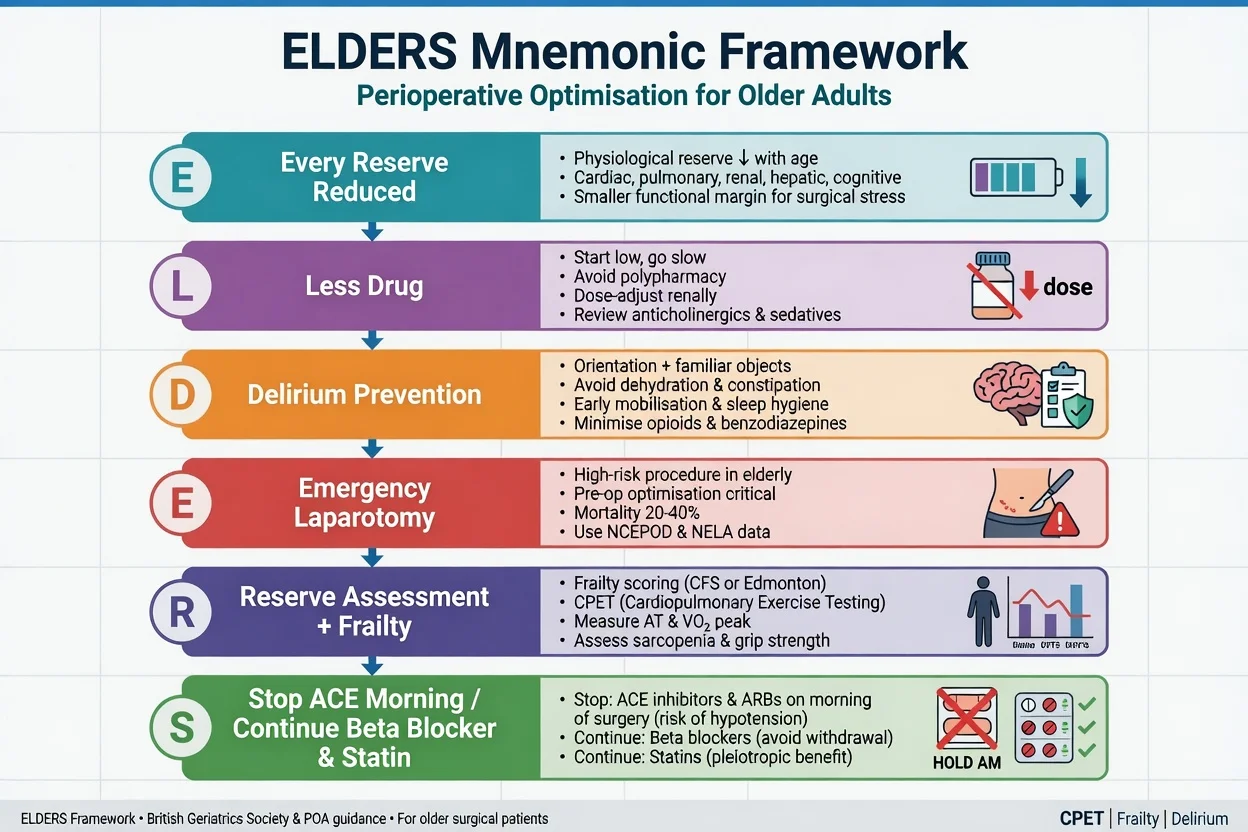
The polypharmacy and the drug interactions
The elderly surgical patient takes on average five to ten long-term medications, and the polypharmacy (the ten or more, or the prescription beyond the evidence) is the independent predictor of the adverse drug event, the drug interaction, the fall, the delirium, and the readmission. The Beers criteria (the American Geriatrics Society) list the potentially inappropriate medications for the older adult — the long-acting benzodiazepines, the anticholinergics, the first-generation antihistamines, the long-acting sulphonylureas, the non-steroidal anti-inflammatories in the chronic kidney disease, the oxybutynin — and the perioperative medication review is the essential step. [1]
The principles of the perioperative medication review. [1]
- Continue the essential drugs that prevent the rebound or the destabilisation: the beta-blockers (continue — but the POISE trial warns against the acute high-dose initiation, which causes the stroke and the bradycardia), the statins, the anti-Parkinson drugs (the patient must swallow or the nasogastric dose, never withheld), the thyroid replacement, the antiepileptics, the immunosuppressants.[10]
- Hold the drugs that cause the perioperative harm: the diuretics on the morning of surgery (the hypovolaemia), the angiotensin-converting-enzyme inhibitors and the angiotensin-receptor blockers (the induction hypotension — the most evidence-based hold), the metformin and the SGLT2 inhibitors on the morning (the acidosis risk, the euglycaemic ketoacidosis of the SGLT2), the oral hypoglycaemics generally.
- Adjust the renally-cleared and the hepatically-cleared drugs for the organ function.
- Deprescribe the harmful or the unnecessary drugs: the benzodiazepines, the anticholinergics, the long-acting opioids, the duplicate agents. The deprescribing is a careful, tapering process, ideally begun weeks before the elective surgery.
- Manage the anticoagulants and the antiplatelets (below).
The anticoagulated and the antiplatelet patient
The elderly often take the anticoagulants (the warfarin for the atrial fibrillation or the mechanical valve, the direct oral anticoagulants for the atrial fibrillation or the venous thromboembolism) and the antiplatelets (the aspirin, the clopidogrel, the ticagrelor — for the coronary stent or the cerebrovascular disease). The perioperative management balances the thrombosis risk (the stroke, the valve thrombosis, the stent thrombosis, the venous thromboembolism) against the bleeding risk (the surgical site, the neuraxial). [1]
- The direct oral anticoagulants (the dabigatran, the rivaroxaban, the apixaban). The predictable pharmacokinetics and the short half-life mean that the bridging is usually unnecessary. Stop the apixaban and the rivaroxaban forty-eight hours (two doses) before the high-bleeding-risk surgery, the dabigatran longer in the renal impairment; resume six to seventy-two hours after the haemostasis, the timing by the bleed risk. The idarucizumab reverses the dabigatran; the andexanet alfa and the prothrombin complex concentrate reverse the factor-Xa inhibitors in the emergency.
- The warfarin. The INR must be normalised (under 1.5 for the major surgery) — stop the warfarin five days before. The heparin bridging (the low-molecular-weight heparin or the intravenous unfractionated heparin) is reserved for the high-thrombosis-risk patient (the mechanical mitral valve, the recent stroke, the recent venous thromboembolism); the BRIDGE trial showed that the atrial fibrillation patient does NOT benefit from the bridging (the bleeding rises, the stroke does not fall). The vitamin K and the prothrombin complex concentrate reverse the warfarin in the emergency.
- The antiplatelets and the coronary stent. The aspirin is continued for the cardiac protection unless the surgery is the closed space (the intracranial, the posterior chamber of the eye). The dual antiplatelet therapy after the coronary stent (the drug-eluting stent — at least six to twelve months; the bare-metal stent — at least six weeks) must NOT be stopped prematurely: the stent thrombosis carries a fifty-per-cent mortality. Coordinate with the cardiologist; defer the elective non-cardiac surgery until the dual antiplatelet can be safely reduced to the aspirin alone. [1]
The preoperative assessment — the CPET, the CGA, and the shared decision
The preoperative assessment of the elderly goes beyond the cardiac risk stratification to the quantification of the reserve and the frailty. [1]
The cardiopulmonary exercise testing (CPET). The CPET measures the aerobic capacity (the anaerobic threshold, the peak oxygen consumption, the ventilatory equivalent for the carbon dioxide) on the cycle ergometer. The anaerobic threshold under eleven millilitres per kilogram per minute, the peak oxygen consumption under fifteen, and the raised ventilatory equivalent identify the high-risk patient for the major surgery — the CPET predicts the postoperative morbidity and the mortality, and it is the gold-standard objective measure of the physiological reserve.[12] It is most used before the major elective colorectal, the oesophagogastric, the hepatic, the cystectomy, and the thoracic surgery, where it informs the decision to operate, the surgical approach, and the level of the postoperative care.
The comprehensive geriatric assessment (CGA). The CGA is the multidimensional, interdisciplinary assessment of the medical, the psychological, the functional, and the social domains, leading to the individualised plan. In the elective and the emergency elderly surgical patient, the CGA (the comprehensive geriatric assessment) reduces the mortality, the complications, the length of stay, and the institutional discharge. It is delivered by the geriatrician-led team and is the cornerstone of the perioperative medicine for the older adult. [1]
The shared decision-making and the advance care planning. The realistic goals (the survival, the function, the quality of life), the discussion of the burdens and the benefits, the advance directive, the goals-of-care conversation, and the documentation of the patient's values are central to the geriatric surgery. The decision not to operate (the conservative or the palliative path) is a legitimate and often the right outcome for the very frail elderly patient with the high-mortality surgery (the emergency laparotomy, the ruptured aneurysm). The "what matters to you" question is more useful than the "what is the matter with you" question.[13]
The risk tools. The revised cardiac risk index, the NSQIP surgical risk calculator, the Portsmouth-POSSUM, the SORT (the Surgical Outcome Risk Tool), the Nottingham Hip Fracture Score, and the NELA risk model — the risk tools quantify the probability of the mortality and the morbidity and inform the decision and the consent. None captures the frailty as well as the Clinical Frailty Scale, which should be added to every risk assessment.[11]
The choice of the anaesthetic technique
The choice between the general and the regional anaesthesia (the neuraxial, the peripheral nerve block), and between the TIVA and the volatile, in the elderly is individualised to the patient, the surgery, and the goal. [1]
Regional versus general anaesthesia. The regional anaesthesia (the spinal, the epidural, the fascial-plane block, the peripheral nerve block) reduces the respiratory complications, the opioid use, the ileus, and the venous thromboembolism in some settings, and may reduce the delirium and the cognitive decline. The hip-fracture surgery is the classic indication (the spinal anaesthesia, the fascia-iliaca block) and the regional analgesia combined with the light general is often optimal. But the general anaesthesia is not inferior to the regional for most outcomes in the modern trials; the choice is driven by the patient's preference, the cooperation, the airway, the surgery, and the contraindications to the neuraxial (the anticoagulation, the infection, the fixed cardiac output state, the aortic stenosis where the sympathectomy is poorly tolerated). The combined approach (the regional for the analgesia plus the light general anaesthesia) is often the optimal — the opioid-sparing analgesia reduces the delirium and the pneumonia. [1]
TIVA versus the volatile. The TIVA (the propofol and the remifentanil target-controlled infusion) and the volatile (the sevoflurane, the desflurane) are both acceptable. The desflurane has the faster emergence but the greater haemodynamic effect and the coughing; the sevoflurane is the smooth. The propofol-based TIVA avoids the greenhouse-gas pollution and may reduce the postoperative nausea and vomiting. The processed EEG is essential to titrate the TIVA in the elderly (the over-sedation is the silent danger). The deep anaesthesia hypothesis (the deep BIS, the low minimum alveolar concentration) is associated with the delirium and the mortality, but the randomised trials are not uniformly supportive.[6][7]
The depth monitoring. The processed electroencephalogram (the bispectral index, the patient-state index, the density spectral array) avoids the over-sedation and may reduce the delirium in the high-risk elderly; the burst suppression is to be avoided. The bispectral index between forty and sixty is the target.[6]
The haemodynamic management. The induction hypotension is the danger — the slow titration, the vasopressor ready (the metaraminol, the phenylephrine, the noradrenaline), the goal-directed haemodynamic therapy (the stroke-volume optimisation, the mean arterial pressure within ten per cent of the baseline), and the avoidance of the prolonged hypotension (which causes the myocardial injury, the kidney injury, the stroke, and the delirium). The coronary perfusion depends on the diastolic pressure, which is already low in the stiff-aorta elderly — the cautious vasopressor to defend the diastolic is rational. [1]
The specific co-morbidities
The cardiac disease (the ischaemic heart disease, the heart failure, the valvular disease, the atrial fibrillation) is the commonest and the highest-risk co-morbidity. The continuation of the beta-blockers and the statins, the avoidance of the hypotension and the tachycardia (the supply-demand mismatch of the type-2 myocardial infarction), the surveillance for the myocardial injury after the non-cardiac surgery (the troponin, the MINS), the goal-directed haemodynamic therapy, and the early cardiology involvement for the new ischaemia. The severe aortic stenosis is the classic "fixed cardiac output state" — the careful maintenance of the sinus rhythm, the preload, the afterload, and the contractility (avoid the vasodilatation, the tachycardia, and the hypovolaemia). The POISE trial taught that the acute high-dose beta-blockade is harmful (the stroke and the bradycardia), but the continuation of the chronic beta-blockade is essential and the withdrawal is dangerous.[10]
The respiratory disease (the COPD, the obstructive sleep apnoea, the smoking history). The preoperative optimisation (the smoking cessation at least four to six weeks, the bronchodilators, the pulmonary rehabilitation, the treatment of the infection), the protective intraoperative ventilation (the tidal volume six to eight millilitres per kilogram of the predicted body weight, the positive end-expiratory pressure, the recruitment), and the postoperative lung-expansion (the early mobilisation, the incentive spirometry, the high-flow nasal therapy, the continuous positive airway pressure for the sleep apnoea). [1]
The renal impairment. The dose-adjustment of the renally-cleared drugs, the avoidance of the nephrotoxins (the non-steroidal anti-inflammatories, the aminoglycosides, the contrast), the haemodynamic preservation (the mean arterial pressure within ten per cent of the baseline, the goal-directed therapy), the avoidance of the hyperchloraemic acidosis of the saline (the balanced crystalloid), and the surveillance for the acute kidney injury (the urine output, the creatinine, the KDIGO criteria). [1]
The diabetes and the metabolic. The perioperative glycaemic control (the target of six to ten millimoles per litre, the avoidance of the hypoglycaemia — more dangerous than the mild hyperglycaemia — and the severe hyperglycaemia above twelve that impairs the wound healing and the immunity). The management of the oral hypoglycaemics (the metformin held on the morning, the SGLT2 inhibitors held — the euglycaemic ketoacidosis — for the day of the surgery), the insulin (the variable-rate intravenous insulin infusion for the major surgery or the poor control), and the perioperative monitoring. The malnutrition and the obesity (the sarcopenic obesity — the obese with the low muscle mass — is the high-risk phenotype). [1]
The elderly emergency laparotomy
The elderly emergency laparotomy is the high-mortality index operation and the recurrent fellowship topic. The NELA audit reports the thirty-day mortality of about fifteen to twenty per cent in the over-eighties (rising to near thirty per cent in the very frail), the prolonged stay, and the high rate of the institutional discharge and the loss of the independence.[11]
The reasons for the high mortality are the convergence of every risk factor: the emergency (no time to optimise), the sepsis or the haemorrhage (the depleted reserve), the fluid shift and the third-space loss (the brittle haemodynamics), the open abdomen and the heat loss (the hypothermia), the prolonged surgery (the depth and the drug accumulation), and the postoperative atelectasis and the pneumonia (the weak cough). The frailty is the dominant predictor.[11]
The management principles. [1]
- The rapid assessment (the airway, the breathing, the circulation, the disability, the sepsis — the sepsis-six bundle for the perforation). The early resuscitation with the balanced crystalloid and the blood products; the avoidance of the excessive fluid (the fluid overload and the ileus). The vasopressor early (the noradrenaline) for the vasodilatory septic shock. The empirical broad-spectrum antibiotic and the source control.
- The senior anaesthetist and the surgeon. The consultant presence, the brief, the shared decision (the laparotomy or the conservative path — especially in the very frail), and the goals-of-care conversation with the patient and the family before the induction.
- The rapid sequence induction (the elderly with the ileus and the obstruction is the full stomach). The reduced dose of the induction agent (the ketamine or the etomidate in the shocked patient — preserve the haemodynamics), the suxamethonium or the high-dose rocuronium (with the sugammadex ready to reverse), the meticulous preoxygenation and the apnoeic oxygenation, the prepared vasopressor for the post-induction hypotension.
- The invasive monitoring (the arterial line, the central line, the cardiac output monitor in the high-risk), the warmed fluid and the forced-air warmer, the protective ventilation, the depth monitoring.
- The postoperative care. The level-two or the level-three (the intensive care) for the high-risk; the goal-directed haemodynamic therapy, the analgesia (the regional, the opioid-sparing multimodal, the avoidance of the patient-controlled analgesia in the confused), the DVT prophylaxis, the early nutrition (the enhanced recovery), the delirium prevention bundle, and the early mobilisation. The mortality review and the NELA audit submission. [1]
The postoperative delirium
The postoperative delirium is the acute, the fluctuating disturbance of the attention and the awareness, with the disorganised thinking and the altered arousal, developing hours to days after the surgery, and it is the most common and the most harmful complication of the geriatric anaesthesia — up to fifty per cent after the hip fracture and the major elective surgery in the high-risk elderly. The delirium predicts the longer stay, the complications, the falls, the pressure injuries, the new institutionalisation, the persistent cognitive decline, and the mortality.[13]
The risk factors (the predisposing and the precipitating — the delirium is the interaction of the vulnerable brain with the insult). [1]
- The predisposing (the patient): the older age, the cognitive impairment and the dementia (the strongest), the frailty, the sensory impairment (the poor vision, the poor hearing), the depression, the functional dependence, the prior delirium, the alcohol misuse, the polypharmacy.
- The precipitating (the perioperative): the drugs (the benzodiazepines, the anticholinergics, the long-acting opioids, the pethidine — avoid them all), the pain (the under-treated and the over-treated), the sleep disruption, the infection, the hypoxia, the hypotension, the metabolic disturbance (the hyponatraemia, the hypoglycaemia, the uraemia), the urinary catheter, the constipation, the immobilisation, the environment (the noisy, the unfamiliar, the lack of the windows). [1]
The prevention bundle. The delirium is partly preventable — the multicomponent, non-pharmacological intervention reduces the incidence by about a third. The Hospital Elder Life Program (HELP) is the prototype: the orientation, the therapeutic-activity programme, the sleep protection (the sleep-hygiene protocol, the noise reduction, the non-pharmacological sleep aid), the early mobilisation, the hearing and the vision aids, the hydration, the prevention of the constipation, and the minimisation of the sedatives. The tailored, family-involved HELP reduced the postoperative delirium and the functional decline in the randomised trial.[9]
The pharmacological prevention. Avoid the benzodiazepines (the strongest modifiable risk) and the anticholinergics. The dexmedetomidine prophylaxis was promising in the meta-analysis but the large randomised trial (Deiner, JAMA Surgery 2017) was negative — the dexmedetomidine did NOT reduce the delirium after the major non-cardiac surgery in the elderly.[8] The processed electroencephalogram to avoid the over-sedation (the deep anaesthesia) may reduce the delirium (Chan, the BIS-guided anaesthesia reduced the delirium and the cognitive decline at one year; the evidence is supportive but not unanimous).[6][7]
The treatment. The correction of the precipitant (the infection, the hypoxia, the metabolic disturbance, the urinary retention, the constipation), the supportive care (the oxygen, the hydration, the nutrition, the mobilisation, the orientation), the reassurance and the reorientation, the family at the bedside, the avoidance of the physical restraint. The low-dose antipsychotic (the haloperidol or the risperidone) ONLY for the severe agitation that endangers the patient or the staff (it does not change the outcome and may prolong the stay). The benzodiazepine is reserved for the alcohol or the benzodiazepine withdrawal. [1]
The postoperative cognitive dysfunction and the neurocognitive disorders
The postoperative cognitive dysfunction (POCD) is the subtler, the longer-lasting decline in the memory, the attention, and the executive function, detected only by the formal neuropsychological testing weeks to months after the surgery (it is NOT the bedside syndrome that the delirium is). The ISPOCD1 study (Moller, Lancet 1998) established the entity: the cognitive dysfunction at one week in about a quarter and at three months in about ten per cent of the elderly after the major non-cardiac surgery, associated with the older age, the longer anaesthesia, the lower education, the second operation, the postoperative infection, and the respiratory complications.[4] The longer-term trajectory (one to two years, ISPOCD2) showed the partial recovery, but the question of the permanent decline and the dementia remains debated.[14]
The 2018 nomenclature. The 2018 consensus (Evered and colleagues, endorsed by the major anaesthesia societies) replaced the heterogeneous terms (the postoperative cognitive dysfunction, the postoperative delirium, the early postoperative cognitive decline, the neurocognitive dysfunction) with a unified framework aligned to the DSM-5 neurocognitive disorders:[5]
- The acute postoperative neurocognitive disorder (the postoperative delirium) — hours to days, the bedside diagnosis.
- The early postoperative neurocognitive disorder (the former POCD) — up to thirty days, the formal neuropsychological testing.
- The delayed postoperative neurocognitive disorder (the former late POCD) — up to twelve months.
- The postoperative behavioural disturbance (the emergence agitation and the delirium of the recovery room). [1]
The relationship to the dementia. The question whether the anaesthesia and the surgery accelerate the dementia (the Alzheimer's disease) is unsettled — the observational association exists but the causality is not established; the intra-cerebral amyloid and the tau mechanisms are active research areas. The practical message for the consent is that the major surgery in the elderly carries a small but real risk of the persistent cognitive decline, especially in the already-impaired patient. [1]
The enhanced recovery (ERAS) in the elderly
The enhanced recovery after the surgery (ERAS) protocol — the evidence-based bundle of the perioperative interventions — is as applicable to the elderly as to the young, with modifications. The elements (the avoidance of the prolonged fasting, the carbohydrate drink up to two hours before, the goal-directed fluid therapy, the opioid-sparing multimodal analgesia, the early mobilisation, the early enteral nutrition, the avoidance of the drains and the tubes) reduce the length of stay, the complications, and the delirium. The elderly-specific modifications: the careful carbohydrate drink (the diabetes), the more aggressive delirium prevention, the more cautious opioid dosing, the attention to the frailty and the nutrition, and the early rehabilitation. The frailty and the ERAS are complementary — the prehabilitation before the surgery and the rehabilitation after. [1]
The end-of-life decisions
The anaesthetist for the very frail elderly patient is increasingly the physician who facilitates the conversation about the goals of care. The realistic discussion of the burdens and the benefits, the patient's values (the independence, the cognition, the dignity over the survival), the advance care plan, the decision to de-escalate or to palliate, the involvement of the family and the geriatrician and the palliative-care team — these are the skills of the modern perioperative physician. The "do not resuscitate" order does not preclude the surgery (the graded resuscitation), and the palliative surgery (the relief of the suffering without the curative intent) is a legitimate goal. The anaesthetist who says "this operation will not help this patient, and may harm them" is exercising the senior judgement that the elderly patient deserves.[13]
Red flags
[1] [1] [1] [1] [1] [1]Hub map and leaf depth
This page is the co-morbid and elderly hub (perioperative medicine crossover). Related depth: applied physiology of the elderly, acute pain multimodal, regional techniques for hip fracture, and trauma/emergency laparotomy pathways. [1]
| Domain | Examiner focus |
|---|---|
| Physiology of ageing | Reserve loss, MAC↓, closing capacity |
| Frailty / sarcopenia | CFS, Fried phenotype, outcome prediction |
| Polypharmacy / anticoagulants | Hold/continue rules, neuraxial timing |
| Delirium / PNCD | Prevention bundle, 2018 nomenclature |
| CPET / CGA | Risk communication, shared decisions |
| Emergency laparotomy | NELA-style mortality, senior care |
Crisis bank
- Profound induction hypotension in fixed cardiac output (AS).
- Postoperative delirium with self-harm risk.
- Residual neuromuscular block in frail elderly.
- High spinal in aortic stenosis.
- Aspiration with delayed gastric emptying / opioids.
- Acute kidney injury after major emergency surgery.
- Goals-of-care conflict mid-crisis. [1]
Regional practice deltas
ANZ. Comprehensive geriatric assessment pathways expanding; Clinical Frailty Scale widely taught. Metaraminol common for induction support; NELA-equivalent audit thinking for emergency laparotomy.
SAQ / viva scaffolds
SAQ: "84-year-old frail patient for emergency laparotomy. Outline anaesthetic priorities."
- Senior team, goals of care, sepsis source control urgency.
- RSI with reduced induction dose, vasopressor ready, arterial line early.
- Haemodynamic and renal protective strategy; temperature; glucose.
- Multimodal analgesia; ICU destination; delirium prevention from minute one.
- Family communication and realistic outcomes framed by frailty. [1]
Viva openers: MAC change with age; CFS; why creatinine misleads; ISPOCD; hold ACE or not; delirium bundle components. [1]
Summary and the exam tips
ELDERS — the framework for the elderly anaesthetic
The fellowship questions fall into the four clusters. The physiology (the cardiovascular, the respiratory, the renal, the hepatic, the central nervous system) is the Primary favourite — the MAC reduction, the closing capacity, the creatinine trap, the blunted beta-response. The pharmacology (the distribution, the protein binding, the clearance, the sensitivity) is the crossover question. The perioperative medicine (the frailty, the CGA, the CPET, the delirium, the POCD, the ERAS) is the Final favourite — the prevention bundle, the nomenclature, the shared decision. The emergency laparotomy (the NELA, the mortality, the frailty) is the hot case and the viva. The discriminating points are: the six-per-cent-per-decade MAC reduction, the creatinine trap and the Cockcroft-Gault, the closing capacity and the FRC, the induction hypotension and the held ACE inhibitor, the Clinical Frailty Scale, the delirium prevention bundle and the dexmedetomidine-negative Deiner trial, the ISPOCD1 numbers, the 2018 nomenclature, and the POISE trial on the beta-blockade. [1]
References
- [1]Coetzee E, et al. Pharmacokinetic and Pharmacodynamic Changes in the Elderly: Impact on Anesthetics Anesthesiol Clin, 2023.PMID 37516494
- [2]Fried LP, Tangen CM, Walston J, et al. Frailty in older adults: evidence for a phenotype J Gerontol A Biol Sci Med Sci, 2001.PMID 11253156
- [3]Rockwood K, Song X, MacKnight C, et al. A global clinical measure of fitness and frailty in elderly people CMAJ, 2005.PMID 16129869
- [4]Moller JT, Cluitmans P, Rasmussen LS, et al.; ISPOCD1 group. Long-term postoperative cognitive dysfunction in the elderly ISPOCD1 study. ISPOCD investigators. International Study of Post-Operative Cognitive Dysfunction Lancet, 1998.PMID 9525362
- [5]Evered L, Auersbach D, Lin L, et al. Recommendations for the nomenclature of cognitive change associated with anaesthesia and surgery-2018 Br J Anaesth, 2018.PMID 30336844
- [6]Chan MTV, Cheng BC, Lee TM, Gin T; CODA Trial Group. BIS-guided anesthesia decreases postoperative delirium and cognitive decline J Neurosurg Anesthesiol, 2013.PMID 23027226
- [7]Evered LA, Avramescu S, Precopio A, et al. Anaesthetic depth and delirium after major surgery: a randomised clinical trial Br J Anaesth, 2021.PMID 34465469
- [8]Deiner S, Luo J, Lin HM, et al. Intraoperative Infusion of Dexmedetomidine for Prevention of Postoperative Delirium and Cognitive Dysfunction in Elderly Patients Undergoing Major Elective Noncardiac Surgery: A Randomized Clinical Trial JAMA Surg, 2017.PMID 28593326
- [9]Wang YY, Yue JR, Xie DM, et al. Effect of the Tailored, Family-Involved Hospital Elder Life Program on Postoperative Delirium and Function in Older Adults: A Randomized Clinical Trial JAMA Intern Med, 2020.PMID 31633738
- [10]POISE Study Group; Devereaux PJ, et al. Effects of extended-release metoprolol succinate in patients undergoing non-cardiac surgery (POISE trial): a randomised controlled trial Lancet, 2008.PMID 18479744
- [11]Price A, Short V, Doleman JF, et al. Estimating the effect of frailty on longer-term survival following emergency laparotomy: an observational study using National Emergency Laparotomy Audit data Anaesthesia, 2025.PMID 40432239
- [12]Stubbs DJ, Shippey JP, Pal N, et al. Performance of cardiopulmonary exercise testing for the prediction of post-operative complications in non cardiopulmonary surgery: A systematic review PLoS One, 2020.PMID 32012165
- [13]Watt J, Tricco AC, Talwar-Joshi P, et al. Identifying older adults at risk of harm following elective surgery: a systematic review and meta-analysis BMC Med, 2018.PMID 29325567
- [14]Abildstrom H, Rasmussen LS, Rentowl P, et al.; ISPOCD2 group. Cognitive dysfunction 1-2 years after non-cardiac surgery in the elderly. ISPOCD group. International Study of Post-Operative Cognitive Dysfunction Acta Anaesthesiol Scand, 2000.PMID 11065205