Anaes · Perioperative medicine
Day-case and ambulatory anaesthesia
Also known as Ambulatory anaesthesia · Day surgery anaesthesia · PADSS discharge · Same-day discharge
Exam-pass day-case ambulatory anaesthesia: patient and procedure selection, OSA rules, short-acting techniques, PONV prophylaxis, PADSS discharge, unplanned admission drivers, and freestanding centre safety for ANZCA Final.
On this page & tools
Your progress
Saved locally on this device.
Target exams
Red flags
Why this is examined / the one-line answer
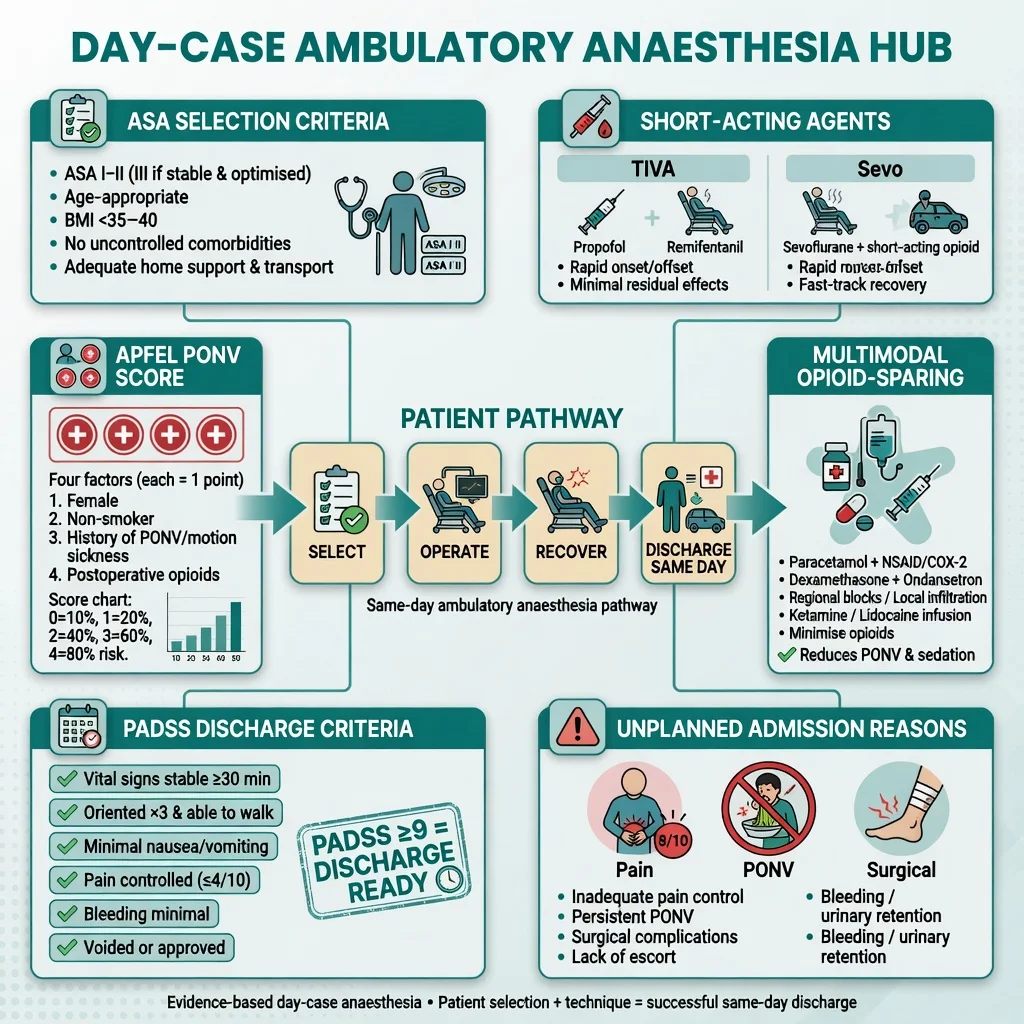
Day-case work is most of elective volume. Fellowship exams test selection, who must not go home, OSA, regional enabling discharge, PADSS-style criteria, and unplanned admission drivers. One-liner: I only book patients with a safe home plan, anaesthetise with short-acting opioid-sparing methods, kill PONV proactively, and I admit early when discharge would export risk. [1]
Pathway framework
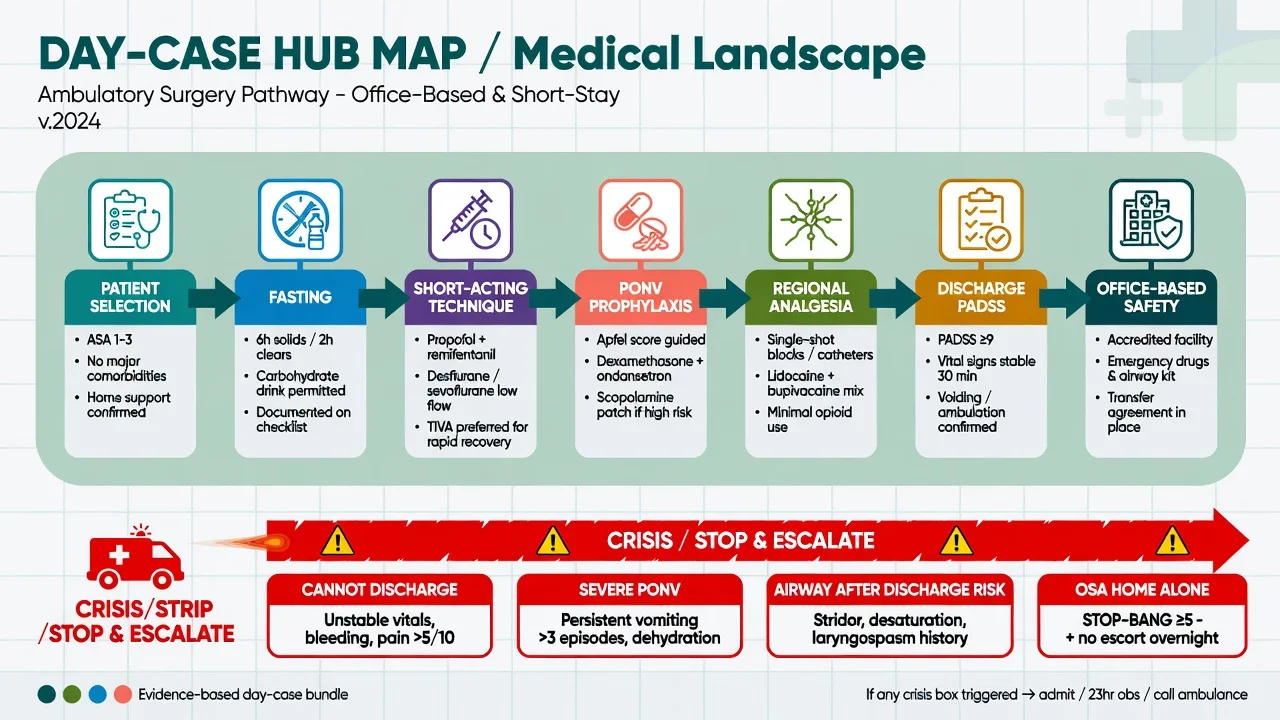
Ambulatory success = right patient + right procedure + right anaesthetic + right recovery system + right home environment. Failure in any link causes unplanned admission or post-discharge harm. [1]
Selection criteria (who is suitable)
| Domain | Favour day-case | Caution / exclude |
|---|---|---|
| ASA / stability | Stable chronic disease | Unstable cardiorespiratory disease |
| Airway | Straightforward | Known difficult airway needing overnight observation after event |
| OSA | Mild, optimised, opioid-light plan | Severe untreated OSA, no CPAP, opioid-heavy surgery |
| Social | Adult escort, overnight support, phone, transport | Lives alone, remote, no phone |
| Procedure | Low bleeding/airway risk, pain controllable | Major cavity, free flap, expected major fluid shifts |
| PONV/pain risk | Manageable with multimodal | Prior catastrophic PONV without plan |
Who is not for pure day-case (say it firmly)
- No responsible escort for 24 hours.
- Uncontrolled systemic disease (unstable angina, decompensated heart failure, severe uncontrolled asthma/COPD exacerbation).
- Severe untreated OSA with expected significant opioids — overnight monitored stay preferred.[2]
- Complex social vulnerability without support.
- Procedures with high bleeding or airway oedema risk needing observation.
- Inadequate pain or PONV control at assessment time of discharge.
OSA specifically
SAMBA-style selection emphasises optimising OSA, preferring local/regional and opioid-sparing techniques, ensuring CPAP availability, and matching monitoring to residual risk. Severe symptomatic OSA with opioid requirement is a classic reason to convert to overnight stay.[2]
Fasting and medications
Standard fasting rules; continue most chronic meds with sips; hold ACE-I/ARB per local guidance for some cases; diabetes plans that avoid hypo at home; anticoagulation timing if regional planned. [1]
Anaesthetic technique — short-acting and opioid-sparing
- Prefer regional ± sedation or local when surgery allows.
- If GA: short-acting agents (propofol, desflurane/sevoflurane or TIVA), avoid long-acting benzodiazepine premed in elderly, minimise long-acting opioids.
- Multimodal analgesia: paracetamol, NSAID if safe, local infiltration, blocks.
- Antiemetic multi-modal for ≥2 Apfel risk factors.[3]
- Full neuromuscular recovery if NMB used — residual block ruins day-case safety.
PONV prophylaxis (do not improvise)
Apfel risks: female, non-smoker, history of PONV/motion sickness, postoperative opioids.
≥2 factors → at least dual prophylaxis (e.g. 5-HT3 + dexamethasone ± droperidol/NK1 as available). Rescue with different class.[3]
Multimodal analgesia
Goal: home with controlled pain on oral regimen. Nerve blocks enable discharge after limb surgery — counsel on dense block protection (sling, no driving, injury risk). LAST readiness if large volumes used.[4]
Discharge criteria — PADSS and judgement
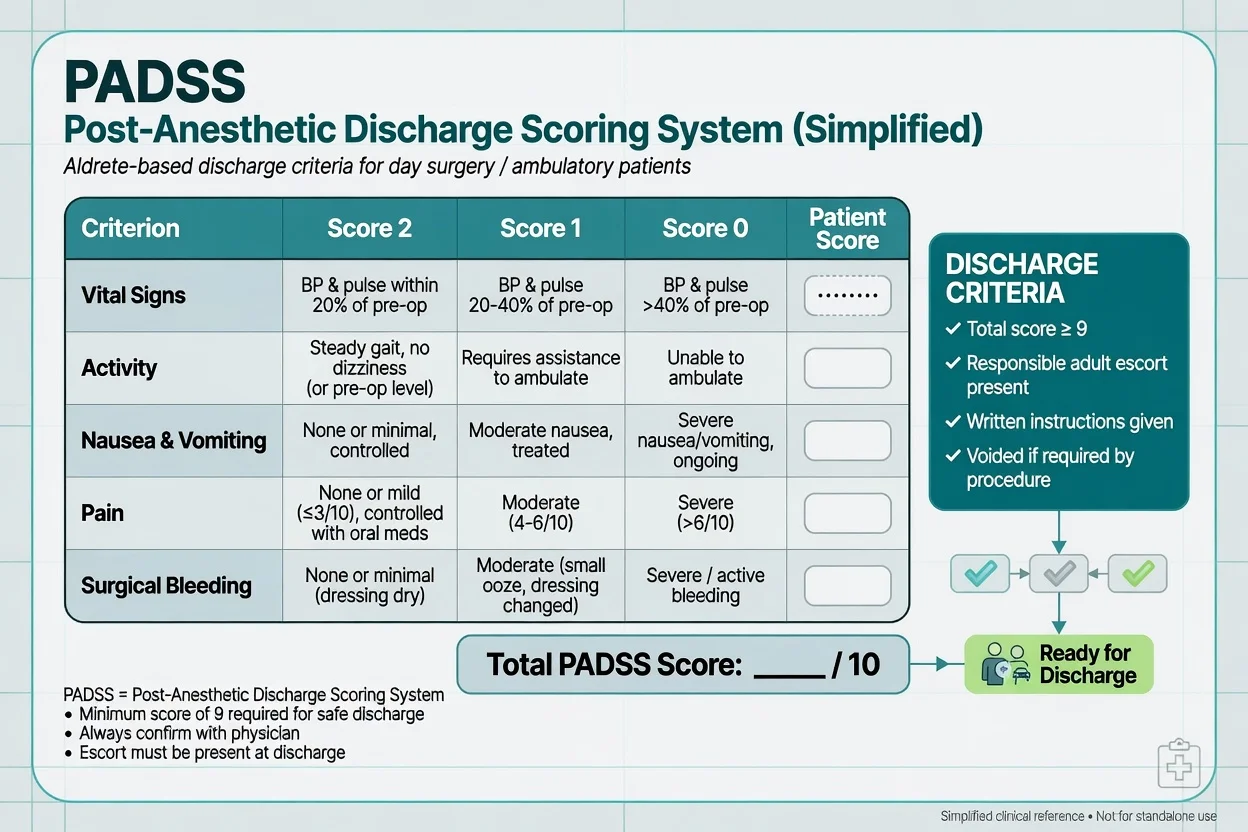
Post-Anaesthetic Discharge Scoring System (PADSS) classically scores five domains (vital signs, ambulation, nausea/vomiting, pain, surgical bleeding) toward home readiness.[1]
Still required beyond the score: [1]
- Oriented, airway protective.
- Tolerating oral fluids as appropriate (not absolute for all pathways).
- Passed urine when procedure/risk requires (urology, neuraxial — local rules).
- Understood written/verbal advice; emergency contact.
- Escort present; not driving themselves.
- Procedure-specific warnings (bleeding, compartment, block resolution). [1]
PADSS is necessary scaffolding, not a rubber stamp.[1]
Unplanned admission drivers
Pain, PONV, surgical bleeding/complication, urinary retention, aspiration/airway event, uncontrolled OSA symptoms, social discovery (“no one at home”), anaesthetic residual sedation, surgical time/complexity creep. [1]
Audit unplanned admission rate as a quality metric (BADS-style thinking in UK practice). [1]
Regional and day-case
Excellent enabler: awake shoulder/hand/foot lists, caesarean is not day-case but principle of opioid-sparing applies. Document LAST consent/risk; provide block duration expectations; prevent falls with numb limbs. [1]
Office-based / freestanding centres
Same standards for airway rescue, oxygen, suction, defibrillation, drugs, transfer agreements, and patient selection — geography does not excuse missing emergency equipment. [1]
Worked examples
Example A: ASA 2 laparoscopic cholecystectomy, Apfel 3, escort OK → GA TIVA or volatile, dual antiemetics, multimodal analgesia, local infiltration, PADSS, same-day home if stable. [1]
Example B: BMI 42, STOP-Bang 6, non-compliant CPAP, opioid-expecting open procedure → not pure day-case. [1]
Example C: Wrist ORIF under US brachial plexus block, light sedation, oral analgesics → classic ambulatory success if home support exists. [1]
SAQ scaffold
Discuss principles of safe day-case anaesthesia for adult patients. [1]
- Selection patient/procedure/social (4).
- OSA rules (2).[2]
- Short-acting opioid-sparing technique + PONV (3).[3]
- PADSS + judgement + escort (3).[1]
- Unplanned admission and when to convert (2).
Viva stems
Stem 1: “PADSS?”
Model: “A scored discharge tool covering vitals, ambulation, nausea, pain, and bleeding — plus clinical judgement and escort.”[1]
Stem 2: “Severe OSA for day arthroscopy?”
Model: “Possible only with opioid-light technique, optimised CPAP, and low residual risk — otherwise overnight stay.”[2]
Stem 3: “Why dual antiemetics?”
Model: “Multiple Apfel risk factors predict PONV; combination prophylaxis reduces unplanned admission from vomiting.”[3]
Stem 4: “No escort at collection time?”
Model: “Not discharged — admit or wait for safe support; social criteria are clinical criteria.” [1]
Stem 5: “Residual TOF 0.7?”
Model: “Not home — reverse fully, observe; residual block is a day-case failure mode.” [1]
Stem 6: “Block still dense at 4 hours after hand surgery?”
Model: “May still discharge with protection counselling if other criteria met — prevent injury to the numb limb.” [1]
Stem 7: “Office-based liposuction GA?”
Model: “Only with full emergency capability and transfer plan; selection must match the facility.” [1]
Common traps
- Ignoring social criteria
- Opioid-heavy OSA discharge
- Single antiemetic for high Apfel score
- PADSS tick-box without judgement
- No escort exceptions “just this once”
- Missing residual NMB
- Freestanding centre without transfer plan [1]
Day-case safe — HOME
Monitoring, recovery bay, and phone-call culture
Ambulatory units live or die on recovery discipline. Minimum: continuous pulse oximetry until ready for discharge pathway, pain and nausea scores at defined intervals, surgical site checks, and a named clinician who can convert to admission without argument. Provide written and verbal instructions covering bleeding, fever, uncontrolled pain, urinary retention, block-related injury prevention, and when to call the unit or present to ED. A post-discharge phone call the next day is good practice for higher-risk day cases and captures near-miss admissions. [1]
Medication at home: supply or prescribe adequate multimodal analgesia for 48–72 hours of expected pain with clear maximum doses; avoid “just take the strong ones if it hurts” without a plan. Include antiemetic rescue for high Apfel scores. Diabetic patients need a written meal/insulin plan for the afternoon of surgery. [1]
Paediatric and elderly day-case nuances
Children: social criteria include two responsible adults for some procedures (local policy), car-seat safety after sedation, and clear fasting recovery rules. Post-tonsillectomy bleeding risk means not every ENT case is pure remote day-case. [1]
Elderly: avoid long-acting benzos; expect urinary retention after hernia/hernia-mesh and neuraxial; cognitive baseline documentation prevents “new confusion” false alarms; escort is non-negotiable. Frailty may convert an anatomically minor case into an overnight observation decision. [1]
Crisis pivots specific to ambulatory lists
Unexpected difficult airway on a freestanding list
Follow DAS principles; do not start without a transfer plan and emergency kit. If intubation trauma or aspiration occurs, admit — day-case booking does not override airway events.
Surgical bleeding in PACU
Resuscitate, return to theatre if needed, reverse anticoagulants when indicated, abandon discharge fantasies.
Severe PONV despite prophylaxis
IV fluids, different-class rescue antiemetic, consider overnight stay rather than “try the car trip”.
Parental/patient pressure to leave early
Safety criteria win. Document discussion. Offer review later the same day if borderline and escort strong — do not yield to parking pressure.
Examiner mental map
- Selection (patient/procedure/social).
- OSA rules.
- Technique short-acting, opioid-sparing.
- PONV multi-modal.
- PADSS + judgement + escort.
- When to admit. [1]
Pathway thinking passes; “it’s only a quick case” fails. [1]
References
- [1]Chung F, Chan VW, Ong D. A simplified risk score for predicting postoperative nausea and vomiting: conclusions from cross-validations between two centers Anesthesiology, 1999.PMID 10485781
- [2]Joshi GP, Ankichetty SP, Gan TJ, Chung F. Pediatric Extracorporeal Membrane Oxygenation Reach-Out Program: Successes and Insights ASAIO J, 2020.PMID 31977355
- [3]Apfel CC, Heidrich FM, Jukar-Rao S, et al. 5th National Audit Project (NAP5) on accidental awareness during general anaesthesia: summary of main findings and risk factors Br J Anaesth, 2014.PMID 25204697
- [4]Neal JM, Barrington MJ, Fettiplace MR, et al. The Third American Society of Regional Anesthesia and Pain Medicine Practice Advisory on Local Anesthetic Systemic Toxicity: Executive Summary 2017 Reg Anesth Pain Med, 2018.PMID 29356773