Anaes · Paediatric anaesthesia
Difficult and syndromic paediatric airway: anticipation, syndromes, and algorithms
Also known as Syndromic paediatric airway · Pierre Robin anaesthesia · APAGBI DAS paediatric difficult airway
Exam-exhaustive anticipated difficult paediatric airway: syndrome-specific anatomy (Pierre Robin, Treacher Collins, mucopolysaccharidoses, Down syndrome, Goldenhar), APAGBI/DAS unanticipated difficult intubation principles, equipment, spontaneous ventilation strategies, CICO pathways, and shared decision planning for fellowship exams.
On this page & tools
Your progress
Saved locally on this device.
8 MCQs with explanations
Target exams
Red flags
Why this is examined / the one-line answer
Syndromic and difficult paediatric airways are high-yield because anatomy is predictable yet unforgiving, and task fixation kills. The ANZCA Final (and FRCA/EDAIC/ABA/FCAI equivalents) tests named syndrome features, a plan that preserves oxygenation and often spontaneous ventilation, adherence to APAGBI/DAS paediatric algorithms, and the humility to have ENT in the room before induction of a known nightmare airway.[1]
One-line opener: I anticipate from the syndrome, oxygenate continuously, limit attempts, use video and fibreoptic tools early, and never convert a can-ventilate child into CICO with trauma and oedema. [1]
Preoperative assessment and risk stratification
History that predicts difficulty: diagnosed syndrome; previous difficult intubation or failed intubation letters; snoring, witnessed apnoeas, CPAP use; previous tracheostomy or neonatal airway surgery; poor mouth opening from radiotherapy or juvenile idiopathic arthritis; cervical fusion or instability; mucopolysaccharidosis progressive course; recent URTI (laryngospasm multiplier).[2]
Examination — gentle, child-centred: facial profile (micrognathia is best seen from the side), mouth opening, tongue size, palate shape, neck length and mobility, ability to turn the head, scars, tracheostomy site, work of breathing when supine versus prone/lateral, oxygen saturation baseline. [1]
Investigations: previous anaesthetic charts are gold; recent ENT endoscopy reports; sleep study if available; flexion-extension cervical films or MRI only when they change management and can be obtained without distress — do not force imaging that precipitates obstruction. For MPS and some skeletal dysplasias, cardiac and multilevel airway assessment is required before elective anaesthesia. [1]
Risk stratification:
- Low: normal examination, no syndrome, previous easy airway documented
- Intermediate: mild micrognathia, Down syndrome without prior difficulty, history of snoring
- High: Pierre Robin with ongoing obstruction, Treacher Collins, MPS, severe Goldenhar, previous failed intubation, fixed cervical spine, combined micrognathia and limited mouth opening [1]
Decision before induction: can this be done under local/regional? Can it wait for a tertiary paediatric centre? Who is the most experienced airway clinician available? Is ENT scrubbed with rigid bronchoscope and surgical airway capability? Is an ICU bed available postoperatively? [1]
Applied anatomy by syndrome
Pierre Robin sequence
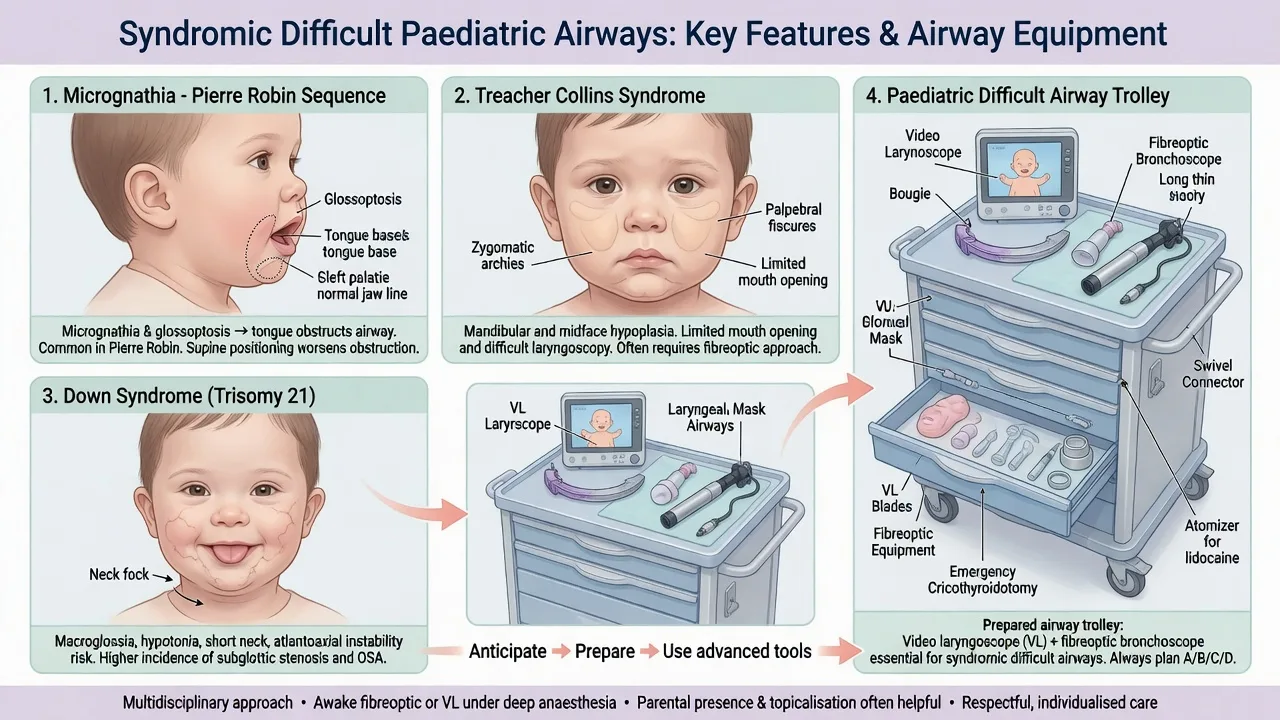
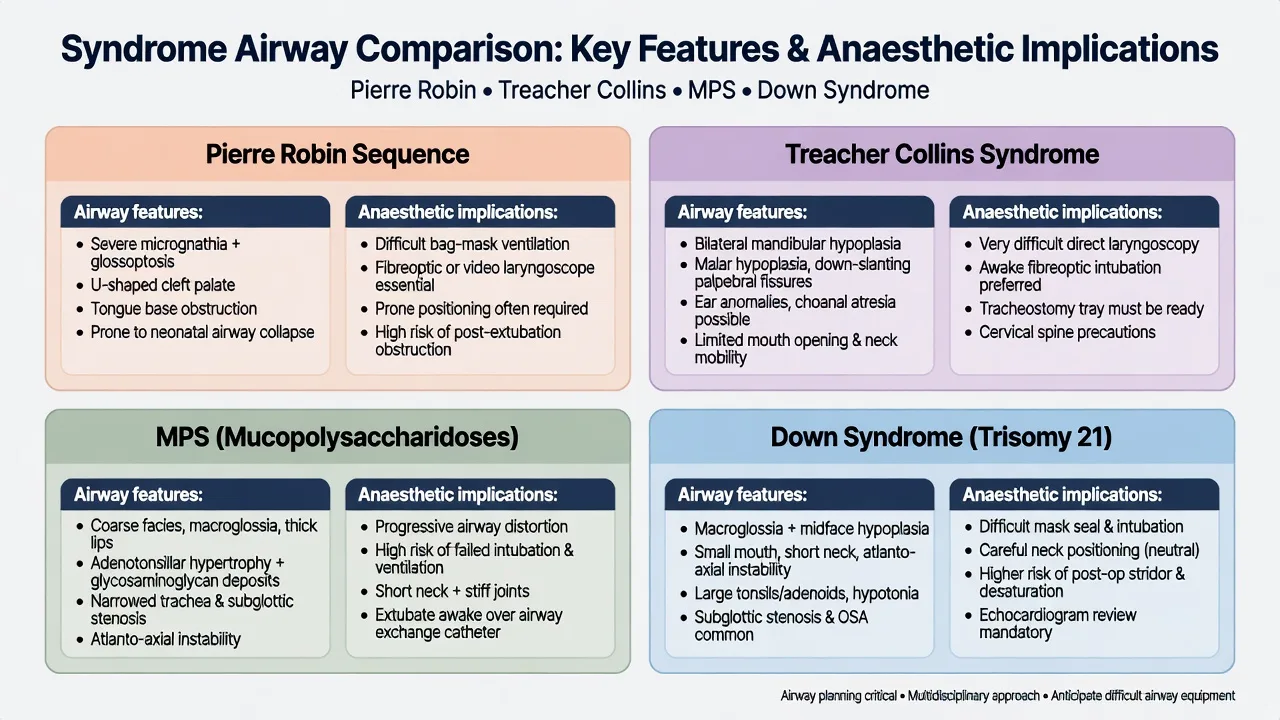
Triad of micrognathia, glossoptosis, and airway obstruction (cleft palate often associated). The tongue falls back and occludes the pharynx, worse supine. Immediate life-saving manoeuvres in the neonate: prone or lateral positioning, nasopharyngeal airway, and in severe cases early surgical airway or mandibular distraction pathways managed by specialist teams. Anaesthesia: expect difficult direct laryngoscopy; video laryngoscopy and fibreoptic intubation (often via a supraglottic conduit or with hyperangulated VL) are primary tools; maintain spontaneous ventilation until the airway is secured when obstruction risk is high. [1]
Treacher Collins (mandibulofacial dysostosis)
Bilateral malar and mandibular hypoplasia, down-slanting palpebral fissures, ear anomalies, and sometimes choanal stenosis. Mask seal and laryngoscopy are both difficult. Plan as anticipated difficult airway with ENT present for elective cases requiring intubation. [1]
Mucopolysaccharidoses (Hurler, Hunter, and related)
Progressive glycosaminoglycan deposition in tongue, pharynx, larynx, and tracheobronchial tree; cervical spine instability and restricted mobility; cardiomyopathy and coronary involvement in some types. Even “trivial” MRI or ENT exams have caused catastrophic airway failure. Principles: most experienced paediatric anaesthetist and ENT; consider whether the procedure is essential; spontaneously breathing fibreoptic techniques; low threshold for controlled tracheostomy in extreme anatomy; postoperative ICU for obstruction and sleep-disordered breathing. [1]
Down syndrome (trisomy 21)
Relative macroglossia, midface hypoplasia, small mouth, subglottic stenosis risk (start with a smaller than predicted ETT and have half-sizes ready), atlantoaxial instability risk (minimise extreme flexion-extension; care with positioning; neurological history and, when indicated, imaging), and higher rates of OSA. Post-extubation stridor and post-obstructive pulmonary oedema are examinable complications. Cuffed tubes with pressure monitoring are acceptable with correct sizing.[3]
Goldenhar and hemifacial microsomia
Asymmetric mandibular and soft-tissue hypoplasia — the laryngoscopic view may be surprisingly difficult from the “normal-looking” side if the mandibular ramus and soft tissues misalign the axes. Plan for the worst side; fibreoptic and VL skills essential. [1]
Anaesthetic goals
- Oxygenation continuous — never trade the SpO2 for a better view repeatedly.
- Preserve spontaneous ventilation until the airway is secured when difficulty is high.
- Limit intubation attempts; change device or operator thoughtfully, not frantically.
- Second-generation SGA as rescue and fibreoptic conduit.
- ENT/surgical airway plan sized for age before induction of high-risk cases.
- Postoperative monitoring for obstruction — the crisis often comes after extubation. [1]
Technique options and decision matrix
Anticipated difficult paediatric airway strategy
[1]Options matrix:
- Awake / sedated fibreoptic in cooperative older children with topical local anaesthetic — rare in toddlers.
- Inhalational induction maintaining spontaneous ventilation with sevoflurane in oxygen, then VL or FOI at depth without relaxant until tube is in.
- IV induction without relaxant only when bag-mask ventilation is confidently predicted easy — dangerous assumption in micrognathia.
- Elective tracheostomy under local in extreme MPS or failed previous attempts — specialist centre.
- Cancel and refer is a valid anaesthetic plan. [1]
Equipment checklist: age-appropriate VL blades; flexible fibreoptic scopes (ultrathin for infants); second-generation SGAs as conduits; cuffed and uncuffed tubes half a size smaller than formula predicts; nasopharyngeal airways; throat packs only with meticulous count; front-of-neck kit (needle techniques more often discussed in small children; surgical expertise essential); adrenaline nebuliser and dexamethasone for postoperative oedema. [1]
Unanticipated difficult intubation
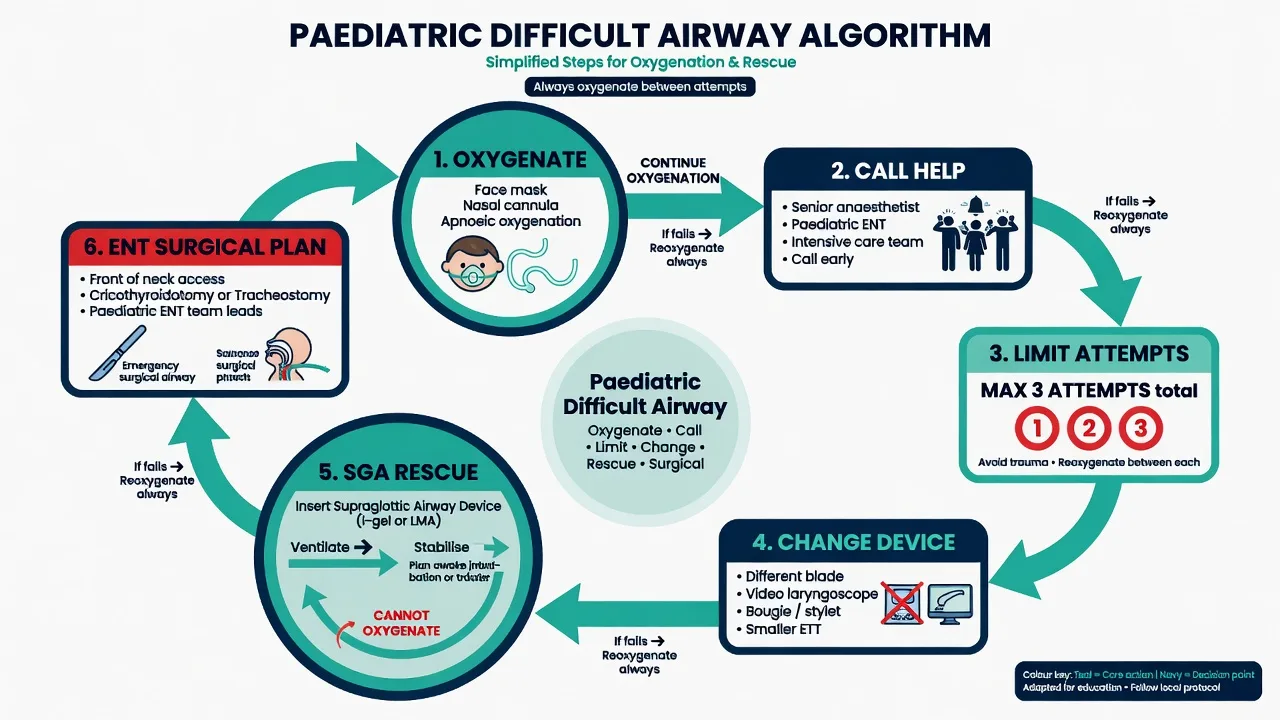
APAGBI/DAS 2015 paediatric guidelines (children approximately 1 to 8 years for the unanticipated algorithms) emphasise three linked pathways: difficult mask ventilation, unanticipated difficult tracheal intubation, and cannot-intubate-cannot-ventilate (CICO). Structure mirrors adult DAS: call for help early, maintain oxygenation, limit attempts, deploy SGA early, and escalate to age-appropriate front-of-neck access without delay in true CICO.[1] Adult DAS principles of avoiding task fixation still apply.
Difficult paediatric airway priorities
CICO in children
Declare CICO early. Oxygenation attempts with optimal mask and SGA continue in parallel with front-of-neck access. Age and anatomy determine technique: needle cricothyroidotomy with insufflation is discussed more in younger children with a small cricothyroid membrane; surgical techniques require ENT/paediatric surgery expertise. Percutaneous kits designed for adults may not fit infants — know your local paediatric CICO protocol before you need it. Hypoxia causes bradycardia and arrest rapidly; start CPR when indicated while the airway is secured. [1]
Monitoring and equipment
Full standard monitoring; waveform capnography essential for every tube and SGA. Consider arterial line for long complex cases. Have a difficult airway trolley dedicated and checked. Cognitive aid (APAGBI/DAS poster or Vortex) visible. Suxamethonium and atropine drawn if laryngospasm risk high — airway anomaly multiplies laryngospasm risk (odds ratio about 3.4).[2] Lidocaine may reduce laryngospasm risk.[4]
Intraoperative management
Once intubated: confirm position carefully (endobronchial intubation easy with short tracheas); secure meticulously; consider throat pack for shared airways; lung-protective ventilation; plan extubation as a separate difficult airway event — fully reversed, fully awake or deeply extubated per strategy, with re-intubation plan and ENT available for high-risk syndromes. Steroids (dexamethasone 0.15 to 0.5 mg/kg IV, max commonly 8 to 10 mg) for airway oedema prophylaxis in selected cases; nebulised adrenaline for post-extubation stridor. [1]
Crisis pivots
- Cannot mask ventilate on induction: call for help, oropharyngeal/nasopharyngeal airways, two-person mask, early SGA, deepen if light laryngospasm, reverse obstruction positioning (prone/lateral for Pierre Robin), prepare for CICO.
- Cannot intubate but can oxygenate: stop attempts, maintain SGA or mask, wake if elective, or secure with FOI via SGA if surgery must proceed.
- Bleeding and oedema after multiple looks: you have created CICO — stop, oxygenate, surgical airway.
- Postoperative obstruction in recovery: re-escalate airway algorithm; do not send high-risk MPS or Pierre Robin children to an unmonitored ward early.
- Bradycardia during airway instrumentation: hypoxia until proven otherwise — 100 percent oxygen and airway, then atropine/adrenaline as needed. [1]
Postoperative / ICU plan
High-risk syndromic airways often need HDU/ICU observation overnight, especially after airway surgery or difficult intubation. Nurse head-up, avoid residual opioids that obtund, have difficult airway trolley at the bedside, and leave an airway alert in the notes and with the family. Elective procedures in MPS may warrant delayed extubation strategies in ICU. [1]
Special populations and comorbidities
Neonate with Pierre Robin: positioning and NPA before drugs. Cardiac comorbidity in Down and MPS: haemodynamic plan with airway plan. Raised ICP in craniosynostosis syndromes: avoid hypercarbia and hypoxia during difficult intubation. Neurotoxicity parental questions after complex infant anaesthesia: brief single exposures have reassuring GAS data, but complex airway cases are longer and different — communicate honestly.[5][6]
SAQ answer scaffold
- List five predictors of difficult paediatric intubation.
- Tabulate Pierre Robin, Treacher Collins, MPS, and Down with one key anaesthetic implication each.
- Outline anticipated difficult airway strategy preserving spontaneous ventilation.
- State APAGBI/DAS priorities for unanticipated difficulty.[1]
- Describe postoperative risks and monitoring plan.
Viva stem bank and model phrases
Stem: “Infant with micrognathia and desaturation when supine.”
Model: “Likely Pierre Robin physiology — prone or lateral positioning and nasopharyngeal airway immediately; call neonatology/ENT; do not force supine mask induction without a full difficult airway plan.” [1]
Stem: “Teenage Hunter syndrome for dental extractions under GA.”
Model: “This is a high-risk progressive airway. I question necessity, ensure the most experienced team and ENT, plan spontaneous ventilation fibreoptic or controlled surgical airway strategy, and book ICU.” [1]
Stem: “Down syndrome child, easy looking face — any special concerns?”
Model: “Macroglossia, possible subglottic stenosis so smaller tubes, atlantoaxial instability risk with careful neck handling, and OSA with postoperative obstruction risk.”[3]
Common traps
- Normal-looking face hiding severe micrognathia on profile view
- Inducing without ENT for known nightmare airways
- Using adult CICO kit sizes in infants
- Forgetting atlantoaxial risk in Down syndrome
- Repeated blind forceful attempts creating bleeding and oedema
- Planning only intubation, not extubation
- Ignoring progressive nature of MPS — last year’s easy airway is this year’s disaster
- Omitting smaller ETT sizes on the trolley [1]
Know the APAGBI/DAS paediatric difficult airway guidelines by name and where your hospital keeps the paediatric difficult airway trolley and ENT emergency pathway. ANZCA Final hot cases love Pierre Robin and MPS narratives.
Detailed syndrome notes for discriminating vivas
Pierre Robin — stepwise neonatal rescue
- Prone or lateral positioning immediately.
- Nasopharyngeal airway sized roughly nostril to tragus; secure carefully.
- Continuous pulse oximetry and neonatology review.
- Consider tongue-lip adhesion, mandibular distraction, or tracheostomy in specialist pathways for refractory obstruction — not the district general solo plan at 03:00 without retrieval.
- Anaesthesia for any procedure: spontaneous ventilation induction preferred; VL/FOI; ENT in theatre; postoperative HDU. [1]
Treacher Collins — mask seal tactics
Midface hypoplasia means the standard mask may not seal. Try a smaller mask, oral airway early, two-person technique, and early SGA. Expect that direct laryngoscopy will fail even when the child “looks only mildly dysmorphic” in frontal photographs — always inspect the profile. [1]
Mucopolysaccharidoses — perioperative pathway
Preoperative: recent ENT assessment, sleep study, echo, cervical imaging as indicated, difficult airway letter. Intraoperative: most senior team, spontaneous ventilation fibreoptic or controlled surgical airway, avoid unnecessary cervical manipulation, prepare for failed extubation. Postoperative: ICU, low threshold for delayed extubation, CPAP/BiPAP available. Cancel elective dental “clearance” under GA in a remote site. [1]
Down syndrome — neck and tube size
Ask about neurological symptoms (weakness, sensory change, bladder). Avoid extreme flexion-extension for DL; use gentle neutral positioning with VL. Start with a tube half a size smaller than Cole predicts; have another half size smaller ready; monitor cuff pressure.[3] Plan OSA-aware recovery.
CHARGE, Goldenhar, Apert/Crouzon
CHARGE association includes choanal atresia and cranial nerve anomalies — nasal routes may be impossible. Goldenhar is asymmetric — plan as bilateral worst-case. Syndromic craniosynostosis combines difficult mask with possible raised intracranial pressure — ventilate to normocapnia once the airway is secure. [1]
APAGBI/DAS algorithms — what to say word-for-word
“I would call for help, maintain 100 percent oxygen, limit intubation attempts, use simple airway manoeuvres and adjuncts, insert a second-generation supraglottic airway early, and if I cannot oxygenate I would declare CICO and proceed to age-appropriate front-of-neck access with ENT. I avoid task fixation and I re-oxygenate between attempts.” Adult DAS 2015 supports the same philosophy of limited attempts and early SGA.[1]
Fibreoptic and hybrid techniques
Fibreoptic intubation in children may be performed asleep under sevoflurane with topical lidocaine, via a supraglottic airway conduit, or combined with video laryngoscopy (the “hybrid” technique where VL opens the pharynx and the flexible scope rails the tube). Practise on manikins; know your scope diameters relative to tube IDs. Warm and lubricate tubes; do not force. [1]
Extubation of the difficult paediatric airway
Treat extubation as a second difficult airway event. Ensure full reversal, adequate analgesia without obtundation, and a clear re-intubation plan. Consider an airway exchange catheter in older children in specialist practice. For extreme risk, extubate in ICU over a tube exchanger or delay extubation overnight after airway surgery. Dexamethasone and nebulised adrenaline for oedema. Document the airway for the next team. [1]
Human factors
Production pressure to “just get the MRI done” kills children with MPS. Speak up. Use cognitive aids. Rehearse CICO with the team on paediatric manikins, not only adult ones. [1]
Exam integration notes
This topic is examined across MCQ, SAQ, anaesthesia viva, and hot-case surfaces. Lead with the one-line algorithm, then expand into physiology, exact doses, and decision tables. Name the landmark guideline or trial early. Close with human factors: call for help, declare the problem, limit harmful persistence, and document. Cross-link maternal or paediatric physiology rather than treating the crisis as a pure checklist. In the ANZCA Final, discriminating marks come from absolute doses, absolute contraindications, and the structured decision when two reasonable options exist (wake versus proceed; deep versus awake extubation; proceed versus cancel). [1]
Worked scenarios (model answers)
Scenario A — Neonate with Pierre Robin, SpO2 80 percent supine. Prone positioning and nasopharyngeal airway immediately; call neonatology and ENT; do not force supine inhalational induction without a full team; plan FOI/VL with spontaneous ventilation if anaesthesia required; HDU afterward. [1]
Scenario B — 8-year-old Hurler syndrome for MRI. Challenge necessity of GA; if essential, tertiary paediatric centre, most experienced anaesthetist and ENT, spontaneous ventilation fibreoptic plan, ICU for recovery, low threshold to abort if obstruction worsens on induction. [1]
Scenario C — Down syndrome toddler, easy frontal appearance, for T&A. Anticipate smaller tube, careful neck, OSA recovery risk, possible post-obstructive oedema; have half-size smaller ETT; dexamethasone; overnight observation if severe OSA. [1]
Scenario D — Unanticipated difficult intubation after relaxant in a normal-looking child. Call for help; 100 percent oxygen; limit attempts; second-generation SGA; FOI via SGA if skilled; wake if elective and oxygenating; CICO pathway if not oxygenating; debrief and airway alert. [1]
Equipment table in prose for the trolley
Video laryngoscope with paediatric blades; flexible fibreoptic scopes of appropriate diameter; second-generation SGAs sizes 1 through 3; cuffed and uncuffed tubes from 2.5 to 6.0 mm ID in half-size steps; nasopharyngeal airways; Yankauer and flexible suction; front-of-neck kit with paediatric considerations; emergency drugs labelled by weight; cognitive aid card for APAGBI/DAS steps. [1]
Communication with parents
Explain that some children have airways that are harder to manage because of their anatomy; the plan prioritises oxygen and uses special cameras and tools; a surgeon who specialises in airways may be present; after surgery the child may need extra monitoring. Avoid false reassurance that “it will be easy.” Document the discussion. [1]
Decision matrix: proceed, modify, or cancel
| Clinical setting | Preferred action | Rationale | | Elective dental in MPS at non-specialist site | Cancel and refer | Progressive catastrophic airway risk | | Semi-elective MRI in Pierre Robin with baseline obstruction | Tertiary centre, ENT present, spontaneous ventilation plan | Obstruction risk on induction | | Emergency surgery, known difficult airway | Most experienced team available; FOI/VL; surgical airway ready | Cannot cancel; maximise skill and equipment | | Unanticipated difficulty, elective list, SGA oxygenating | Wake and replan | Default safe option when surgery not urgent | | Unanticipated difficulty, emergency full stomach, SGA working | Proceed cautiously or FOI via SGA | Clinical urgency may favour proceeding with clear rescue plan | [1]
Speak the decision aloud. Document it. If you cancel, you have still delivered safe anaesthesia. [1]
Postoperative airway alert content
Include: syndrome diagnosis; devices that worked (blade, VL brand, tube size and depth, SGA size); devices that failed; number of attempts; grade of view; neck precautions; extubation method; complications; recommendation for future (ENT present, fibreoptic first, ICU). Give a copy to the family and enter institutional difficult airway systems where they exist. [1]
Cross-exam alignment and curriculum mapping
For ANZCA Final SS_PA outcomes this topic sits under difficult airway anticipation, equipment selection, and crisis management. FRCA Final and EDAIC Part II examiners ask the same syndrome features and the same “what if you cannot intubate” branch. ABA APPLIED OSCE stations may present a Pierre Robin photograph or an MPS history and expect a spoken plan within two minutes. The safe structure is identical across exams: assess, optimise positioning, preserve oxygenation, choose a spontaneously breathing technique when risk is high, limit attempts, use video and fibreoptic tools early, involve ENT before induction of the known difficult airway, and treat extubation as a planned event. Candidates who list syndromes without a plan fail; candidates who give a plan without naming anatomy fail; candidates who do both and then stop attempts before trauma convert a difficult airway into a saved airway. Remember that laryngospasm risk is higher with airway anomalies, so the difficult airway trolley and the laryngospasm drugs belong together on every high-risk induction. Postoperative destination is part of the plan — not an afterthought — because obstruction in the elevator or on the unmonitored ward is still an anaesthetic outcome. [1]
Final revision checklist
Before the exam, rehearse out loud until the doses and decision forks are automatic. Check that you can draw the algorithm on blank paper in under two minutes. Check that you can list five human-factor errors that turn a recoverable event into catastrophe. Check that you can name the guideline document and one landmark trial relevant to the wider paediatric or obstetric context of the stem. Sleep matters as much as reading: a tired candidate fixates. In the hot case, put the mask on, call for help, and speak your plan so the examiner and the confederates can follow you. [1]
Closing human-factors reminder
In the minutes before a real case as well as before the exam, rehearse out loud until the doses and decision forks are automatic. Check that you can draw the algorithm on blank paper in under two minutes. Check that you can list five human-factor errors that turn a recoverable event into catastrophe. Check that you can name the guideline document and one landmark trial relevant to the wider paediatric or obstetric context of the stem. Sleep matters as much as reading: a tired candidate fixates. In the hot case, put the mask on, call for help, and speak your plan so the examiner and the confederates can follow you. [1]
References
- [1]Frerk C, Mitchell VS, McNarry AF, et al. Difficult Airway Society 2015 guidelines for management of unanticipated difficult intubation in adults Br J Anaesth, 2015.PMID 26556848
- [2]Flick RP, Wilder RT, Pieper SF, et al. Risk factors for laryngospasm in children during general anesthesia Paediatr Anaesth, 2008.PMID 18315633
- [3]Shi F, Xiao Y, Xiong W, Zhou Q, Huang X Cuffed versus uncuffed endotracheal tubes in children: a meta-analysis J Anesth, 2016.PMID 26296534
- [4]Mihara T, Uchimoto K, Morita S, Goto T The efficacy of lidocaine to prevent laryngospasm in children: a systematic review and meta-analysis Anaesthesia, 2014.PMID 24992191
- [5]Davidson AJ, Disma N, de Graaff JC, et al. Neurodevelopmental outcome at 2 years of age after general anaesthesia and awake-regional anaesthesia in infancy (GAS): an international multicentre, randomised controlled trial Lancet, 2016.PMID 26507180
- [6]McCann ME, de Graaff JC, Dorris L, et al. Neurodevelopmental outcome at 5 years of age after general anaesthesia or awake-regional anaesthesia in infancy (GAS): an international, multicentre, randomised, controlled equivalence trial Lancet, 2019.PMID 30782342