Anaes · Head & neck / ECT
Anaesthesia for electroconvulsive therapy (ECT)
Also known as ect anaesthesia
Exam-exhaustive ECT anaesthesia: biphasic autonomic response, induction agent versus seizure quality, suxamethonium-modified technique, bite block, hyperventilation, post-ictal catecholamine surge control, and recovery airway protection for ANZCA Final.
On this page & tools
Your progress
Saved locally on this device.
8 MCQs with explanations
Target exams
Red flags
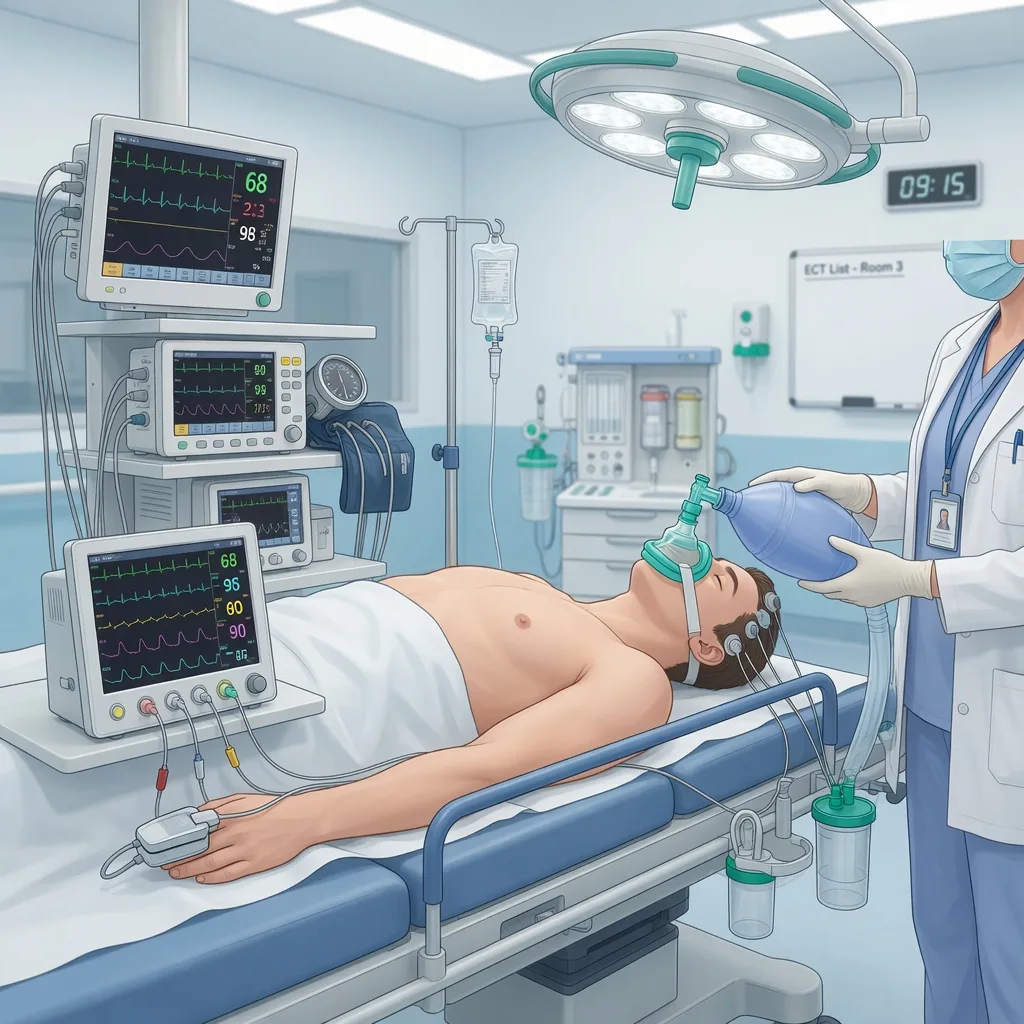
Why this is examined / the one-line answer
Electroconvulsive therapy (ECT) is a high-frequency, short-duration general anaesthetic with a stereotyped biphasic autonomic response, a tight coupling between induction agent choice and seizure quality, and non-negotiable dental and airway protection. Examiners use ECT to test whether you can run a safe remote-site or dedicated-suite anaesthetic, titrate drugs that are inherently anticonvulsant, modify the motor seizure with suxamethonium, and manage bradycardia then hypertension without treating ECT as “just a bit of propofol.” [1]
The one-line answer: I deliver a short general anaesthetic with full monitoring — induce with a short-acting agent chosen for the seizure–haemodynamic trade-off, give suxamethonium after loss of consciousness for modified ECT, insert a soft bite block, hyperventilate briefly to lower seizure threshold, support ventilation through the fit, treat the parasympathetic then sympathetic surge, and recover only when airway reflexes and neuromuscular function have returned. [1]
Preoperative assessment and risk stratification
Psychiatric and consent context
Confirm indication (severe depression, catatonia, selected other disorders), capacity and consent pathway (including substitute decision-makers when required), and treatment schedule (acute course versus maintenance). Coordinate with psychiatry on medications that raise seizure threshold (benzodiazepines, anticonvulsants) or interact with induction agents. [1]
Medical screening
- Cardiac: recent MI, unstable angina, severe aortic stenosis, decompensated heart failure, uncontrolled hypertension, significant arrhythmia, pacemakers/ICDs (magnet or programming plan with cardiology)
- Neurological: raised intracranial pressure, recent stroke or intracranial surgery, space-occupying lesion — relative contraindications needing multidisciplinary discussion
- Phaeochromocytoma and hyperthyroidism concerns if clinically suggested (extreme catecholamine risk)
- Dental: loose teeth, crowns, bridges — document; bite block essential
- Aspiration risk: GORD, full stomach, pregnancy, delayed gastric emptying
- Airway: standard assessment; remote-site difficult airway equipment must still meet standards
- Suxamethonium contraindications: hyperkalaemic risk states (burns, denervation, certain myopathies, prolonged immobilisation in susceptible patients), malignant hyperthermia susceptibility (choose non-triggering technique and alternative relaxant strategy), allergy
- Medications: MAOIs, lithium (prolonged seizures and confusion historically discussed), antihypertensives, anticoagulants (not usually a neuraxial issue here, but bleeding risk for other procedures)[3]
Fasting and logistics
Standard fasting; morning antihypertensives per plan; ECT suite monitoring equivalent to theatre minimum standards; recovery capacity for post-ictal agitation. [1]
Applied physiology and pharmacology
Autonomic physiology of the stimulus
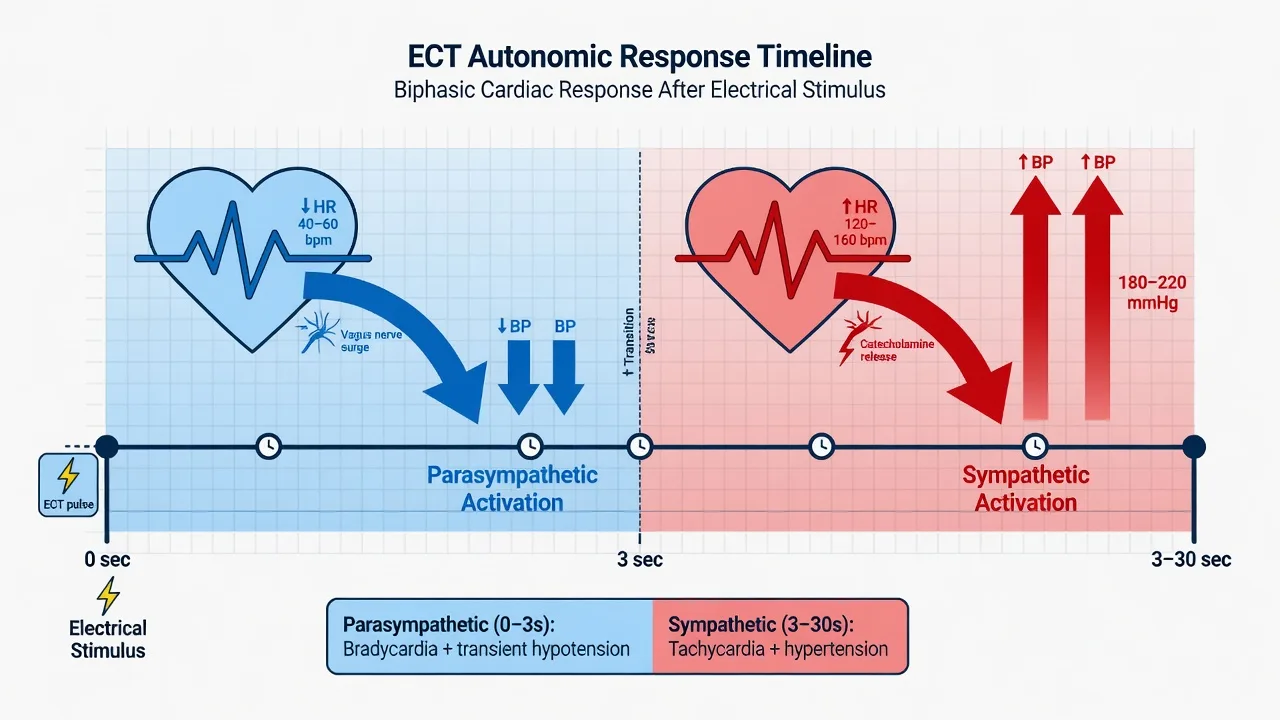
The electrical stimulus first produces a brief parasympathetic discharge: sinus bradycardia, atrioventricular block, even asystole lasting seconds. This is followed by a sympathetic surge: hypertension, tachycardia, increased myocardial oxygen demand, raised cerebral blood flow and intracranial pressure, raised intraocular and intragastric pressure, and arrhythmias. Cerebral metabolic rate rises with the seizure. After the fit, patients may show confusion, agitation, headache, and myalgia. [1]
Why “modified” ECT
Unmodified ECT (without anaesthesia and paralysis) risks fractures, dislocations, and awareness of the stimulus. Modified ECT uses a short general anaesthetic plus neuromuscular blockade to prevent injurious motor activity while preserving a therapeutic cerebral seizure, monitored by EEG and often an isolated-limb motor response (tourniquet on one arm before suxamethonium so that limb’s motor seizure remains visible). [1]
Induction agents and seizure quality
All induction agents are anticonvulsant in a dose-dependent fashion. The art is enough hypnosis for ethical unawareness without abolishing the seizure. [1]
[1]Remifentanil or other adjuncts are sometimes used to reduce induction agent dose and improve seizure duration — institutional protocols vary. Anticholinergic premedication (glycopyrrolate or atropine) is used in some units to blunt the initial bradycardia; not universal. [1]
Hyperventilation
Brief hyperventilation with 100 percent oxygen before the stimulus lowers PaCO2 and can lengthen or improve seizure quality. Balance against apnoea time and the need for full preoxygenation. Do not confuse this with prolonged hyperventilation for neurosurgical ICP control — this is a short, purposeful manoeuvre. [1]
Anaesthetic goals
- Loss of consciousness for the electrical stimulus (ethical modified ECT).
- Attenuate but not abolish the therapeutic cerebral seizure.
- Prevent musculoskeletal injury with appropriate neuromuscular blockade.
- Protect teeth and tongue with a soft bite block every time.
- Control extreme bradycardia then hypertension/tachycardia.
- Maintain oxygenation throughout apnoea and the fit.
- Rapid smooth recovery without residual paralysis or aspiration. [1]
Technique options and decision matrix
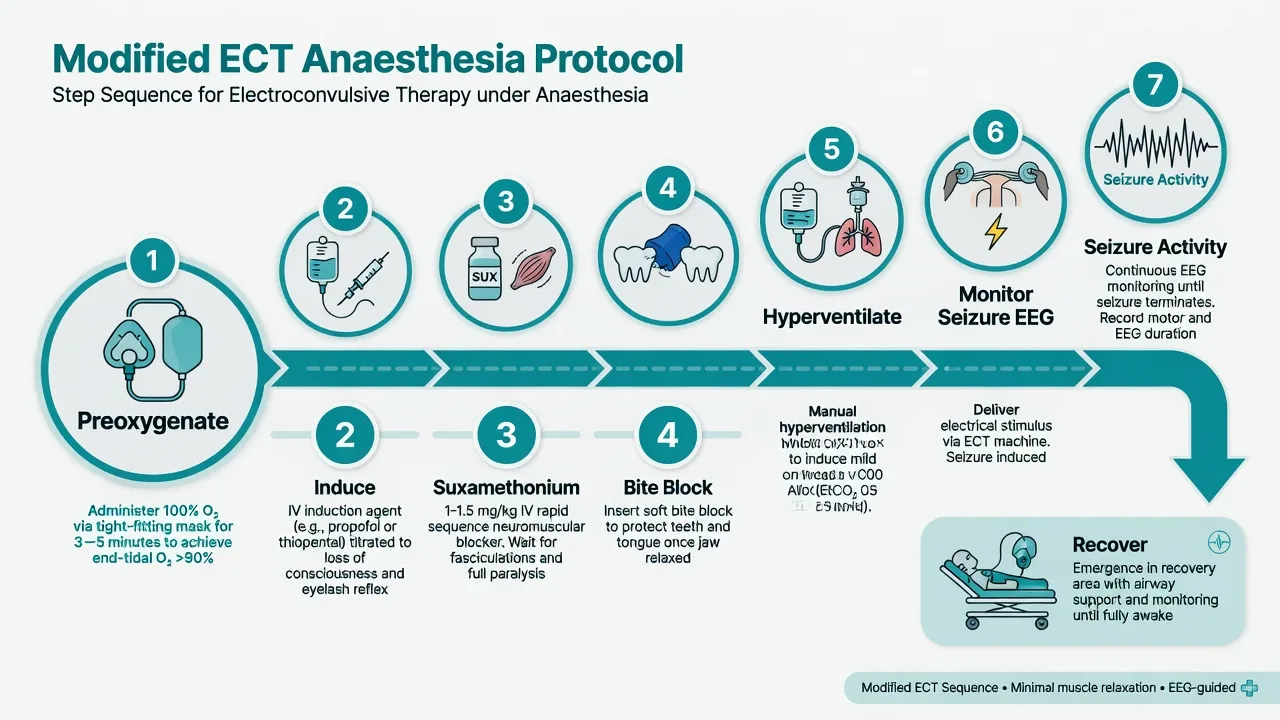
Standard sequence
- Monitoring on (ECG, SpO2, NIBP, capnography available).
- Preoxygenation.
- Optional isolated-limb tourniquet before relaxant.
- Induction bolus.
- Suxamethonium after loss of consciousness (typical modified-ECT range about 0.5–1.0 mg/kg IV — enough to soften the motor seizure, not necessarily a full intubating dose in every protocol; many use toward 1 mg/kg).
- Soft bite block inserted; no hard airway objects between teeth without a plan.
- Gentle hyperventilation with 100 percent oxygen via bag-mask.
- Stimulus delivered by the ECT team.
- Observe motor seizure (isolated limb) and EEG duration; document.
- Support ventilation until spontaneous breathing and protective reflexes return.
- Recover with airway support; left-lateral if institutional preference and no contraindication. [1]
Airway strategy
Most ECT is bag-mask ventilation without intubation. Intubate if full stomach, known difficult airway with high aspiration risk, or failed mask ventilation — then DAS principles apply if difficulty arises.[1] Have suction, oropharyngeal airways, second-generation SGA, and a difficult airway trolley available even in the “short case” suite.
When seizure quality is poor
Reduce anticonvulsant anaesthetic load next session, check stimulus parameters with psychiatry, consider methohexital/etomidate/ketamine strategies, ensure hyperventilation occurred, and review benzodiazepine timing. Do not simply “give more propofol and blame the machine.” [1]
Monitoring and equipment
Minimum monitoring standards equivalent to general anaesthesia: ECG (mandatory for bradycardia/asystole detection), pulse oximetry, NIBP (rapid cycling around stimulus), capnography when an advanced airway is used and available for mask cases as practical, suction, bag-mask, airway adjuncts, defibrillator in the suite, emergency drugs (atropine/glycopyrrolate; short-acting beta-blocker such as esmolol or short-acting vasodilator per local protocol for extreme hypertension), and documented seizure monitoring (EEG ± isolated limb). [1]
Regional blocks are not part of standard ECT, but if other procedures share a list, LAST preparedness remains part of anaesthesia culture.[2]
Intraoperative management
Anticipate the biphasic autonomic pattern. Treat prolonged asystole or severe bradycardia promptly with atropine and CPR if pulseless. After the sympathetic surge, support ventilation; treat extreme hypertension if it threatens myocardial or neurological safety. Avoid premature transfer to recovery while residual suxamethonium effect persists — residual paralysis with an unprotected airway is an aspiration and awareness risk. Document seizure duration for the psychiatry record. [1]
Crisis pivots
ECT crisis pivots
Failed mask ventilation / difficult airway mid-list: call for help, escalate airway devices, convert to definitive airway if needed per DAS.[1]
Suspected MH after suxamethonium/volatile (if used): rare pathway — dantrolene algorithm if triggered anaesthesia was used; many ECT suites use TIVA-only environments.
Post-ictal agitation: protect patient and staff, small titrated sedative if needed after airway secure, quiet recovery.
Postoperative / PACU plan
Orient the patient, treat headache and nausea, monitor for agitation, ensure full neuromuscular recovery (clinical and nerve stimulator if doubt), document seizure metrics, and only discharge from recovery when criteria met. Serial treatments need cumulative cognitive side-effect awareness led by psychiatry with anaesthetic input on cardiovascular tolerance. [1]
Special populations
Elderly: lower induction doses, higher cardiac risk, careful BP control, dental fragility. Pregnancy: rare, multidisciplinary; left tilt, fetal monitoring as appropriate, aspiration risk higher. Raised ICP or recent intracranial surgery: often relative contraindication — discuss. Pacemaker/ICD: magnet or programming plan; have defibrillator ready. Adolescents: consent complexity; dosing weight-based. Myasthenia or neuromuscular disease: suxamethonium dosing complex — specialist plan, may use non-depolarising strategies carefully with full recovery guaranteed. Burns / denervation / MH risk: do not use suxamethonium when contraindicated. [1]
Suite standards and remote-site anaesthesia
ECT often occurs outside the main theatre block. Standards do not drop: oxygen supply and backup, suction, monitoring, defibrillator, emergency drugs, difficult airway equipment, and adequate recovery staffing remain mandatory. A short case is still a general anaesthetic. Pre-list checks should include suxamethonium cold-chain if relevant, bite blocks stocked, and atropine drawn or immediately available. If the suite cannot meet standards, do not start. [1]
Detailed drug recipes (exam-friendly ranges)
- Propofol: often 0.75–1.5 mg/kg IV titrated — lower than full induction for long cases because seizure duration matters; elderly start low.
- Methohexital: classically about 0.5–1.0 mg/kg IV where available.
- Etomidate: about 0.15–0.3 mg/kg IV — longer seizures, myoclonus, adrenal effects with repeated dosing theoretically.
- Ketamine: about 0.5–1.0 mg/kg IV when used to augment seizure quality — expect more hypertension and possible emergence phenomena.
- Suxamethonium: about 0.5–1.0 mg/kg IV for modified ECT after hypnosis.
- Atropine: 0.3–0.6 mg IV adults for severe bradyarrhythmia; paediatric weight-based 20 microg/kg when used.
- Glycopyrrolate: about 0.2–0.4 mg IV adults as alternative anticholinergic.
- Esmolol: titrated small boluses for extreme post-stimulus tachycardia/hypertension when myocardial risk is high — avoid turning every case into deep beta-blockade. [1]
Seizure monitoring explained
EEG electrodes record cerebral seizure duration; psychiatry teams often target a minimum motor or EEG duration historically (commonly discussed targets around 15–25 seconds motor, longer EEG — institutional). The isolated limb technique: inflate a tourniquet on one arm before suxamethonium so that arm’s neuromuscular junction is not blocked, allowing visible clonic activity as a motor endpoint while the rest of the body is modified. Document both EEG and motor times. [1]
Cardiovascular disease — how far is too far?
Unstable angina, decompensated failure, and critical AS require optimisation and possible delay. Treated stable hypertension is common and usually acceptable with careful surge control. Recent MI needs cardiology input; elective ECT is not worth a fresh infarct window without strong psychiatric urgency. Pacemakers generally tolerate ECT with magnet or monitoring plans; ICDs need clear programming/magnet strategies so inappropriate shocks or failure to treat are avoided. [1]
Pregnancy and ECT
Rare but life-saving for severe perinatal psychiatric disease. Multidisciplinary: obstetric, psychiatry, anaesthesia. Left lateral tilt, aspiration prophylaxis, fetal heart rate monitoring as gestational age indicates, avoid aortocaval compression, and prepare for obstetric emergency if labour coincides. Suxamethonium remains common; sugammadex is not the ECT default story unless rocuronium strategies are chosen. [1]
Cognitive side effects and anaesthetic contribution
Retrograde and anterograde memory effects are primarily from ECT itself and electrode placement (unilateral vs bilateral). Anaesthetic contribution is minor but repeated deep propofol and hypoxia are not helpful — optimise seizure quality with the lowest effective hypnotic dose and impeccable oxygenation so psychiatry is not forced into excessive stimulus charges. [1]
Post-ictal pulmonary and aspiration issues
Increased intragastric pressure and unprotected airway during paralysis create aspiration risk if bag-mask is careless or if the patient has a full stomach. Suction must be on. Desaturation during the fit is usually brief if preoxygenation was good; persistent desaturation needs airway inspection, laryngospasm treatment, and consideration of aspiration or other pulmonary events. [1]
Quality assurance for an ECT service
Track adverse events: dental injury, prolonged seizures, asystole needing CPR, aspiration, awareness complaints, unplanned ICU. Standardise drug trays, consent forms including dental risk, and handover templates with seizure duration. New assistants need simulation of the bradycardia-then-hypertension sequence. [1]
Unilateral versus bilateral electrode placement (anaesthetic relevance)
Bilateral ECT may produce more robust seizures and more cognitive side effects; unilateral may need higher charges. Anaesthetic anticonvulsant load interacts with charge titration — communicate agent and dose clearly each session so psychiatry does not chase a moving target. Keep the anaesthetic recipe as constant as clinically safe across a course when possible. [1]
Status epilepticus after ECT
Prolonged seizures (for example beyond 120 seconds institutional cut-off) are treated with additional induction agent (propofol) or benzodiazepines per protocol, airway support, and psychiatry notification. Document duration carefully. Repeated prolonged seizures need medication review (lithium, theophylline historically, tramadol, etc.). [1]
Myalgia and suxamethonium
Post-ECT myalgia may relate to fasciculations and the seizure. Small defasciculating doses of non-depolarising agents are sometimes discussed but complicate the short case; many units accept mild myalgia. Counsel patients. [1]
Awareness risk
Inadequate hypnotic dose to “save the seizure” risks awareness of paralysis and the stimulus — ethically unacceptable. NAP5-type lessons apply: ensure loss of consciousness before relaxant and stimulus, and do not use relaxant as a substitute for anaesthesia. If using very low propofol doses, consider methohexital/etomidate strategies or adjuncts rather than pure underdosing. [1]
Day-of checklist poster (cognitive aid)
Monitoring on → IV access → preoxygenate → induction → suxamethonium → bite block → hyperventilate → stimulus → support ventilation → treat autonomic phases → full recovery before next patient. Emergency: atropine, defibrillator, airway trolley, dantrolene location if volatiles ever used in the suite. [1]
Interaction with psychiatric drugs
Benzodiazepines raise seizure threshold — may need dose timing adjustment by psychiatry. Lithium may prolong seizures and confuse recovery. MAOIs interact with certain vasopressors historically — use direct-acting agents carefully if needed. Continue most antidepressants peri-ECT as directed by psychiatry. [1]
Comparing induction agents in a single paragraph viva answer
Methohexital remains the reference agent with relatively favourable seizure duration; propofol is widely available and haemodynamically smoothing but more anticonvulsant so I titrate to the lowest effective hypnotic dose; etomidate preserves seizures but causes myoclonus; ketamine can rescue poor seizure quality at the cost of sympathetic stimulation. I pick based on previous seizure quality, cardiovascular status, and drug availability, and I document EEG duration every time. [1]
Recovery room red flags after ECT
Persistent desaturation, stridor, dental fragments, chest pain, focal neurology, prolonged confusion beyond expected post-ictal state, and residual paralysis (soft voice, weak head lift, low TOF) all require senior review before the next case starts. Do not rush the list at the expense of the recovering patient. [1]
Full worked example sequence with approximate adult doses
70 kg adult, previous good seizures on propofol: monitoring on; preoxygenate three minutes; propofol 80 mg IV; loss of lash reflex; suxamethonium 50–70 mg IV; soft bite block; hyperventilate with 100% oxygen for 20–30 seconds; stimulus; motor seizure 25 s / EEG 40 s; brief bradycardia to 40 bpm resolving; BP rises to 180/100 then settles; bag-mask until tidal volumes return; recover left lateral; document times; next patient only when first is safe. Adjust every number to the patient in front of you — this is a template, not a protocol mandate. [1]
Why examiners like ECT
It tests remote-site standards, neuromuscular blockade without intubation, autonomic physiology, drug–seizure pharmacology, and dental safety in one compact stem. Lead with the sequence, then expand. [1]
SAQ answer scaffold
Stem: First ECT session for severe depression in a 68-year-old with treated hypertension. [1]
- Preoperative assessment (3 marks): cardiac, dental, drugs, consent, fasting, sux risks.
- Physiological sequence (3 marks): parasympathetic then sympathetic with clinical effects.
- Anaesthetic technique (4 marks): agents, suxamethonium dose band, bite block, hyperventilation, monitoring seizure.
- Haemodynamic management (3 marks): bradycardia then hypertension treatment options.
- Complications (2 marks): dental, aspiration, awareness if inadequate hypnosis, prolonged seizure, MI risk. [1]
Viva stem bank and model phrases
Stem 1: “Talk me through your ECT anaesthetic.”
Model: “Full monitoring, preoxygenate, induce with a short-acting agent titrated to hypnosis without abolishing the seizure, suxamethonium after loss of consciousness, soft bite block, brief hyperventilation, stimulus, support ventilation, treat brady then hyperdynamic phases, recover with protected airway.” [1]
Stem 2: “Propofol versus methohexital?”
Model: “Methohexital is the classical reference with relatively less anticonvulsant effect; propofol shortens seizures more but often smooths haemodynamics — I titrate and document EEG duration.” [1]
Stem 3: “Why a bite block?”
Model: “Masseter contraction with the stimulus risks dental and tongue injury — a soft bite block is mandatory every time.” [1]
Stem 4: “Heart rate 20 after stimulus.”
Model: “Expected parasympathetic phase — atropine if severe or prolonged, CPR if no output, ensure oxygenation.” [1]
Stem 5: “Seizure only four seconds on EEG.”
Model: “Likely excessive anticonvulsant anaesthetic depth or stimulus issues — next time reduce induction agent dose, hyperventilate, review medications and stimulus settings with psychiatry.” [1]
Stem 6: “Can I skip the muscle relaxant?”
Model: “Not for modified ECT — unmodified motor seizures risk injury; the point of modern practice is controlled hypnosis plus paralysis with EEG-confirmed cerebral seizure.” [1]
Common traps
- Omitting the bite block
- High-dose propofol then blaming the ECT machine for short seizures
- Forgetting residual neuromuscular block in recovery
- Treating every ECT as zero risk because it is short
- Using suxamethonium despite clear hyperkalaemic contraindication
- No atropine available for asystole
- No plan for dental damage documentation
- Remote-site anaesthesia without difficult airway equipment [1]
ANZCA Final candidates should describe modified ECT as a proper general anaesthetic with suite standards equal to theatre minimums, not as sedation in a corner of the psychiatry ward.
References
- [1]Frerk C et al. Difficult Airway Society 2015 guidelines for management of unanticipated difficult intubation in adults Br J Anaesth, 2015.PMID 26556848
- [2]Neal JM et al. The Third American Society of Regional Anesthesia and Pain Medicine Practice Advisory on Local Anesthetic Systemic Toxicity: Executive Summary 2017 Reg Anesth Pain Med, 2018.PMID 29356773
- [3]Horlocker TT et al. Regional Anesthesia in the Patient Receiving Antithrombotic or Thrombolytic Therapy: American Society of Regional Anesthesia and Pain Medicine Evidence-Based Guidelines (Fourth Edition) Reg Anesth Pain Med, 2018.PMID 29561531