Anaes · Cardiac anaesthesia
Myocardial protection and cardioplegia
Also known as Myocardial protection and cardioplegia · del Nido HTK cardioplegia · Antegrade retrograde cardioplegia
Exam-exhaustive myocardial protection for ANZCA Final: hyperkalaemic diastolic arrest, blood vs crystalloid, warm vs cold, antegrade vs retrograde, del Nido and HTK single-shot strategies, failure modes, and low-output presentation after cross-clamp release.
On this page & tools
Your progress
Saved locally on this device.
10 MCQs with explanations
Target exams
Red flags
Why this is examined / the one-line answer
Myocardial protection is core cardiac anaesthesia (SS_CS) material. Examiners expect the mechanism of hyperkalaemic diastolic arrest, delivery routes, solution types, and how poor protection presents as low-output failure after cross-clamp release.
One-line answer: Cardioplegia protects the heart by hyperkalaemic diastolic arrest, usually with hypothermia and intermittent or single-shot redosing via antegrade and/or retrograde routes — unprotected warm ischaemia during aortic cross-clamping is the enemy.
[2]Preoperative assessment and risk stratification
Protection strategy is planned from the surgical pathology: severe CAD (uneven antegrade distribution), aortic regurgitation (root cardioplegia fails), aortic root open procedures (ostial delivery), long expected clamp times, LV hypertrophy (higher metabolic demand, harder protection), redo surgery, and right ventricular dysfunction (retrograde limitations). Discuss with surgeon and perfusionist before cannulation: solution type, temperature, redose interval, vents, and topical cooling. Baseline TOE documents regional wall motion so new post-clamp dysfunction can be recognised.[2]
Applied physiology
Why the clamped heart is vulnerable
During aortic cross-clamping, coronary flow from the aortic root ceases. Unprotected warm ischaemia depletes ATP, raises wall tension if the heart fibrillates or distends, promotes contracture risk, and worsens reperfusion injury when the clamp is released. Oxygen supply is zero while demand continues unless electromechanical activity is stopped and metabolism lowered.
[2]Hyperkalaemic diastolic arrest — mechanism
Raising extracellular potassium depolarises the myocyte resting membrane potential, inactivates fast sodium channels, and prevents action-potential propagation. The heart stops in diastole, minimising wall tension and oxygen consumption compared with fibrillating or beating ischaemic muscle.
[3]Adjuncts that reduce demand or injury
- Hypothermia (systemic and/or cold cardioplegia) reduces metabolic rate.
- Buffering (blood, histidine in HTK) manages ischaemic acidosis.
- Substrate (glucose, oxygenated blood) in blood cardioplegia.
- Membrane stabilisers (lidocaine in del Nido) and magnesium.
- LV venting prevents distension and subendocardial ischaemia.
- Topical ice slush (with phrenic nerve caution) in some programmes.
- Terminal warm "hot shot" before unclamping in many blood cardioplegia protocols to resuscitate metabolism.
Reperfusion injury
On clamp release, oxygen free radicals, calcium overload, and inflammation can stun myocardium even after "good" protection. Temporary inotropic support is common; persistent new RWMA suggests technical or protection failure.
[2]Cardioplegia types
Cold blood cardioplegia remains a workhorse in many adult units: oxygenated blood mixed with hyperkalaemic concentrate, given antegrade and often retrograde, redosed about every 15–20 minutes (unit-dependent).
[3]St Thomas' solution is a classic extracellular crystalloid cardioplegia (high potassium, magnesium, procaine in original formulations).
[2]del Nido cardioplegia (originally paediatric) is a diluted blood-based solution containing lidocaine and magnesium, often allowing longer single-dose intervals (commonly discussed around 60–90 minutes of protection after an adequate dose — follow local redose rules). Increasingly used in adult cases for valve and minimally invasive work.
[2]HTK (Histidine-Tryptophan-Ketoglutarate / Bretschneider) is an intracellular-type crystalloid with strong buffering, used as prolonged single-shot protection, especially in complex or minimally invasive surgery. Large volumes can cause hyponatraemia and water load — watch sodium and volume status.
[1]Delivery routes
Antegrade via aortic root: requires competent aortic valve so root pressure drives flow into coronaries. Ineffective as sole strategy in severe AR — solution floods the LV instead of coronaries. Use ostial cannulae when the root is open or AR is severe.
[2]Antegrade via coronary ostia: direct delivery during aortotomy.
[2]Retrograde via coronary sinus: useful in severe CAD with poor antegrade distribution and in AR; continuous or intermittent. May underprotect the right ventricular free wall because of venous drainage anatomy — examiners love this limitation. Monitor coronary sinus pressure to avoid injury (keep pressures in safe range per perfusion protocol).
[2]Combined antegrade and retrograde strategies are common for high-risk myocardium and long clamps.
[2]Graft delivery: after constructing proximal or distal grafts, cardioplegia can be given down vein grafts to protect territories.
[2]Anaesthetic priorities
Coordinate the protection plan aloud. Confirm asystole after cardioplegia and soft heart on inspection. Watch for:
[2]- Incomplete arrest or breakthrough electrical activity → more cardioplegia, check delivery, consider delivery route change.
- LV distension → venting, check AR, reduce flow into root if inappropriate.
- Rising myocardial temperature on long clamps → redose, topical cooling, systemic temperature plan.
- Cumulative cardioplegia effects: hyperkalaemia, hyperglycaemia (some blood solutions), hyponatraemia (HTK), haemodilution.
After large potassium loads, treat hyperkalaemia before weaning (glucose-insulin, bicarbonate as indicated, ultrafiltration on bypass, calcium carefully if indicated). Transfusion decisions on bypass and after follow cardiac surgery evidence including TRICS III restrictive thresholds when bleeding is controlled.[1] Protamine after weaning is a separate coagulopathy topic but part of the same case arc.[3]
Crisis pivots — what changes the plan
Inability to wean with new regional dysfunction after clamp release: differential includes incomplete revascularisation, air in coronary arteries, technical graft issues, inadequate protection, coronary spasm, and residual ischaemia. Actions: rest on CPB, TOE-guided diagnosis, de-air, graft revision, intracoronary interventions as appropriate, inotropes, vasopressors, IABP or other MCS, correct electrolytes and temperature.[2]
Severe AR discovered or known: do not rely on root antegrade alone — plan ostial or retrograde delivery before clamp.
[2]Coronary sinus injury: surgical repair; alternative protection routes.
[2]Phrenic nerve injury from ice slush: diaphragmatic dysfunction postoperatively — prevention awareness.
[2]Postoperative plan
Expect temporary stunning even after good protection. Continue haemodynamic support, correct potassium and magnesium, and use TOE if low output persists. ECG and enzyme surveillance for perioperative MI. Coordinate with ICU on inotrope wean and mechanical support plans.
[2]Special populations
Severe LVH (AS, hypertension): higher risk of suboptimal protection; meticulous delivery and venting.
[2]Paediatrics: del Nido origins; different volumes and temperatures.
[2]Minimally invasive and long clamps: single-shot strategies popular; redose rules still exist.
[2]OPCAB: no cardioplegia — protection is native flow, shunts, and limited ischaemia time (companion CABG topic).
[2]SAQ answer scaffold
Define protection goals → hyperkalaemic diastolic arrest mechanism → blood/crystalloid and warm/cold table → antegrade vs retrograde with AR and RV caveats → del Nido/HTK → monitoring clues of failure → management of low output after clamp release.
[2]Viva openers and model phrases
- "How does cardioplegia stop the heart?" → hyperkalaemic diastolic arrest.
- "When is retrograde preferred?" → severe CAD distribution issues, AR, combined strategies.
- "What is the limitation of retrograde?" → possible RV underprotection.
- "What is del Nido?" → lidocaine-containing diluted blood solution allowing longer dosing intervals.
- "Why is root cardioplegia unreliable in severe AR?" → LV flooding, poor coronary perfusion pressure.
Fellowship depth notes — failure modes and solution brand literacy
Mechanism paragraph (pass sentence)
High extracellular potassium depolarises myocytes, inactivates fast sodium channels, stops conduction, and arrests the heart in diastole, cutting oxygen demand. Hypothermia multiplies the metabolic saving. Redosing or single-shot long-acting solutions maintain arrest during long clamps.
[2]AR failure mode
Antegrade root cardioplegia requires a competent aortic valve. In severe AR the LV fills and coronary perfusion pressure is not achieved — use ostial cannulae or retrograde (with RV caveat) or both.
[2]RV failure mode with retrograde
Coronary sinus retroperfusion may underprotect the RV free wall. Combined strategies and clinical vigilance for RV dysfunction after weaning matter.
[2]del Nido versus HTK talking points
del Nido: diluted blood, lidocaine, longer interval dosing, paediatric origins now adult use. HTK: crystalloid intracellular-type, long single-shot, watch sodium and volume. Neither absolves the team from redose rules when clamp times extend beyond protocol.
[2]Post-clamp low output differential
Protection failure vs air vs graft problem vs incomplete revascularise vs spasm vs stunning. TOE is central.[2] Support on CPB, fix the fixable, MCS if needed. Transfusion thresholds after cardiac surgery can follow restrictive evidence when bleeding controlled.[1] Protamine comes after successful wean planning.[3]
Anaesthetist checklist during cardioplegia
Confirm asystole; watch root pressure and coronary sinus pressure; watch for LV distension; track cumulative potassium; communicate redose times; plan hot shot if used.
[2]Extended SAQ
Mechanism; table of types; routes with limitations; recognition of inadequate protection; management of failure to wean.
[2]Common traps
Assuming retrograde fully protects the RV; giving antegrade root cardioplegia with severe AR without ostial delivery; forgetting hyperkalaemia after large doses; equating OPCAB with no need for any protection strategy; failing to vent a distended LV; missing new RWMA as a technical problem rather than "just stunning."
[2] [2]Model SAQ answers (fellowship length)
SAQ: How does cardioplegia protect the myocardium?
By inducing hyperkalaemic diastolic arrest that stops electromechanical activity and minimises wall tension and oxygen demand, usually combined with hypothermia and intermittent or long-interval redosing to maintain arrest and provide buffering and substrate depending on solution type.
[2]SAQ: Antegrade versus retrograde delivery.
Antegrade via aortic root needs a competent aortic valve; ostial delivery is used when the root is open or AR is severe. Retrograde via coronary sinus helps in severe CAD or AR but may underprotect the RV free wall. Combined strategies are common for high-risk hearts and long clamps.
[2]SAQ: del Nido and HTK in one paragraph each.
del Nido is a diluted blood-based lidocaine-containing solution allowing longer dosing intervals, originating in paediatrics and now used in many adult cases. HTK is an intracellular-type crystalloid used for prolonged single-shot protection; large volumes can affect sodium and water balance.
[2]SAQ: Failure to wean with new RWMA after clamp release.
Differential includes inadequate protection, air embolism in coronaries, graft problems, incomplete revascularisation, and stunning. I rest on CPB, use TOE, correct electrolytes, support with inotropes, fix technical issues, and escalate to MCS if needed.
[2]Extended viva scripts
Examiner: One-line mechanism? Candidate: Hyperkalaemic diastolic arrest.
[2]Examiner: Why is severe AR a problem for root cardioplegia? Candidate: Solution floods the LV instead of generating coronary perfusion pressure — use ostial or retrograde routes.
[2]Continuous clinical narrative — protection as a team sport
Myocardial protection fails in silence during the clamp and announces itself at weaning. The team that talks before cross-clamp rarely improvises under low-output crisis. Before the clamp the surgeon, perfusionist, and anaesthetist agree on solution type, temperature, antegrade and retrograde routes, redose interval, and whether a terminal warm shot will be used. In severe aortic regurgitation everyone hears that root antegrade alone will not work. In long clamp cases for complex valves, del Nido or HTK single-shot strategies are chosen deliberately rather than by habit, with clear redose triggers if the clock runs long.
[2]When cardioplegia is delivered, the heart should soften into asystole. Electrical activity or a firm heart prompts questions about delivery route, root pressure, coronary sinus position, and whether ostial cannulae are needed. The left ventricle must not distend; vents and TOE help. Cumulative potassium rises on the blood gas; insulin and glucose on bypass are routine tools. After clamp release the first TOE views of regional wall motion are compared with baseline. New severe anterior hypokinesia after a graft to the LAD territory is a technical conversation, not a vague stunning label. Resting on bypass, revising a graft, de-airing a coronary, and supporting with inotropes or an IABP are all part of protection's failure branch. The candidate who only memorises solution brand names without the failure branch is incomplete.
[3]Board alignment and key numbers card
Say hyperkalaemic diastolic arrest first. Then blood versus crystalloid, cold versus warm, multi-dose versus del Nido/HTK, antegrade versus retrograde. Antegrade root needs competent aortic valve; retrograde may underprotect RV. Failure to wean with new RWMA needs TOE and a technical differential, not only stunning language.[2] Watch potassium after large cardioplegia loads. Transfusion after cardiac surgery can follow restrictive evidence when bleeding is controlled.[1] Protamine follows successful weaning plans.[3] Protection is agreed before clamp and judged at weaning — that timeline is the fellowship story.
Additional examiner stems and expanded protection prose
Hyperkalaemic diastolic arrest is the opening sentence. Cold blood multi-dose cardioplegia remains common in adult practice with redose intervals often near fifteen to twenty minutes depending on protocol. del Nido and HTK enable longer single-shot strategies for suitable cases but still have redose rules when clamps run long. Antegrade root delivery fails in severe aortic regurgitation; ostial or retrograde routes are required. Retrograde coronary sinus delivery may underprotect the right ventricle. Combined delivery is a high-risk-heart strategy. Incomplete arrest, LV distension, rising myocardial temperature, and post-clamp new regional wall motion abnormalities are the bedside clues of trouble. Hyperkalaemia after large doses impairs weaning and is treated on bypass. Protection quality is judged when the clamp comes off; stunning is common, technical failure must be excluded, and mechanical support is part of the branch plan. That full arc is what SS_CS examiners want.
[2]Integration with CPB conduct and examination technique
Protection cannot be separated from CPB conduct: adequate decompression, correct cannula position, temperature strategy, and communication of clamp time all influence myocardial outcome. In the viva, structure answers as mechanism, types, routes, monitoring of adequacy, and failure management. In the SAQ, use tables for blood versus crystalloid and antegrade versus retrograde, then write a short paragraph on low-output differential after clamp release. Mention del Nido and HTK by name with one correct fact each. Mention the RV limitation of retrograde delivery without being asked. That pre-emptive precision is how cardiac candidates separate themselves. Link briefly to CABG on-pump sequences and to weaning topics so the examiner sees a curriculum map rather than an isolated fact island.
[2]For the one-line viva close: hyperkalaemic diastolic arrest, cold blood multi-dose or del Nido/HTK single-shot strategies, antegrade and retrograde routes with aortic regurgitation and right-ventricular caveats, and a low-output differential after clamp release that includes technical failure. Agree the plan before the clamp; judge the result at weaning.
[2]Rapid revision box
Rehearse aloud: core definition, three exact numbers or doses, one crisis algorithm, and one common trap. If you can deliver those four items in under ninety seconds, the rest of the topic becomes supporting detail rather than a scramble. Fellowship exams reward automatic structures under time pressure.
[2]Close by restating hyperkalaemic diastolic arrest, route limitations in aortic regurgitation and right ventricular protection, and the post-clamp low-output differential that includes technical graft and air problems.
[2]Final mark-scheme reminder
Deliver definition, exact numbers, crisis algorithm, and common traps in that order. Support each claim with the physiology that makes it true. Examiners award structure as highly as content density.
[2] [2]These high-yield lines should be automatic under viva pressure.
[2] [2]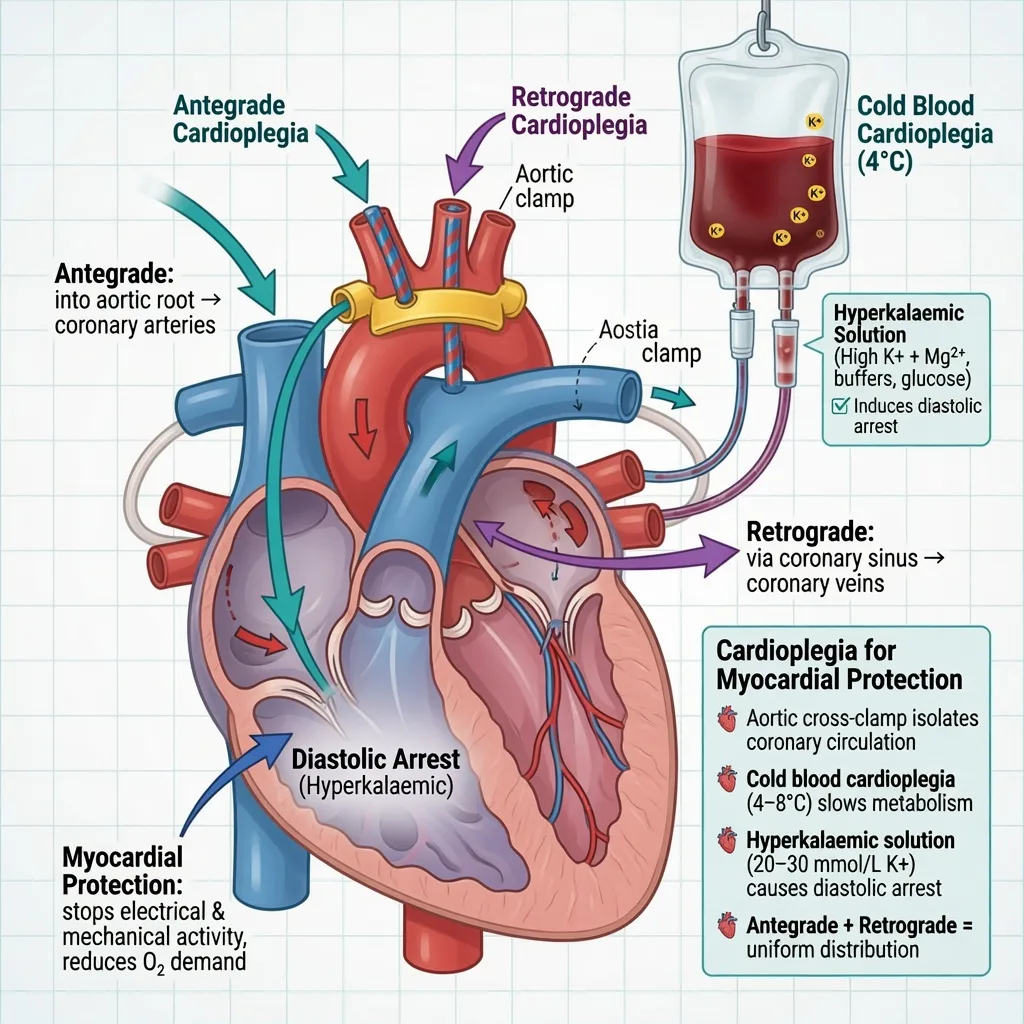

References
- [1]Mazer CD, Whitlock RP, Fergusson DA, et al. Restrictive or Liberal Red-Cell Transfusion for Cardiac Surgery N Engl J Med, 2017.PMID 29130845
- [2]Hahn RT, Abraham T, Adams MS, et al. Guidelines for performing a comprehensive transesophageal echocardiographic examination: recommendations from the American Society of Echocardiography and the Society of Cardiovascular Anesthesiologists J Am Soc Echocardiogr, 2013.PMID 23998692
- [3]Levy JH, et al. What's fishy about protamine? Clinical use, adverse reactions, and potential alternatives J Thromb Haemost, 2023.PMID 37062523