Anaes · Paediatric anaesthesia
Neonatal anaesthesia and the ex-preterm infant
Also known as Ex-preterm anaesthesia · Apnoea of prematurity postoperative · Neonatal anaesthesia
Premature physiology, Coté postoperative apnoea risk by post-menstrual age, NEC and inguinal hernia procedures, glucose and temperature management, oxygen targeting, and monitoring rules for fellowship exams.
On this page & tools
Your progress
Saved locally on this device.
9 MCQs with explanations
Target exams
Red flags
Why this is examined
Neonates and ex-preterm infants are over-represented in serious adverse event data and dominate viva stems about inguinal hernia repair and apnoea risk. Examiners want three things stated clearly: definitions of age (gestational, chronological, post-menstrual), the Coté combined-analysis framework for postoperative apnoea, and a meticulous physiology care plan (temperature, glucose, oxygen, ventilation).[1] The GAS trial keeps awake-regional versus GA developmental outcomes in the curriculum for the same population.[2][3]
Definitions — get the age vocabulary right
| Term | Meaning |
|---|---|
| Gestational age (GA) | Age from last menstrual period at birth |
| Chronological age | Time since birth |
| Post-menstrual age (PMA) | GA + chronological age |
| Corrected age | Chronological age minus weeks of prematurity (used more in developmental follow-up) |
Risk stratification for postoperative apnoea uses PMA (and history of apnoea/anaemia), not chronological age alone. Saying “this is a 3-month-old” without PMA is an examinable error.
[1]Physiology special to neonates and prematurity
Respiratory
Surfactant deficiency risk if premature; compliant chest wall with high distortion work; immature central respiratory drive; reduced respiratory muscle endurance; residual lung disease/BPD after prolonged ventilation; high closing capacity relative to FRC; rapid desaturation. Apnoea of prematurity may persist beyond NICU discharge in former preterms.
[1]Cardiovascular and transitional
Reactive pulmonary vascular bed; possible residual PDA physiology; limited stroke-volume reserve; heart-rate dependence of cardiac output. Hypoxia/hypercarbia/acidosis can recreate right-to-left shunt physiology.
[1]Metabolic and thermal
Low glycogen stores → hypoglycaemia risk with fasting and stress. Large BSA:mass, thin skin → hypothermia. Immature hepatic and renal clearance → prolonged drug effects (opioids, muscle relaxants, volatiles in residual effect).
[4]Haematology and oxygen
Anaemia of prematurity increases apnoea risk and reduces oxygen content. Historical concern about retinopathy of prematurity (ROP) and uncontrolled hyperoxia means oxygen is titrated to unit-specific SpO2 targets — not maximised indiscriminately, but hypoxia is also harmful. Follow the neonatal unit’s saturation band for that infant.
[4]Postoperative apnoea — the Coté framework
Practical discharge/monitoring rules (exam-safe phrasing)
- State PMA at pre-op briefing.
- If PMA below local threshold (often quoted near 60 weeks for conservative units, some use ~52–56 weeks with risk stratification): overnight apnoea monitoring after GA.
- Additional risk: anaemia, ongoing home apnoeas, residual lung disease, opioid use, history of NEC/sepsis.
- Regional techniques with minimal sedation are used in some centres for hernia repair; GAS compared awake-regional with sevoflurane GA for neurodevelopmental endpoints, not primarily as an apnoea-prevention trial — do not oversell GAS as an apnoea study.[2][3]
Conduct of anaesthesia
Preoperative
Review neonatal course: ventilation duration, BPD/CLD, PDA, IVH, seizures, apnoeas, home oxygen, current weight, haemoglobin, electrolytes, glucose, infection status. Discuss fasting with glucose strategy (see fluids topic). Confirm NICU/paediatric bed availability for monitoring. Senior anaesthetist involvement for true neonates and unstable preterms.
[1]Intraoperative
- Airway: gentle laryngoscopy; appropriate tube size; avoid excessive peak pressure; consider cuffed microcuff where institutional practice allows in larger infants.
- Ventilation: lung-protective thinking — avoid volutrauma; PEEP as needed; EtCO2 targets appropriate to pulmonary hypertension risk.
- Oxygen: titrate to unit targets; avoid wild hyperoxia–hypoxia swings.
- Haemodynamics: age-normal BP; treat bradycardia as oxygen-delivery emergency.
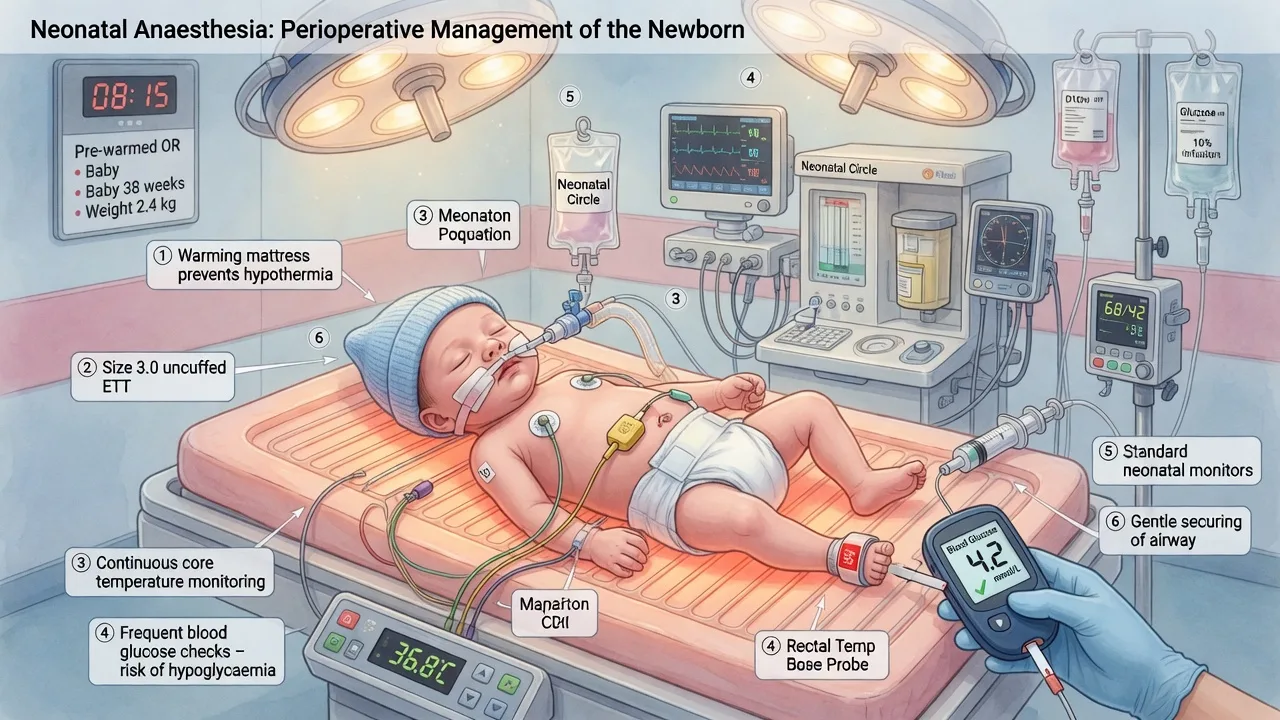
- Temperature: forced air, warm room, cover head, warm fluids, minimise exposure time.
- Glucose: check at induction and during long cases; include dextrose in maintenance fluids when indicated.
- Drugs: weight-based; reduce maintenance opioids if apnoea risk high; regional analgesia to spare systemic opioids when appropriate.
Postoperative
Explicit written plan: continuous SpO2 and apnoea monitoring duration, caffeine continuation if already prescribed by neonatology (do not start novel therapy without specialist input in the exam answer unless local protocol), feeding plan, pain plan that minimises respiratory depression, escalation criteria.
[1]Common procedures and scenario-specific traps
Anaesthetic technique options
- GA with ETT: default for emergency laparotomy and many neonates.
- Awake-regional (spinal/caudal) with minimal sedation: used selectively for hernia repair in skilled hands; requires patience, monitoring, and conversion plan. GAS showed similar developmental outcomes to brief sevoflurane in the studied cohort.[2][3]
- Combined GA + caudal: common for sub-umbilical surgery with opioid sparing.
Crisis pivots
- Bradycardia on induction/intubation: 100% oxygen, ventilation, atropine, CPR thresholds.
- Laryngospasm: physiology makes desaturation brutal; treat immediately (see airway topics).[4]
- Sudden desaturation on NEC case: aspiration, abdominal distension limiting ventilation, septic shock, tube displacement.
- Hyperglycaemia/hypoglycaemia swings: recheck; adjust dextrose rate; avoid treating numbers without clinical context.
SAQ answer scaffold
- Define PMA and why it matters.
- Summarise Coté-level apnoea risk and monitoring implication.[1]
- List physiology vulnerabilities (drive, FRC, glucose, temperature, drugs).
- Give intraoperative care bundle.
- Write an explicit postoperative monitoring plan.
Viva stem bank
- “A 44-week PMA ex-28-week infant for hernia repair — day case?”
- “How does anaemia interact with apnoea risk?”
- “What did GAS actually randomise and conclude?”
- Model phrase: “I will quote post-menstrual age, apply our institutional monitoring threshold informed by Coté, and write overnight cardiorespiratory monitoring into the plan.”
Coté numbers candidates should be able to paraphrase
Without inventing false precision beyond the paper: combined analysis of former preterm infants after herniorrhaphy showed postoperative apnoea risk that declined with rising post-conceptual/post-menstrual age, remained clinically important into the late 40s–50s weeks range, and was increased by anaemia.[1] Modern units translate this into local admission and monitoring policies rather than a single universal cut-off. In viva, say: “I will apply Coté-informed PMA risk stratification and our institutional overnight monitoring threshold, modified by anaemia and ongoing apnoea history.”
Airway and ventilation specifics in neonates
- Start ETT size roughly 3.0 mm (preterm smaller; term often 3.0–3.5); have half-size alternatives.
- Depth rules of thumb differ from older children; confirm bilateral air entry and tube mark; secure meticulously.
- High oxygen for rescue of hypoxia is appropriate; ongoing targeting should follow neonatal unit SpO2 bands when stable.
- Avoid excessive peak pressure; stomach decompression if mask ventilation inflated the abdomen.
- Cuffed microcuff tubes are increasingly used in larger neonates/infants in many centres with cuff pressure monitoring — follow local practice.
Pharmacology pearls
Immature hepatic enzymes and reduced GFR prolong many drugs. Morphine active metabolites accumulate in renal impairment. Remifentanil is titratable but causes bradycardia and chest wall rigidity if bolused carelessly. Regional techniques reduce systemic opioid need. Caffeine or theophylline for apnoea of prematurity is a neonatology prescription — continue established therapy; do not freestyle new methylxanthine plans without specialist input in the exam answer unless stating a local protocol.
[1]Team and logistics
True neonatal cases need: warm theatre, difficult airway adjuncts, weight-based emergency drugs drawn or immediately calculable, glucose meter, blood products if major surgery, NICU bed, and a named postoperative monitoring location. The pre-op brief should state PMA, weight, Hb, glucose plan, and apnoea monitoring disposition out loud.
[1]Age vocabulary drills and worked PMA examples
Examiners fail candidates who say “three-month-old” without post-menstrual age when discussing ex-preterms.
[2]Worked examples:
[1]- Born at 28 weeks, now chronological age 16 weeks → PMA = 28 + 16 = 44 weeks
- Born at 32 weeks, now chronological age 20 weeks → PMA = 52 weeks
- Born at 26 weeks, now chronological age 30 weeks → PMA = 56 weeks
Policies for overnight cardiorespiratory monitoring after anaesthesia commonly activate below local thresholds near 50–60 weeks PMA, modified by anaemia, ongoing apnoeas, residual lung disease, and opioids. Quote Coté as the classic combined-analysis foundation for postoperative apnoea risk after herniorrhaphy in former preterms, and then apply your institutional threshold rather than inventing a universal single cut-off.[1]
Coté framework — what to say without false precision
Coté and colleagues combined prospective data on former preterm infants after inguinal herniorrhaphy. Postoperative apnoea risk declined with increasing post-conceptual/post-menstrual age, remained clinically important into the late 40s–50s weeks range, and increased with anaemia.[1] Modern practice translates this into admission and monitoring policies. Exam-safe sentence: “I will state PMA, apply Coté-informed risk stratification, account for anaemia and apnoea history, and write overnight SpO2 and apnoea monitoring into the plan when below our institutional threshold.”
Respiratory pathophysiology of prematurity
Surfactant deficiency, alveolar simplification, and prolonged ventilation contribute to bronchopulmonary dysplasia/chronic lung disease. These infants may have baseline oxygen requirement, reactive airways, pulmonary hypertension, and poor reserve. Under anaesthesia:
[1]- Expect desaturation with short apnoeas
- Titrate oxygen to unit SpO2 targets when stable; use high FiO2 for rescue of hypoxia
- Avoid extreme hyperoxia–hypoxia swings linked to oxidative injury and ROP concerns in the relevant age window
- Plan postoperative respiratory support location before induction
Apnoea of prematurity reflects immature brainstem control and may persist after NICU discharge. Anaesthesia and opioids add peripheral and central respiratory depression on top of that immaturity.
[2]Cardiovascular and PDA considerations
A haemodynamically significant PDA changes pulmonary and systemic flow balance. Preterm myocardium has limited compliance and calcium handling immaturity. Induction agents and positive-pressure ventilation can drop systemic perfusion. For PDA ligation specifically: arterial monitoring often indicated, lung-protective ventilation, readiness for blood pressure swings when the duct is clipped, and communication with the surgeon about pulmonary hypertension and inotrope needs.
[1]NEC and emergency laparotomy
Necrotising enterocolitis presents a septic, fluid-shifted, coagulopathic neonate. Anaesthetic priorities: senior help, blood products available, glucose control, invasive monitoring as indicated, careful ventilation with abdominal distension, vasoactive support, and postoperative NICU. Induction can precipitate collapse — resuscitate in parallel, not after “getting the line in perfectly.”
[1]Glucose strategy integrated with fasting
Low glycogen stores mean hypoglycaemia risk with prolonged fasting. Check glucose at induction and during long cases. Include dextrose in maintenance fluids when indicated. Avoid both hypoglycaemia and extreme hyperglycaemia. Coordinate fasting times with the neonatal unit so feeds are timed rather than accidentally extended for hours on a delayed list.
[4]Temperature bundle for true neonates
Radiant warmer or forced air from before undressing; plastic wrap for extremely preterm infants in some protocols; warm room; hats; warm fluids; minimise procedures that require full exposure. Continuous temperature monitoring. Hypothermic neonates become acidotic, apnoeic, and coagulopathic.
[1]Airway sizing and ventilation specifics
- Extreme preterm: often 2.5 mm ETT
- Term neonate: often 3.0–3.5 mm
- Confirm bilateral air entry frequently; secure against dislodgement
- Peak pressure discipline to reduce barotrauma and pneumothorax
- Capnography may be imperfect with leaks — clinical chest movement still matters
- Microcuff tubes in larger infants where institutional practice supports them, with cuff pressure monitoring
Anaesthetic technique options — balanced view
GA with ETT is default for emergency laparotomy and many neonates.
Awake-regional (spinal/caudal) with minimal sedation for hernia repair is used in skilled centres; requires patience, conversion plan, and monitoring. GAS compared awake-regional with sevoflurane for neurodevelopmental outcomes, not primarily as an apnoea-prevention trial — do not oversell GAS as solving apnoea risk.[2][3]
GA plus caudal is a common opioid-sparing hybrid for sub-umbilical surgery.
Pharmacology in immature organs
Hepatic enzyme immaturity and reduced GFR prolong many drugs. Morphine metabolites accumulate in renal impairment. Remifentanil is titratable but causes bradycardia and wall rigidity if bolused carelessly. Muscle relaxants may have altered duration; reverse appropriately. Volatile MAC patterns differ by age; haemodynamic sensitivity is high in the sick neonate. Caffeine for apnoea of prematurity is a neonatology prescription — continue established therapy; do not freestyle new methylxanthine regimens without specialist input unless stating a clear local protocol.
[1]Postoperative monitoring plan template
Write in the notes:
[1]- PMA and chronological age
- Monitoring location (NICU/HDU/ward with telemetry)
- Duration of continuous SpO2 and apnoea monitoring (e.g. overnight / 12–24 h)
- Oxygen target band
- Glucose check schedule
- Analgesia plan with opioid minimisation rationale
- Escalation triggers (apnoeas needing stimulation, desaturation, bradycardia, feed intolerance)
- Named responsible team
Team brief script (say it out loud)
“This is a 44-week PMA ex-28-week infant, weight 3.8 kg, Hb 95, no home oxygen, for inguinal hernia repair under GA with caudal. Overnight apnoea monitoring planned. Glucose check at induction. Warming on. Senior available.” That script alone signals competence.
[1]Crisis pivots unique to this population
- Bradycardia on induction: 100% oxygen, ventilation, atropine, CPR thresholds
- Laryngospasm: treat immediately; desaturation is brutal in ex-preterms
- Sudden high airway pressure in NEC: abdominal distension, tube displacement, pneumothorax
- Hypoglycaemia: protocolised dextrose bolus and recheck
- Unexpected anaemia-related apnoea risk: consider transfusion thresholds with neonatology for major cases
Linking URI and elective timing
A concurrent upper respiratory infection multiplies laryngospasm risk in children generally; in a low-PMA ex-preterm the same event is more dangerous because reserve is smaller.[4] Defer true electives when clinically appropriate.
Extended viva model answers
Day-case hernia at 44 weeks PMA?
“No casual day-case discharge after GA. PMA is 44 weeks, below typical institutional overnight monitoring thresholds informed by Coté. I will plan cardiorespiratory monitoring overnight, minimise opioids, check glucose, warm actively, and document the plan.”
What did GAS actually show?
“GAS randomised infants having hernia repair to awake-regional versus sevoflurane and found similar neurodevelopmental outcomes at two and five years for primary cognitive endpoints. It is not primarily an apnoea-prevention trial.”
How do you target oxygen?
“Rescue hypoxia with oxygen immediately. When stable, follow the neonatal unit SpO2 band for that infant because uncontrolled hyperoxia and hypoxia both carry risks in the preterm population.”
Procedure-specific micro-plans
Inguinal hernia: PMA monitoring decision, opioid-sparing caudal or local, glucose, overnight plan.
ROP laser: remote site anaesthesia challenges, secure airway plan, oxygen targeting, neonatal team communication.
PDA ligation: invasive monitoring, lung disease ventilation strategy, haemodynamic swings at clip.
NEC laparotomy: septic resuscitation parallel to induction, blood products, NICU bed, glucose.
Documentation snippet
“PMA __ weeks. Post-GA apnoea monitoring: continuous SpO2 and apnoea monitoring overnight on NICU/HDU. Glucose checked. Warming used. Analgesia: __. Escalation: any apnoea needing stimulation, HR less than age threshold, SpO2 below target despite stimulation.”
[1]Comprehensive preoperative checklist for the ex-preterm
- PMA, GA at birth, chronological age, corrected age for development notes
- Current weight and recent trend
- Respiratory: home oxygen, recent apnoeas, BPD diagnosis, last viral illness
- Cardiac: PDA status, pulmonary hypertension, echo summary
- Neuro: IVH grade history, seizures, ventriculoperitoneal shunt
- Haematology: Hb, platelets if regional planned
- Metabolic: glucose history, electrolytes
- Medications: caffeine, diuretics, antireflux therapy
- Social: carer understanding of overnight stay need
- Logistics: NICU/HDU bed booked before induction
Conduct of anaesthesia — minute structure
Before induction: warm theatre, calculate emergency drugs, draw atropine and adrenaline per weight, check airway kit including smaller tubes, discuss plan A/B.
Induction: preoxygenate as able; IV preferred when access present; careful sevoflurane if gas induction; treat bradycardia as emergency.
Maintenance: controlled ventilation for most intubated neonates; titrate oxygen; active warming; glucose checks on long cases; opioid-sparing regional when suitable.
Emergence: fully reversed if relaxants used; consider ICU extubation for the sickest; do not race for day-case discharge when PMA low.
Postop: written apnoea monitoring plan; continue caffeine if already prescribed by neonatology.
Anaemia and apnoea interaction
Anaemia reduces oxygen content and is an independent risk factor in the Coté combined analysis framework for postoperative apnoea after herniorrhaphy in former preterms.[1] Optimise Hb for major cases with neonatology input; even for minor surgery, anaemia should influence monitoring intensity and disposition.
Regional versus GA decision in hernia repair
Awake-regional can reduce airway instrumentation and systemic anaesthetic exposure and was the comparator arm in GAS for developmental outcomes.[2][3] It requires skill, time, and a conversion plan. Many centres use GA plus caudal for practicality. Neither choice removes the need for PMA-based apnoea monitoring after anaesthesia when below threshold.
Pulmonary hypertension of prematurity
Chronic lung disease with elevated PVR decompensates with hypoxia, hypercarbia, acidosis, and pain. Anaesthetic plan: ICU involvement, careful ventilation, avoid PVR triggers, inodilators/pulmonary vasodilators as directed by specialists, postoperative ICU for major procedures.
[1]Family communication
Explain why overnight monitoring is recommended using PMA language parents can understand: “Because your baby was born early, their breathing control is still immature after anaesthetic, even if they seem well now.” Avoid alarming neurotoxicity digressions unless asked; if asked, use GAS-context balance without delaying indicated hernia repair.
[2]Common traps
Using chronological age alone; adult SpO2 targets without unit guidance; missing glucose; underestimating heat loss under drapes; promising day-case discharge below PMA threshold; claiming GAS proved regional prevents apnoea.
[2]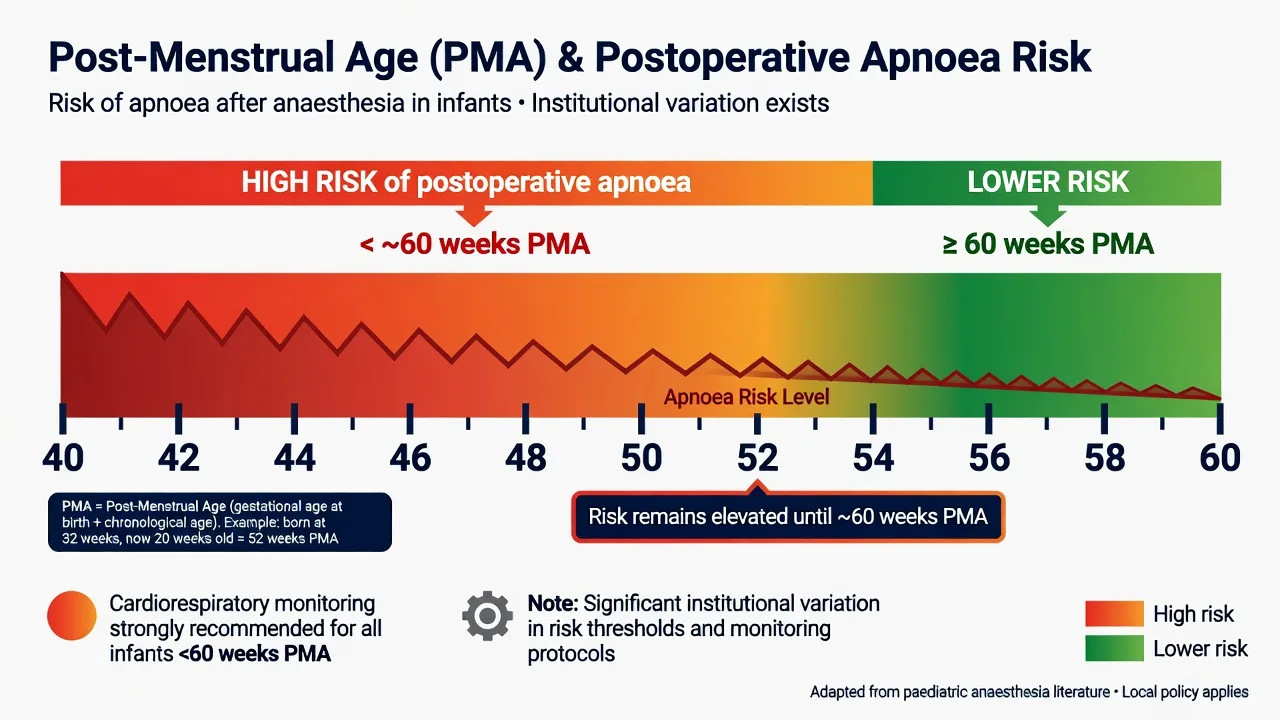

Fellowship consolidation — neonatal and ex-preterm anaesthesia [1]
The examiner expects a single coherent story: define post-menstrual age, apply Coté-informed apnoea risk, and deliver a meticulous physiological anaesthetic with an explicit overnight monitoring plan when PMA remains below institutional thresholds. [1]
Post-menstrual age equals gestational age at birth plus chronological age. A baby born at 27 weeks who is now 18 weeks old has a PMA of 45 weeks. Saying only chronological age in a hernia-repair viva is an automatic fail for disposition decisions. [1]
Coté and colleagues combined prospective herniorrhaphy data in former preterms and showed postoperative apnoea risk that fell with rising post-conceptual age, remained clinically important into the late 40s to 50s weeks, and increased with anaemia. Modern units convert that evidence into local overnight cardiorespiratory monitoring policies rather than a single universal magic number. [1]
Respiratory vulnerability includes immature central drive, reduced muscle endurance, residual BPD, high closing capacity relative to FRC, and rapid desaturation. Cardiovascular vulnerability includes heart-rate-dependent cardiac output and a reactive pulmonary vascular bed. Metabolic vulnerability includes hypoglycaemia from low glycogen stores and rapid heat loss from a high surface-area-to-mass ratio. [1]
Intraoperative care bundles: active forced-air warming from induction, glucose checks for neonates and long cases, oxygen titrated to unit SpO2 targets when stable with high FiO2 for hypoxic rescue, gentle ventilation avoiding gastric overdistension, weight-based drugs, and opioid-sparing regional techniques when appropriate. [1]
Technique options include GA with ETT for emergency laparotomy, GA plus caudal for many sub-umbilical cases, and selective awake-regional hernia pathways in skilled hands. GAS showed similar developmental outcomes for awake-regional versus brief sevoflurane in the studied infant hernia population; it is not primarily an apnoea-prevention trial. [1]
Disposition documentation must state PMA, monitoring location, duration of continuous SpO2 and apnoea monitoring, glucose plan, analgesia plan, and escalation triggers. Discharging a low-PMA ex-preterm as a routine day case after GA without monitoring is the classic safety failure. [1]
Emergency laparotomy for NEC demands parallel resuscitation: access, antibiotics, glucose, temperature, blood products, vasoactives, and a NICU bed. Induction can unmask septic shock — senior help and invasive monitoring readiness are part of the plan, not optional extras. [1]
Airway sizing starts around 2.5 mm for extreme preterms and 3.0 to 3.5 mm for term neonates, with half-size alternatives ready. Confirm bilateral air entry repeatedly and secure the tube against short-trachea dislodgement. [1]
Family communication should explain apnoea monitoring in plain language using prematurity and breathing-control immaturity after anaesthetic, without unnecessary alarmism and without delaying indicated surgery for theoretical neurotoxicity concerns. [1]
[1]References
- [1]Coté CJ, Zaslavsky A, Downes JJ, et al. Postoperative apnea in former preterm infants after inguinal herniorrhaphy. A combined analysis Anesthesiology, 1995.PMID 7717551
- [2]Davidson AJ, Disma N, de Graaff JC, et al. Neurodevelopmental outcome at 2 years of age after general anaesthesia and awake-regional anaesthesia in infancy (GAS): an international multicentre, randomised controlled trial Lancet, 2016.PMID 26507180
- [3]McCann ME, de Graaff JC, Dorris L, et al. Neurodevelopmental outcome at 5 years of age after general anaesthesia or awake-regional anaesthesia in infancy (GAS): an international, multicentre, randomised, controlled equivalence trial Lancet, 2019.PMID 30782342
- [4]Flick RP, Wilder RT, Pieper SF, et al. Risk factors for laryngospasm in children during general anesthesia Paediatr Anaesth, 2008.PMID 18315633
- [5]Sikich N, Lerman J Development and psychometric evaluation of the pediatric anesthesia emergence delirium scale Anesthesiology, 2004.PMID 15114210