Anaes · Obstetric anaesthesia
Neonatal resuscitation for the anaesthetist: NLS/NRP sequence and adrenaline dosing
Also known as NLS neonatal life support · NRP for anaesthetists · Neonatal adrenaline dose · Newborn resuscitation caesarean
Neonatal resuscitation skills for anaesthetists at delivery: initial steps, PPV, 3:1 compressions, adrenaline 0.01–0.03 mg/kg IV/IO, volume 10 mL/kg, and role allocation with neonatology.
On this page & tools
Your progress
Saved locally on this device.
1 MCQ with explanations
Target exams
Red flags
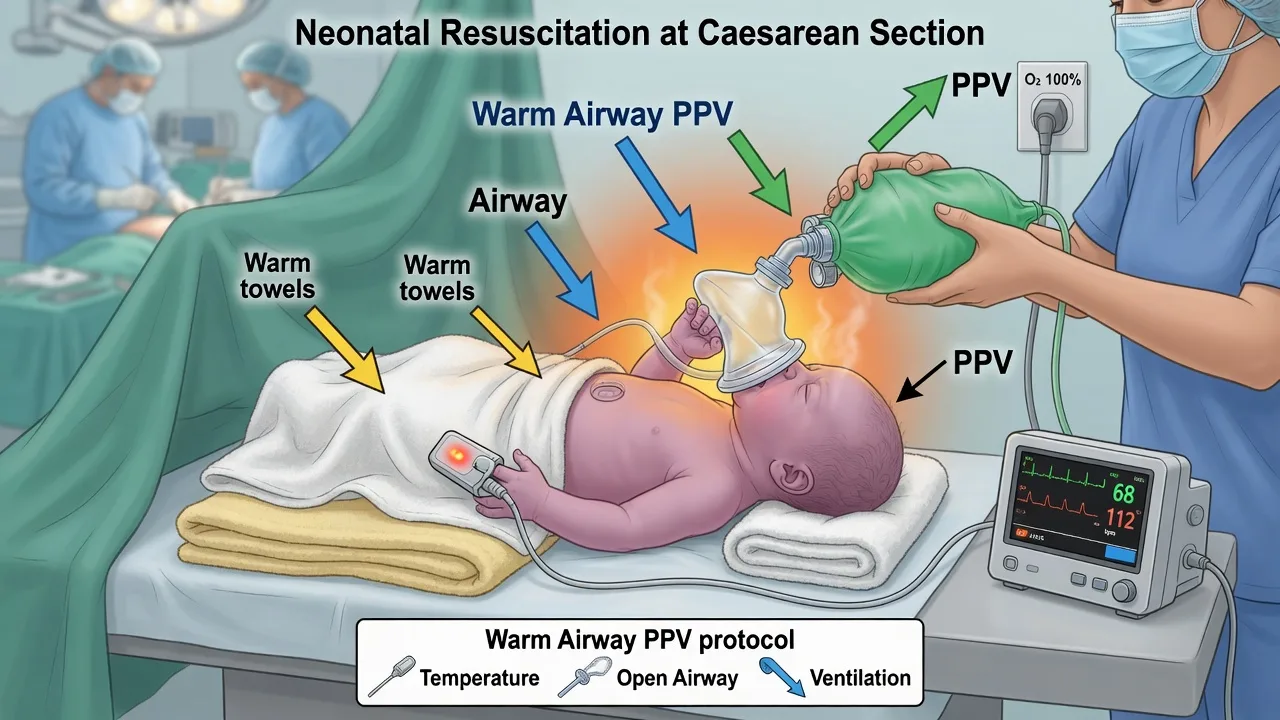
Why this is examined
Anaesthetists at caesarean delivery and other operative births may need to start neonatal resuscitation before the neonatal team arrives, assist in theatre, or simultaneously manage a dual maternal–neonatal crisis. The exam expects the NRP/AHA and ILCOR neonatal life support sequence, exact adrenaline and volume doses, the 3:1 compression-to-ventilation ratio, oxygen targeting, and clear role allocation so the mother is not abandoned during failed obstetric intubation or collapse.[1][2][3][4]
Curriculum anchors sit under obstetric and paediatric specialised study units across ANZCA Final, FRCA, EDAIC, ABA APPLIED, and FCAI. Discriminating viva marks come from saying “ventilation first,” quoting adrenaline as 0.01–0.03 mg/kg of 1:10,000 IV/IO, and refusing adult 15:2 ratios.
[4]Preparation before the baby is born
Know who is primarily responsible for the neonate. Check the resuscitaire: radiant warmer on, towels ready, oxygen/air blender, appropriately sized face masks, T-piece (Neopuff-style) or self-inflating bag with pressure manometer, suction, laryngoscope with straight blades, ETTs (typically 2.5, 3.0, 3.5 mm), stylet if used, end-tidal CO2 detector, umbilical venous catheter kit, adrenaline 1:10,000 drawn or immediately available, clocks visible, and a warm theatre environment.
[3]High-risk deliveries that should trigger neonatology presence before knife-to-skin include preterm labour, fetal distress or non-reassuring CTG, meconium-stained liquor with additional risk, multiple pregnancy, known fetal anomaly, shoulder dystocia risk, and general anaesthesia for category-1 caesarean. State the plan aloud in the team brief: who holds the baby, who leads neonatal airway, who continues maternal anaesthesia, and when to call for more help.
[3]Why newborns need a different algorithm
Transition from fetal to neonatal circulation requires lung aeration. Most newborns need only drying, warmth, and stimulation. Primary failure is almost always respiratory, not cardiac: effective lung inflation raises pulmonary blood flow, improves oxygenation, and allows heart rate to recover. That is why drugs come late and ventilation quality comes first.[1]
Fetal haemoglobin, high oxygen consumption relative to stores, and a compliant chest wall mean hypoxaemia and bradycardia escalate quickly once aeration fails. Thermal stress increases oxygen consumption and worsens acidosis — radiant heat and drying are physiology, not hotel service.
[3]Initial steps (first sixty seconds)
- Warm, dry, stimulate. Place under radiant heat; dry thoroughly; remove wet linen; stimulate by rubbing the back or feet.
- Open the airway. Sniffing position; shoulder roll for large occiput if needed; avoid extreme hyperextension or flexion.
- Assess. Tone, breathing effort, and heart rate (the best single vital sign). Auscultate the precordium or feel the umbilical stump; ECG leads if available improve accuracy of low rates.
- Attach preductal pulse oximetry on the right hand or wrist. SpO2 rises gradually after birth — do not expect adult values at one minute.
- Suction only if needed. Clear obvious obstruction; routine deep suction of vigorous babies is not indicated and delays ventilation.
Most term babies improve with these steps alone. If apnoeic, gasping, or heart rate less than 100/min after initial steps, move immediately to positive-pressure ventilation.
[1]Positive-pressure ventilation — the decisive skill
Start PPV if the newborn is apnoeic, gasping, or has a heart rate less than 100/min after initial steps. Effective ventilation is the single most important action in neonatal resuscitation.[1][2]
How to deliver effective breaths
- Correct mask size covering nose and mouth without eye pressure
- Good seal; two-person technique if single-handed seal fails
- Peak inspiratory pressures sufficient to move the chest (often start around 20–25 cmH2O term; higher may be needed initially; preterm gentler)
- Rate about 40–60 breaths/min when not doing compressions
- Watch for chest rise; listen for breath sounds; rising heart rate is the best feedback that ventilation is working
Corrective steps (MR SOPA-type thinking)
If the chest is not moving or heart rate is not rising: Mask adjustment, Reposition airway, Suction mouth and nose, Open mouth, Pressure increase, Alternative airway (supraglottic device or endotracheal tube). Do not pile adrenaline on top of an unventilated baby.
[4]Oxygen targeting
Use blended oxygen guided by oximetry rather than routine 100 percent oxygen for all term babies from the first breath. Start lower for term infants and titrate to minute-specific SpO2 targets in NRP-style algorithms; increase oxygen if bradycardia persists or saturation lags. During the CPR phase, 100 percent oxygen is used while compressions continue, with titration after recovery as per current algorithm cards.[1][3]
Advanced airway
Escalate to endotracheal intubation or a neonatal supraglottic airway when mask PPV is ineffective, when prolonged ventilation is expected, or when compressions are required. Confirm tube placement with clinical signs plus exhaled CO2 detection when available. Typical starting ETT sizes: extreme preterm often 2.5 mm; term often 3.0–3.5 mm. Secure meticulously — short tracheas make dislodgement easy.
[4]Chest compressions
If heart rate remains below 60/min despite at least 30 seconds of effective PPV, start chest compressions coordinated with ventilation at a 3:1 ratio (three compressions to one breath), aiming for about 90 compressions and 30 breaths per minute (120 events/min). Prefer two-thumb encircling technique; compress the lower third of the sternum to about one-third of the anteroposterior chest diameter. Use 100 percent oxygen during the CPR phase as per algorithm; place an advanced airway when feasible to improve coordination.[1][2]
Do not use the adult 15:2 ratio. That single error fails many obstetric vivas.
[4]Drugs and volume — exact doses
Adrenaline (epinephrine)
- Preferred route: intravenous or intraosseous
- Dose: 0.01–0.03 mg/kg (equal to 0.1–0.3 mL/kg of 1:10,000)
- Repeat every 3–5 minutes while heart rate remains less than 60/min despite ventilation and compressions
- Endotracheal adrenaline is less reliable; if used as a temporising measure while access is obtained, higher ET doses appear in some algorithms — prioritise IV/IO access
Worked example: 3 kg term neonate → 0.03–0.09 mg adrenaline IV = 0.3–0.9 mL of 1:10,000. Draw from a clearly labelled 1:10,000 ampoule; concentration errors kill.
[3]Volume expansion
Give 10 mL/kg isotonic crystalloid or blood if hypovolaemia is suspected: pale baby, weak pulses, history of antepartum haemorrhage, abruption, feto-maternal haemorrhage, or cord accident. Reassess after each bolus; avoid routine volume loading of every bradycardic neonate without a hypovolaemia story.[1]
Other agents
Sodium bicarbonate is not routine first-line neonatal resus. Naloxone is not first-line for the depressed newborn of a mother on chronic opioids (may precipitate withdrawal); support ventilation first. Glucose: check and treat hypoglycaemia in prolonged resuscitations and at-risk infants once circulation allows.
[3]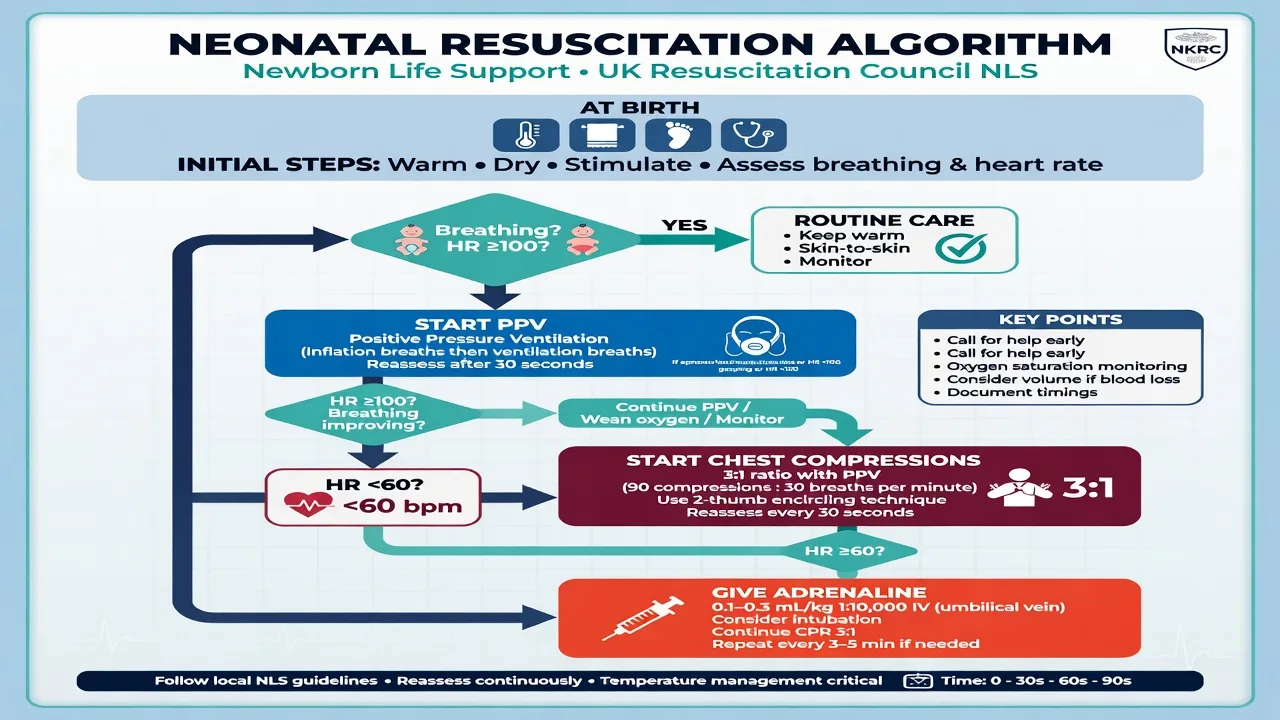
Special situations
Preterm
Thermal care is critical (plastic wrap for very preterm, radiant heat, warm room). Use gentle ventilation to reduce lung injury; follow unit SpO2 targets; early surfactant pathways are neonatology-led. Delayed cord clamping practices continue to evolve — follow current obstetric/neonatal protocol for the scenario.
[3]Meconium
Routine vigorous suctioning of vigorous babies with meconium-stained liquor is not indicated. Non-vigorous babies need airway support without delaying PPV; tracheal suction is selective when airway obstruction from particulate meconium is suspected, not a mandatory ritual before every breath.
[4]Maternal general anaesthesia and opioids
Support ventilation; residual anaesthetic and opioids may depress the newborn. Naloxone is not a substitute for airway support and is avoided as first-line when maternal opioid use is chronic. Communicate anaesthetic drug timing to the neonatal team.
[3]Congenital anomalies
Known diaphragmatic hernia: avoid prolonged bag-mask gastric distension; early intubation preferred in many protocols. Known difficult airway or micrognathia: call senior help early; have advanced airway kit ready.
[4]Maternal cardiac arrest
Perimortem caesarean delivery is part of maternal resuscitation (classically considered around 4 minutes of arrest if no ROSC, aiming for delivery by 5 minutes in the third trimester — follow current ALS/obstetric guidance). Resuscitate the neonate after delivery while maternal ACLS continues. This is a dual-team crisis, not a neonatal-only event.
[1]Anaesthetist role boundaries and dual crisis
Primary duty may remain the mother — especially during maternal collapse, massive haemorrhage, or difficult/failed obstetric intubation.[4] Call neonatal help early. Do not abandon an unstable mother to run a prolonged solo neonatal resuscitation if alternatives exist. In category-1 GA caesarean with a depressed baby and a difficult maternal airway, allocate the most appropriate clinician to each patient and call for a second anaesthetist.
Exam phrase: “I will ensure effective neonatal ventilation is started immediately, but I will not leave an unsecured maternal airway or uncontrolled haemorrhage to provide prolonged solo neonatal care when help can be summoned.”
[3]Umbilical access and practical theatre tips
Umbilical venous catheter is the classic emergency access for adrenaline and volume when peripheral IV fails. Intraosseous access is an accepted alternative. Pre-draw weight-estimated doses when high-risk delivery is expected. Assign a scribe for times, heart rates, and drugs. Keep the resuscitaire head of the table clear of surgical clutter before induction.
[1]Monitoring targets after transition
Preductal SpO2 rises over the first 5–10 minutes; use NRP target tables rather than forcing SpO2 of 100 percent at one minute. Heart rate above 100/min with good tone and breathing is the recovery goal. Persistent cyanosis with good ventilation raises differential of congenital heart disease, pneumothorax, or PPHN — escalate to neonatology/NICU.
[1]Postoperative / disposition
Document times of birth, PPV start, compression start, drug doses/routes/times, airway interventions, and heart-rate responses. Hand over formally to the neonatal team: estimated blood loss context, maternal drugs (anaesthetics, magnesium, opioids), meconium, and risk factors. Support family communication led by neonatology and obstetrics; anaesthetists contribute factual timelines without speculation.
[4]Linking to obstetric anaesthesia crises
Failed intubation at GA caesarean: follow OAA/DAS — maternal oxygenation first; neonatal team should already be present for category-1 risk deliveries.[4] Massive PPH with simultaneous depressed neonate: two teams, two priorities, one theatre lead. Magnesium toxicity in the mother may associate with floppy neonates — support ventilation; calcium is maternal therapy primarily.
SAQ answer scaffold
- Preparation and role allocation (mother vs baby).
- Initial steps and when to start PPV.
- How to make ventilation effective (seal, MR SOPA, advanced airway).
- Compressions threshold and exact 3:1 ratio.
- Adrenaline 0.01–0.03 mg/kg IV/IO of 1:10,000; volume 10 mL/kg.
- Special situations (preterm, meconium, dual crisis).
- Documentation and handover.
Viva stem bank
- “You are the sole anaesthetist; the baby is born floppy at GA caesarean and the mother is bleeding — priorities?”
- “Heart rate is 50 after bag-mask for 40 seconds — next steps and doses?”
- “Why not 15:2?”
- “When do you give volume rather than more adrenaline?”
- Model phrase: “Effective ventilation is the key intervention; adrenaline is 0.01 to 0.03 milligrams per kilogram IV of one in ten thousand.”
Worked 3 kg emergency card (exam-ready)
- PPV if apnoeic/gasping or HR less than 100
- Compressions if HR less than 60 after effective PPV at 3:1
- Adrenaline: 0.03–0.09 mg IV = 0.3–0.9 mL of 1:10,000 (using 0.01–0.03 mg/kg range)
- Volume: 30 mL crystalloid or blood if hypovolaemic
- Recheck HR every 60 seconds during CPR cycles per algorithm discipline
Deep fellowship expansion — neonatal resuscitation for anaesthetists
Role clarity
Anaesthetists may lead or assist neonatal resuscitation in theatre after caesarean delivery, in the emergency department, or when paediatric teams are delayed. Use current NLS/NRP algorithms rather than adult ALS reflexes. Temperature, airway, and ventilation dominate adrenaline.
[1]Initial steps
Warm, dry, stimulate; position airway; assess tone, breathing, heart rate. Heart rate is the critical vital sign. Start timer. Delayed cord clamping policies interact with resuscitation need — follow obstetric–neonatal local protocols when baby is vigorous versus needing immediate help.
[1]Ventilation first
Most compromised newborns need effective positive pressure ventilation, not immediate drugs. Use correct interface, rate, and rising chest as the marker of success. SpO2 targets rise over minutes — do not demand adult saturations at 60 seconds of life. Air versus oxygen blending follows algorithm updates — state you follow current NLS/NRP guidance.
[2]Chest compressions
Indicated when heart rate remains very low despite effective ventilation. Coordination ratio and two-thumb technique are algorithm-defined. Reassess frequently; poor ventilation is a common reason compressions “fail.”
[1]Adrenaline dosing discipline
Use the neonatal concentration and route pathway in your local algorithm (IV preferred via emergency UVC when needed; endotracheal less reliable). Dose is weight-based at neonatal order of magnitude — quote your course card rather than adult 1 mg boluses. Flush appropriately. Repeated dosing per algorithm if HR stays low.
[1]Volume and glucose
Blood loss consideration (twin, abruption, cord accident): isotonic crystalloid or blood carefully. Hypoglycaemia risks brain injury — check and treat per neonatal protocols.
[3]Meconium and special paths
Approaches to meconium-stained liquor have evolved away from routine vigorous suction for all; follow current guidance emphasising ventilation for the non-vigorous infant. Congenital anomalies (diaphragmatic hernia, airway malformations) need early advanced airway strategies and gentle ventilation.
[2]Communication with parents and teams
Call neonatal/paediatric help early; assign roles; speak closed-loop; update obstetric team; document times of HR, first cry, drugs, and cord management.
[4]Deep fellowship expansion
Why examiners keep this leaf
This topic sits at the intersection of physiology, crisis drills, and guideline-aware decision-making. Candidates who only memorise a single sentence fail when the stem adds comorbidity, anticoagulation, pregnancy, or a second crisis. Build every answer as assessment → physiology → goals → technique → monitoring → intraoperative conduct → crisis → postoperative care → special populations → traps.
[1]Structured preoperative assessment
Take a focused history that captures disease severity, prior anaesthetics, airway predictors, fasting, allergies, medications (especially anticoagulants, antiplatelets, cardiac drugs, insulin, psychotropics), functional capacity, and red-flag symptoms. Examine airway, cardiorespiratory status, neurological baseline, and site-specific signs relevant to this operation. Review bloods, ECG, and imaging that change risk. Consent must name the critical complications unique to this leaf, not only generic nausea and sore throat.
[1]Applied physiology the viva expects
Explain the core physical or reflex pathway in plain language first, then add exam detail. Link macro-haemodynamics to organ perfusion. State what makes physiology worse (hypoxia, hypercapnia, hypotension, hypertension, anaemia, pain, light anaesthesia, positioning extremes) and what improves it. If a formula exists (risk index, pressure equation, dose per kilogram), say it exactly and define each term.
[2]Anaesthetic goals (make them measurable)
- Safety of airway and oxygenation without secondary injury
- Haemodynamic targets agreed with the surgical team
- Analgesia that enables recovery goals without toxicity
- Neurologic or organ-specific protection relevant to the case
- Plan for the single most dangerous crisis of this operation
- Disposition matched to risk (ward versus HDU/ICU)
Technique options and decision matrix
Compare at least two legitimate anaesthetic techniques when they exist (for example regional versus general, spontaneous versus controlled ventilation, invasive versus non-invasive monitoring). For each, state benefits, risks, and the patient who fits best. If only one technique is realistic in a crisis, say why alternatives fail. Always include a failure plan: what you do when plan A collapses at two in the morning.
[2]Monitoring and equipment packing list
Standard ASA monitors are assumed. Add what this leaf specifically needs: arterial line, depth of anaesthesia, neuromuscular quantitation, special Doppler/TOE, temperature, urine output, point-of-care blood gas and haemoglobin, difficult airway trolley, lipid emulsion, dantrolene, defibrillator, or neonatal resuscitaire as relevant. Check devices before induction, not after the crisis starts.
[1]Intraoperative conduct — phase by phase
Induction: control the stimulus response that is dangerous in this disease. Maintenance: match anaesthetic depth and drug choice to monitoring constraints (for example evoked potentials) and to organ physiology. Surgical phases of risk should be announced (cementing, traction on extraocular muscles, clamp on, clamp off, tourniquet down, bone work, fetus delivery, etc.). Emergence: smooth when coughing or hypertension threatens the repair; awake and protective when aspiration or airway soiling is the threat.
[2]Crisis pivot scripts
Rehearse a sub-fifteen-second script for the signature crisis. Name the diagnosis, give the surgeon a concrete request, state the first drug or manoeuvre, and the monitoring endpoint you will reassess in one minute. Differential diagnosis should be short and ordered by likelihood and lethality, not an exhaustive textbook dump.
[3]Drug doses and order-of-magnitude anchors
Where doses are classic fellowship anchors, quote them with units and a citation mindset: atropine for oculocardiac pathways, adrenaline in neonatal resuscitation algorithms, local anaesthetic maxima, mannitol ranges, TXA timing windows, or heparin/protamine contexts as relevant to the leaf. Never invent a microgram figure you cannot support; if practice varies, say “per local protocol” after the exam-classic range.
[1]Postoperative and disposition
PACU handovers must include the crisis that almost happened, ongoing infusion plans, neurological observations, drain care, VTE prophylaxis timing, and who to call if the signature complication appears on the ward at midnight. HDU/ICU criteria should be explicit for high-risk leaves.
[2]Special populations
Work through pregnancy, paediatrics, elderly frailty, obesity, severe cardiopulmonary disease, and anticoagulation as modifiers. Each changes drug dosing, airway strategy, monitoring intensity, or whether regional anaesthesia remains available.
[1]SAQ scaffold (use as timing plan)
- Definition and why it matters to outcome
- Pathophysiology in five to eight lines
- Preoperative optimisation and consent highlights
- Intraoperative plan with numbers
- Crisis management algorithm
- Postoperative care and prevention of recurrence
Viva stem bank and model phrases
Prepare three stems: a routine elective case, a crisis mid-case, and a comorbidity twist (anticoagulant, pregnancy, or ICU-bound patient). Model phrases should sound like theatre leadership: short, directive, and closed-loop. Examples of tone: “Surgeon, please stop traction — treating as reflex bradycardia.” “I am treating this as the signature crisis until the monitors say otherwise.”
[1]Common traps for this leaf type
- Memorising one drug dose without the stop-stimulus or surgical-first step
- Ignoring anticoagulation timing for neuraxial or deep blocks
- Forgetting disposition and overnight monitoring
- Using false precision for controversial numbers
- Failing to reassess after the first manoeuvre
- Neglecting communication with surgeon and scrub team
Full case narrative template
Describe a realistic patient, the preassessment findings that change the plan, induction and monitoring choices, an intraoperative wobble that you correct with a named algorithm, and a clean PACU outcome with preventive advice. Narratives score because they prove you can sequence priorities under time pressure.
[2]Guidelines and evidence posture
When landmark trials or society statements exist for the leaf, name them at the correct depth: what they showed, what they did not show, and how they change tomorrow morning’s anaesthetic. Avoid weaponising a trial beyond its population. Prefer mechanisms plus one evidence anchor over a reference salad.
[1]Human factors
Call for help early, use cognitive aids, assign roles, and avoid fixation error. Many signature crises are rare enough that the first actions must be overlearned. If your hospital has a checklist for the crisis, say you will use it.
[2]Regional versus systemic trade-offs (when relevant)
Regional anaesthesia may blunt stress responses and improve analgesia but introduces block failure, LAST, and haematoma risks. Systemic multimodal analgesia avoids needles but may sedate and depress ventilation. Hybrid plans are often best. Match the plan to bleeding risk and monitoring needs.
[1]Ventilation and oxygenation themes
Even non-thoracic leaves punish hypoxia and hypercapnia. State protective ventilation ideas when the chest or abdomen is open, when prone, or when intracranial elastance is high. Correlate EtCO2 with blood gas when accuracy matters.
[2]Haemorrhage and fluid themes
If the leaf risks bleeding, state access, blood product availability, cell salvage rules when appropriate, and triggers for activation of major haemorrhage protocols. Avoid both running dry and drowning the patient with crystalloid.
[3]Pain, PONV, and recovery quality
Multimodal analgesia and stratified antiemetic prophylaxis are part of modern fellowship answers even when the “main” topic is a crisis pathway. Uncontrolled pain and vomiting destabilise physiology you just protected.
[1]Documentation and medicolegal clarity
Write the risk discussion, the crisis, the doses given, and the neurological or visual observations that matter. Future clinicians and coroners read what you chart, not what you meant to do.
[2]Teaching one-liners to memorise
Create five one-liners unique to the leaf: the reflex arc, the first action, the dangerous drug interaction, the monitoring modality of choice, and the disposition rule. Recite them at the end of the viva if invited to summarise.
[1]Worked numbers board
On a whiteboard in the viva, write the two to four numbers that define competence for this topic (for example a dose, a pressure target, a timing interval, a risk index cut-point). Speak units. If a number is controversial, present the range and your institutional default.
[2]Interaction with concurrent topics
Map this leaf to neighbours on the syllabus map: airway, cardiac risk, neuraxial timing, neuroprotection, paediatric dosing, or obstetric physiology as relevant. Examiners love cross-links that remain accurate.
[3]Quality improvement angle
Mention audit of complications, simulation of the crisis, and equipment standardisation. Consultant answers often include how the system prevents the next event, not only how the individual heroically treats it.
[1]Ethical and consent nuances
If the signature complication includes permanent harm (vision loss, stroke, death, awareness risk), your consent must be specific and documented. Shared decision-making applies when alternatives exist with different risk profiles.
[2]Paediatric dose discipline (if ever relevant)
Use weight-based dosing with ceilings, lean versus total weight where appropriate, and double-check high-risk drugs. In neonates, temperature and glucose join ABC as immediate priorities.
[1]Obstetric modifier (if ever relevant)
Aortocaval compression relief, aspiration risk, two-patient oxygen delivery, and uteroplacental perfusion targets modify every crisis algorithm. Call obstetric and neonatal teams early when the stem involves pregnancy.
[2]ICU handoff blueprint
Illness severity, airway status, infusions, targets for BP/SpO2/CO2, neurological observations, drains, pending imaging, family location, and ceilings of care if already discussed.
[3]Simulation checklist you would run for your department
Setup, recognition cues, first 60 seconds actions, role allocation, common failure points (wrong dose, forgotten stop-stimulus, no help called), and debrief prompts. This demonstrates mastery beyond rote MCQ facts.
[1]Closing consultant sentence
“I will manage this case with explicit physiological targets, a rehearsed crisis script, guideline-aware drug choices, and a disposition plan that matches residual risk — and I will call for help early if the signature complication appears.”
[2]Common traps
Drugs before effective ventilation; wrong adrenaline concentration (1:1000 vs 1:10,000); adult 15:2 ratio; forgetting thermal care; abandoning the mother during dual crisis; routine deep suction delaying PPV; expecting SpO2 of 95 percent at 60 seconds of life; giving volume to every baby with bradycardia without a hypovolaemia story.
[3]Cross-exam phrasing bank
- ANZCA/FRCA: “Ventilation quality before adrenaline; quote NRP doses.”
- ABA APPLIED: structured NRP stem with dose calculation under pressure.
- EDAIC/FCAI: same physiology, name local NLS course equivalent if asked, but doses align with ILCOR-derived algorithms.[3]
Extended physiology for the primary-level examiner
Lung liquid clearance and the first effective breaths drop pulmonary vascular resistance, allowing right-to-left ductal and foramen shunts to reverse as systemic oxygenation improves. Persistent high PVR (hypoxia, acidosis, hypothermia) maintains cyanosis — another reason ventilation, temperature, and pH matter before exotic pharmacology. Anaesthetists who understand transitional circulation resuscitated better and explain better.
[4]Equipment failure pivots
Empty oxygen cylinder, disconnected blender, wrong-sized mask, blocked suction, failed laryngoscope light: announce the failure, switch devices, call for help. Have a self-inflating bag available if wall gas fails. These mundane failures feature in real theatre morbidity and in realistic viva stems.
[4]Team resource management
Use closed-loop communication: “Adrenaline 0.09 milligrams IV now” → “Drawing 0.9 millilitres of one in ten thousand” → “Given.” Assign roles: airway, compressions, drugs/access, scribe, family liaison. If only two clinicians are present, airway/ventilation outranks everything except uncontrolled maternal haemorrhage or unsecured maternal airway.
[4]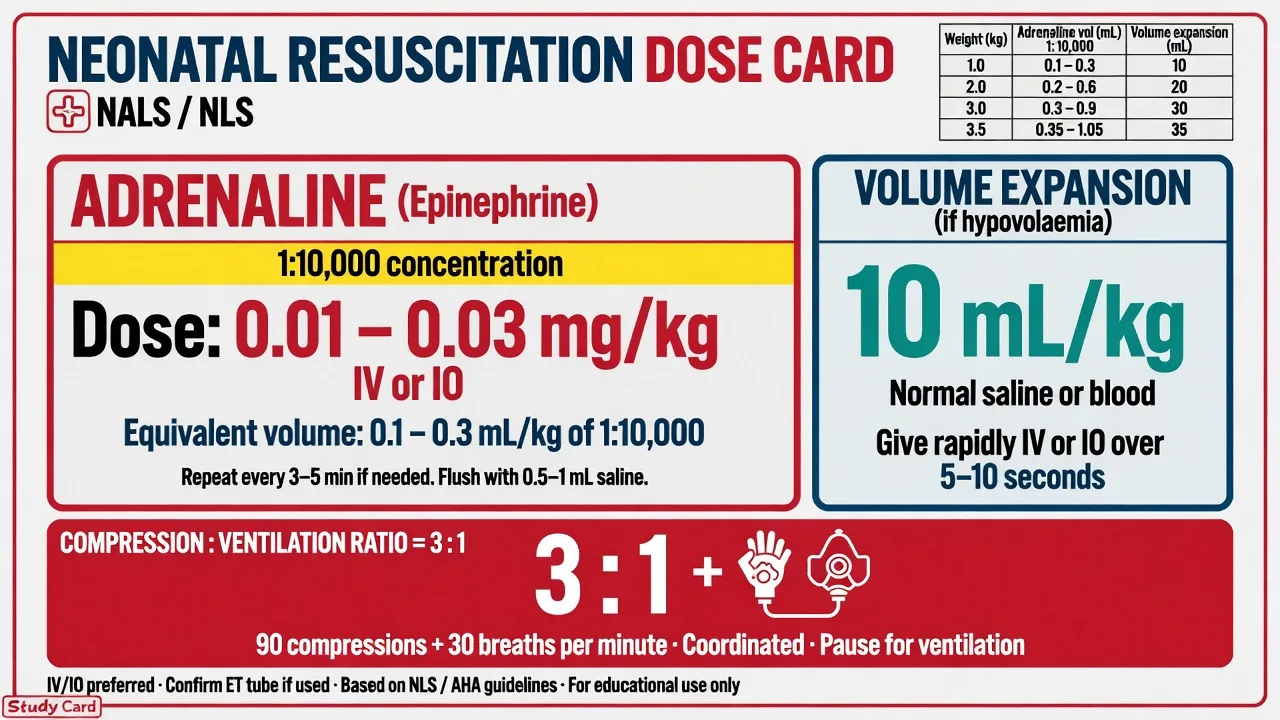
One-page mental checklist before category-1 GA caesarean
Warmer on · neonatology called · masks and T-piece checked · ETTs 2.5–3.5 · adrenaline 1:10,000 present · suction working · role split mother/baby agreed · OAA/DAS difficult airway plan stated for mother · left tilt and haemorrhage kit ready.
[4]That checklist prevents the common disaster of discovering a cold resuscitaire and no neonatal help after a depressed baby is handed up.
[3] [3] [3] [3]Neonatal resus sequence
References
- [1]Aziz K, Lee HC, Escobedo MB, et al. Part 5: Neonatal Resuscitation: 2020 American Heart Association Guidelines for Cardiopulmonary Resuscitation and Emergency Cardiovascular Care Circulation, 2020.PMID 33081528
- [2]Aziz K, Lee CHC, Escobedo MB, et al. Part 5: Neonatal Resuscitation 2020 American Heart Association Guidelines for Cardiopulmonary Resuscitation and Emergency Cardiovascular Care Pediatrics, 2021.PMID 33087555
- [3]Liley HG, Weiner GM, Wyckoff MH, et al. Neonatal Life Support: 2025 International Liaison Committee on Resuscitation Consensus on Science With Treatment Recommendations Resuscitation, 2025.PMID 41117580
- [4]Mushambi MC, Kinsella SM, Popat M, et al. Obstetric Anaesthetists' Association and Difficult Airway Society guidelines for the management of difficult and failed tracheal intubation in obstetrics Anaesthesia, 2015.PMID 26449292