Anaes · Obstetric anaesthesia
Obstetric anaesthesia
Also known as Obstetric anaesthesia · Caesarean section anaesthesia · Labour epidural · Pre-eclampsia anaesthesia · Obstetric GA · SS_OB specialised study unit
Exam-pass obstetric anaesthesia hub (SS_OB): maternal physiology, labour epidural/CSE, caesarean decision matrix, OAA/DAS failed intubation and wake-versus-proceed, pre-eclampsia/magnesium, PPH with WOMAN TXA, AFE, and leaf links for crises.
On this page & tools
Your progress
Saved locally on this device.
Target exams
Red flags
Why this is examined
SS_OB carries 30 FEx outcomes but the highest crisis density of any specialised study unit. Every on-call anaesthetist must manage labour analgesia, category-1 caesarean, failed intubation, pre-eclampsia, and massive PPH. MBRRACE-UK repeatedly places anaesthesia skill, airway, and haemorrhage response at the centre of preventable maternal death narratives.[5][6] FRCA CRQ, ABA APPLIED, EDAIC oral, and FCAI SOE all stress prioritisation: what kills mother first, what saves baby second, when to wake, when to proceed.
SSU framework and hub map
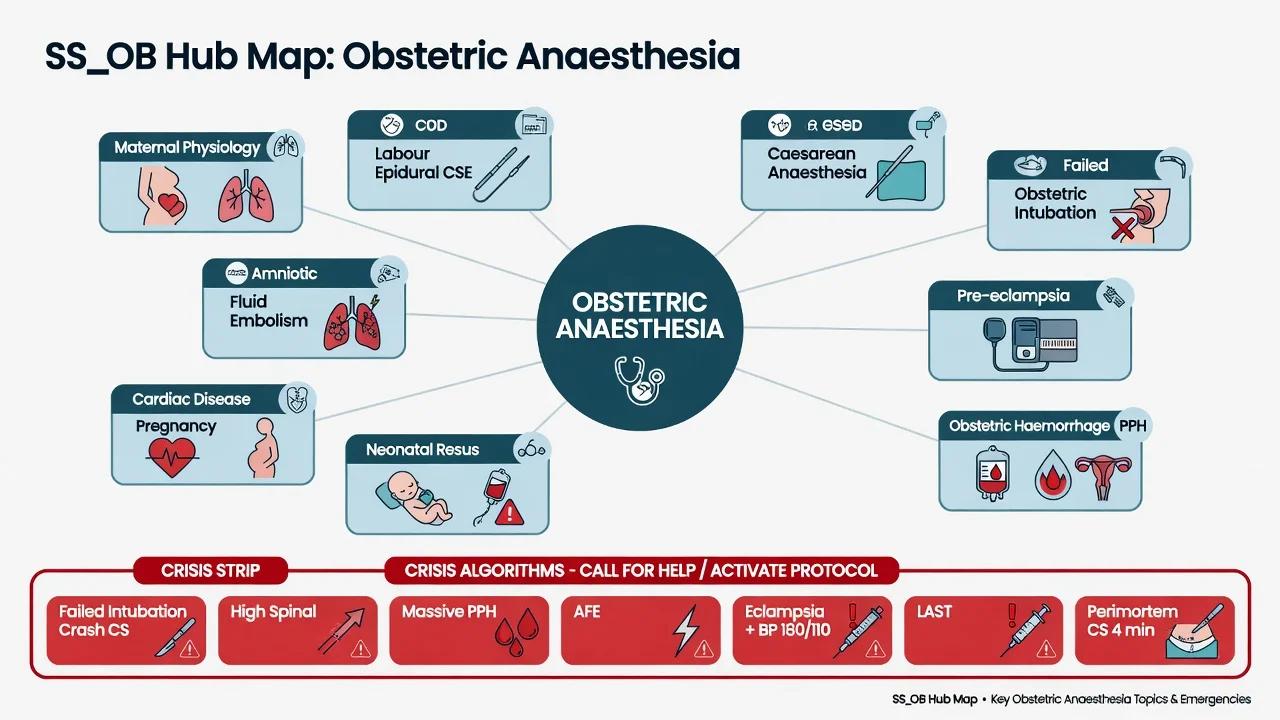
| Leaf / depth topic | Examiner focus |
|---|---|
| Maternal physiology (hub + dedicated leaf planned) | FRC↓, VO2↑, aortocaval compression, airway oedema, aspiration, MAC↓ |
| Labour analgesia epidural/CSE | Solutions, PCEA, breakthrough pain, dural tap |
| Caesarean anaesthesia | Spinal vs CSE vs GA; category urgency |
failed-obstetric-intubation | OAA/DAS 2015, wake vs proceed, SGA, CICO |
| Pre-eclampsia anaesthetic plan | Airway, platelets, magnesium, BP control, fluids |
obstetric-haemorrhage-pph | 4 Ts, uterotonics, TXA, fibrinogen, cell salvage, IR |
| Cardiac disease in pregnancy | Leading indirect maternal death cause |
| Amniotic fluid embolism | Collapse + DIC biphasic pattern |
| Neonatal resuscitation for anaesthetists | Initial steps after difficult delivery |
Maternal physiology that changes the plan
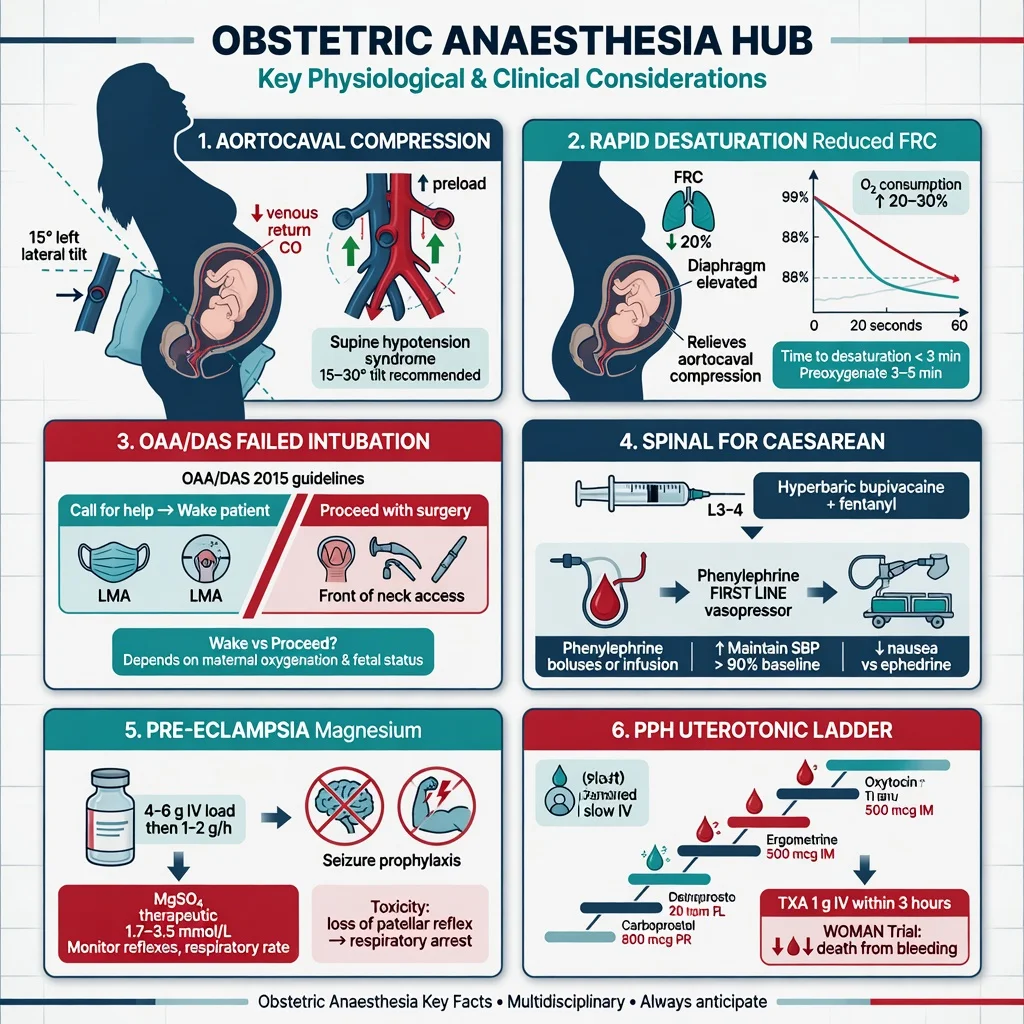
Respiratory. Minute ventilation rises (progesterone); FRC falls as the uterus elevates the diaphragm; oxygen consumption rises. Apnoeic desaturation is rapid — preoxygenate to high end-tidal oxygen, head-up position, consider apnoeic oxygenation adjuncts for GA.[4]
Cardiovascular. Cardiac output and blood volume rise (~40%); SVR falls. From 20 weeks, the gravid uterus compresses IVC (± aorta) when supine → reduced venous return, reduced cardiac output, reduced uterine perfusion. Left lateral tilt ~15° or manual uterine displacement is mandatory for any supine procedure. [1]
Airway and GI. Capillary engorgement and oedema raise Mallampati class; mucosa bleeds easily. Lower oesophageal sphincter tone falls; gastric emptying slows in labour; aspiration risk is high — RSI for GA, non-particulate antacid + H2 blocker as prophylaxis per local protocol.[1][4]
Coagulation and pharmacology. Pregnancy is hypercoagulable (VTE risk). MAC of volatiles falls ~25–40%. Epidural venous engorgement reduces local anaesthetic dose requirement for neuraxial block. [1]
Labour analgesia
Options: simple measures and TENS (limited), nitrous oxide (Entonox), systemic opioid (limited efficacy; neonatal respiratory depression), epidural or CSE (gold standard), remifentanil PCA where epidural contraindicated or declined. Modern low-dose epidural solutions preserve mobility better than historical dense blocks. Know test dose philosophy, breakthrough pain algorithm (check block, catheter, top-up, anaesthetist review), and complications: hypotension, inadequate block, dural puncture → PDPH, high block, LAST, infection/haematoma (rare). [1]
Caesarean anaesthesia decision matrix
| Category / situation | Preferred technique | Notes |
|---|---|---|
| Elective / category 2–3, no contraindication | Single-shot spinal (or CSE) | Fast, dense, reliable |
| Labour epidural in situ, category 2–3 | Epidural top-up | Know local top-up mixture and time to surgical anaesthesia |
| Category 1 (immediate threat) | GA if neuraxial impossible in time | Preoxygenate, RSI, left tilt, experienced hands |
| Coagulopathy, infection at site, refusal | GA | Failed-intubation plan rehearsed |
| Anticipated difficult airway | Awake strategy or CSE with careful planning | Avoid crash GA if possible |
Spinal hypotension prevention: left tilt, co-loading/co-hydration with crystalloid, prophylactic phenylephrine infusion or boluses (first-line; better maternal BP control and fetal acid-base profile than historical ephedrine-first practice), titrate to systolic near baseline.[3] Oxytocin: small slow IV bolus then infusion — avoid large boluses (hypotension, tachycardia).
Failed obstetric intubation (hub algorithm)
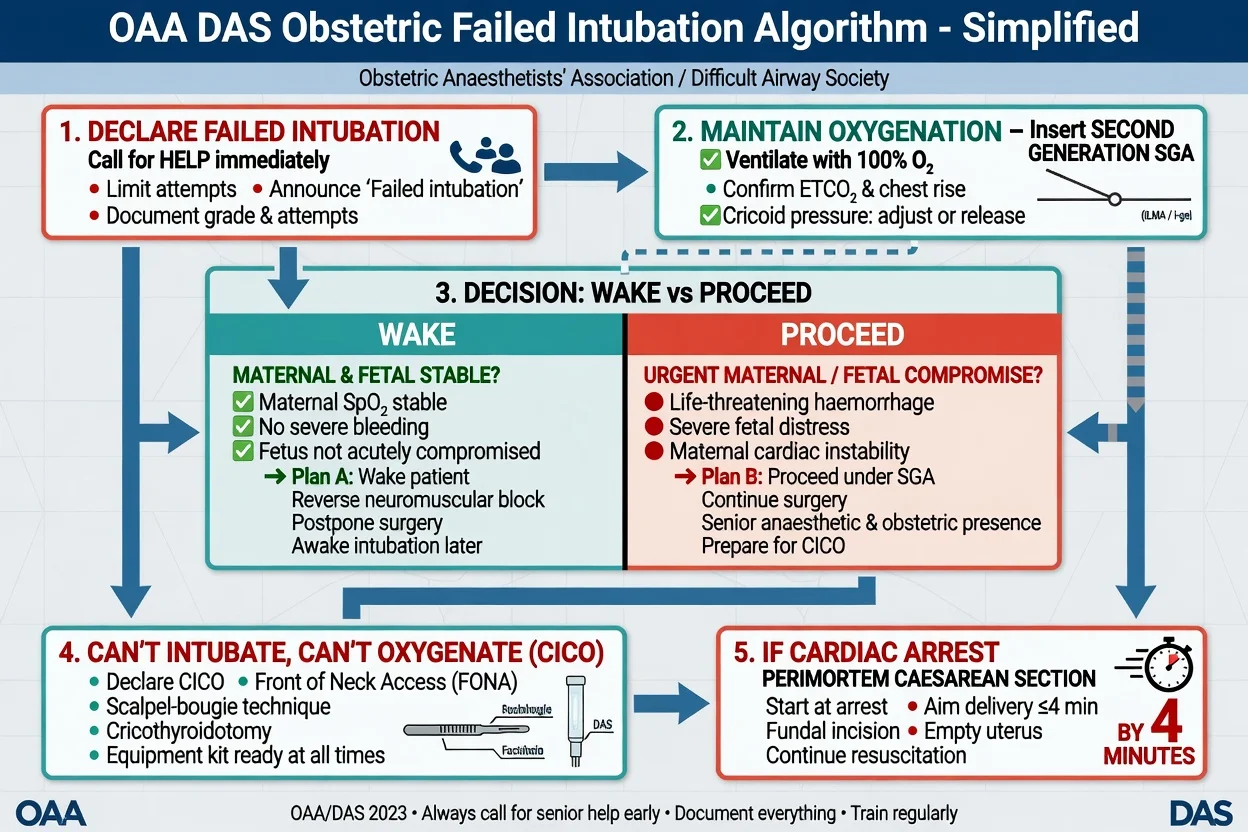
This is the single most classic obstetric crisis. OAA/DAS 2015 structure:[1]
- Declare failure early; call for help; limit attempts (max two with optimisation).
- Maintain oxygenation — release/adjust cricoid if impairing; early second-generation SGA.
- Wake versus proceed table: maternal condition, fetal urgency, ability to oxygenate, bleeding, expertise.
- If CICO → front-of-neck access without delay.
- Supraglottic devices can oxygenate many parturients; ETT remains the planned airway when emergency GA is chosen, but SGA is the rescue bridge that makes wake-versus-proceed possible.[1][4]
Pre-eclampsia and eclampsia
Multisystem disease: hypertension + proteinuria/end-organ features. Anaesthetic issues: oedematous difficult airway, low platelets (neuraxial safety threshold institutional — commonly platelets ≥70×10⁹/L for spinal if trend stable and no coagulopathy, but quote local guideline), exaggerated pressor response to laryngoscopy, pulmonary oedema risk with fluid overload, magnesium therapy. [1]
Magnesium (exam regimens):
- Zuspan: 4 g IV load over 10–20 min, then 1–2 g/h infusion.
- Pritchard: 4 g IV + 10 g IM, then 5 g IM q4h. Monitor reflexes, respiratory rate, urine output; toxicity → calcium gluconate 1 g IV. BP control: labetalol, hydralazine, nifedipine per protocol — avoid precipitous drops.[5][6]
Postpartum haemorrhage
4 Ts: Tone (atony — commonest), Trauma, Tissue (retained), Thrombin (coagulopathy). Thresholds: major >1.5 L; massive >2.5 L (UK teaching). [1]
Uterotonic ladder: oxytocin 5 IU slow IV → ergometrine (avoid in hypertension) → carboprost (avoid in asthma) → misoprostol; mechanical (balloon), surgical (B-Lynch), IR embolisation, hysterectomy.[2]
TXA 1 g IV within 3 hours of birth reduces death from bleeding — name the WOMAN trial.[2] Activate MTP; watch fibrinogen (often first to fall); cell salvage where available; early senior obstetric and anaesthetic leadership.
Other crises in the bank
- High/total spinal after top-up or accidental intrathecal injection — ABC, left tilt, intubation if needed, vasopressors, fluids, deliver baby.
- AFE — sudden collapse ± seizure + early DIC; supportive care, treat coagulopathy, delivery if undelivered.
- LAST after epidural top-up — lipid emulsion 20%, ALS.
- Maternal cardiac arrest — left uterine displacement, standard ALS, perimortem CS by ~4 minutes to improve maternal resuscitation.
- Eclamptic seizure — magnesium, airway protection, BP control after seizure. [1]
Landmark trials and guidelines
| Item | Takeaway |
|---|---|
| OAA/DAS 2015 | Obstetric failed intubation algorithm; wake vs proceed.[1] |
| MBRRACE-UK | Cardiac disease leading indirect death; airway/haemorrhage lessons.[5] |
| WOMAN | TXA 1 g early in PPH reduces bleeding death.[2] |
| Phenylephrine infusion regimens (Ngan Kee) | Phenylephrine first-line for spinal BP at CS.[3] |
| NAP4/5/7 | Obstetric airway and awareness themes |
| GA in obstetrics (BJA Ed) | RSI, aspiration, airway planning summary.[4] |
Regional practice deltas
ANZ. ANZCA SS_OB outcomes; local obstetric massive transfusion protocols; metaraminol still widely used alongside phenylephrine for spinal hypotension — state your first-line and why. Category system for caesarean urgency aligns with RANZCOG practice.
SAQ answer scaffold
Stem: "Category-1 caesarean for fetal bradycardia. Epidural not working. Outline your anaesthetic management including failed intubation plan." [1]
- Call help, left tilt, preoxygenate, antacid prophylaxis, monitors.
- Decision: GA RSI vs attempt rapid spinal if truly seconds allow — usually GA for true category 1 with failed epidural.
- Induction: head-up, ramped if obese, videolaryngoscope, sux or roc 1.2 mg/kg, cricoid per local practice.
- Failed intubation: OAA/DAS — oxygenate, SGA, wake vs proceed table (fetal bradycardia pushes proceed if mother oxygenatable).
- After delivery: uterotonics carefully, analgesia plan, debrief, neonatal team.[1][4]
Viva stem bank
- "Why does the parturient desaturate so quickly?"
- "Run the OAA/DAS failed intubation algorithm."
- "Spinal for caesarean — how do you prevent hypotension?"
- "Pre-eclampsia for caesarean, platelets 65 — talk me through options."
- "Massive PPH after atonic uterus — first five minutes."
- "When do you perform perimortem caesarean?"
- "AFE versus high spinal versus PE — how do you discriminate?" [1]
Common traps
- Supine flat parturient without tilt.
- Ephedrine as routine first-line (outdated as default).
- Endless intubation attempts without declaring failure.
- Large oxytocin bolus causing profound hypotension.
- Giving TXA after 3 hours without thinking about timing evidence in trauma; in PPH give early as per obstetric evidence.
- Ignoring cardiac disease in the "well" multip with breathlessness. [1]
OBSTETRIC crisis bank
Spinal CS
- Default when possible
- Phenylephrine ready
- Fast dense block
- Avoids GA airway
Epidural top-up
- Working labour catheter
- Know local mixture
- Time to surgical block
- Risk of high block
GA CS
- Category 1 / contraindications
- RSI + VL
- OAA/DAS plan
- Aspiration and awareness risks
Non-obstetric surgery in pregnancy
Principles: defer elective surgery to second trimester when possible; maintain left tilt after 20 weeks; aspiration prophylaxis; avoid hypoxia and hypotension; fetal heart monitoring strategy depends on gestational age and feasibility; teratogenicity concerns are mainly first trimester (most modern anaesthetics not major teratogens at clinical doses — avoid unnecessary drugs). Laparoscopy is possible with care to insufflation pressures and positioning. The obstetric team should know the patient is in theatre if viable fetus. [1]
PDPH in detail (hub)
Dural puncture headache is postural, fronto-occipital, with possible neck stiffness, tinnitus, diplopia (cranial nerve VI). Conservative care: hydration, simple analgesia, caffeine in some protocols. Epidural blood patch (typically 15–20 mL autologous blood) is definitive for severe or prolonged PDPH — consent for repeat, infection, and rare neurological injury; perform by experienced hands with surgical sterility.[5]
Category system for caesarean (communication tool)
Category 1 — immediate threat to life of woman or fetus; Category 2 — maternal or fetal compromise not immediately life-threatening; Category 3 — needs early delivery no compromise; Category 4 — elective. The anaesthetic technique must match the clock without abandoning airway safety for speed. [1]
Red flags
[1] [1] [1] [1] [1]References
- [1]Mushambi MC, Kinsella SM, Popat M, et al. Obstetric Anaesthetists' Association/Difficult Airway Society difficult and failed tracheal intubation guidelines--the way forward for the obstetric airway Br J Anaesth, 2015.PMID 26511060
- [2]WOMAN Trial Collaborators Effect of early tranexamic acid administration on mortality, hysterectomy, and other morbidities in women with post-partum haemorrhage (WOMAN): an international, randomised, double-blind, placebo-controlled trial Lancet, 2017.PMID 28456509
- [3]Ngan Kee WD, Khaw KS, Ng FF Comparison of phenylephrine infusion regimens for maintaining maternal blood pressure during spinal anaesthesia for Caesarean section Br J Anaesth, 2004.PMID 14977792
- [4]Delgado C, Ring L, Mushambi MC General anaesthesia in obstetrics BJA Educ, 2020.PMID 33456951
- [5]Freedman RL, Lucas DN MBRRACE-UK: saving lives, improving mothers' care - implications for anaesthetists Int J Obstet Anesth, 2015.PMID 25841640
- [6]Bamber JH, Plaat F Beyond the numbers: obstetric anaesthesia and maternal deaths Br J Anaesth, 2025.PMID 40089396