Anaes · Paediatric anaesthesia
Paediatric anaesthesia
Also known as Paediatric anaesthesia · Neonatal anaesthesia · Paediatric airway · Emergence delirium children · SS_PA specialised study unit
Exam-pass paediatric anaesthesia hub (SS_PA): airway sizing formulae, induction choices, fluids/glucose, emergence delirium, sick-child pointers, laryngospasm ladder, GAS 2- and 5-year neurodevelopment, and NAP7 neonatal risk — with leaf links.
On this page & tools
Your progress
Saved locally on this device.
Target exams
Red flags
Why this is examined
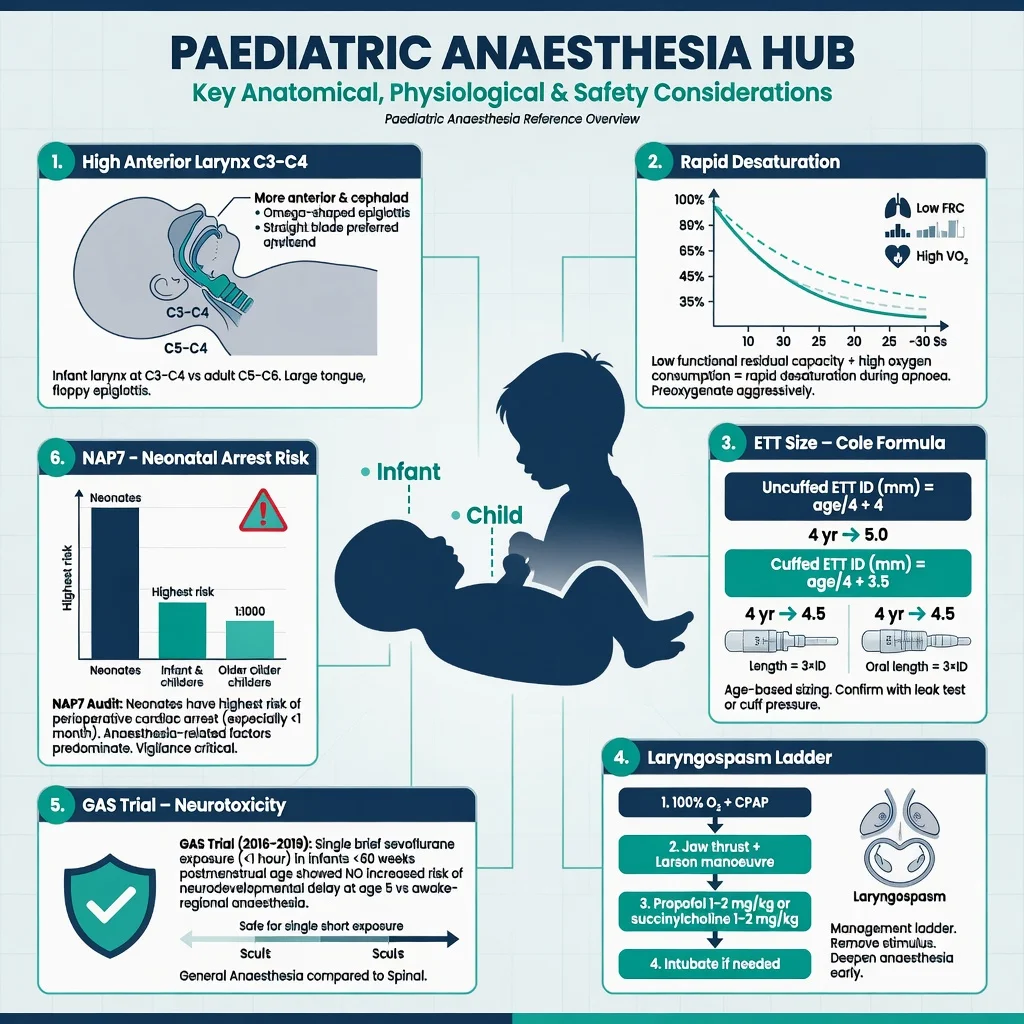
Paediatric anaesthesia is the single densest pure-anaesthesia specialised study unit on the ANZCA Final Examination (SS_PA, 83 FEx outcomes). It is also flagged in the college Exam Topic Support module and carries a standalone ANZCA library guide. Cross-exam equivalents (FRCA Final CRQ/viva, EDAIC MTF and oral, ABA APPLIED, FCAI SOE, FCA(SA) data and OSCE) share the same core: anatomy that changes technique, formulae that must be reproduced under pressure, crisis ladders that kill children in minutes, and landmark trials candidates are expected to name (GAS, NAP7, APAGBI/DAS algorithms).[3]
The examiner is not looking for a textbook chapter. They want a framework that links physiology to action, a hub map that shows you know which subtopic owns which crisis, and the ability to prioritise what kills the child first (airway, hypoxia, bradycardia). [1]
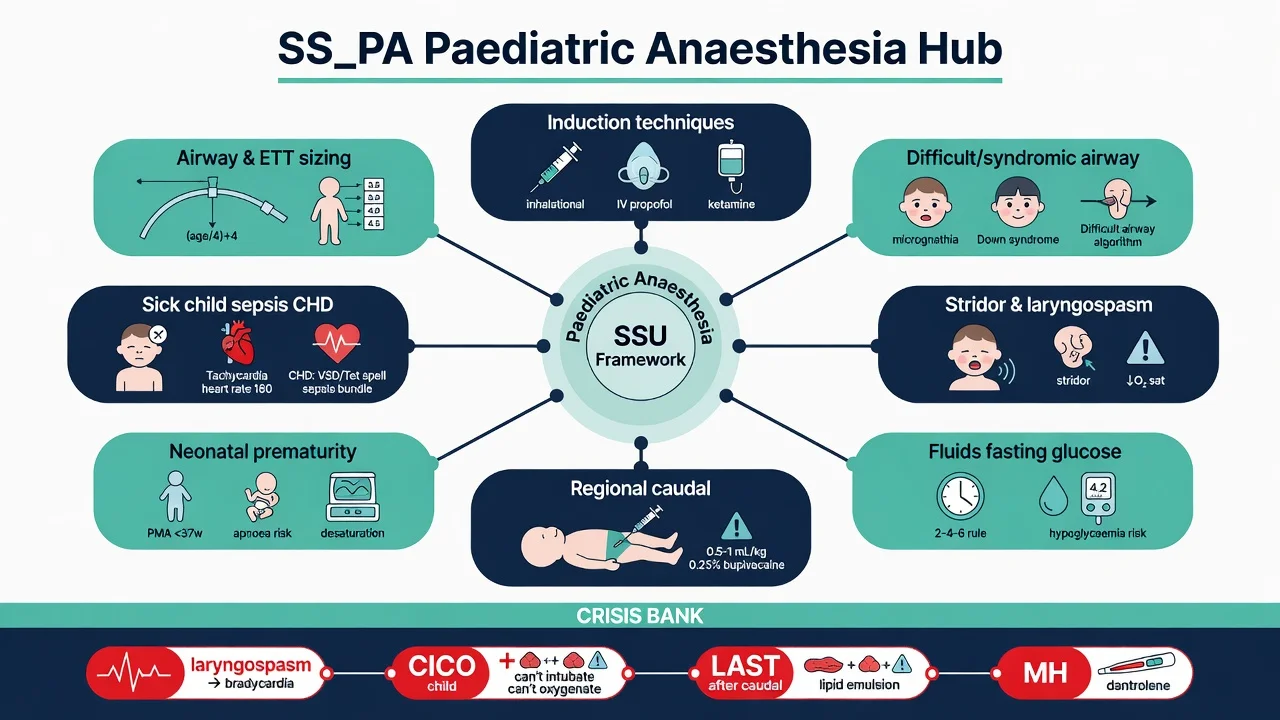
SSU framework and hub map
This page is the hub. Leaf topics carry the depth; the hub gives the spine, the crisis bank, the trial names, and the regional deltas. Navigate from here: [1]
| Leaf topic | What the examiner owns there |
|---|---|
paediatric-airway-equipment-sizing | Anatomy differences, Cole formulae, cuffed vs uncuffed, depth rules |
paediatric-induction-techniques | Sevoflurane gas induction vs IV, parental presence, RSI modifications |
difficult-paediatric-airway-syndromic | Down, Pierre Robin, Treacher Collins, MPS; APAGBI/DAS algorithms |
stridor-upper-airway-obstruction-laryngospasm | Croup, epiglottitis, FB, laryngospasm ladder, Larson manoeuvre |
paediatric-respiratory-cardiovascular-physiology | FRC, closing capacity, VO2, HR-dependent CO, HbF, thermoregulation |
neonatal-anaesthesia-prematurity | Prematurity, NEC, TOF, CDH, apnoea risk, NICU handover |
paediatric-fluids-fasting-glucose | Holliday-Segar, isotonic maintenance, 2-4-6 fasting, hypoglycaemia |
paediatric-regional-caudal-dosing | Armitage volumes, test dose, LAST, ultrasound caudal |
Planned leaves (build queue): emergence delirium and PONV; sick child, sepsis and congenital heart; multimodal analgesia; anaesthesia neurotoxicity debate. [1]
Applied physiology that changes the anaesthetic
Four systems drive almost every paediatric viva stem. [1]
Respiratory. Infant oxygen consumption is about 6 mL/kg/min (roughly twice adult). Functional residual capacity is small relative to that demand, and closing capacity sits near tidal volume under anaesthesia, so dependent airways close during normal breathing. Safe apnoea time after preoxygenation is measured in tens of seconds, not minutes. Capnography, continuous SpO2, and a plan for re-oxygenation are non-negotiable.[3]
Cardiovascular. Stroke volume is relatively fixed; cardiac output is heart-rate dependent. Bradycardia is a pre-arrest state, not a curiosity. Hypoxia produces bradycardia quickly via the immature autonomic system. Atropine and adrenaline must be weight-calculated and drawn up for the neonate and the high-risk infant. [1]
Temperature. Large surface-area-to-mass ratio and limited non-shivering thermogenesis make hypothermia inevitable without active warming. Hypothermia prolongs drug action, promotes bradycardia and apnoea, and worsens coagulopathy. Forced-air warming, warm fluids, and ambient temperature control start before induction. [1]
Renal and hepatic. Immature GFR and phase-I enzymes prolong clearance of many drugs. The blood-brain barrier is more permeable. Dose by weight (and ideally lean mass in the obese adolescent), use organ-independent agents where possible (atracurium/cisatracurium, remifentanil, sevoflurane), and reverse with sugammadex when rocuronium is used — paediatric Cochrane evidence supports efficacy and safety.[5]
Airway anatomy and equipment (hub-level)
The infant larynx is high and anterior (C3 to C4 versus adult C5 to C6), the tongue is large relative to the oral cavity, the epiglottis is long and U-shaped, and the airway is classically funnel-shaped with the cricoid as the narrowest point (modern refinement: the cricoid lumen is elliptical, so a snug circular tube can still damage mucosa). Straight (Miller) blades often give a better view in infants; video laryngoscopy is now standard kit on any paediatric list that might go wrong. [1]
Cole (Motley) ETT sizing — rote for viva
Modern practice prefers microcuff cuffed tubes at most ages with cuff pressure monitored (keep below about 20–25 cmH2O). Advantages: better seal, fewer exchanges, lower leak, ability to use a slightly smaller ID. Neonates and young infants still need weight/gestation-based starting sizes (term neonate often 3.0 mm). Always prepare ±0.5 mm sizes. Full detail lives in the airway leaf. [1]
Induction, maintenance, and the full stomach
Inhalational induction with sevoflurane remains the default for the young or needle-phobic child: parental presence when helpful, calm environment, IV after loss of consciousness. IV induction with propofol suits the cooperative older child and the child who already has access. Modified RSI for the full stomach or bowel obstruction: preoxygenation, reduced apnoea tolerance, carefully chosen relaxant (suxamethonium or high-dose rocuronium with sugammadex available), and a plan for failed intubation that does not rely on endless attempts. [1]
Maintenance is multimodal: sevoflurane or TIVA, multimodal analgesia, temperature, glucose in infants, and isotonic maintenance fluid. Hypotonic maintenance fluids are obsolete because of hyponatraemic encephalopathy risk; Plasma-Lyte or similar isotonic solutions with appropriate glucose for small infants are the modern standard. [1]
Fluids, fasting, and glucose (hub numbers)
Holliday-Segar maintenance: 4 mL/kg/h for first 10 kg + 2 mL/kg/h for next 10 kg + 1 mL/kg/h above 20 kg. Replace deficits and ongoing losses separately. Infants are at real risk of hypoglycaemia — check and treat; do not run pure glucose-free fluid for prolonged cases in neonates.[3]
Fasting (classic teaching): clear fluids 2 h, breast milk 4 h, formula/solids 6 h. Many centres now liberalise clear fluids closer to 1 hour under local policy — quote local guidance in viva and know the aspiration risk trade-off. Leaf topic: paediatric-fluids-fasting-glucose. [1]
Regional anaesthesia and the caudal
Caudal epidural is the workhorse for lower abdominal, perineal, and lower-limb surgery in small children. Armitage volume guide (of dilute bupivacaine/levobupivacaine ~0.19–0.25%): 0.5 mL/kg sacral/lumbar height; 1.0 mL/kg lower thoracic; 1.25 mL/kg high thoracic (with ceiling dose awareness). Ultrasound improves sacral hiatus identification. Test dose and maximum local anaesthetic dose calculation remain mandatory — LAST after caudal is an examiner favourite. Codeine is contraindicated after tonsillectomy/adenoidectomy (CYP2D6 ultra-rapid metaboliser risk). Leaf: paediatric-regional-caudal-dosing.[5]
Emergence delirium and neurotoxicity
Emergence delirium (PAED score ≥10 suggests ED) is common after sevoflurane in preschool children, especially after ENT. Distinguish from pain. Prevention: parental presence, quiet recovery, dexmedetomidine or small propofol at end, and EEG-guided titration of depth — meta-analytic support for EEG-guided strategies reducing ED.[4]
Developmental neurotoxicity. Animal models show anaesthetic-induced neuronal apoptosis. The GAS trial randomised infants needing hernia repair to sevoflurane GA versus awake-regional and found equivalence for neurodevelopment at 2 years and at 5 years after a single brief exposure — the strongest clinical reassurance available.[1][2] Repeated or prolonged exposures remain less certain. Do not delay necessary surgery purely for theoretical neurotoxicity; discuss elective timing case-by-case under age three.
Sick child pointers (hub)
- Sepsis: early antibiotics, fluid boluses titrated carefully, inotropes for fluid-refractory shock, avoid delayed source control; draw up weight-based adrenaline/atropine before induction.
- Congenital heart disease: know lesion physiology (mixing vs obstructed vs shunt direction), air-bubble hygiene, infective endocarditis prophylaxis when indicated, destination ICU.
- Full stomach / bowel obstruction: modified RSI, expect rapid desaturation, senior help.
- Leaf depth:
sick-child-sepsis-congenital-heart. [1]
Crisis bank (memorise the ladders)
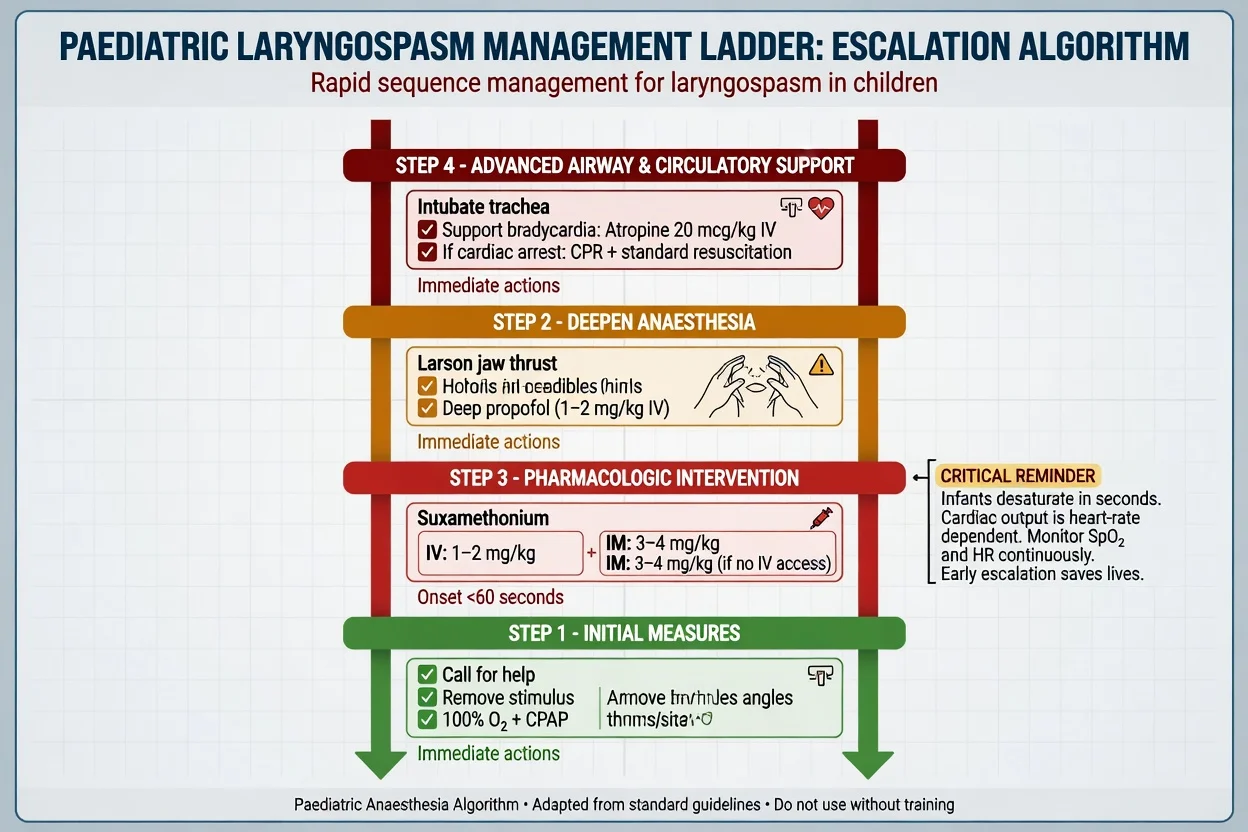
- Laryngospasm → hypoxia → bradycardia → arrest — the classic paediatric cascade. Stimulus off, 100% O2 with CPAP, jaw thrust / Larson manoeuvre, deepen with propofol, suxamethonium (IV preferred; IM if no access), atropine for bradycardia, CPR if pulseless.
- Unanticipated difficult intubation — APAGBI/DAS 2015 paediatric algorithms: limit attempts, early second-generation SGA, maintain oxygenation, call for help, age-appropriate CICO pathway.
- CICO in a child — surgical front-of-neck is age- and size-specific; do not improvise adult cricothyroidotomy blindly on a neonate.
- Anaphylaxis at induction — adrenaline, remove trigger, fluid, call help; same algorithm, weight-based dosing.
- Malignant hyperthermia — masseter spasm after suxamethonium, rising EtCO2, rigidity; dantrolene, cool, treat hyperkalaemia.
- LAST after caudal — stop injectate, lipid emulsion 20%, seizure control, advanced life support without lidocaine antiarrhythmics.
- Foreign body / acute stridor — do not upset the child; inhalational induction in controlled theatre with ENT ready. [1]
Landmark trials and guidelines (name them)
| Name | Exam takeaway |
|---|---|
| GAS (Lancet 2016/2019) | Single brief sevoflurane equivalent to awake-regional for neurodevelopment at 2 and 5 years.[1][2] |
| NAP7 (RCoA) | Neonates and congenital heart disease dominate perioperative arrest risk; hypoxaemia common |
| APAGBI/DAS 2015 | Three paediatric difficult-airway algorithms |
| APA / NICE fluid guidance | Isotonic maintenance; no hypotonic maintenance |
| FDA/MHRA codeine | Contraindicated post tonsillectomy/adenoidectomy in children |
| Sugammadex Cochrane (paeds) | Effective, safe reversal of rocuronium/vecuronium in infants and children |
Regional practice deltas
ANZ / ANZCA. SS_PA outcomes drive FEx tagging. Use local paediatric difficult-airway carts and local weight-based emergency drug charts (e.g. Broselow-style or institution binders). Metaraminol and phenylephrine both appear in practice; quote institutional paediatric dosing. Neonatal and infant lists ideally senior-led.
SAQ answer scaffold
Stem example: "A 3-year-old for tonsillectomy develops complete airway obstruction after extubation. Outline your management and how you would prevent recurrence." [1]
- Immediate: call help, 100% O2, CPAP, jaw thrust/Larson, deepen propofol, prepare suxamethonium and atropine, reintubate if needed.
- Physiology one-liner: high VO2, low FRC → seconds to desaturation; hypoxia → bradycardia.
- Differential: laryngospasm vs residual obstruction vs blood/clot vs negative-pressure pulmonary oedema after relief.
- Prevention: adequate depth at instrumentation, topical/IV lidocaine strategies where appropriate, smooth emergence, suction under vision, consider dexmedetomidine.
- System: report, debrief, check recovery staffing and emergency drugs for the list. [1]
Viva stem bank (model openers)
- "How does the infant airway differ from the adult — and so what for your laryngoscopy?"
- "Give me the cuffed and uncuffed tube formulae and a worked example for a 4-year-old."
- "Talk me through laryngospasm from first recognition to arrest."
- "What did GAS actually show, and what does it not show?"
- "Armitage caudal dosing — volumes and your maximum local anaesthetic dose."
- "Why is the neonate the highest-risk age for perioperative cardiac arrest?"
- "URTI yesterday — cancel or proceed? Structure your risk discussion." [1]
Common traps
- Quoting adult apnoea times or adult cricothyroidotomy kit for a neonate.
- Using hypotonic maintenance fluid "because that is what paediatrics always used."
- Claiming all GA under three is unsafe despite GAS.
- Confusing emergence delirium with pain (and over-treating with opioids).
- Omitting glucose consideration in prolonged neonatal cases.
- Forgetting that blood pressure is a late sign of hypovolaemia in children (compensate then crash). [1]
Anaesthetic goals (one-page checklist)
- Oxygenation first — preoxygenate, continuous SpO2/EtCO2, short apnoea plan.
- Right kit — correct ETT sizes ±0.5 mm, Miller/VL, SGA, suction, emergency drugs by weight.
- Temperature and glucose — active warming; check sugar in infants.
- Multimodal analgesia — paracetamol, NSAID if appropriate, regional, opioid sparingly.
- Smooth emergence — ED prevention, quiet PACU, parent present when safe.
- Escalate early — senior help before the child is blue and bradycardic. [1]
CHILD — viva opener for any paediatric stem
Inhalational induction
- Young/needle-phobic
- Sevoflurane default
- IV after sleep
- Parental presence often helps
IV induction
- Older cooperative
- Access already present
- Full stomach RSI path
- Propofol titrated
Crisis path
- Laryngospasm ladder
- APAGBI/DAS difficult airway
- CICO age-specific
- LAST after caudal
Red flags
[1]References
- [1]Davidson AJ, Disma N, de Graaff JC, et al. Neurodevelopmental outcome at 2 years of age after general anaesthesia and awake-regional anaesthesia in infancy (GAS): an international multicentre, randomised controlled trial Lancet, 2016.PMID 26507180
- [2]McCann ME, de Graaff JC, Dorris L, et al. Neurodevelopmental outcome at 5 years of age after general anaesthesia or awake-regional anaesthesia in infancy (GAS): an international, multicentre, randomised, controlled equivalence trial Lancet, 2019.PMID 30782342
- [3]Cook TM, Armstrong RA, Oglesby F NAP7: high mortality risk in neonates and very low risk in children Br J Anaesth, 2025.PMID 39645515
- [4]Haidar L, Abadi F, Sarieddine T, et al. EEG-Guided Anesthesia for the Prevention of Emergence Delirium in Children: A Systematic Review and Meta-Analysis JAMA Pediatr, 2026.PMID 41627803
- [5]Raphael CK, El Bcherawi N, Atallah F, et al. Sugammadex for reversing neuromuscular blockade in infants and children Cochrane Database Syst Rev, 2025.PMID 41257414