Anaes · Paediatric anaesthesia
Paediatric multimodal analgesia and pain assessment
Also known as FLACC score · Paediatric opioid dosing · Codeine contraindicated tonsillectomy · Multimodal analgesia children
Age-appropriate pain assessment (FLACC, FACES, self-report), multimodal paediatric analgesia with weight-based doses, opioid PCA/NCA principles, and the codeine/tramadol contraindications after tonsillectomy for fellowship exams.
On this page & tools
Your progress
Saved locally on this device.
10 MCQs with explanations
Target exams
Red flags
Why this is examined
Pain assessment and weight-based multimodal dosing are core paediatric fellowship skills. Examiners expect FLACC components, exact common doses, the codeine black-box story, and the ability to design day-case versus major surgery analgesic plans without oversedation.
[1]Pain assessment by age
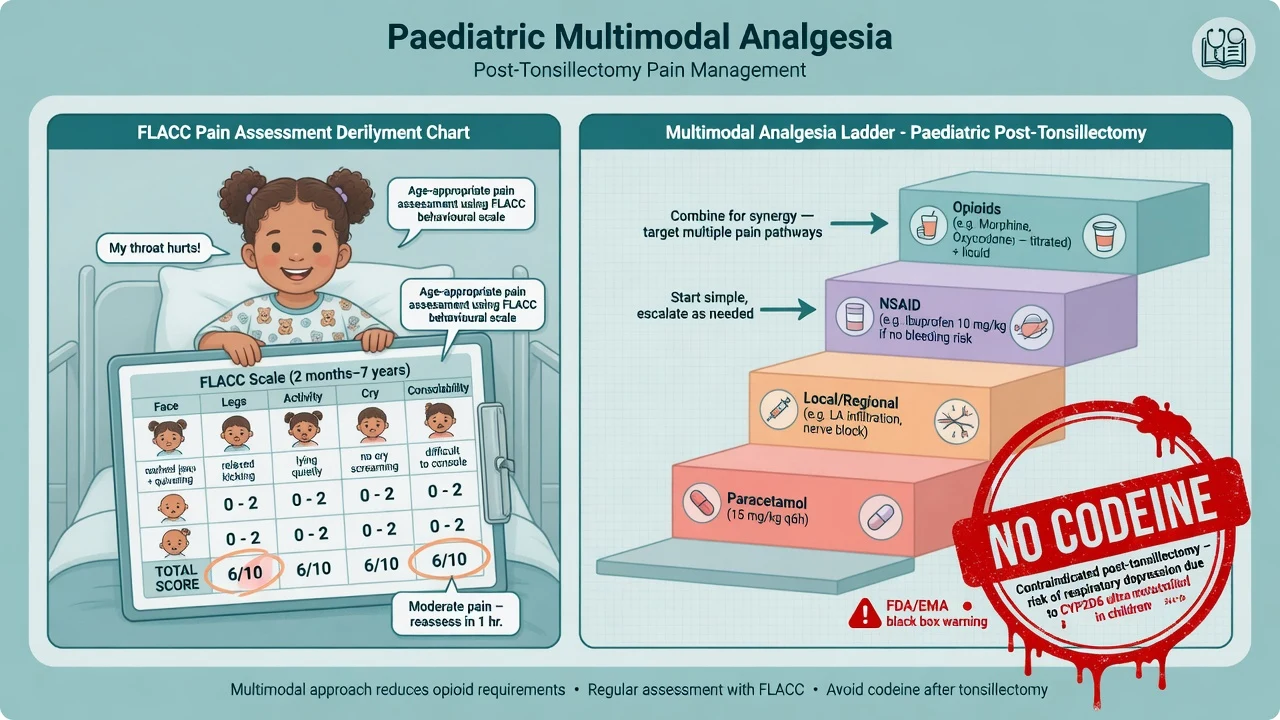
FLACC (about 2 months–7 years, non-verbal)
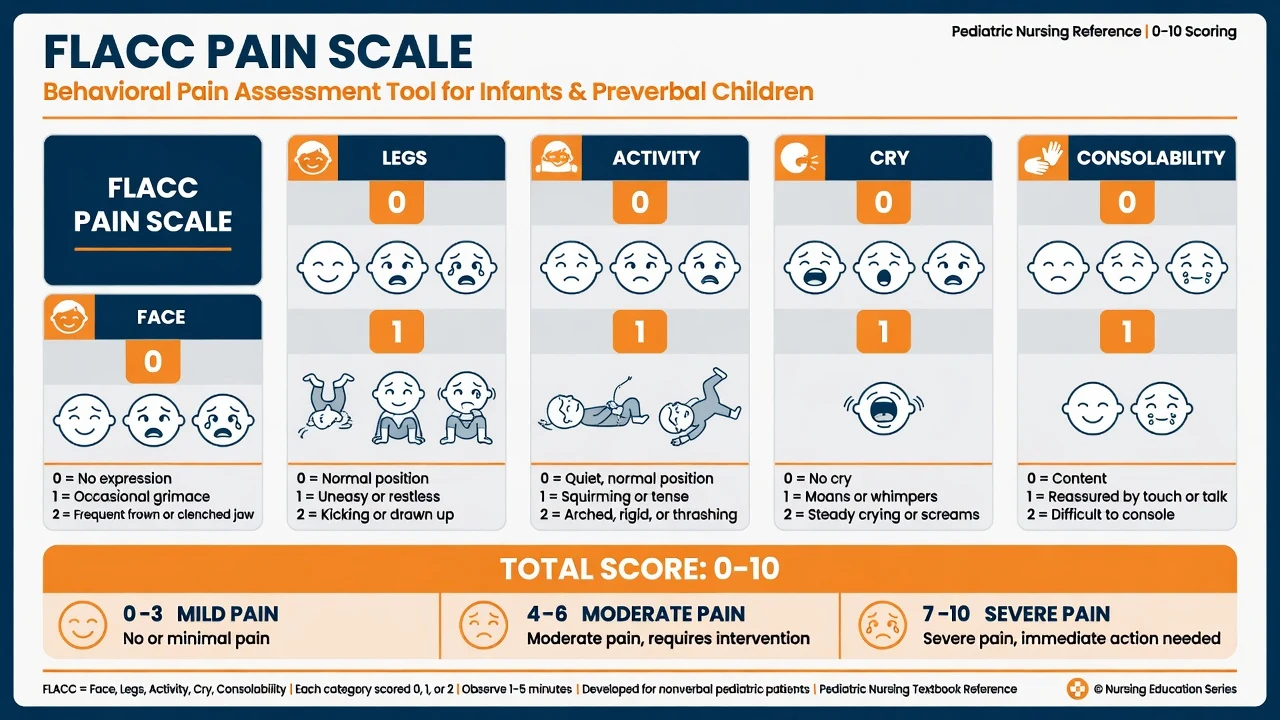
Five categories each 0–2 (total 0–10): Face, Legs, Activity, Cry, Consolability.[1]
Interpretation (common teaching): 0 relaxed; 1–3 mild; 4–6 moderate; 7–10 severe discomfort/pain.
[1]Other tools
- Neonates: NIPS, PIPP (unit preference)
- Self-report: Faces scales, numeric 0–10 when developmentally ready
- Cognitive impairment: revised FLACC or individualised behaviour baselines from carers
- Separate PAED scoring when emergence delirium is on the differential so pain and ED are not conflated.[4]
Multimodal ladder (paediatric)
- Psychological / environmental — parental presence, distraction, play therapy, cold/heat as appropriate
- Simple analgesics — paracetamol ± NSAID
- Local / regional — wound infiltration, caudal, peripheral blocks, neuraxial where indicated
- Opioids — intermittent, NCA, or PCA with monitoring
- Adjuncts — ketamine low-dose, alpha-2 agonists, gabapentinoids (selected cases), sucrose in infants for procedures
Core drug doses (exam-ready)
Always check local formulary; these are standard teaching doses.
[1] [1]Codeine and tramadol
After tonsillectomy/adenoidectomy, codeine is contraindicated in children because CYP2D6 ultra-rapid metabolisers can generate life-threatening morphine levels; poor metabolisers get no analgesia. Regulatory black-box actions followed fatalities; yet inappropriate prescribing has persisted historically — examiners still test this.[2][3] Prefer multimodal non-opioid + carefully monitored alternative opioids if needed, plus local techniques.
Regional and local techniques (opioid-sparing)
- Wound infiltration with safe local anaesthetic mg/kg limits
- Caudal for lower abdominal/perineal/lower limb (see caudal dosing topic)
- Peripheral blocks under ultrasound when skilled
- Always calculate maximum LA dose (bupivacaine/levobupivacaine/ropivacaine weight-based)
Opioid delivery systems
- Nurse-controlled analgesia (NCA) for young children
- PCA when child understands button use
- Background infusions increase respiratory depression risk — use cautiously
- Monitoring: sedation score, RR, SpO2, pain score; naloxone available
Procedure-specific sketches
Day-case hernia / orchidopexy: paracetamol + NSAID + local/caudal; minimal opioid.
[1]Tonsillectomy: multimodal non-opioids; avoid codeine; careful opioid if needed; watch OSA.[2]
Laparotomy / major orthopaedic: multimodal + regional/neuraxial when appropriate + opioid NCA/PCA + adjuncts; HDU if high opioid need or comorbidities.
[1]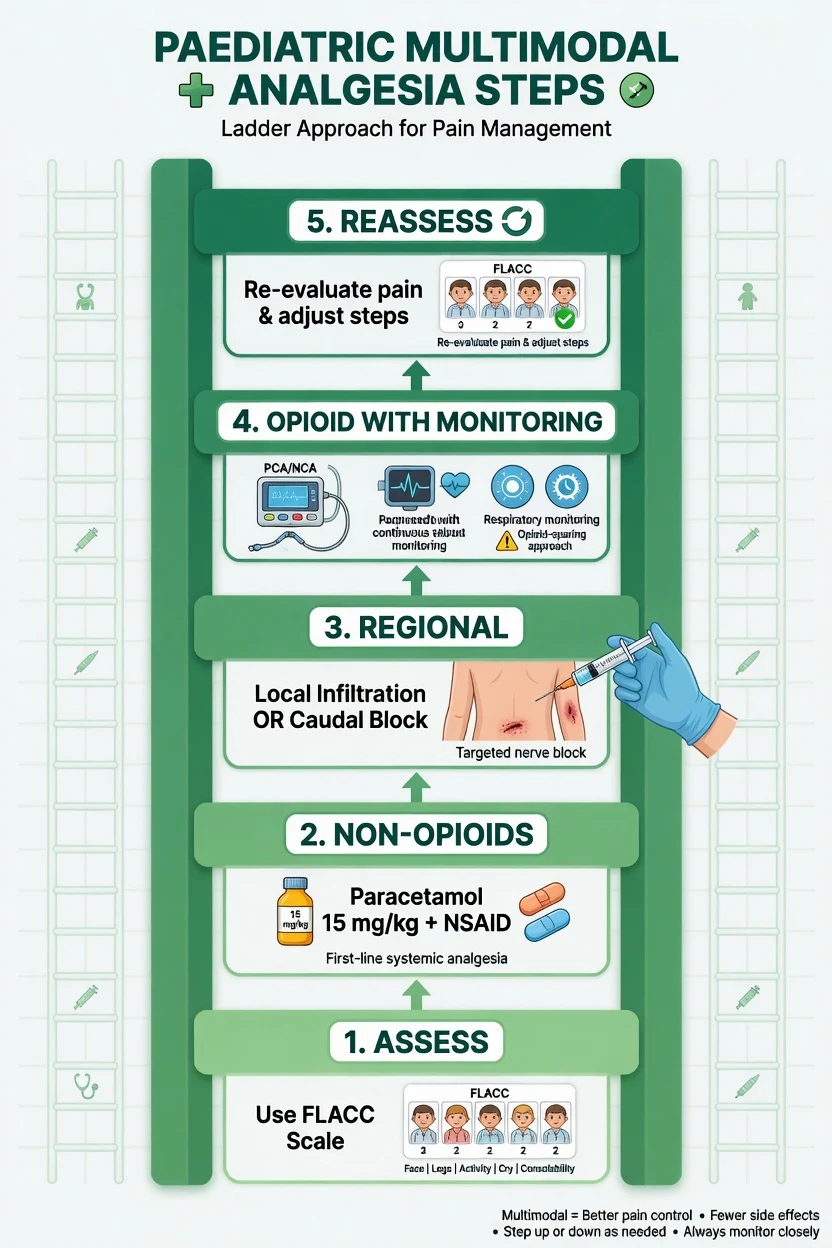
PACU and ward plan
- Score pain on arrival and after interventions
- Treat moderate–severe pain promptly
- Antiemetic plan if opioids used
- Parent education: next dose times, maximum daily doses, red flags (sedation, snoring, vomiting, uncontrolled pain)
Special populations
- Neonates: reduced clearance; longer intervals; sucrose/non-nutritive sucking for minor procedures
- OSA / obesity: opioid-sparing priority; extended observation
- Renal/hepatic disease: avoid or adjust NSAID/opioid/paracetamol per organ function
- Chronic pain / oncology: specialist acute pain service early
SAQ answer scaffold
- Choose and justify a pain score
- Multimodal plan with exact doses for the stem surgery
- Why not codeine after tonsillectomy
- Monitoring and discharge education
- What changes if FLACC remains high after morphine
Viva stem bank
- "Score this 18-month-old with FLACC."
- "Prescribe day-case analgesia for tonsillectomy."
- "Why is codeine banned in this setting?"
- "Design NCA for a 6-year-old after laparotomy."
Dose arithmetic and maxima (exam discipline)
Weight-based dosing is necessary but not sufficient — candidates must also track daily maxima and cumulative local anaesthetic milligrams.
[1]Worked day-case tonsillectomy plan (18 kg, no contraindications)
- Paracetamol 15 mg/kg = 270 mg orally or IV at induction; maximum often 60 mg/kg/day (lower in infants/neonates) → daily ceiling 1080 mg in this child if using 60 mg/kg/day teaching figure
- Ibuprofen 10 mg/kg = 180 mg orally 6–8 hourly when enteral route returns (if NSAID accepted for this surgery and bleeding risk discussed with surgeon)
- Local infiltration by surgeon within bupivacaine/levobupivacaine maximum (commonly 2–2.5 mg/kg total for plain long-acting agents — calculate before injection)
- Opioid: avoid codeine; if needed, morphine 0.05 mg/kg IV in PACU titrated to FLACC and sedation score
- Dexamethasone for PONV/analgesic adjunct per unit tonsillectomy protocol (also see ED/PONV topic)
Worked major laparotomy plan (25 kg)
- Paracetamol 15 mg/kg IV 6 hourly (watch daily max)
- NSAID if renal perfusion, bleeding, and surgical preference allow
- Thoracic epidural or wound catheters / TAP as skills and coagulation allow
- Morphine NCA: typical demand bolus 10–20 microg/kg with lockout (unit protocol) — state that you will use the institutional NCA prescription chart rather than inventing pump settings
- Ketamine low-dose infusion only with acute pain service guidance in selected major cases
- HDU if high opioid need, OSA, or fluid shifts
FLACC in practice — scoring discipline
Each domain Face, Legs, Activity, Cry, Consolability is 0–2.[1] Score before assuming the child “just needs more morphine.” Recheck 10–15 minutes after an intervention. Rising sedation with falling FLACC means stop opioids and support ventilation. Rising FLACC after opioid may mean surgical complication, compartment syndrome, full bladder, or wrong dose route — examine the child.
Separating pain from emergence delirium
PAED and FLACC answer different questions.[4] A thrashing preschooler after sevoflurane ENT surgery may have high PAED and modest FLACC; another may have localised guarding and high FLACC. Treat pain first when plausible, but do not stack opioids into pure ED. Document both scores when the differential is active.
Local anaesthetic safety within multimodal plans
Every infiltration and block counts toward the daily toxicity budget. Typical teaching maxima (confirm formulary): bupivacaine/levobupivacaine ~2–2.5 mg/kg; ropivacaine ~2–3 mg/kg depending on context. For a 10 kg child, 2.5 mg/kg bupivacaine = 25 mg = 10 mL of 0.25%. If the surgeon wants more volume, dilute — do not break the milligram ceiling. Have 20% lipid emulsion available wherever high-dose blocks are performed.
[4]PCA and NCA safety culture
- Two-nurse checks for pump programming when required by policy
- Naloxone available; know the paediatric dose pathway (e.g. 1–10 microg/kg titrated — follow local emergency card)
- Continuous SpO2 for opioid-naïve children on demand systems overnight when policy dictates
- No unauthorised parental proxy dosing on PCA buttons unless a formal parent/nurse-controlled protocol exists
- Review at least every nursing shift: pain scores, sedation, nausea, pruritus, bowel and bladder, IV site
Tonsillectomy deep dive (high-stakes exam stem)
Post-tonsillectomy pain is severe and prolonged; dehydration from poor oral intake causes readmission; OSA children are sensitive to opioids; haemorrhage risk constrains NSAID timing in some units; codeine is contraindicated because CYP2D6 ultra-rapid metabolisers can suffer fatal respiratory depression while poor metabolisers get no analgesia.[2][3] Build the answer around multimodal non-opioids, careful monitored opioids if needed, antiemetics, hydration, and extended observation for OSA.
Adjuncts — when they earn their place
- Ketamine low dose: opioid-sparing in major surgery and opioid-tolerant children — emergence phenomena and secretions possible
- Clonidine / dexmedetomidine: sedation, opioid-sparing, ED reduction; bradycardia and hypotension
- Gabapentinoids: selected chronic or major orthopaedic pathways — sedation and dizziness
- Sucrose / non-nutritive sucking: neonates for brief procedures
- Magnesium, lidocaine infusions: specialist acute pain contexts only
Do not present every adjunct as mandatory for every hernia repair.
[1]Communication with parents
Explain expected pain trajectory, next dose times, maximum daily paracetamol (show the milligram total), red flags (sedation, snoring pauses, persistent vomiting, uncontrolled pain, bleeding after tonsillectomy), and who to call. Written plans reduce both under-treatment and accidental overdose after discharge.
[2]Regional–systemic integration examples
Inguinal hernia: caudal or ilioinguinal/iliohypogastric + paracetamol + NSAID → often opioid-free recovery.
Lower limb orthopaedic: femoral/sciatic or neuraxial as indicated + multimodal systemic.
Thoracotomy: paravertebral/epidural + multimodal; plan for chest physiotherapy compliance.
Audit and quality markers
Percentage of children with documented pain scores, time to first analgesia in PACU, opioid-related adverse events, codeine prescription rate after tonsillectomy (should be near zero), and parental satisfaction. Fellowship answers that mention measurement sound like consultants.
[3]Extended viva model answers
“Score this toddler.” Name FLACC domains, give a total, link to mild/moderate/severe banding, propose treatment, reassess.
“Why not codeine?” CYP2D6 ultra-rapid metabolism → morphine surge → apnoea/death after tonsillectomy; regulatory contraindication; use alternatives.[2][3]
“FLACC 8 after morphine 0.1 mg/kg.” Re-examine surgical site, bladder, cast, compartment; consider regional top-up or further multimodal; exclude ischaemia; do not only repeat opioid blindly if something surgical is wrong.
Deep fellowship expansion — paediatric multimodal analgesia
Assessment tools
Self-report when developmental age allows (Wong-Baker, numerical scores). Observational tools for preverbal children (FLACC: Face, Legs, Activity, Cry, Consolability). Consider NIPS or similar in neonates. Reassess after every intervention. Parental report helps but does not replace structured scoring.
[1]Multimodal ladder
Paracetamol weight-based regular dosing; NSAIDs if no contraindication (age and renal/surgical bleeding caveats); regional anaesthesia when appropriate (caudal, peripheral blocks, local infiltration); opioids as rescue or for major surgery with monitoring for respiratory depression; adjuncts (ketamine, alpha-2 agonists) in selected cases per protocol.
[2]Opioid safety in children
Dose by weight with ceilings; prefer oral when possible after minor surgery; PCA only with trained staff and appropriate age/understanding; watch for obstruction in tonsillectomy/OSA phenotypes; naloxone available. Codeine is restricted/avoided in many regions due to ultra-rapid metaboliser risk — know local policy.
[3]Regional paediatric points
Caudal dosing classic teaching uses concentration and volume trade-offs for height of block; calculate maximum local anaesthetic mg/kg carefully; ultrasound improves peripheral blocks; test doses and aspiration still matter; day-case blocks need family education about dense limb numbness.
[2]Non-pharmacological measures
Parental presence, distraction, sucrose in infants for minor procedures, positioning, and quiet environment reduce distress scores and sometimes drug need.
[1]Special surgical contexts
Tonsillectomy pain is intense and OSA risk high — balance analgesia with airway obstruction risk. Scoliosis and laparotomy need APS-level plans. Sickle cell pathways need oxygenation, warmth, and multimodal opioid-inclusive plans.
[4]Deep fellowship expansion
Why examiners keep this leaf
This topic sits at the intersection of physiology, crisis drills, and guideline-aware decision-making. Candidates who only memorise a single sentence fail when the stem adds comorbidity, anticoagulation, pregnancy, or a second crisis. Build every answer as assessment → physiology → goals → technique → monitoring → intraoperative conduct → crisis → postoperative care → special populations → traps.
[1]Structured preoperative assessment
Take a focused history that captures disease severity, prior anaesthetics, airway predictors, fasting, allergies, medications (especially anticoagulants, antiplatelets, cardiac drugs, insulin, psychotropics), functional capacity, and red-flag symptoms. Examine airway, cardiorespiratory status, neurological baseline, and site-specific signs relevant to this operation. Review bloods, ECG, and imaging that change risk. Consent must name the critical complications unique to this leaf, not only generic nausea and sore throat.
[1]Applied physiology the viva expects
Explain the core physical or reflex pathway in plain language first, then add exam detail. Link macro-haemodynamics to organ perfusion. State what makes physiology worse (hypoxia, hypercapnia, hypotension, hypertension, anaemia, pain, light anaesthesia, positioning extremes) and what improves it. If a formula exists (risk index, pressure equation, dose per kilogram), say it exactly and define each term.
[2]Anaesthetic goals (make them measurable)
- Safety of airway and oxygenation without secondary injury
- Haemodynamic targets agreed with the surgical team
- Analgesia that enables recovery goals without toxicity
- Neurologic or organ-specific protection relevant to the case
- Plan for the single most dangerous crisis of this operation
- Disposition matched to risk (ward versus HDU/ICU)
Technique options and decision matrix
Compare at least two legitimate anaesthetic techniques when they exist (for example regional versus general, spontaneous versus controlled ventilation, invasive versus non-invasive monitoring). For each, state benefits, risks, and the patient who fits best. If only one technique is realistic in a crisis, say why alternatives fail. Always include a failure plan: what you do when plan A collapses at two in the morning.
[2]Monitoring and equipment packing list
Standard ASA monitors are assumed. Add what this leaf specifically needs: arterial line, depth of anaesthesia, neuromuscular quantitation, special Doppler/TOE, temperature, urine output, point-of-care blood gas and haemoglobin, difficult airway trolley, lipid emulsion, dantrolene, defibrillator, or neonatal resuscitaire as relevant. Check devices before induction, not after the crisis starts.
[1]Intraoperative conduct — phase by phase
Induction: control the stimulus response that is dangerous in this disease. Maintenance: match anaesthetic depth and drug choice to monitoring constraints (for example evoked potentials) and to organ physiology. Surgical phases of risk should be announced (cementing, traction on extraocular muscles, clamp on, clamp off, tourniquet down, bone work, fetus delivery, etc.). Emergence: smooth when coughing or hypertension threatens the repair; awake and protective when aspiration or airway soiling is the threat.
[2]Crisis pivot scripts
Rehearse a sub-fifteen-second script for the signature crisis. Name the diagnosis, give the surgeon a concrete request, state the first drug or manoeuvre, and the monitoring endpoint you will reassess in one minute. Differential diagnosis should be short and ordered by likelihood and lethality, not an exhaustive textbook dump.
[3]Drug doses and order-of-magnitude anchors
Where doses are classic fellowship anchors, quote them with units and a citation mindset: atropine for oculocardiac pathways, adrenaline in neonatal resuscitation algorithms, local anaesthetic maxima, mannitol ranges, TXA timing windows, or heparin/protamine contexts as relevant to the leaf. Never invent a microgram figure you cannot support; if practice varies, say “per local protocol” after the exam-classic range.
[1]Postoperative and disposition
PACU handovers must include the crisis that almost happened, ongoing infusion plans, neurological observations, drain care, VTE prophylaxis timing, and who to call if the signature complication appears on the ward at midnight. HDU/ICU criteria should be explicit for high-risk leaves.
[2]Special populations
Work through pregnancy, paediatrics, elderly frailty, obesity, severe cardiopulmonary disease, and anticoagulation as modifiers. Each changes drug dosing, airway strategy, monitoring intensity, or whether regional anaesthesia remains available.
[1]SAQ scaffold (use as timing plan)
- Definition and why it matters to outcome
- Pathophysiology in five to eight lines
- Preoperative optimisation and consent highlights
- Intraoperative plan with numbers
- Crisis management algorithm
- Postoperative care and prevention of recurrence
Viva stem bank and model phrases
Prepare three stems: a routine elective case, a crisis mid-case, and a comorbidity twist (anticoagulant, pregnancy, or ICU-bound patient). Model phrases should sound like theatre leadership: short, directive, and closed-loop. Examples of tone: “Surgeon, please stop traction — treating as reflex bradycardia.” “I am treating this as the signature crisis until the monitors say otherwise.”
[1]Common traps for this leaf type
- Memorising one drug dose without the stop-stimulus or surgical-first step
- Ignoring anticoagulation timing for neuraxial or deep blocks
- Forgetting disposition and overnight monitoring
- Using false precision for controversial numbers
- Failing to reassess after the first manoeuvre
- Neglecting communication with surgeon and scrub team
Full case narrative template
Describe a realistic patient, the preassessment findings that change the plan, induction and monitoring choices, an intraoperative wobble that you correct with a named algorithm, and a clean PACU outcome with preventive advice. Narratives score because they prove you can sequence priorities under time pressure.
[2]Guidelines and evidence posture
When landmark trials or society statements exist for the leaf, name them at the correct depth: what they showed, what they did not show, and how they change tomorrow morning’s anaesthetic. Avoid weaponising a trial beyond its population. Prefer mechanisms plus one evidence anchor over a reference salad.
[1]Human factors
Call for help early, use cognitive aids, assign roles, and avoid fixation error. Many signature crises are rare enough that the first actions must be overlearned. If your hospital has a checklist for the crisis, say you will use it.
[2]Regional versus systemic trade-offs (when relevant)
Regional anaesthesia may blunt stress responses and improve analgesia but introduces block failure, LAST, and haematoma risks. Systemic multimodal analgesia avoids needles but may sedate and depress ventilation. Hybrid plans are often best. Match the plan to bleeding risk and monitoring needs.
[1]Ventilation and oxygenation themes
Even non-thoracic leaves punish hypoxia and hypercapnia. State protective ventilation ideas when the chest or abdomen is open, when prone, or when intracranial elastance is high. Correlate EtCO2 with blood gas when accuracy matters.
[2]Haemorrhage and fluid themes
If the leaf risks bleeding, state access, blood product availability, cell salvage rules when appropriate, and triggers for activation of major haemorrhage protocols. Avoid both running dry and drowning the patient with crystalloid.
[3]Pain, PONV, and recovery quality
Multimodal analgesia and stratified antiemetic prophylaxis are part of modern fellowship answers even when the “main” topic is a crisis pathway. Uncontrolled pain and vomiting destabilise physiology you just protected.
[1]Documentation and medicolegal clarity
Write the risk discussion, the crisis, the doses given, and the neurological or visual observations that matter. Future clinicians and coroners read what you chart, not what you meant to do.
[2]Teaching one-liners to memorise
Create five one-liners unique to the leaf: the reflex arc, the first action, the dangerous drug interaction, the monitoring modality of choice, and the disposition rule. Recite them at the end of the viva if invited to summarise.
[1]Worked numbers board
On a whiteboard in the viva, write the two to four numbers that define competence for this topic (for example a dose, a pressure target, a timing interval, a risk index cut-point). Speak units. If a number is controversial, present the range and your institutional default.
[2]Interaction with concurrent topics
Map this leaf to neighbours on the syllabus map: airway, cardiac risk, neuraxial timing, neuroprotection, paediatric dosing, or obstetric physiology as relevant. Examiners love cross-links that remain accurate.
[3]Quality improvement angle
Mention audit of complications, simulation of the crisis, and equipment standardisation. Consultant answers often include how the system prevents the next event, not only how the individual heroically treats it.
[1]Ethical and consent nuances
If the signature complication includes permanent harm (vision loss, stroke, death, awareness risk), your consent must be specific and documented. Shared decision-making applies when alternatives exist with different risk profiles.
[2]Paediatric dose discipline (if ever relevant)
Use weight-based dosing with ceilings, lean versus total weight where appropriate, and double-check high-risk drugs. In neonates, temperature and glucose join ABC as immediate priorities.
[1]Obstetric modifier (if ever relevant)
Aortocaval compression relief, aspiration risk, two-patient oxygen delivery, and uteroplacental perfusion targets modify every crisis algorithm. Call obstetric and neonatal teams early when the stem involves pregnancy.
[2]ICU handoff blueprint
Illness severity, airway status, infusions, targets for BP/SpO2/CO2, neurological observations, drains, pending imaging, family location, and ceilings of care if already discussed.
[3]Simulation checklist you would run for your department
Setup, recognition cues, first 60 seconds actions, role allocation, common failure points (wrong dose, forgotten stop-stimulus, no help called), and debrief prompts. This demonstrates mastery beyond rote MCQ facts.
[1]Closing consultant sentence
“I will manage this case with explicit physiological targets, a rehearsed crisis script, guideline-aware drug choices, and a disposition plan that matches residual risk — and I will call for help early if the signature complication appears.”
[2]Common traps
Adult doses; codeine "because mild"; treating ED with only more opioid when pain score low; no maximum daily paracetamol maths; forgetting LA toxic dose.
[3]References
- [1]Merkel SI et al. The FLACC: a behavioral scale for scoring postoperative pain in young children Pediatr Nurs, 1997.PMID 9220806
- [2]Lauder G et al. Confronting the challenges of effective pain management in children following tonsillectomy Int J Pediatr Otorhinolaryngol, 2014.PMID 25241379
- [3]Kohler JE et al. Continued Prescribing of Periprocedural Codeine and Tramadol to Children after a Black Box Warning J Surg Res, 2020.PMID 32693330
- [4]Sikich N, Lerman J. Development and psychometric evaluation of the pediatric anesthesia emergence delirium scale Anesthesiology, 2004.PMID 15114210